
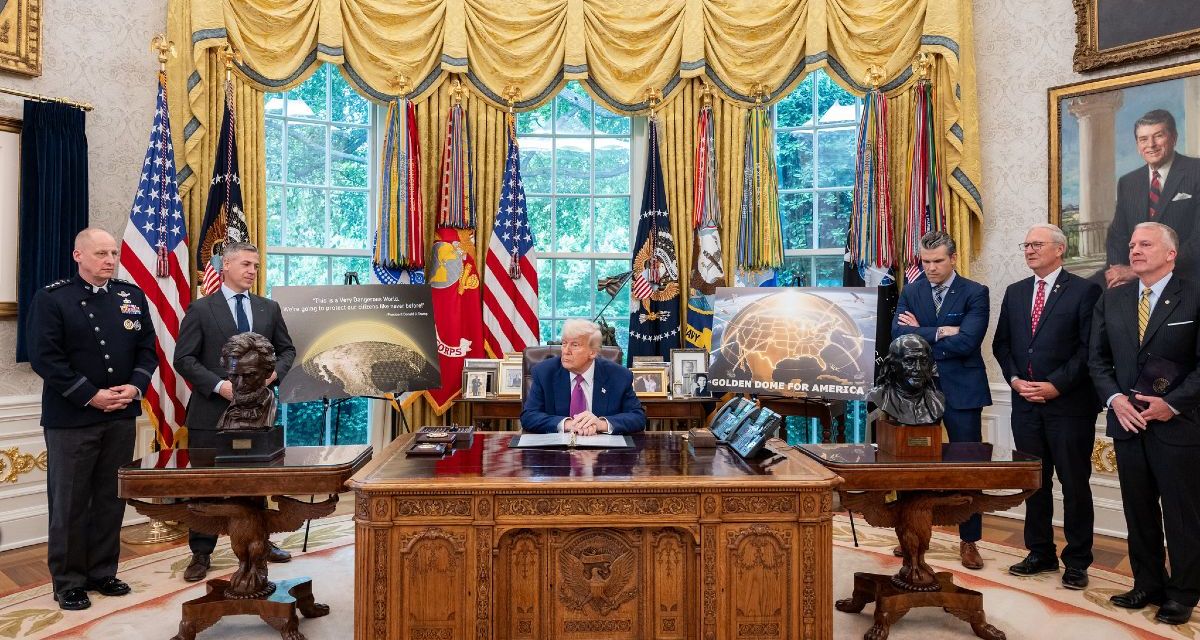
President Donald Trump’s Oval Office “Golden Dome” announcement kicked off the most ambitious American defense project since President Ronald Reagan’s Strategic Defense Initiative. Although the collapse of the Soviet Union brought that project to a premature end, the Cold War still offers important lessons for defense innovators.
The most critical lesson is that Golden Dome will require an empowered leader who remains in place until it is fully deployed—a common component of the most impactful Cold War innovation success stories. The president’s designation of the vice chief of space operations General Michael Guetlein to head Golden Dome is an encouraging first step—but there is more to be done, and quickly.
Analyses by the Center for Strategic and Budgetary Assessments pinpoint four prerequisites for successful military innovation: an operational problem with no existing solution; senior leader support; receptive organizational norms and culture; and empowered innovators. Golden Dome appears to be on relatively firm footing on the first two prerequisites—but its success or failure will hinge on the administration’s ability to accomplish all four.
When it comes to rapid and effective defense innovation, two Cold War examples set the gold standard. Using these as benchmarks, we can identify the near-term decisions and actions essential to Golden Dome’s ultimate success. This first of these groundbreaking achievements is Admiral Hyman Rickover’s naval nuclear power program. Rickover’s accomplishment was astounding. “Almost none of the necessary technology was available,” wrote one chronicler. “It all had to be created.” Yet USS Nautilus was underway on nuclear power in January 1955, five years after program start.
The second accomplishment is General Bernard Schriever’s Atlas intercontinental ballistic missile (ICBM). The first operational Atlas missile went on alert in 1959, five years after President Dwight Eisenhower designated the ICBM a top national priority.
Golden Dome: A Preliminary Scorecard
On the four prerequisites for successful defense innovation, how does Golden Dome measure up to naval nuclear power and ICBMs so far?
First, successful innovations are propelled by operational problems so vexing that they “break the strong preference of existing bureaucracies to apply their standard solutions.” Nuclear power solved such a problem. In the late 1940s, Soviet submarines based on captured German designs threatened to allow Moscow to sever the sea lanes connecting the United States to its European allies. US nuclear subs with high speed and nearly unlimited endurance could place the Soviet fleet on its heels. Atlas, in turn, addressed the possibility that Soviet ICBMs could neutralize the US bomber force at a stroke. American ICBMs would reestablish a favorable deterrent posture.
Today, the United States is vulnerable to direct attack by a panoply of aerospace threats, with no quick or easy fixes on the horizon. Golden Dome scores high on the operational problem scale.
Second, innovations succeed when senior leaders actively sponsor them and provide top cover to defeat bureaucratic antibodies. Atlas, for example, benefited from President Eisenhower’s decision to prioritize the ICBM program “above all others.” And while nuclear propulsion initially lacked a powerful sponsor, Rickover had a matchless ability to circumvent bureaucracy. Engineering his own dual-hatting as head of the Navy’s Nuclear Power Division and chief of the Atomic Energy Commission’s Naval Reactors Branch, he orchestrated the intersecting interests of the Navy and Atomic Energy Commission to make nuclear power a national priority, culminating in strong congressional support and the authorization of USS Nautilus in 1951.
Golden Dome achieves promising marks on this criterion. President Trump has made it a top priority and set a January 2029 deadline. But now his advisors, especially Secretary of Defense Pete Hegseth, will need to seek his continued personal engagement when the Washington budget battle throws up the inevitable roadblocks.
Third, while presidential support goes a long way, innovators and their sponsors must work constantly to avoid being thrown off course by the crosscurrents of organizational culture, including informal rules, swim lanes, and unspoken but consequential preferences and norms.
Nuclear power, for example, called for a major expansion of engineering training. But this would disrupt personnel management processes jealously guarded by the Navy’s submarine tribe. Rickover, realizing that nuclear accidents could strike a death blow to public and official support for nuclear power, instituted zero-defect safety requirements that the submarine admirals couldn’t argue with, thereby defeating their opposition.
The ICBM had an especially fearsome adversary: General Curtis LeMay, commander of the Strategic Air Command bomber force. With four stars to Schriever’s one and an unshakeable commitment to manned bombers, LeMay dismissively told Schriever, “When you can put something on that missile bigger than a f—ing firecracker, come and see me.” His opposition continued even after Eisenhower’s order to prioritize the ICBM. The solution: Air Force Chief of Staff General Thomas White cannily reassigned LeMay to be his vice chief. As White’s direct subordinate, LeMay could no longer indulge in open ICBM naysaying.
Here, Golden Dome faces major challenges. US aerospace defenses are spread across all five services and the federal civil sector. Homeland air surveillance, for example, is largely reliant on the Federal Aviation Administration. The president and secretary of defense will need to invest their time and political capital in sustained engagement with the cabinet, Congress, and industry to pave the way for success; otherwise, bureaucratic inertia, competing priorities, and the sheer complexity of this massively interagency project may prove insurmountable.
Fourth, the president and secretary of defense cannot do the heavy lifting themselves. Innovation at Golden Dome scale requires total focus and a capacity for seven-day workweeks. And while innovation may be a team sport, only one innovator can be the boss. As Rickover told Congress, “Unless you can point your finger at the one person who is responsible when something goes wrong, then you have never had anyone really responsible.” General Guetlein’s assignment to lead Golden Dome is a good step in this regard, but it is only the first. Beyond simply naming a boss, there are two more key factors.
One of these two critical factors is leadership tenure. Rickover and Schriever were present at the creation and remained until their innovations blossomed into deployed capabilities. It is unlikely that nuclear power or ICBMs would have been fielded so quickly (if at all) had their leaders been replaced midstream based on personnel rotation cycles, as is usually the case today.
Equally crucial is delegation of sufficient authority and autonomy. Innovations rarely fit neatly into existing organizational lanes and approval hierarchies. Rickover’s Naval Reactors, for example, bridged the Navy and Atomic Energy Commission; and Schriever’s consolidated authority as head of the Air Force’s Western Development Division was cemented by the Gillette Procedures, an arrangement that sidelined the bulk of his Air Force chain of command. As Schriever noted, rapid innovation is unlikely to survive “interference from those nit-picking sons of bitches at the Pentagon.”
This may be the most serious challenge for Golden Dome. To succeed, General Guetlein must have both tenure and a span of authority that transcends not just the Space Force, but the Department of Defense. Like Rickover, he may need to wear two, three, or even more hats in other federal departments, and the formally delegated ability to direct—not just request—rapid decisions and actions by elements of non-DoD agencies. Otherwise, Golden Dome will capsize in a sea of conflicting priorities, incompatible cultures, and uncoordinated processes.
Recommendations
Three years and seven months remain until the president’s deadline for arguably the most complex military innovation since the Manhattan Project. To maximize the chances of success, the administration should take the following steps.
First, the president and Secretary Hegseth should affirm that General Guetlein will remain in charge until Golden Dome is deployed and judged effective.
Second, with Congress’s consent, the president should reassign General Guetlein to a new position as director, Golden Dome. It is almost inconceivable that concurrent duty as vice chief of space operations would permit anyone to fulfill either job effectively, let alone both.
Third, the president should make clear to his cabinet that the director has full authority to act on his behalf in all matters relating to Golden Dome—from coordination with affected allies, to unconstrained communication with Congress touching on multiple departments’ equities, and the many more unknown unknowns that will inevitably emerge.
These steps will be monumentally difficult, both politically and organizationally. But the success of Golden Dome will hinge on the administration’s ability to capitalize on the examples of Rickover, Schriever, and the presidents who supported them.
Thane Clare is a senior fellow at the Center for Strategic and Budgetary Assessments (CSBA). A retired Navy captain with twenty-five years’ experience at sea and in the Pentagon, he commanded warships forward deployed to the Arabian Gulf and Western Pacific and served on the staffs of the chief of naval operations and secretary of defense. His current focus areas at CSBA are air defense, command and control, and defense innovation.
The views expressed are those of the author and do not reflect the official position of the United States Military Academy, Department of the Army, or Department of Defense.
Image credit: Joyce N. Boghosian, White House