
The war in Ukraine has produced a steady stream of striking images and tactical innovations that have baited the US defense community into simple conclusions: Either Ukraine is a crystal ball for the future of warfare or its experience is so theater- or country-specific that it has no bearing on US strategy and modernization efforts. What is missing in much of the debate is critical thinking anchored in doctrine, operational understanding, realities of the current state of American equipment, and strategic context. Far too often, the conversation begins and ends with first-person-view (FPV) drones, and the larger lessons get lost. FPVs matter and have a role to play, but they should not dominate how defense leaders and the policymaking community should think about this war. To understand Ukraine’s relevance for US strategy, we need to widen the aperture—looking beyond FPVs to the other innovations across air, land, and sea that the United States can adapt for defense modernization to counter threats around the globe—in the many theaters where it has interests and where US forces might find themselves actively engaged. While there are vast potential lessons learned from Ukraine, hardware implementation is an area that offers the promise of particularly quick wins for the United States.
Ukraine’s maritime story during the war is the most visible example of necessity forcing creative adaptation. Kyiv has weaponized the littoral in ways Western navies rarely imagined before the war. Small unmanned surface vessels (USVs)—Magura is the most well-known producer—have gone beyond kamikaze boat missions to perform surveillance, logistics, and even antiair missions in the Black Sea. In early May 2025, Ukrainian forces shocked the world when the Magura USVs armed with repurposed air-to-air missiles shot down two Su-30 fighters, marking the first reported instance of uncrewed surface drones downing manned military aircraft in combat. That event did not happen in a doctrinal vacuum: It was the result of integrating the latest innovative technology with intelligence, surveillance, and reconnaissance tools, weapons platforms, and distributed operators into a coherent maritime concept of operations. The point for US planners is not to simply import Magura USVs—even though a US-listed company, Red Cat Holdings, has agreed to a coproduction deal—but to recognize what low-cost, networked surface systems change about naval campaigning. In the Indo-Pacific—where geography rewards dispersion and the tyranny of distance strains centralized defenses—attritable USVs can extend sensor nets, complicate enemy targeting, impose costs on high-value surface and air platforms, and even, as Magura proved, provide deadly surface-to-air attacks in contested environments. In South America, the same platforms can fuse maritime security and defense missions: persistent interdiction of illicit traffic, protection of coastal infrastructure, and low-risk presence operations without sending major surface combatants to every flashpoint. The lesson of the Black Sea is doctrinal: When inexpensive platforms can force a peer navy to alter operations, they become a lever of deterrence and maneuver rather than a sideshow. The United States is slowly learning this, but more investment, education, and doctrine creation are needed to fully operationalize the lesson.
That same logic—cost, scale, and the ability to impose strategic effects—drives the second lesson: the disproportionate value of one-way deep-strike drones. Over the last year Ukrainian planners shifted from tactical harassment to an operational campaign against Russian oil and logistics nodes. Massed long-range strikes with payloads varying from twenty to fifty kilograms have produced effects that cascade well beyond the immediate blast damage: refinery outages, disrupted tanker schedules, and reported shortages at pumps in Russia’s Far East. Independent reporting estimates a meaningful share, somewhere between 10 and 17 percent, of Russian refining capacity was taken offline in a matter of weeks, producing local fuel shortages and forcing Moscow to reroute exports—outcomes that have significant military and civilian strategic impact. What makes these attacks notable for US strategists is not the novelty of precision alone but the economics: Many of these loitering and deep-reach systems are built for $20,000–50,000, compared to up to $170,000 for a single Hellfire missile and up to $2.4 million for a tomahawk missile. Although payload sizes are smaller, leveraging one-way deep-strike drones enables massed employment against critical nodes in ways that are markedly cheaper than high-end munitions but can deliver desired effects, overwhelm enemy radar systems, and force the adversary to expend high-cost air defense systems.
Those economic dynamics matter even more given America’s current airpower readiness picture: The Mitchell Institute finds the average mission-capable rate for the US fighter fleet is only 59 percent, a level that constrains sortie generation and the ability to absorb attrition in a high-end fight. Compounding that vulnerability, unclassified public wargames indicate the United States could exhaust key munitions inventories in as few as three to four weeks in a major peer fight—an acute reminder that affordable, attritable strike options can preserve high-end stocks while protecting our airpower and still achieving strategic effects. For the United States and allies, the implication is clear—cost-effective, attritable strike capabilities can multiply options in a campaign of denial, particularly in theaters where logistical hubs and chokepoints are exposed. Being able to choose from a variety of attack weapons depending on the situation will make strikes harder and more expensive to defend against and make US forces more lethal. That means continuing to invest in exquisite long-range strike systems but also building an industrial base that can produce affordable, mission-tailored systems at scale when operational or strategic effect—not platform prestige—matters.
Ukraine’s offensive creativity has been matched by a defensive counterlogic: If attackers mass cheap loitering munitions, defenders must reduce their own costs on the fly. The result has been a massive push into low-cost kinetic interceptors—around $2,000-5,000 in most cases—mostly FPV and other small-form interceptors built to collide with or detonate near incoming drones. These interceptors do not pretend to be a replacement for integrated surface-to-air missiles; rather, they are a different tier in a layered architecture. The economics remain convincing: When a successful interceptor costs a few thousand dollars and it negates a loitering munition with a price point an order of magnitude higher, a commander saves critical PAC-3 and NASAMS missiles for true high-value threats. Kyiv and its partners have scaled production rapidly, with government programs and industrial initiatives targeting monthly outputs in the thousands to blunt wave attacks and preserve strategic interceptors for ballistic and cruise missile threats. Operationally, these systems are pragmatic: Launched from trucks, camouflaged positions, or even locally improvised sites, they allow maneuver units to defend themselves without diverting strategic interceptors or airframes. The United States should absorb the doctrinal lesson: Distributed operations—whether island bases in the Pacific or dispersed partner sites in Latin America—need low-cost, rapidly produced layers of defense that preserve scarce high-end interceptors for equally high-end threats.
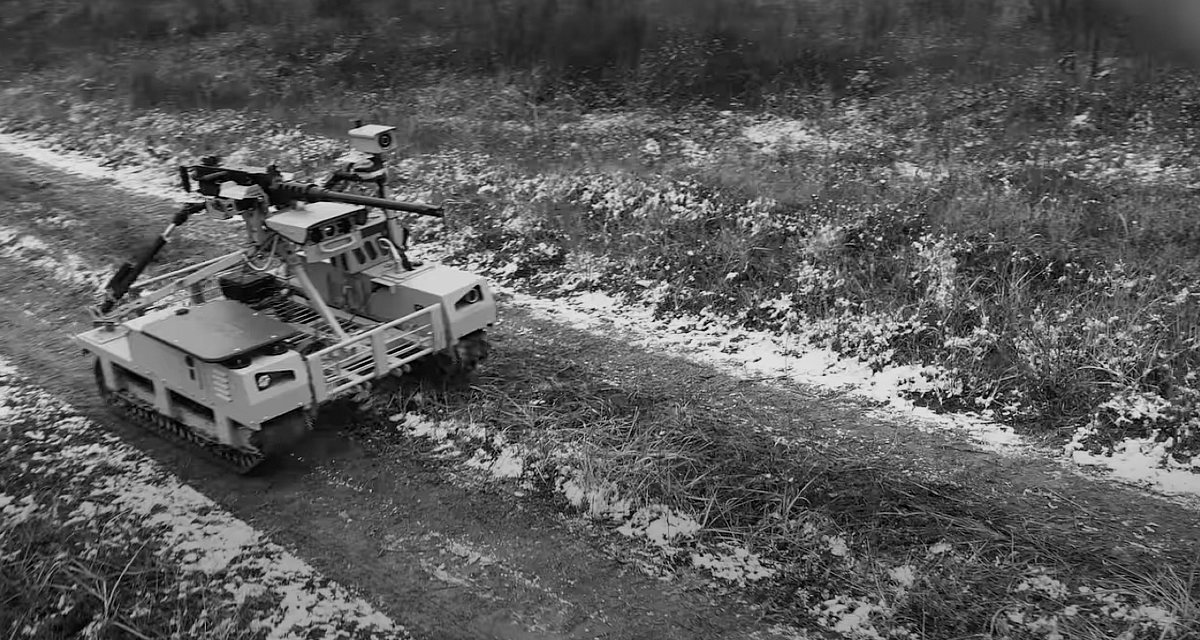
Finally, Ukraine’s push into unmanned ground vehicles (UGVs) completes the picture—moving robotics from experiment to operational utility in ways the West should no longer treat as hypothetical. Beyond resupply under fire and casualty evacuation, Ukrainian formations leverage UGVs to help mitigate personnel shortages across warfighting functions and have now used combined UGV teams in combat: In December 2024, Ukraine’s first all-robot assault force fought and won its initial engagement in Kharkiv, an event many rightly call a milestone in the history of uncrewed combat systems. That episode matters not because robots are a panacea but because it demonstrates a doctrinal shift: Commanders are willing to plan and execute missions that accept attritability, automation, and remote control as integral parts of maneuver. UGVs are also proving critical for the last mile of logistics, carrying artillery shells and other supplies forward under fire and sparing soldiers the kinds of resupply runs that were among the most dangerous missions of the post-9/11 wars in Iraq and Afghanistan. Ukraine has taken unmanned systems out of labs and trials and placed them directly into frontline missions, closing the operational loop between software, intelligence, surveillance, and reconnaissance, and logistics in ways that produce immediate battlefield utility. The takeaway for US forces is practical: When integrated with sustainment pipelines and training, UGVs reduce the human burden of routine, high-risk tasks and free scarce personnel for decisions machines cannot make.
Taken together, these threads refute the false dichotomy. Ukraine is not a universal template and it is not irrelevant; it is a laboratory of applied adaptation where limited resources, pragmatic engineering, and improvised doctrine have produced scalable effects. The imperative for US planners is not to mimic Kyiv’s kits or tactics dogmatically but to institutionalize the analytical discipline that the Ukraine war forces upon us: Test systems for cost per effect, assess sustainment and electronic warfare resilience, and design force architectures that accept attritability as a tool rather than a failure. That will mean changes across acquisition, budgets, and training. And it will mean a willingness to accept lower unit cost for some mission sets, to fund production lines that can surge, and to practice distributed defense that pairs high-end systems with thousands of low-cost nodes.
If we do that, we retain what matters most—decision advantage and the ability to impose costs on adversary forces faster than they can absorb them. If we instead retreat into slogans—either the maximalist view that Ukraine is everything or the dismissive view that Ukraine is nothing—we risk a mismatch between our doctrine and the environments in which we will be called to fight. The smarter path is clear: Learn selectively, adapt quickly, and prepare the force architectures that make those lessons operationally useful across all theaters—from the Indo-Pacific to Europe to the Americas—and for the full range of established and emerging threats.
Sam Scanlon is a former US Army explosive ordnance disposal officer and a Defense Council fellow for the Truman National Security Project.
The views expressed are those of the author and do not reflect the official position of the United States Military Academy, Department of the Army, or Department of Defense.
Image credit: Ukrainian Ministry of Defense