
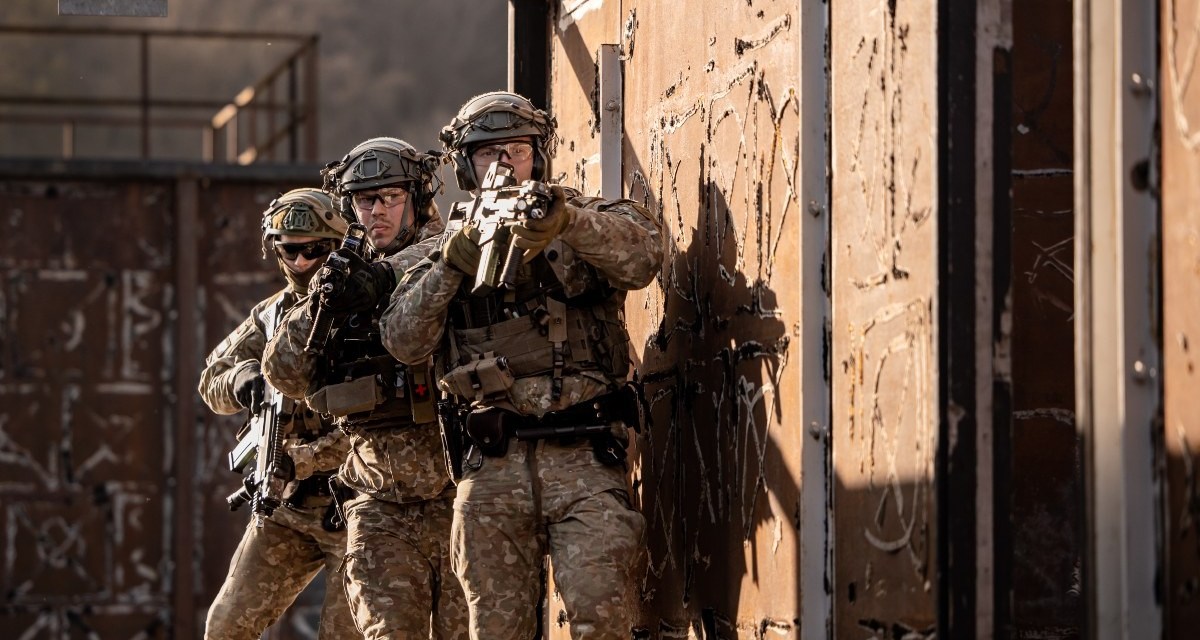
In doctrine, dogma dies hard. Nowhere is this more evident than in NATO’s enduring obsession with the offense, particularly in the terrain of the urban environment. Despite being a fundamentally defensive alliance, most NATO exercises, training courses, and operational plans focus on seizing ground, breaching defenses, and clearing strongpoints. The result is a dangerous conceptual imbalance: armies that are prepared to attack in cities but not to defend them. In reality, they will likely have to do the latter before they ever do the former.
This is not an abstract concern. If conflict erupts in NATO’s sphere of interest, the first units to make contact will almost certainly be defending, not attacking. An adversary is likely to have the important first-mover advantage, seizing the initiative by making the opening moves. Initial objectives in such conflicts will undoubtedly include those large urban areas that straddle the main transportation infrastructure leading farther toward the adversary’s objectives. Potential adversaries know this in advance. They will plan to mass fires, integrate uncrewed aerial vehicles (UAVs) with thermobaric payloads, and conduct urban shaping operations before launching a combined arms assault. They will not wait for NATO to organize a counterattack. War will come to the defenders.
Why, then, are NATO militaries still preparing to assault someone else’s trenches instead of holding their own?
The Cult of the Urban Offense
The roots of this imbalance lie in what can only be described as a cult of the urban offense. It is baked into NATO doctrine, into training centers, and into the very language of tactical education. Urban warfare is taught almost exclusively through the narrow lens of clearing buildings, breaching doors, assaulting intersections, and suppressing enemy strongpoints. The imagery is kinetic, aggressive, and built around a World War II model of urban combat that focuses almost entirely on the tactical level.
That model is outdated. NATO instructors still teach tactics developed to defeat Axis defenders in fortified cities. But modern adversaries are not relying on bunkers and machine gun nests. They are using thermobaric weapons, precision-guided bombs, loitering munitions, tandem-charge rocket-propelled grenades, and multispectral UAV reconnaissance. A shoulder-fired rocket that once might have created a breach in a wall now flattens a room, an entire floor, or even a whole building. In Ukraine, even basic UAVs are delivering thermobaric payloads through second-story windows.
Yet our tactics have not caught up. NATO battalions in the Baltics still train to assault trench lines. But whose trenches? If Russia crosses the border, NATO’s first mission is to hold ground, not to seize it. We are preparing to storm positions that we should already be occupying.
How Training Shapes Thinking
The problem runs deeper than doctrine. The way we train shapes the way we think. When soldiers spend months rehearsing assaults but never practice layered defense or mobile delay operations, they internalize a false belief that success only comes from attacking. Urban exercises often end at the point of entry (the break-in), not with the enemy’s inevitable counterattack. There is little emphasis on hasty defense after seizure, even though many major urban battles such as Stalingrad, Ortona, Aachen, Grozny, Fallujah, Mosul, Marawi, and Sieverodonetsk required forces to shift from offense to defense, sometimes repeatedly.
Urban training environments make this worse. Most NATO sites are sterile and overly simplified. They consist of a few one- or two-story buildings arranged in a grid, with no interior clutter, no civilian presence, no collateral damage, and no realistic fire effects. These facilities are useful for rehearsing movement drills but do not prepare troops to survive real contact. No NATO unit trains under thermobaric blasts crashing through upper floors or autocannon fire ripping through multiple walls. No site simulates the violence of joint fires in dense terrain or the intensity of enemy shaping operations that strike everything around a defensive position.
Effective urban defense involves three integrated components:
- Perimeter force shapes enemy forces’ approach and contests their initial entry into the urban area.
- Disruption force engages enemy forces after a break-in, imposing delays, attrition, and disorganization as they attempt to exploit their gains.
- The main defensive area holds the majority of the defending force, positioned where the attacker—already shaped and degraded—will be halted or defeated.
Most training areas are too small to field all three layers together. Without scale, units cannot rehearse the complex command and control needed for modern urban defense. In many cases, the attacking force already knows where defensive positions will be, which eliminates the need for deception, reconnaissance, or adaptive planning.
This failure to replicate real-world conditions reinforces outdated thinking. If soldiers only train in sanitized environments, they will not learn how quickly a position can be located, targeted, and destroyed. If they never experience fire effects such as rounds passing through concrete, they will not understand the limits of cover or the importance of dispersion, concealment, and movement.
The lack of depth also prevents defenders from practicing fallback routes, alternate positions, and layered deception. Units become conditioned to static defense. And yet, many NATO militaries still express confidence in their ability to conduct urban operations at scale.
The British Army’s Land Operating Concept, published in 2023, sets out how the British Army thinks it will fight peer adversaries in conventional wars. It states:
Whilst fighting hard to survive, [the deployed force] will spoil the enemy’s advance up to the urban fringe, contest the break-in battle, block avenues of approach, and conduct dynamic urban defence to drive the enemy’s early culmination.
This concept is sound, but it assumes a level of strength, initiative, and air superiority that may not exist at the outset of a high-end war. It also assumes a level of training that currently remains insufficient.
We must stop thinking of defense as a temporary pause before resuming the offense. Counterattacks are essential, but they succeed only when built on a foundation of preparation, terrain shaping, and flexible maneuver. Urban defense demands the same intensity of training, resourcing, and doctrinal clarity as any offensive operation. NATO must learn not just how to seize cities, but how to hold them.
A Call for Mobile Urban Defense
It is time to reset. NATO must train for mobile urban defense, not just offensive clearing. This requires a doctrinal and cultural shift—starting with a new mindset that treats defense as an active, adaptive operation, not a static pause before the next assault. Such a shift should be built on key, fundamental principles.
First, defending forces must limit the attacker’s options. One of the defender’s most pressing challenges in urban terrain is poor situational awareness in the surrounding environment. Line of sight is limited, and urban clutter obscures movement and intent. While this affects both sides, attackers often retain the initiative and usually enjoy better intelligence, surveillance, and reconnaissance coverage from the outset. This gives them more options for break-in points than most defenders can realistically cover.
The solution is shaping the battlespace before contact. Urban defenders must find ways to constrain enemy maneuver and channel it into predictable, killable avenues. At the operational level, this can be done through terrain denial, as seen when Ukrainian forces flooded areas north of Kyiv in 2022, limiting Russian avenues of approach. At the tactical level, it can mean reducing road access into urban zones—much like the German defense in Ortona (1943), where the defenders funneled Canadian troops into narrow axes of advance to lure them into kill zones. The goal is economy of force: to avoid expending combat power on areas that will be bypassed or isolated and to instead focus on decisive terrain.
Second, dispersion within the local urban environment must be maximized. NATO forces must abandon the one building, one squad mentality. Instead, available construction and fortification materials should be used to reinforce a distributed network of mutually supporting buildings. This creates layered strongpoints that can deliver interlocking fields of fire, absorb attrition in stages, and delay the enemy’s tempo.
Defenders should prepare loopholes for overlapping fires, establish mouseholes for concealed movement and fallback, and construct alternate positions that are ready for rapid displacement. These routes should be obscured from overhead observation to reduce vulnerability to UAV detection and indirect fire. Camouflage and concealment remain essential. Avoiding enemy intelligence, surveillance, and reconnaissance entirely is all but impossible, so survivability depends on signature reduction so fighting positions are not targetable or worth the attacker’s munition.
During the early phases of the 2022 Battle of Mariupol, Ukrainian Marines employed this principle effectively—operating in dispersed teams of ten to fifteen soldiers across multiple low-rise buildings. Each position provided mutual support with antitank guided missiles, snipers, and machine guns. Because the positions were spread out and not obviously fortified, Russian forces had to expend significant effort to clear each one—often under fire and only with artillery or armor support. When encirclement became a threat, Ukrainian units withdrew in good order to secondary defensive lines.
Third, building fortified strongpoints is important, but commanders must also enable repositioning through a mobile defense. NATO doctrine still emphasizes heavily hardened static defenses, often with substantial construction materials inside and outside buildings. This approach consumes time, attracts attention, and becomes a magnet for precision fires.
Once a building is visibly fortified, it presents the attacker with two simple choices: bypass or destroy. Either way, the defender loses. The better approach is to build strongpoints that do not appear as such. They should offer enough protection to survive the first exchange, deliver damage, and then be abandoned before they are destroyed. When the trap is sprung and the attacker reacts with firepower, the defender must already be displacing to alternate positions.
Commanders must plan for this. Pre-sited indirect fire should cover withdrawal routes and threaten enemy flanks. By combining minimal signature strongpoints with constant mobility, defenders can stretch the attacker’s resources, preserve their own force, and set conditions for the next phase: the counterattack.
NATO’s Way Ahead
Breaking free of dogma is difficult, and breaking up the cult of the urban offense will be challenging. But there are things the alliance and its members can do now to begin meeting this challenge and develop a more lethal force, ready for all the military problems cities will present to them. First and foremost, it is understanding the modern threat is vital. NATO forces must prepare for the tools and tactics adversaries are already using. These include thermobaric weapons, massed UAVs, large-caliber autocannons, and layered reconnaissance systems. Defenders need to understand enemy arming distances, anticipate shaping fires on known positions, and grasp how targets are identified and struck in real time.
The ongoing war in Ukraine provides a clear warning. Russia has employed thermobaric rockets, loitering munitions, and precision drone-guided fires to overwhelm fixed defenses. In Mariupol and Bakhmut, they systematically struck hide sites, logistics nodes, command centers, and fallback routes before committing ground forces.
These threats are not hypothetical. They are present now. NATO units must train under conditions that reflect this reality. Thermobarics can destroy a strongpoint from within. UAVs can direct fire with real-time accuracy. Any defense plan that ignores these capabilities is flawed from the start.
The modern urban battlefield will not forgive unprepared forces. NATO must stop planning for yesterday’s war and start training for the threats already in play.
Second, NATO militaries’ preparation for defending cities must recognize the importance of counterattacks. Counterattacks are not optional in urban defense. They are essential. Well-timed strikes can stall the attacker’s momentum, inflict disproportionate casualties, and create critical windows to reposition, reset, withdraw, or buy time for reinforcements to arrive.
History makes this clear. During the Battle of Stalingrad, the Soviet 62nd Army repeatedly counterattacked to hold ground. The October 1944 counterattack by the 1st SS Battalion in Aachen forced US forces to regroup and rewrite their assault plan. It did not win the battle, but it delayed the American advance and inflicted significant cost. In Grozny in 1994, Chechen fighters inflicted heavy losses through urban counterattacks, forcing Russian forces to withdraw and replan. In Mosul from 2016 to 2017, Islamic State fighters launched daily counterattacks with suicide vehicle-borne improvised explosive devices, UAVs, and small units. These actions disrupted Iraqi tempo and conditioned coalition units to wait for additional firepower before each movement. The same approach was seen in Marawi and Sieverodonetsk, where defenders counterattacked after nearly every engagement. In Sieverodonetsk, Ukraine’s International Legion repeatedly forced Russian units to resecure ground they had just seized.
Finally, decentralizing survivability is vital. Urban defenders must be positioned in ways that make them difficult to target decisively. This does not mean avoiding detection altogether. It means creating uncertainty. Enemy forces should never be confident about what to strike or whether a position is still occupied. The goal is to waste their time, effort, and firepower chasing ghosts.
Every building enemy units target should either be empty or deliberately used as bait. Either way, they expend resources and lose tempo. Survivability depends less on hardened positions and more on forcing the attacker into repeated mistakes.
History provides clear examples. In Ortona in December 1943, German forces lured Canadian troops into a school with light resistance, then detonated pre-planted explosives and killed an entire section. They used the same tactic days later against a full platoon in another building. These deceptions worked so well that Canadian forces began using similar methods.
Nearly eighty years later, Ukrainian forces applied the same principle in Bakhmut. On March 27, 2023, they set charges in a building later occupied by Russian troops. Once the enemy was inside, they brought it down, killing those within.
These are not relics of past wars. They are enduring lessons in dispersion, deception, and timing. NATO forces must stop treating survivability as fixed protection and start treating it as active control over the enemy’s decision-making process.

Defense is not simply the absence of offense. It is a complementary function that requires its own mindset, planning, and discipline. Effective urban defense demands deliberate integration of deception, maneuver, timing, and resilience.
Urban defense lacks glamour. It does not resemble parade-ground doctrine. It is complex, costly, and often thankless. Yet history shows that when defenders succeed in cities, it is usually because they were well prepared or because the attackers employed poor operational planning and tactics. Russia has demonstrated the latter repeatedly in Ukraine.
NATO already has the doctrine. What it lacks is urgency. In the next war, especially in the opening days, urban defense may be the only factor that prevents forward units from being destroyed. NATO was built to deter war through strength. That strength begins with the recognition that the first blow may fall on its defenders. They must be ready to absorb it with discipline and adaptation, not outdated assumptions.
NATO must be able to hold cities under fire, counterattack with precision, delay until reinforcements arrive, and transition to the offensive when conditions allow. Offense and defense are not opposites. They are interdependent. To focus on only one is to plan for failure.
The cult of the urban offense must end.
John Spencer is chair of urban warfare studies at the Modern War Institute, codirector of MWI’s Urban Warfare Project, and host of the Urban Warfare Project Podcast. He served twenty-five years as an infantry soldier, which included two combat tours in Iraq. He is the author of the book Connected Soldiers: Life, Leadership, and Social Connections in Modern War and coauthor of Understanding Urban Warfare.
Stuart Lyle is the urban operations research lead for the UK-based Defence Science and Technology Laboratory (Dstl). His work is varied and has included designing force concepts for the British Army to improve effectiveness in urban combat. He led Dstl’s Future Cities study which looked at global trends in urbanization and their implications for military operations.
Major Jayson Geroux is an infantry officer with The Royal Canadian Regiment and is currently with the Canadian Army Doctrine and Training Centre. He has been a fervent student of and has been involved in urban operations training for over two decades. He is an equally passionate military historian and has participated in, planned, executed, and intensively instructed on urban operations and urban warfare history for the past twelve years. He has served thirty years in the Canadian Armed Forces, which included operational tours to the former Yugoslavia (Bosnia-Herzegovina) and Afghanistan.
The views expressed are those of the authors and do not reflect the official position of the United States Military Academy, Department of the Army, or Department of Defense.
Image credit: Sgt. Wesley Riley, US Army