Editor’s note: This is an epilogue to “Maneuver Under a Lying Sky,” a work of FICINT. In it, the author of the short story extracts five real-world lessons from it for US and allied military forces. You can read the story here.
“Maneuver Under a Lying Sky” is a work of fiction. But the details the story weaves together are not. FICINT—fictional intelligence—offers a powerful means of anticipating and understanding threats because it blends imagination and reality. It secures our understanding of potential threats to ground truths while simultaneously freeing us to consider how those threats might present themselves before we face them in the real world. So what lessons emerge from the story?
1. Russia’s Existing Theater PNT Campaign
The pattern of Russian activity “Maneuver Under a Lying Sky” portrays is already visible in open sources. In April 2024, Finnair temporarily suspended flights to Tartu, Estonia after repeated GPS interference prevented safe landings, prompting Estonian officials to blame deliberate jamming from Russia. Later that year and into 2025, Baltic and Nordic authorities continued to report widespread disturbances to satellite navigation, particularly near Kaliningrad and the Gulf of Finland. A Ryanair flight to Vilnius, Lithuania was diverted to Poland in January 2025 because of GPS interference on approach, underscoring how safety margins for civil aviation can erode when position, navigation, and timing (PNT) are contested in peacetime.
By mid-2025, multiple European Union member states had moved beyond isolated complaints. A group of thirteen EU countries formally called on the European Commission to respond to global navigation satellite system (GNSS) jamming and spoofing linked to Russia and Belarus, and a broader coalition of states backed common action against interference in the Baltic and Nordic region. Analysts have documented tens of thousands of incidents affecting aircraft and ships since 2022. The Baltic Sea and the Gulf of Finland have become persistent hotspots for GNSS disruption rather than rare anomalies.
2. Stress-Testing New Allies and New Commands
The story’s headquarters in Mikkeli, Finland, is modeled on NATO’s real Multinational Corps Land Component Command Northwest. The command became operational in Mikkeli on September 1, 2025 and was formally inaugurated the following month as a multinational land headquarters for northern Europe. Reporting from Finland and allied outlets describes a small but growing international staff led by a Nordic core, exactly the kind of team the vignette imagines reacting in contact. In addition, NATO opened a new combined air operations center in Norway in October 2025, which integrated with NATO’s air command-and-control architecture.
At the same time, NATO has been reshaping its operational-level command seams. Joint Force Command Norfolk (JFC Norfolk) has assumed responsibility for a redefined “northwest” region that now includes the territory of all five Nordic allies along with the North Atlantic. Recent coverage notes that this shift concentrates responsibility for the Arctic, the North Atlantic, and the Nordic-Baltic approaches under a single headquarters, tightening the link between maritime reinforcement routes and land operations in Finland and Sweden.
3. Implications for MCLCC-NW and JFC Norfolk
In that context, the story’s crisis is best read as a stress test: Russia uses PNT disruption to probe NATO’s newest allies and newest command arrangements. For Multi-Corps Land Component Command Northwest (MCLCC-NW) and JFC Norfolk, several implications follow:
First, treat Russian GNSS jamming and spoofing as a standing theater condition, not a rare technical anomaly. That means building a persistent PNT running estimate that fuses civil aviation, maritime, and land reports into a single picture.
Second, standardize a simple PNT status line in reporting across the region (for example, green/amber/red plus one concrete example), so that land, air, and maritime headquarters can compare effects quickly without bespoke formats.
Third, rehearse red PNT conditions in major exercises, including NATO’s new regional defense plan drills and Nordic-hosted maneuvers, so that staff processes and command post layouts work when satellite-derived time and location are untrusted.
And fourth, align authorities and processes between JFC Norfolk, MCLCC-NW, Allied Maritime Command, and Allied Air Command so that Russian PNT attacks trigger a shared operational response rather than siloed technical troubleshooting.
Those command-level changes sit alongside a quieter revolution in how allies think about backup timing and navigation. Defense ministries and regulators on both sides of the Atlantic are experimenting with assured-PNT approaches that blend multiple technologies: vehicle-mounted that combine GPS with inertial sensors and integrity monitoring; alternative satellite layers in low-earth orbit; terrestrial timing distribution over fiber; and renewed interest in hardened terrestrial systems such as an enhanced version of LORAN, the hyperbolic radio navigation system pioneered during World War II, as a GNSS backup.
European and international studies point toward a layered future: multiple GNSS constellations, resilient space-based PNT, and signals of opportunity from existing infrastructure. The European Space Agency’s PNT Vision 2035 white paper highlights signals of opportunity and hybrid solutions as key elements of future resilience, while technical vendors and policy papers argue for combining low-earth orbit PNT, miniature atomic clocks, and fiber-based time distribution into a single architecture rather than betting on any one layer.
Research groups have highlighted the particular utility of signals of opportunity, showing that navigation is possible even when GNSS is completely untrustworthy by using signals from cellular networks, broadcast towers, and other ambient radio sources. Early work on GPS spoofing by Professor Todd Humphreys and colleagues helped crystallize the threat; later projects have demonstrated antispoofing, interference detection, and even navigation based largely on non-GNSS signals. A recent paper coauthored by Humphreys details dozens of days of interference patterns and underscores that human-directed interference is now part of the operational backdrop, not an edge case.
4. Tasks for Brigades and Battalions on the Northern Flank
For brigade and battalion commanders who may one day fall under MCLCC-NW in crisis, the scenario points toward tangible tasks that can be trained now, without waiting for new equipment.
First, rebuild analog navigation and time discipline as core skills. Leaders at every echelon should be able to move and report accurately with maps, terrain association, and synchronized watches when GNSS is unreliable.
Second, design PACE (primary, alternate, contingency, emergency) communications plans that explicitly account for Russian jamming of GNSS-dependent systems. Some radios, waveforms, and data links will fail gracefully; others will not. Units need to know which is which.
Third, make PNT a routine part of the running estimate. Intelligence, operations, and signals sections should track Russian electronic warfare activity and GNSS interference the way they track weather or enemy artillery.
And fourth, integrate civil reporting into military understanding. In the Nordic-Baltic region, civil aviation authorities, maritime agencies, and rail and energy operators often see Russian interference first. Their open reporting should inform NATO’s military picture whenever possible.
Units that do have access to assured-PNT kits or experimental navigation aids should treat them as tools to be tactically validated, not magic boxes. Hybrid navigation approaches that combine inertial systems, visual scene matching, and radio frequency signals of opportunity will only deliver real resilience if commanders understand their limits as well as their strengths.
5. Questions for the Next Rotation to Finland and Sweden
Finally, “Maneuver Under a Lying Sky” suggests a few questions that units deploying to Finland, Sweden, or the Baltic states might ask themselves during mission analysis or a predeployment rehearsal-of-concept drill:
If Russian GNSS jamming in our area of operations looked like the last six months of real-world interference over the Baltic Sea, what would break first in our current scheme of maneuver?
Where in our plans do we implicitly assume precise time, location, or automated track correlation without realizing it?
How will we communicate PNT degradation to higher headquarters quickly and clearly enough that MCLCC-NW and JFC Norfolk can adjust?
Which civilian partners in our sector (airports, ports, rail, energy, telecom) have already adapted to GNSS interference, and how can we learn from their procedures before a crisis?
If we were given a small number of assured-PNT or alternative navigation kits, where would we place them to get the most operational value and learning?

The story’s battalion in eastern Finland, the corvette off Gotland, and the staff officers in Mikkeli and Norfolk are invented. The Russian jammers, the diverted flights, the European Union letters, the emerging alternative PNT technologies, and the new NATO headquarters are not. Treating those as a single operating problem, rather than as disconnected news items or science projects, is the first step toward fighting through the lying sky that already hangs over the Baltic-Nordic front.
Lieutenant Colonel James J. Torrence, US Army, is the commander of the 39th Strategic Signal Battalion in Chièvres, Belgium. He holds an MS in strategic design and management, an MS in cybersecurity, a master of military art and science, and a doctorate in strategic security. Torrence is a LTG (Ret) James M. Dubik Writing Fellow. He has deployed twice to Afghanistan as a battalion communications officer and has served in various military leadership positions in the United States, Germany, Belgium, Korea, and Israel.
The views expressed are those of the author and do not reflect the official position of the United States Military Academy, Department of the Army, or Department of Defense.
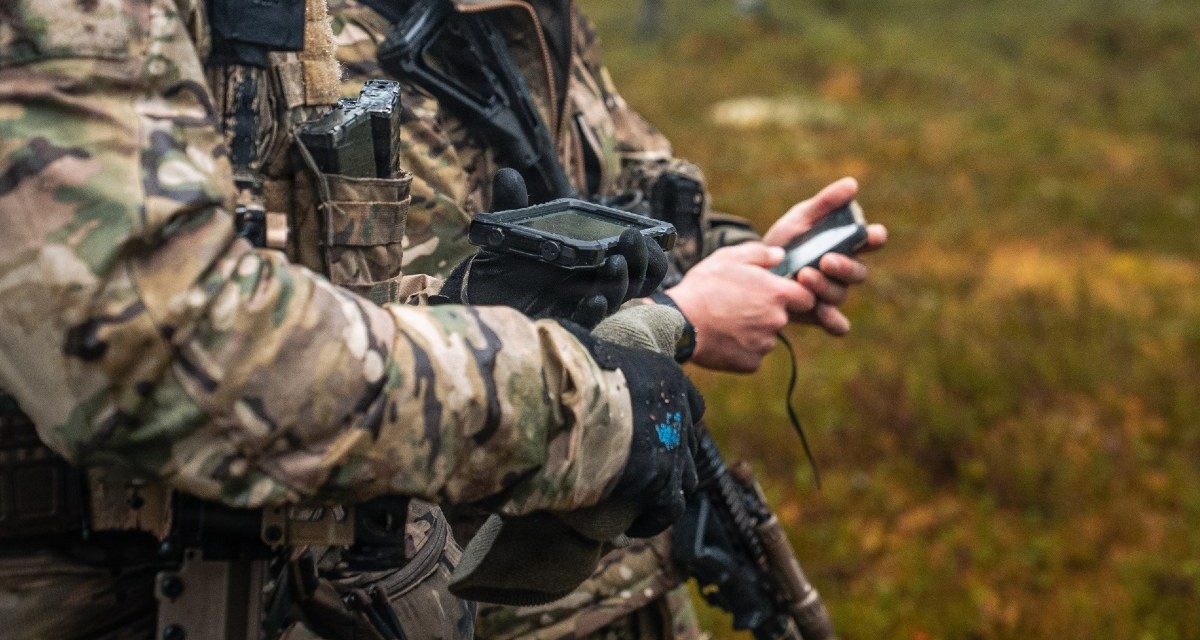
Image credit: Staff Sgt. Reece Heck