After examining more than a hundred wargames and tabletop exercises, the conclusion is unavoidable: The US joint force has a logistics problem. And it does not stem from a lack of effort, insight, or participation. Rather, the real problem is that the board has not moved. Despite repeated play, the joint force’s game pieces—force design choices, posture decisions, assumptions about operational feasibility, and risk decisions—remain largely unchanged, even as wargames have begun to advance the decomposition of contested environments and illuminate the real-world logistics challenges US forces will face under congested and contested conditions.
Across the Department of Defense, industry, interagency partners, and allied and partner nations, logistics is routinely described as decisive, and just as routinely treated as secondary. As the current chairman of the Joint Chiefs of Staff has observed, contested logistics is among the “key capability areas” that are inherently joint, multidomain, and multitheater. This emphasis reflects a broader continuity in senior military leadership: The previous chairman similarly underscored that “all our operations are underwritten by logistics,” explicitly linking sustainment to deterrence and strategic effect. Wargames repeatedly surface the same vulnerabilities, creating a set of well-established known knowns about logistics in contested conditions. Yet those insights rarely translate into changed assumptions, altered force design, or binding institutional decisions. The result is a cycle of activity without progress because we keep rediscovering logistics vulnerabilities instead of converting them into operational advantage.
This is not a failure of analysis. It is a failure of ownership. The issue is not insufficient insight or participation, which are conditions often cited as limiting factors, but the absence of mechanisms to translate recurring findings into enforceable decisions.
Drawing on more than a hundred logistics-oriented wargames and tabletop exercises over the last six years, this assessment examines why recurring insights have not translated into institutional decisions. It reflects experience as a designer, adjudicator, advisor, and participant, as well as personal review of tactical-, operational-, and strategic-level wargame and tabletop exercise reports dating back to 2019.
Decisive in Theory, Optional in Practice
Recent defense publications have highlighted this disconnect. A Navy Supply Journal essay described the “elevation of logistics in joint warfighting,” while a Joint Force Quarterly article warned that US plans still rely on optimistic sustainment assumptions that collapse once conditions become contested. These critiques align closely with what wargames continue to demonstrate: Logistics is acknowledged conceptually but rarely integrated as a determining factor in operational decision-making.
Contested logistics has become a catchall phrase, often used to describe any friction or difficulty. For analytic clarity, it should instead be understood as a condition in which an adversary can deliberately and persistently disrupt the logistics system across domains, authorities, and time horizons, not merely by attacking lines of communication, but by targeting the enterprise that generates, sustains, and regenerates combat power.
It is essential to distinguish contested logistics from two related but distinct conditions that are frequently conflated in wargames. The first is congested logistics, in which throughput is degraded by capacity constraints, bottlenecks, infrastructure limits, or systemic inefficiencies. These conditions create friction and delay, but they are largely internal to the logistics system and can often be mitigated through improved planning, prioritization, or investment.
The second is a logistics environment in which multiple actors, including services, components, allies, partners, or civilian entities compete for shared logistics resources within the same operational or industrial ecosystem. Competition for lift, fuel, munitions, port access, maintenance capacity, or commercial transportation can constrain operations even in the absence of direct adversary interference.
While the distinctions between these two concepts and that of congested logistics are apparent, there is risk when a wargame’s design or play place all logistics challenges into a single bucket rather than forcing participants to engage with them separately. Conflating these conditions drives analytic focus toward managing scarcity rather than countering strategy and leads wargames to generate solutions optimized for efficiency instead of resilience and endurance. The result is a body of analysis that consistently identifies where logistics fails under pressure, but rarely produces pathways to turn those vulnerabilities into operational advantage. Wargames become confirmatory rather than transformative.
Modern contested logistics extends well beyond kinetic attack. It includes cyber effects on planning and transportation systems; economic, legal, and regulatory pressure on industry; political constraints on access and basing; and information operations that shape commercial risk tolerance. In future conflicts, logistics will not transition cleanly from steady state to contested. Persistent disruption is the baseline condition.
More Wargames, No New Outcomes
Joint wargames bring together military professionals, interagency teams, industry experts, and allied and partner nations working in good faith to address logistics challenges. Over the past six years, the volume and frequency of these events have increased markedly. Consistency should have enabled progress; instead, it has normalized risk.
Recurring problems include weak command structure, poor readiness, limited resources, outdated systems, and short endurance.
Despite repeated exposure, these findings rarely drive changes in force design, posture decisions, or institutional priorities. Logistics remains the quiet warfighting function, strategically decisive but rarely given equal footing with fires, maneuver, or command and control.
Across logistics-focused wargames, the most persistent limitation is not a lack of creativity or analytic rigor, but inconsistent problem framing. Logistics is frequently treated as a movement problem focused on how to push forces forward once disruption occurs, rather than as a system that must be designed to operate under persistent pressure. This framing shapes analysis toward workarounds instead of redesign and toward mitigation rather than advantage.
That tendency is reinforced in multidomain wargames, where logistics is often abstracted or simplified to preserve tempo. While adjudication is richly informed for fires, intelligence, and command and control, logistics is frequently treated as a background condition rather than a pacing function. The result is predictable: Games validate legacy assumptions, reinforce optimism bias, and obscure the role logistics plays in determining feasibility, timing, and risk.
Seeing the Parts, Missing the Seams
Wargames often treat logistics as a monolithic system. It is an ecosystem spanning military, industry, interagency, and allied and partner communities. The seams between these actors, across authorities, incentives, infrastructure, and time horizons, are where modern vulnerabilities emerge and where adversaries increasingly focus their efforts.
Near-peer competitors understand this. Their approaches to logistics contestation extend beyond military targets to civilian infrastructure, commercial transportation networks, and industrial dependencies—something the Department of Defense has repeatedly highlighted in its assessments of China’s military strategy. Yet wargame scenarios and adjudication often fail to reflect this reality, limiting their ability to assess enterprise-level risk or inform capability development.
Who Owns Contested Logistics?
The underlying constraint revealed by wargaming is structural rather than cultural or analytical. Contested logistics is treated as an enterprise-level challenge, but no single entity is responsible for integrating its implications across force design, posture, sustainment, and industrial base decisions. Authorities are distributed across organizations with legitimate but partial mandates, producing coherence at the component level but not at the system level.
As a result, insights generated through wargames tend to inform awareness rather than decision-making. Findings are briefed upward, but no designated authority is responsible for adjudicating tradeoffs, accepting risk on behalf of the enterprise, or enforcing alignment across portfolios.
A 2023 Government Accountability Office report underscored this gap, noting the department’s lack of an integrated mechanism to track and coordinate logistics challenges across wargames and exercises.
Congress responded in the FY2026 National Defense Authorization Act by assigning responsibility for global contested logistics posture management to the deputy secretary of defense, the vice chairman of the Joint Chiefs of Staff, and the commander of US Transportation Command. This shift creates a rare opportunity to move beyond diagnosing logistics vulnerabilities and toward enforcing decisions that deliberately trade efficiency for resilience, and mitigation for advantage. Senior leaders should use this new joint responsibility to treat wargaming outputs as decision-forcing mechanisms, linking logistics findings directly to posture, force design, and industrial base tradeoffs rather than allowing them to remain analytic artifacts.
Target the Problem at the Seams
The seams Congress identified, between the Office of the Secretary of Defense, the Joint Staff, and US Transportation Command, are the right place to start. How those seams are managed will determine whether contested logistics insights remain descriptive, or become prescriptive inputs to force design, posture, and operational risk decisions.
The implication is clear: Without sustained ownership to integrate analysis, adjudicate tradeoffs, and enforce alignment, additional wargames will continue to ineffectively represent the logistics enterprise and generate insight without effect. In an environment defined by persistent disruption, delay is not neutral. It compounds risk.
The department has already identified the problem. The question is whether it will convert that understanding into action before conditions impose the decision instead.
Katherine Welch advises senior defense leaders on problem framing in complex, contested environments, with a focus on institutional seams.
The views expressed are those of the author and do not reflect the official position of the United States Military Academy, Department of the Army, or Department of Defense.
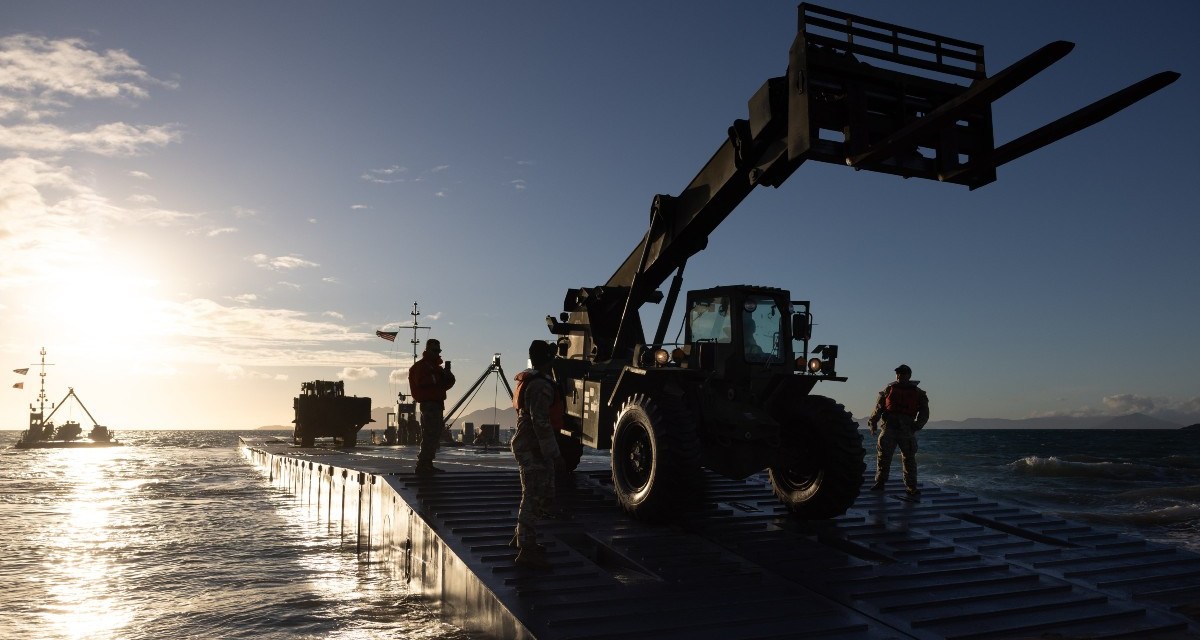
Image credit: Cpl. Jacob Joseph, Australian Defence Force (via US 8th Theater Sustainment Command)