
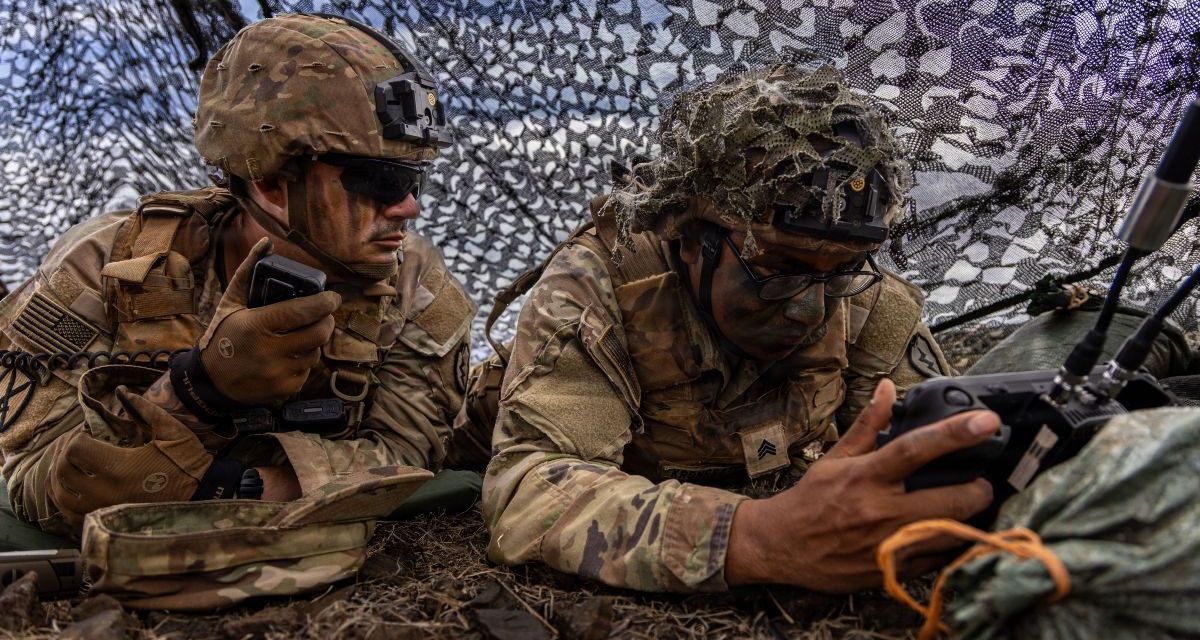
During our brigade’s recent rotation at the Joint Readiness Training Center, an infantry battalion discovered something essential to success on the modern battlefield. Tasked to screen the approach of a larger air assault, 2nd Battalion, 506th Infantry built a layered web of sensors—company drone operators tied directly to mortar sections, scout teams pushed beyond the forward line of troops, and medium-range reconnaissance drones feeding the targeting cycle. The battalion’s single most effective intelligence asset was that medium-range platform. And the after-action lesson its leaders drew was blunt: The drone and its operators had become such a high-payoff target that the system needed to be flown by a specially trained infantryman who could survive in the close fight—not by a tactical unmanned aircraft system (UAS) pilot trained for employment at higher echelons.
That conclusion, reached independently by a maneuver battalion under combat-realistic conditions, makes the case for a new military occupational specialty in miniature. The proliferation of small UAS, first-person-view (FPV) strike drones, and AI-enabled sensing tools has changed how infantry formations move, hide, communicate, and survive. The question is no longer whether drones matter to the close fight. It is whether the Army’s personnel model is built for the battlefield that now exists. It is not. The infantry needs a dedicated specialty—call it 11R, the drone-enabled infantryman—because drone-enabled warfare has become a persistent, technically demanding function of maneuver that can no longer survive as an informal additional duty without degrading both drone proficiency and infantry fundamentals.
A Battlefield Under Constant Observation
The conditions driving this are not speculative. Army Futures Command’s Concept for Brigade Combat Team Cross-Domain Maneuver 2028 describes an environment in which brigade combat teams must disperse, mask their signatures, and survive against adversaries fielding persistent manned and unmanned reconnaissance linked to long-range precision fires. The Center for Army Lessons Learned has documented the same reality from Ukraine, where unmanned systems saturate the airspace and make concealment increasingly difficult. Units must now assume that once they emit, loiter, or move carelessly, they may enter an enemy kill chain in near real time. A formation can be effectively in contact—observed, fixed, and targeted—before a single round is fired.
This is increasingly the infantry’s problem to manage directly, not that of higher headquarters. Small unmanned systems now drive route reconnaissance, target confirmation, battle damage assessment, and immediate strike at the squad, platoon, and company levels. The ability to observe a trench line, confirm enemy movement in dead space, or strike an exposed position before maneuvering can decide the close fight. These functions shape the core maneuver problem: seeing, understanding, and deciding before the enemy does.
The Army Has Solved This Before
The infantry branch has confronted a structurally identical problem before. Mortars were not always organic to infantry formations. As Army historians have noted, the demands of trench warfare in World War I pulled close, infantry-controlled indirect fire deeper into the branch until the Army stopped treating it as an extension of general infantry skill and built a specialty around it. Today’s 11C indirect fire infantryman does not simply carry a mortar, but computes firing data, builds target lists, emplaces and camouflages positions, and supervises indirect fire employment across offensive, defensive, and retrograde operations—tasks requiring certification, repetition, and institutional development.
Recent professional writing has reached for the same analogy. In this vein, the authors of a recent infantry proposal argue that UAS sections should mirror mortar sections precisely because both deliver responsive, commander-controlled effects at the point of contact. The comparison holds not because drones and mortars are interchangeable, but because both become most valuable when they are organic to the maneuver commander rather than borrowed from a distant enabler. Once a capability becomes organic to maneuver, it is part of how the formation fights—and the Army has historically professionalized those capabilities rather than leaving them to part-time enthusiasts.
Critically, the 11C precedent also disposes of the fear that specialization erodes infantry identity. As one Army officer has put it, “an 11 Charlie is also an 11 Bravo.” That is the model for 11R: an infantryman first, grounded in the branch’s warfighting foundations, then developed into a specialist in a function that now demands more than a side task can sustain.
Why Additional Duty Fails
The Army’s current habit is to solve the drone problem informally—a capable soldier or innovative noncommissioned officer becomes the unit’s expert by necessity. The authors of a three-tiered UAS manning proposal, drawing on Ukraine and a combat training center rotation, recognized the limit of this approach: Some systems can remain additional duties, but others displace a soldier’s primary rifleman role. That displacement is the institutional hinge. Once employing a capability begins to crowd out a soldier’s original warfighting function, the Army has a specialization problem, not a training problem.
Our rotation at the Joint Readiness Training Center made the point concrete. To field survivable medium-range drone operators, 2-506 Infantry trained four-man teams to the standard of traditional reconnaissance squads—capable of moving long distances, maintaining beyond-line-of-sight communications, and living in subsurface hide sites. That is not a task bolted onto a rifleman’s existing load. It is a distinct profession. The infantryman already owns an immense burden of perishable skill: marksmanship, movement, communications, fieldcraft, casualty response, battle drills, and reconnaissance. Drone-enabled warfare adds launch and recovery, flight control, maintenance, battery management, target identification through a narrow video feed, fires coordination, and strike execution. Asking general-purpose infantrymen to absorb all of it produces partial expertise in two domains and mastery in neither.
What 11R Would—and Would Not—Own
The 11R would be a soldier in career management field 11, fully grounded in infantry fundamentals, who specializes in tactical unmanned reconnaissance, target acquisition, drone-enabled strike, sensor-to-shooter integration, and survivable employment of unmanned systems in contested environments. The value is not in operating a machine but in operating it as part of infantry combat power—understanding how terrain shapes observation, how schemes of maneuver open windows for employment, and how close combat unfolds in urban and restrictive terrain.
The boundary matters as much as the definition. The 11R would own the systems employed directly by battalion and company commanders in the close fight—short-range reconnaissance platforms, purpose-built attack systems, and the intelligence payloads organic to the infantry battalion and below. Everything above that—brigade and division collection, theater intelligence, surveillance, and reconnaissance, and platforms demanding sustained aviation expertise—stays with 15-series soldiers. The relationship mirrors the existing dynamic between 11Cs and their 13B field artilleryman counterparts: both employ indirect fires, but they serve different commanders at different echelons with different cultures and procedures. A 15X belongs to the aviation branch and brings aviation standardization; an 11R is an infantryman and brings infantry tactical grounding and mastery of systems whose value depends on immediate responsiveness to a maneuver commander.
This argues for a tiered personnel model rather than a binary one. Basic familiarization—launching a simple quadcopter for local reconnaissance—remains a common infantry skill. Recurring tactical reconnaissance and target acquisition warrant designated positions. Close-maneuver employment that fuses reconnaissance, strike, and survivability under persistent observation warrants the 11R. Our brigade saw this gradient in practice: Company operators sensed and queued mortar fires while the battalion’s most proficient teams were pooled and task-organized to mass effects at decisive points. The distinction between a familiarized operator and a specialized one was already visible in the formation’s own task organization.
The Objections, and Why They Fail
Four objections deserve a hearing. The first—that better training for riflemen is enough—confuses familiarization with professionalization; once a perishable, decisive capability regularly displaces primary duties, the organization is already in the realm of specialization. The second—that specialization weakens the rifleman—inverts the real risk, which is the uncontrolled accumulation of technical burden across every soldier; the 11C model shows specialization can protect the branch’s foundation rather than dissolve it. The third—that technology moves too fast for a durable military occupational specialty (MOS)—would be fatal only if the specialty were built around an airframe. It would not be. The Army does not define 11C around a single sighting mechanism; it defines it around the enduring function of organic indirect fire. The 11R’s enduring function is employing unmanned systems for reconnaissance, targeting, strike, and support to maneuver under contested conditions. Platforms will change; the problem will not.
The fourth objection is the strongest: that organizational fixes—UAS sections on the books at company or battalion—make a new MOS unnecessary. But a section answers only where a capability sits on a manning document. It does not solve accession, schoolhouse ownership, certification, career progression, or the long-term development of tactics. Our rotation illustrated the cost of substituting task organization for ownership. Attaching reconnaissance company operators to maneuver battalions helped with targeting, but the handoff seams between echelons produced repeated react-to-contact drills and degraded the brigade commander’s ability to shape the deep fight. Borrowing operators is not the same as owning the profession. Organization offers placement; an MOS guarantees professionalism.
AI Doesn’t Lower the Bar, It Raises It
The maturation of AI-enabled targeting is often read as a reason operators will matter less. The opposite is true in the close fight. As automated target recognition and autonomous flight behaviors improve, the operator’s role shifts from flying the platform to supervising its judgment—reading what the system shows, catching what it misses, and weighing its recommendations against the commander’s intent inside compressed timelines. Picture a platoon at a support-by-fire position as the assault element moves to breach. A drone flags three possible enemy positions, rates one high-confidence, and proposes an FPV strike azimuth in seconds. The operator must decide to strike, redirect, or hold—judging the scheme of maneuver, the assault element’s location, the risk of fratricide, and whether the machine’s confidence reflects ground truth or sensor artifact. That is tactical judgment under time pressure, consequential to the lives of the soldiers nearby. It demands a professional, not a part-timer.
Adapt Before the Crisis
When indirect fire became indispensable to infantry maneuver, the Army did not rely indefinitely on improvised manning. It built specialists. The contemporary battlefield—with its persistent observation, compressed kill chains, proliferated tactical drones, and AI-enabled decision support—presents the same kind of challenge, and our brigade met it firsthand at the Joint Readiness Training Center. Unmanned systems are no longer accessories to the close fight; they are woven into how infantry formations generate combat power.
The answer is not to turn every infantryman into a part-time drone operator. It is to preserve the profession of the rifleman while building a complementary profession inside the branch for those who must master drone-enabled warfare—scoped to the systems that serve the infantry commander in the close fight, built on a career progression that runs from squad-level employment to division-level standardization, and grounded in the same institutional logic that produced the 11C. Institutionalizing that specialty would not be chasing a trend. It would be what capable armies have always done: adapting force design to the conditions of combat before necessity turns adaptation into crisis.
Chief Warrant Officer 2 Cody Stewart is the brigade UAS operations officer for the 3rd Mobile Brigade, 101st Airborne Division, “Rakkasans.” CW2 Stewart is the lead expert in UAS integration inside the mobile infantry construct and is pioneering FPV sUAS integration in the 101st Airborne Division’s multipurpose and multifunctional reconnaissance companies.
Captain Chris Lajeunesse is a US Army infantry officer serving as a rifle company commander in the 2nd Battalion of the 506th Infantry Regiment, “White Currahee.” Captain Lajeunesse is a West Point graduate and Ranger-qualified officer. He previously served as a brigade innovation and modernization officer in the 3rd Mobile Brigade, 101st Airborne (Air Assault) Division, “Rakkasans.”
Captain Matt Vandawater is a US Army infantry officer serving as a brigade operations planner and chief innovation officer for the 3rd Mobile Brigade, 101st Airborne Division, “Rakkasans.” Captain Vandawater is a graduate of the University of Mississippi and a Ranger-qualified officer.
The views expressed are those of the authors and do not reflect the official position of the United States Military Academy, Department of the Army, or Department of Defense.
Image credit: Spc. Abreanna Goodrich, US Army