The war does not begin with American tanks crossing a European border or carrier strike groups racing toward the Taiwan Strait. It begins at home.
Imagine a scenario: Russia invades Poland. Article V is invoked. Within hours, the United States announces that it will surge armored brigades, air defense, sustainment units, ammunition, and follow-on forces to Europe. The message is meant to reassure NATO and warn Moscow: America is coming.
Or an alternative: Beijing makes good on its decades of threats to bring Taiwan under its control and commences a military effort to do so. The United States has substantial joint force assets in the region, but much more must be readied and sent to the theater and steps to do so begin immediately. The message is intended to be unequivocal: The US military will not allow a fait accompli.
But in either scenario, the enemy has already started fighting the deployment. This is not a hypothetical future threat. State-sponsored cyber actors—most notably China’s Volt Typhoon—have already been documented by federal intelligence agencies positioning themselves deep within US critical infrastructure. They are not there for espionage; they are prepositioned for sabotage.
When the deployment order is given, they pull the trigger. A cyberattack strikes the national rail network. Dispatching systems fail. Trains do not stop moving everywhere, but they stop moving predictably. Routes back up. Crews cannot be properly assigned. Rail yards become parking lots. Simultaneously, municipal water treatment facilities near major mobilization installations are compromised, and regional power grids feeding strategic ports fluctuate. The Defense Finance and Accounting Service is shut down; no soldier receives pay. The system is not physically destroyed; it is delayed, confused, and paralyzed just enough to ensure the US forces arrive too late.
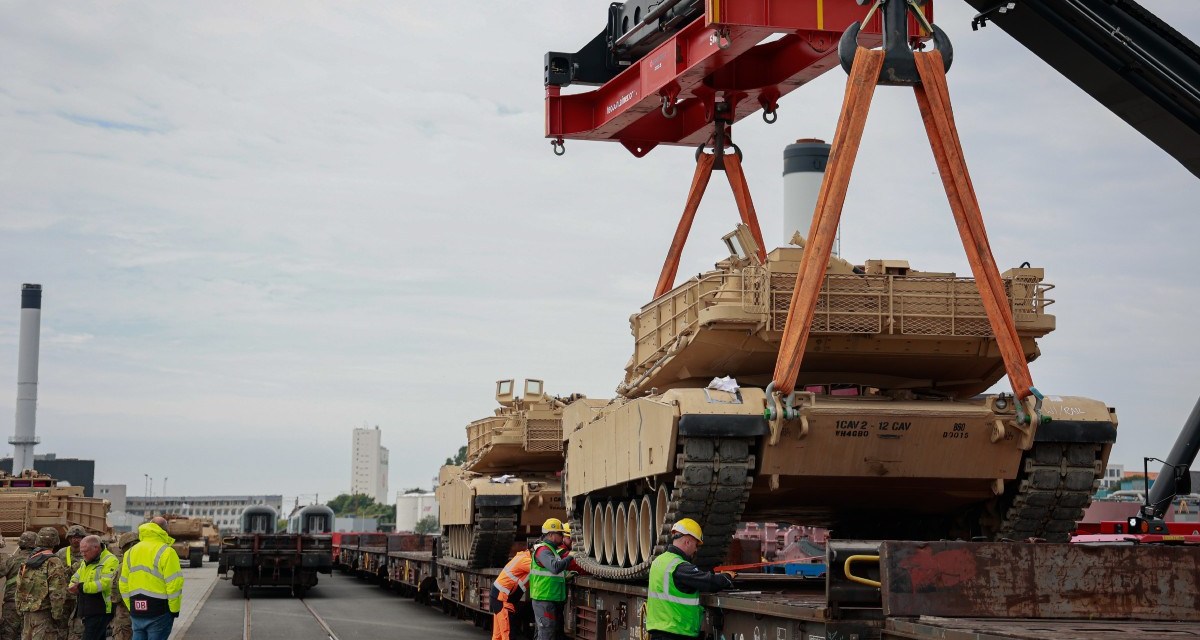
At the same time, military logistic planners discover that there are not enough suitable railcars immediately available to move tanks, Bradley fighting vehicles, recovery vehicles, artillery, engineering equipment, and sustainment platforms at the required scale. The brigades exist. The equipment exists. The will exists. But the transportation capacity does not.
Then a drone swarm from an offshore commercial vessel hits a major US port. It does not need to sink ships or destroy the entire facility. It only needs to inflict damage to cranes, fuel systems, rail connections, staging areas, or command-and-control nodes. One port becomes unusable. Another becomes overwhelmed with vehicles. A third has limited capacity for heavy military equipment. The problem compounds by the hour. The United States is now fighting a major battle mobilizing on its own soil before it can even deploy.
Convoys are delayed before they leave home station. Equipment stacks up at railheads. Ammunition movements are slowed by routing restrictions. Port call timelines collapse. Commercial carriers hesitate. Insurance costs spike. Civil authorities demand answers. Combatant commanders demand timelines. Allies demand reassurance. The president demands options. The standing military is ready to fight, but the nation is not ready to move it.
This is the brutal reality of peer war: The enemy does not have to defeat the joint force in Poland or Taiwan if it can prevent it from arriving in time, in mass, and with the sustainment required to endure. A peer adversary will not wait for American mobilization to unfold uncontested. It will attack the connective tissue of national power: rail, ports, power grids, cyber networks, fuel distribution, shipping capacity, industrial production, and political will.
In this scenario, deterrence fails not because America lacks soldiers, tanks, aircraft, or ships. It fails because the adversary correctly calculates that the United States cannot convert its military power into combat power fast enough under attack. Mobilization is no longer a rear-area administrative function. It is the opening campaign of modern war. The central question is no longer whether the United States possesses military power. It is whether the nation can convert that power into deployable combat capability under attack. The answer to that question will shape adversary decision-making long before the first shot is fired.
Contested Mobilization: The Modern Imperative
In 1963, the United States conducted Operation Big Lift—a strategic message to Moscow. More than fifteen thousand American soldiers deployed from the United States to West Germany in a matter of days, demonstrating the nation’s ability to rapidly reinforce NATO during the height of the Cold War. The exercise reassured allies, strengthened deterrence, and showcased America’s strategic reach. Yet Big Lift was conducted under conditions that no longer reflect the realities of modern warfare. Personnel flew to Europe, where equipment was already waiting. Transportation networks were uncontested, communications were secure, and the exercise assumed a level of strategic sanctuary that future conflicts are unlikely to provide. Even Operation Desert Shield in 1990, the largest American strategic deployment since World War II, shows us only what mobilization looked like when strategic sanctuary still existed.
The United States has shifted over the past three decades from a posture of national mobilization to one of optimized expeditionary deployment. While the Army has become highly proficient at rotating forces into permissive theaters, it has not systematically tested or exercised its ability to mobilize, deploy, and sustain large-scale combat power under contested conditions. Mobilization, unlike deployment, is a national function that integrates military forces with civilian transportation networks, industrial capacity, port infrastructure, and allied reception systems.
The United States, therefore, must execute a Big Lift 2.0, a modern national-level stress test designed not to replicate historical exercises, but to evaluate the resilience of the entire mobilization enterprise under realistic conditions of disruption. Such an exercise would assess the ability of the United States and its allies to generate, move, receive, and sustain the combat power of an Army corps while under persistent attack across multiple domains. It would also expose critical vulnerabilities in rail capacity, sealift availability, port throughput, industrial surge capability, and allied reception and onward movement systems.
Deterrence rests upon both capability and credibility. The United States possesses enormous latent military power, but latent power only contributes to deterrence if adversaries believe it can be converted into combat power rapidly enough to affect the outcome of a conflict. If Beijing or Moscow conclude that American mobilization can be delayed or disrupted before decisive combat power arrives, they may view aggression as a manageable risk rather than an unacceptable gamble.
The Triad of Friction: Industry, Outsourcing, and Lost Expertise
After the collapse of the Soviet Union, the United States made a fateful strategic decision: It traded mobilization depth for peacetime efficiency. Planners assumed the United States would always enjoy strategic warning, incremental deployments, compliant commercial infrastructure, and the sanctuary of uncontested logistics. Consequently, the force became exceptionally proficient at rotating units into permissive theaters like Iraq and Afghanistan. However, the true capacity to mobilize for large-scale combat operations has eroded, leaving the military exposed to a triad of systemic friction: the decay of industrial depth, the outsourcing of logistics, and the loss of institutional expertise.
First, the military has lost the institutional art of mobilization. At the start of World War I, the German General Staff had planned mobilization down to the exact number of railcars required for every unit, maintaining a continuous timeline that enabled a rapid two-front mobilization. Throughout the Cold War, the United States and NATO routinely practiced this scale of movement through annual REFORGER (Return of Forces to Germany) exercises. Today, this mastery is largely gone. While NATO recently executed Steadfast Defender 24 with over ninety thousand troops, this exercise bypassed the friction of a contested trans-Atlantic outload. It is highly questionable whether today’s commanders and staff could calculate their organic railcar requirements, including the specific DODX heavy-duty flatcars needed for M1 Abrams tanks, without relying heavily on civilian contractors or automated software.
Second, the US military has outsourced its mobilization capabilities to commercial entities, transforming strategic partnerships into systemic vulnerabilities. This friction is evident even during routine deployments to the National Training Center, where the tactical necessity of outloading equipment in combat-ready configurations is frequently overridden by civilian rail operators who prioritize the administrative efficiency of loading by vehicle type. Because strategic outloads now rely entirely on commercial infrastructure, civilian contractors, automated logistics software, and uninterrupted GPS access, the mobilization pipeline is highly susceptible to paralysis. A peer adversary’s cyber or kinetic disruptions would devastate an outload process that is managed by civilians who are neither equipped nor contracted to operate under fire. Compounding this is an aging and limited strategic sealift fleet with dwindling roll-on/roll-off capabilities, raising critical doubts about whether the Army still possesses the organic capability to deploy its own forces.
Finally, mobilization is fundamentally an industrial endeavor. Big Lift 2.0 cannot merely evaluate transportation networks; it must assess whether American industry can generate replacement combat power at wartime consumption rates. Modern deterrence is not simply the existence of tanks, ships, and aircraft; it is artillery shell production, missile manufacturing, shipbuilding, fuel distribution, and deep repair capacity. The supply chain disruptions experienced during the COVID-19 pandemic revealed how quickly domestic distribution and production systems can fracture even without military action. A peer adversary will deliberately exploit these exact vulnerabilities during mobilization. Ultimately, if the United States cannot rapidly manufacture armor, artillery, and precision munitions to replace early losses, the speed of its initial deployment becomes irrelevant.
The Indo-Pacific Imperative
When looking at a potential conflict with China, an exercise focused within the Indo-Pacific region would highlight how geographic realities ruthlessly magnify every logistical shortfall. While operations in the European Command’s area of responsibility measure transit and sustainment in days, the Pacific theater is dictated by the tyranny of distance, stretching supply lines into weeks and months. Critically, an Indo-Pacific mobilization cannot rely on the historical assumption of maritime and air supremacy. The joint force will be forced to traverse thousands of miles of ocean while under persistent, multidomain threat from a mature antiaccess/area-denial network.
Because of this, an Indo-Pacific Big Lift 2.0 must force military planners to answer hard questions about long-term endurance and joint interoperability. It requires moving beyond Army-centric planning to demand deep integration with US Transportation Command and Pacific Fleet maneuvers. The exercise must measure not just how fast a corps can arrive, but how sustainment and replacement equipment can reliably follow over contested oceans. This environment will severely test our aging sealift fleet, massive fuel demands, and vulnerability at maritime chokepoints. Furthermore, because adversarial fires will likely target fixed, deep-water infrastructure, the exercise must rigorously validate joint logistics over-the-shore capabilities to offload and project combat power when traditional far-side ports are destroyed or denied. Ultimately, an outsourced, vulnerable mobilization framework that might survive a European deployment will face catastrophic failure in the Indo-Pacific.
Big Lift 2.0: Concept of Exercise
Big Lift 2.0, a deliberately planned and executed national stress test, would fundamentally redefine military deployment exercises by shifting the baseline operational question from Can we move soldiers? to the realistic, contested challenge of Can we mobilize a corps while an adversary actively attempts to stop us? To execute a national-level stress test of this magnitude, the Department of Defense must transition from dangerously optimistic peacetime assumptions to a realistic, contested operational framework. This requires a progressive crawl-walk-run training campaign. Within the next five years, the military should operationalize these requirements by executing a senior-leader tabletop exercise as the crawl/walk phase, followed by a physical, corps-level deployment as the run phase.
The campaign begins with a national mobilization tabletop exercise designed to stress-test senior leadership across the interagency and commercial sectors without the immediate logistical burden of physically moving heavy brigades. This exercise would gather key stakeholders including Army commands, US Transportation Command, the United States Maritime Administration, commercial rail operators, port authorities, the Department of Homeland Security, and allied partners to navigate the deployment of an armored corps within thirty to forty-five days against a peer adversary.
Planners would have to navigate hard, asymmetric friction injectors modeled after real-world threat vectors. This includes Volt Typhoon–style cyber disruptions targeting civil power grids, municipal water systems feeding power-projection platforms (installations), and commercial port control systems. To succeed, leaders would have to answer complex questions regarding railcar prioritization, manual and analog port operations, and emergency civil-military coordination when primary power, communications, and utility systems fail. The required end state of this tabletop is not a standard briefing, but a rigorous assessment of national mobilization gaps that directly informs a funded, actionable mobilization campaign plan.
Once the strategic and interagency decision-making frameworks are validated, the military must transition to the run phase: a comprehensive, physical mobilization exercise that tracks a corps-level force through five progressively contested phases:
- Phase I (Home-Station Mobilization): Establishes the foundation by testing alert procedures, load plans, and civilian rail coordination at the installation railhead.
- Phase II (Fort-to-Port Movement): Evaluates the capacity of the Strategic Rail Corridor Network and commercial rail to sequence and transport equipment to strategic seaports while navigating domestic choke points.
- Phase III (Port Operations): Stresses critical infrastructure at locations like Beaumont or Savannah, testing roll-on/roll-off loading, hazardous cargo handling, and resilience against active cyber disruption.
- Phase IV (Strategic Sealift): Physically validates loading rates and ship availability by moving at least a portion of the force onto maritime vessels.
- Phase V (Far-Side Reception, Staging, Onward Movement, and Integration): Integration with either NATO or Indo-Pacific allies to test host-nation debarkation, rail capacity, road march permissions, and the air defense of logistics nodes.
Ultimately, the true success standard for this physical evaluation is not merely that a force departs, but how rapidly it can generate integrated combat power at the far-side tactical assembly area. Critics may argue that a national mobilization exercise would be costly and disruptive. Yet the expense of revealing vulnerabilities during peacetime is insignificant compared to discovering them during a major war.
Evaluation Requirements for the Big Lift 2.0
Big Lift 2.0 must fundamentally shift the paradigm of military deployment exercises from administrative movements to contested combat operations. The objective is not simply moving an entire corps of combat equipment in a vacuum but executing that massive mobilization while a peer adversary like Russia or China actively attempts to paralyze the supply chain. By deliberately injecting friction at every node, Big Lift 2.0 would recognize that current deployment plans rely on dangerously optimistic assumptions. It would truly measure if the nation and its allies can move, receive, stage, protect, and sustain multiple armored brigades under wartime disruption. To validate true strategic readiness for large-scale combat operations, the Big Lift 2.0 evaluation framework must transcend baseline administrative metrics and rigorously assess five critical, contested dimensions to properly evaluate the exercise:
- Mobilization under cyberattack, forcing units to demonstrate analog command and control, manual backup procedures, and the ability to deploy entirely without digital systems.
- Strategic transportation resilience by identifying domestic bottlenecks and proving rail redundancy along alternate routes.
- Port and airfield survivability must be audited under active disruption, measuring throughput retention, physical security, and infrastructure recovery timelines.
- Industrial surge capacity by auditing real-world production rates, maintenance repair cycles, and the depth of strategic reserves.
- Sustainment at distance, shifting the metric of success from mere initial arrival to the continuous, long-term support of deployed forces in theater.
Collectively, these rigorous criteria transform the exercise from a standard peacetime logistical movement into a realistic stress test of national strategic endurance.
The Nation Must Remember How to Mobilize
During the Cold War, Operation Big Lift demonstrated that America could reinforce Europe. The challenge before us today is far greater. We must prove that the United States can mobilize while under attack. If deterrence ultimately depends on convincing an adversary that war cannot succeed, then mobilization is not merely a logistics function, it is a strategic capability. We must be able to reinforce, equip, and sustain at scale in contact. The decisive battle of the next war may not be fought overseas. It may be fought across America’s ports, railways, shipyards, factories, and networks. If we cannot mobilize under attack, we will not merely struggle to win a war, we will invite one.
Major Jonathan Buckland currently serves in the J33 on the Joint Staff. His previous assignments include serving as the executive officer of 5th Squadron, 7th Cavalry Regiment, 1st Armored Brigade Combat Team (ABCT), 3rd Infantry Division; operations officer for 3rd Battalion, 69th Armor Regiment, 1/3 ABCT; and future operations chief for 3rd Infantry Division. He also commanded both a rifle and headquarters company in the 2nd Brigade Combat Team, 82nd Airborne Division. He has a bachelor’s degree in English from the Virginia Military Institute, a master’s degree in international studies from the University of Kansas, and a master’s in operational studies from the Army Command and General Staff College.
The views expressed are those of the author and do not reflect the official position of the United States Military Academy, Department of the Army, or Department of Defense.
Image credit: Spc. Samuel Signor, US Army