
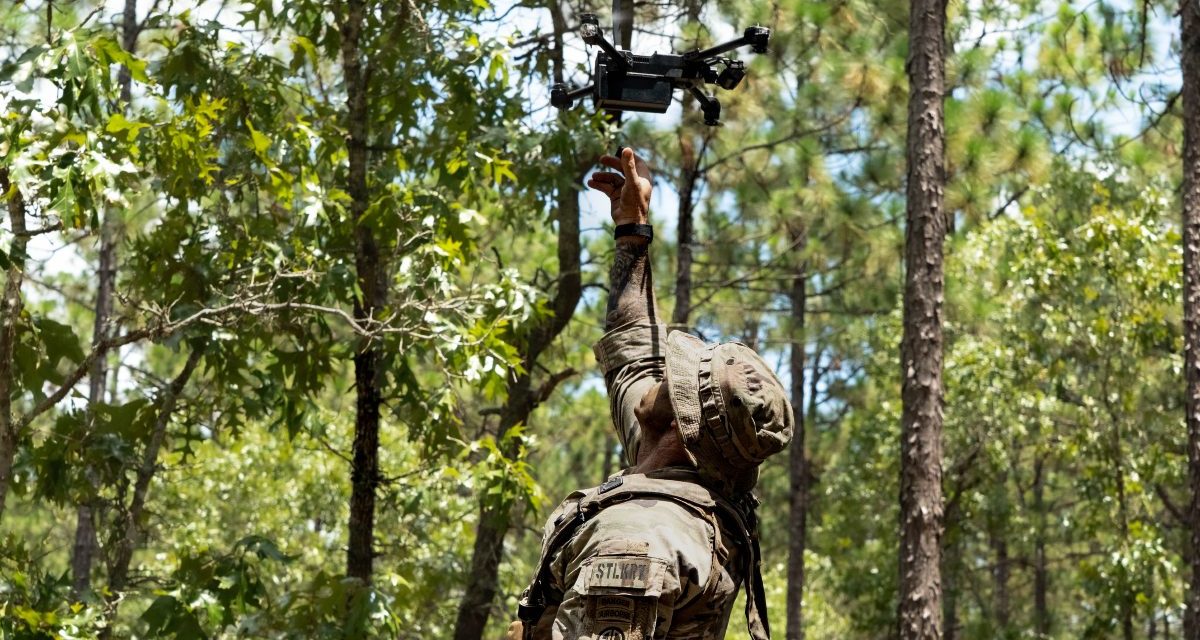
In Ukraine, a soldier is provisioned a low-cost drone from a factory that only began operations in the last twelve months, modifies it with a 3D printed part from a trench, and uses it the next day to spot Russian logistics movements. Meanwhile, the United States Army is just now beginning to meaningfully contend with mechanisms for tactical units to procure drone systems that match the performance levels Ukrainian forces have achieved while also complying with extensive cybersecurity, electromagnetic spectrum use, airworthiness, and compliance standards. This disparity captures the stark difference in how tactical innovation is treated in wartime versus peacetime militaries and highlights a truth we cannot ignore: If the US Army wants to remain a dominant landpower service in large-scale combat operations, it must radically decentralize innovation, especially in the realm of small unmanned aircraft systems (sUAS). This innovation must occur at the lowest tactical level, within squads, platoons, and companies—and the Army should spend money accordingly. This will require tolerating failure, embracing commercial technology, and restructuring acquisition pathways to enable rapid, bottom-up iteration. In other words, the Army needs to apply the principles of the lean startup model, not to billion-dollar programs in the legacy defense industrial base, but to the nineteen-year-old specialist in the mud with a drone and a screwdriver.
Modern warfare is being transformed by the mass use of sUAS. Ukraine and Russia deploy drones for every tactical purpose imaginable: intelligence, surveillance, and reconnaissance, artillery spotting, electronic warfare targeting, psychological operations, logistics, and direct attack. Drones are no longer specialized tools; they are battlefield essentials. In large-scale combat operations, where contested airspace limits manned platforms and the electromagnetic environment is constantly shifting, the United States cannot rely solely on expensive and exquisite platforms. Recent announcements indicate that the Army recognizes that fact—the service is canceling procurement of the MQ-1C Gray Eagle, for instance, and shuttering the Future Tactical UAS program, which had failed in seven years to field a replacement for the Shadow drone. But the mechanisms the service selects in place of the canceled programs to procure, field, and adapt drones will only succeed if they reflect an overarching principle: getting adaptable, expendable sUAS in the hands of the smallest units. The war in Ukraine has proven the battlefield value of sUAS beyond any doubt, but the US Army continues to treat drones as niche enablers. Drone density remains too low across brigade combat teams. Most formations are organized and trained for intelligence, surveillance, and reconnaissance via manned platforms and top-down control, not decentralized swarms of cheap, modular systems. Despite small-scale pilot programs and innovation units, the Army remains tactically and culturally unprepared for the scale and speed of drone warfare in large-scale combat operations.
The lean startup model, popularized by Eric Ries, emphasizes three core principles: build a minimum viable product, test and iterate quickly based on user feedback, and pivot or persevere based on real-world data. This model contrasts with traditional defense acquisition, which relies on long timelines, rigid requirements, and top-down control. Legacy acquisition prioritizes certainty over adaptability, which is the opposite of what tactical innovation demands in today’s fluid battlefield environment. The lean startup model is particularly applicable to sUAS because the technology changes rapidly and is often driven by commercial markets. Commercial drones, 3D printed parts, open-source software, and modular payloads allow for a cycle of experimentation and adaptation that mirrors the iterative product development process used by startups. These are not theoretical advantages; they are playing out in real time on the battlefields of Ukraine, where drone warfare has become a grassroots phenomenon.
While the US military has experimented with rapid innovation cells, these efforts remain largely confined to elite units and pilot programs. The broader force still operates under a procurement regime that expects certainty, punishes failure, and equates innovation with top-down modernization plans rather than bottom-up adaptation. That has to change.
The defense acquisition system was built to procure ships, tanks, and aircraft, not modular electronics with commercial origins and six-month upgrade cycles. That system is deeply ill-suited for the sUAS revolution for several reasons. First, it is overly optimized for compliance. Defense acquisition has traditionally been governed by the Joint Capabilities Integration and Development System (the elimination of which was announced last month), the Planning, Programming, Budgeting, and Execution process, and the Federal Acquisition Regulation. These frameworks prioritize documentation, approval, and accountability over speed or tactical utility. The result is a system that struggles to buy drones at a pace faster than they become obsolete. Second, the acquisition system favors exquisite, long-life, high-cost solutions. But sUAS are short-lived by design. They should be cheap, expendable, and replaceable. The current system fights that logic at every turn, often requiring even inexpensive drones to meet the same certification and documentation standards as major weapons platforms. Third, the industrial base is consolidating. A handful of prime contractors dominate the defense sector. These companies excel at producing complex platforms but are poorly suited for producing and iterating on the kind of fast, modular, user-driven sUAS needed at scale. Smaller firms, including startups and nontraditional defense partners, face massive barriers to entry, including long delays in contracting and lack of programmatic funding continuity. Finally, even when small firms or startups develop promising sUAS, the process of becoming a program of record is so onerous that many never make it past pilot phases. Innovation is strangled not by a lack of ideas, but by a lack of institutional pathways to adoption.
To break this cycle, the Army—and the joint force, more broadly—must reallocate funds directly to tactical units, especially in the combat arms, so they can procure, test, and modify sUAS in operational settings. This is already happening in isolated pockets. Special operations forces have long enjoyed flexible funding and acquisition authority, allowing teams to procure and experiment with new tech quickly. Initiatives within Marine Corps Force Design 2030 elements and Army Futures Command’s soldier touchpoints have pioneered rapid iteration models. But these efforts remain the exception, not the rule. A true shift would involve creating dedicated drone innovation budgets at the battalion and company level, allowing commanders to fail fast and often without career penalty, building support ecosystems such as repair labs, 3D printing capabilities, and software hacking workshops within maneuver units, and partnering directly with commercial drone companies at the operator level.
Imagine an Army infantry company during a training rotation at the National Training Center with $50,000 in discretionary drone funds. Over two weeks, platoons compete to develop the most effective use cases for commercial, off-the-shelf drones. They test different frame types, integrate modular sensors, script simple autonomy routines, and iterate based on feedback in training. Some ideas fail. Others reveal new concepts for scout and strike, obstacle reconnaissance, or low-visibility overwatch. Now multiply that by every company in the Army. Within six months, the Army would generate thousands of operator-tested data points about what works in sUAS employment, far more than a traditional program office could gather in five years. The result is not just smarter purchases; it’s bottom-up innovation, generated by the people who will fight the next war.
Some will argue it is not safe to let units buy and fly their own drones. This concern is valid in controlled airspace or complex electromagnetic environments. But strict oversight should not preclude decentralized innovation. Commanders can establish safety protocols, no-fly zones, and unit-level airspace management tools. Cybersecurity and operational security concerns are also frequently raised. While cybersecurity is essential, it must be tailored to risk. A $1,000 expendable drone flown by a rifleman does not require NSA-level security. DoD should adopt a tiered approach to security, where certain classes of drones meet baseline standards and others are approved for higher-risk missions. Others may argue that the military cannot just throw money at every unit. No one is suggesting unlimited spending. Instead, leaders with the appropriate authority should redirect a fraction of existing sUAS research, development, and procurement funds to unit-level experimentation. This would yield a higher return on investment than overengineered programs with five-year horizons.
Tactical failure is a strategic asset if it happens early and cheaply. That is the entire premise of the lean startup. Letting a squad fail with an ineffective drone configuration costs a few hundred dollars. Learning that lesson in combat, with lives on the line, is unacceptable. The key is to fail forward, to treat every failed experiment as data. A unit that wrecks five drones during a training cycle is not wasting money; it is stress-testing ideas before they face real adversaries. Ironically, the most risk-averse choice is to maintain the status quo: an acquisition system that delivers exquisite drones too slowly, to too few, with too little room for adaptation.
The war in Ukraine offers a real-time laboratory for the future of drone warfare. Ukrainian units have leveraged commercial drones at every echelon, from battalion-level strike coordination to squad-level intelligence, surveillance, and reconnaissance. Soldiers modify drones on the fly using commercial parts, 3D printers, and open-source code. They experiment with new tactics weekly, adapting to Russian jamming and counter-UAS capabilities in real time. One key lesson from Ukraine is that drone warfare is not just about platforms; it is about ecosystems. Units that can build, fix, hack, and redeploy drones faster than the enemy gain a cumulative advantage. This demands technical skill, institutional support, and most importantly, local authority to experiment and innovate. It is the lean startup model applied to the battlefield.
A culture shift around sUAS across all combat units means embedding drone experimentation into training cycles, building local sustainment and fabrication capacity, and treating drone teams as integral parts of tactical formations. Such a shift will not happen by directive alone. It will require resourcing the lowest levels, tolerating failure, and decentralizing innovation authority. It must begin with the squad leader and the drone in his or her rucksack.
To prepare for the next war, the US Army must stop waiting for perfect answers from the top and start empowering its youngest, most adaptable warfighters to build, experiment with, and break equipment like sUAS, reimagining the battlefield from the ground up. This does not mean abandoning oversight, doctrine, or security. It means recognizing that in a world of massed, networked, and expendable sUAS, the only way to stay ahead is to innovate faster than your adversary. That innovation will not come from a program office. It will come from the mud, the barracks, the garage, and the field. If we are serious about competing with peer adversaries, then it is time to let the squad fail—early, often, and forward.
Major Charlie Phelps is a Special Forces officer and currently serves as a company commander in 10th Special Forces Group (Airborne).
The views expressed are those of the author and do not reflect the official position of the United States Military Academy, Department of the Army, or Department of Defense.
Image credit: Sgt. Devyn Adams, US Army