It’s an essential building block of the way the Army trains and operates: the after-action review. A unit, from the squad level to echelons above brigade, completes a training exercise, or even a real-world operation, and turns to this mechanism to identify what went well, where there are opportunities for improvement, and what changes can be implemented next time. It’s how we keep our swords at their sharpest, our readiness and lethality maximized. But in a period of accelerating change in the character of warfare—faster and more digital than ever—are the mechanisms by which units conduct this fundamental activity fit for purpose?
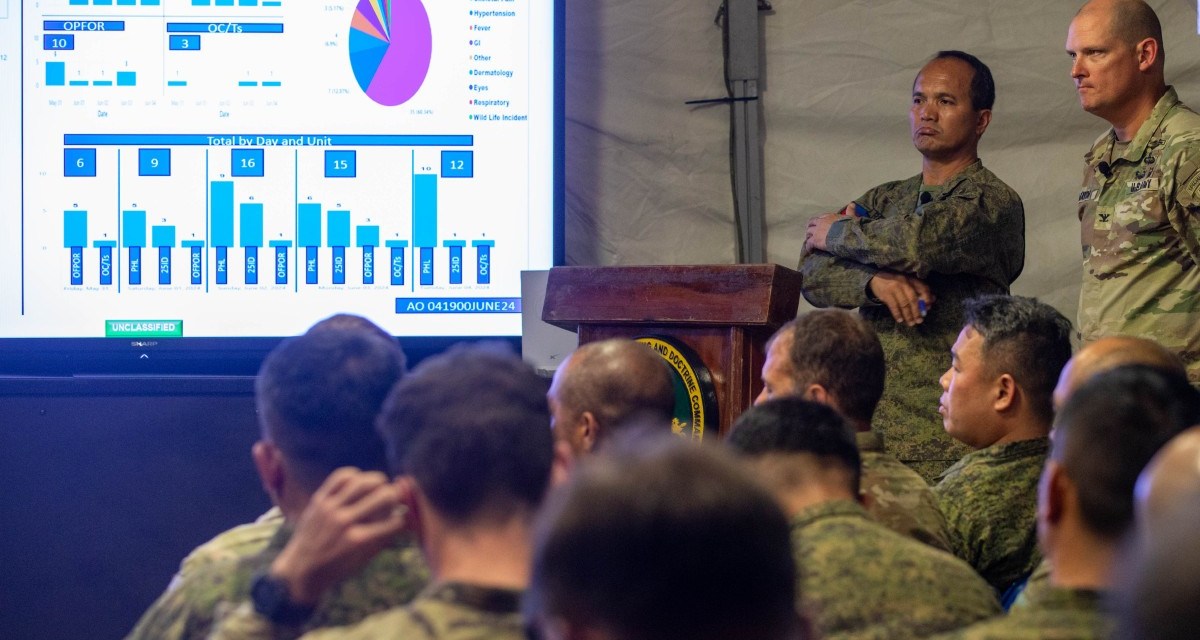
If not, what are the components necessary for a meaningful after-action review (AAR), specifically in today’s digital landscape. And do we have actually to wait until after the action to do it? This question has remained front of mind for me since becoming a task force senior for the Joint Multinational Training Center (JPMRC), the Army’s newest combat training center (CTC). Army Leaders are well versed in the doctrinal standards of AARs from Field Manual 7-0 and the Leaders Guide to Unit and Training Management but struggle to quantify the metrics that drive improves and sustains, those elements of the action that need work and those that were accomplished successfully. How many of us have sat through an AAR where events are blurred, challenges to existing processes are ignored, and opinions on performance drive the conversation? The training audience’s attention is quickly lost and valuable lessons learned are not internalized. To avoid this, the shared observations of observer controller / trainers (OC/Ts) must be linked to the unit’s performance using data in real time. At JPMRC we often refer to a training unit’s data as its “fantasy football stats.” Anyone who has played fantasy football knows that nobody wants to wait until after the game to see the stats. The same holds true for training. Why wait until after an event when data is available during the training? This is where the Data Assessment Tool developed at JPMRC comes into play.
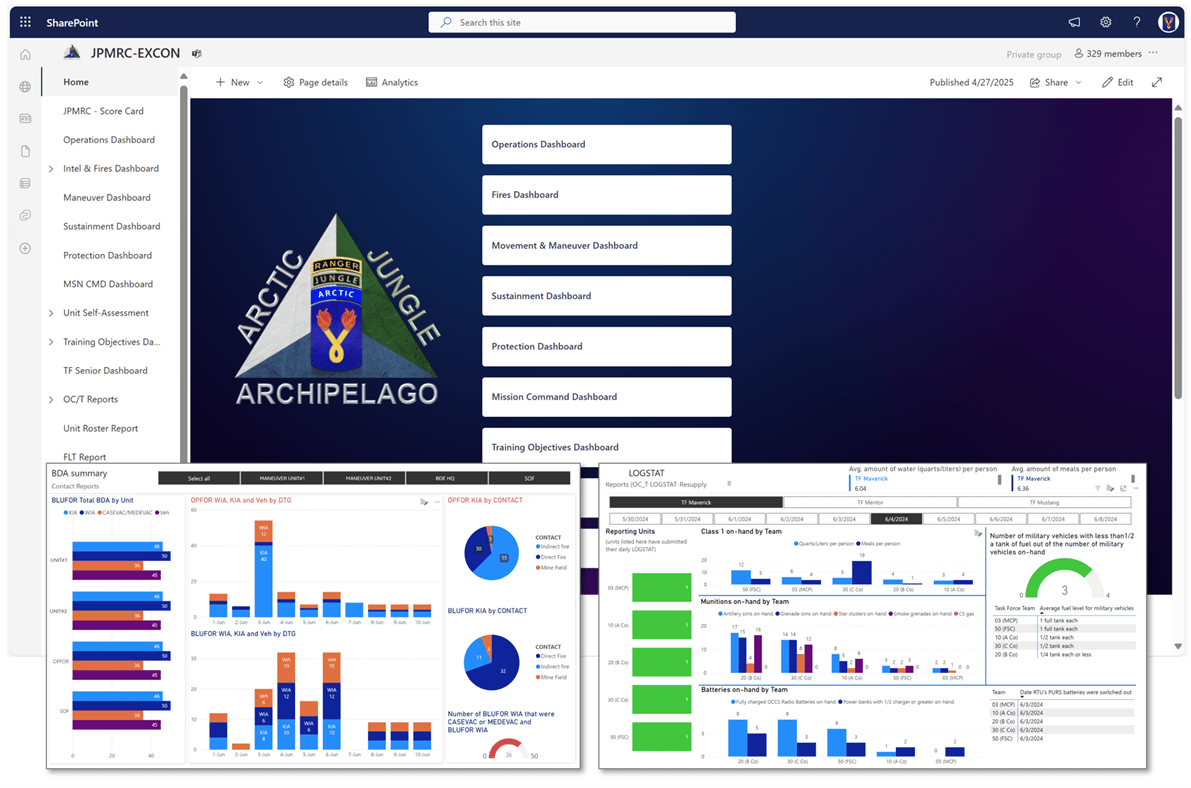
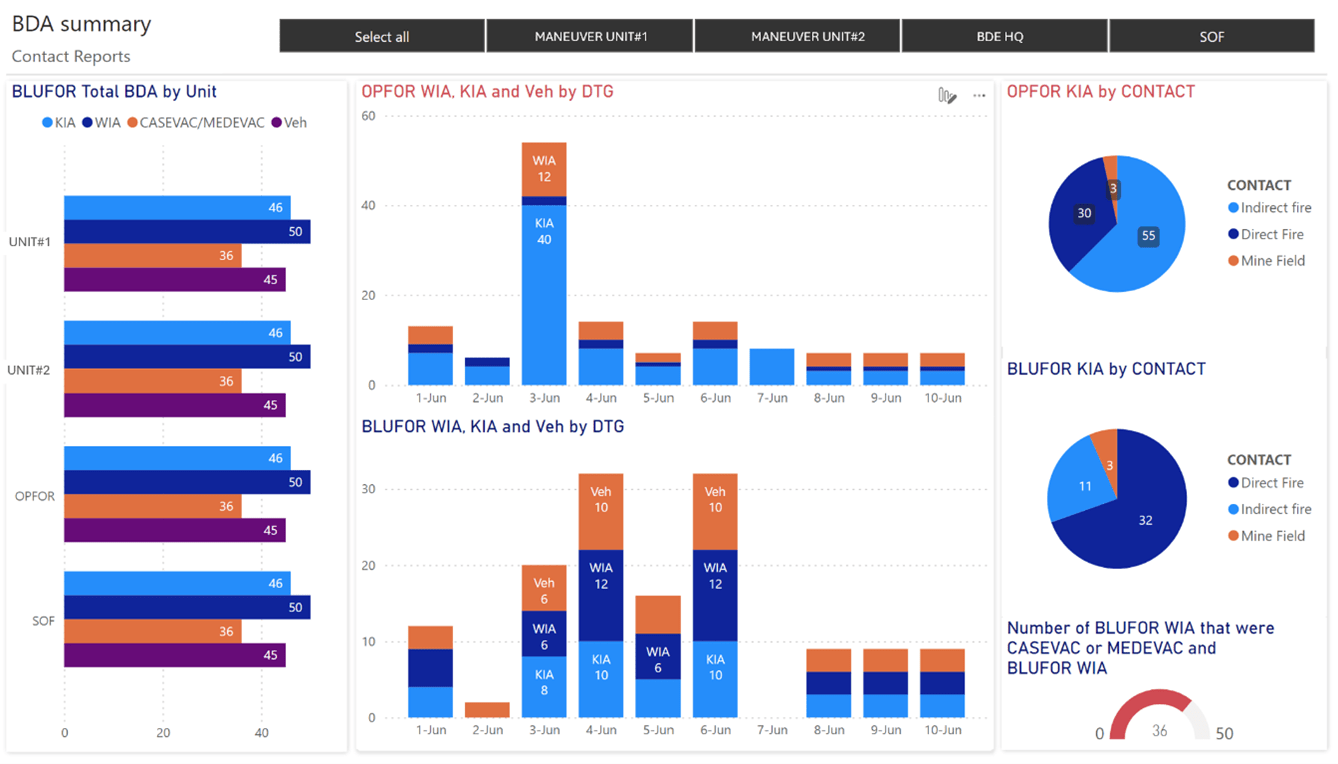
The Data Assessment Tool is JPMRC’s response to the challenge of presenting quality, informative AARs linked to real-time stats and paired with observations from OC/Ts. The tool takes reports submitted by OC/Ts in the field and uses a series of automated processes to post the reports into Microsoft Teams and update stats on Power BI charts. The Data Assessment Tool flattens communication across JPMRC’s operations group and provides a visualization of the data being collected for senior trainers and brigade combat team commanders. The tool was developed to provide leaders with comprehensive performance data and statistics to understand how their formations are performing. The data collection focus ranges from enemy and friendly battle damage assessment and effectiveness of indirect fires to sustainment shortfalls, medical evacuation times, and numerous other areas. As CTCs continue to evolve, there must be systems and processes in place to quickly collect data and process, analyze, and share it with the training unit. Based on discussions at the most recent CTC Commanders Conference hosted by the Combined Arms Center, the Data Assessment Tool is going to be adopted as the baseline for rapidly processing data to enhance learning and leader development at the CTCs.
The Challenge
JPMRC’s response to the challenge led to the implementation of real-time, data-informed AARs with the goal of linking data, based on the training unit’s performance during its rotation, with the observations of the OC/T. At CTCs, more often than not, data flows to the training analysis feedback facility—and then stagnates. Data is constantly being collected but is not always adequately analyzed and presented. This is an area where JPMRC utilizes automation tools for process improvement and digitization. These changes directly impact and improve the outcomes and performance of both the CTC and the training unit and provide visualization of performance data for training unit commanders and staffs.
Historically, CTC rotations have required hours of staff work to analyze data feeds and reports from a CTC rotation to produce a product and share that valuable information with the training unit. The volume of staff work required is a significate challenge for JPMRC due to its small size comparative to the legacy CTCs. In search of a system of change, born out of necessity, JPMRC explored solutions and is now employing a variety of Microsoft applications, tools, and products to analyze performance data. With the use of existing Microsoft applications that every US Army account holder can access, our team created a more effective system of data collection and analysis called the Data Assessment Tool. This tool has allowed us to collect and analyze the data in real time while providing immediate visualization to the command. The data collection system is automated from the OC/T on the ground direct to the common operational picture in the exercise control room and the AAR for presentation.
Process Improvement and Digitization
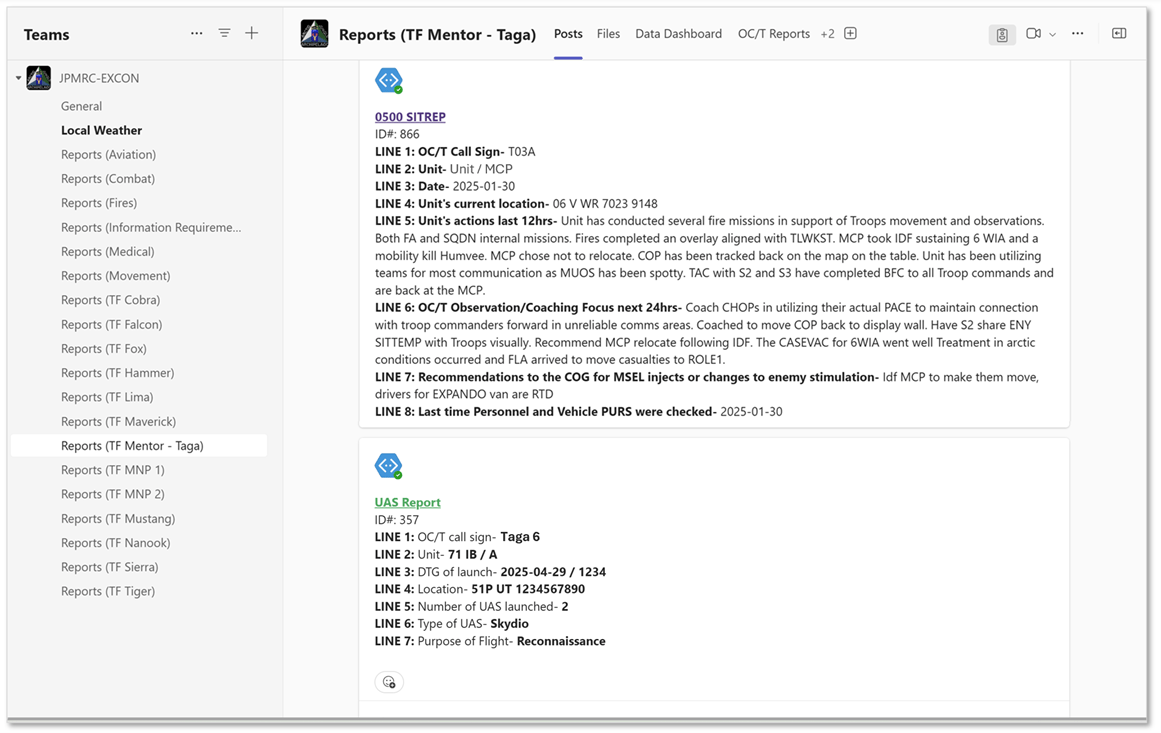
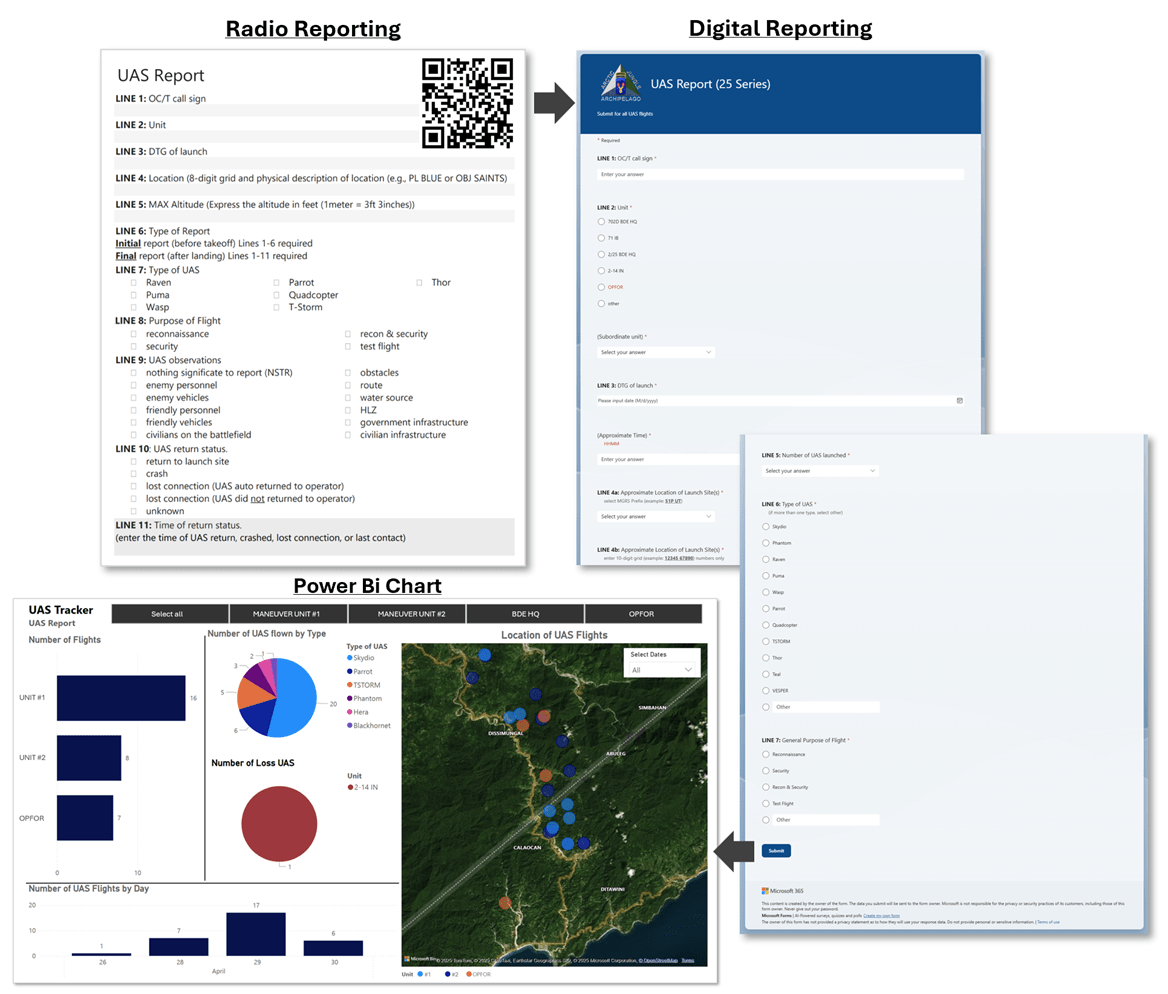
Using Microsoft Forms, OC/Ts can digitally submit situation reports, contact reports, unmanned aircraft system reports, fratricide reports, fire missions, etc. The existing OC/T data collection forms can be quickly digitized with links or QR codes that enable a fast and easy submission. To process the data in real time, our tool utilizes another Microsoft application, Power Automate. Reports submitted via Microsoft Forms are posted on various Microsoft Teams channels within seconds of submission and consolidated in a SharePoint list. This same data can also be automatically distributed via email based on the time sensitivity of the information and its purpose. To analyze the data the staff officer now only needs to utilize Power BI to create charts once and link data from the SharePoint List one time. Charts continue to update as new digital reports are submitted. This is performance data analysis, in real-time. Power BI allows users to display the information collected in a variety of ways, ensuring that performance data and training outcomes are easy to access and interpret and that they improve the efforts of the training unit. This quick visualization and analysis can eliminate the need for hours upon hours of staff work for units and streamline the visualization of the performance analysis of battalions and brigades in a CTC rotation.
Implementation
The process improvement and digitation were field tested a year ago with great success at JPMRC-X in the Philippines, the first fully instrumented CTC rotation west of the international date line. Internet connectivity remains the biggest hurdle for JPMRC due to the exportable nature of the CTC and the terrain in which it operates. OC/Ts often find themselves in austere jungle, mountainous, or Arctic environments with very limited or no internet connectivity. During the first JPMRC-X rotation, towers were sling loaded via helicopters into position to assist with communications. JPMRC continues to mitigate the connectivity challenges through experimentation with satellite-based communication devices that create bubbles of connectivity and enable reporting. The tried and true option in the absence of connectivity remains, with OC/Ts sending their reports via radio to the radio operator in the training analysis feedback facility. The radio operator, who has internet connectivity, is then able to submit the report. Regardless of the method, inputting the data digitally via Microsoft Forms enables the timely processing and visualization of the data.
While data analysis and visualization tools are being used in civilian organizations quite routinely, the Army has lagged behind its civilian counterparts in adapting and implementing change. Advisors and leaders do not need new systems, or million-dollar contracts; we need only a more effective utilization of available products for data analysis and process improvement. The development and implementation of the Data Assessment Tool was undertaken at zero cost to the Army. While the Army works to close the data analysis gap with civilian business, the Digital Assessment Tool is the first step for CTCs. Digitizing our processes enables all leaders to engage in tough and meaningful conversations around a unit’s performance and ensure that lessons learned are based in fact and driven by the real-time data analysis and performance of the unit. Bringing data-informed AARs into our training environments across the Pacific enables our units to improve their training to be as prepared and lethal as possible.
Since the first use of the Data Assessment Tool in the Philippines, it has continued to evolve and improve based on lessons learned from usage in both Hawaii and Alaska CTC rotations. The team at JPMRC received support throughout the process from both the USARPAC chief data office and a group of United States Military Academy cadets from the Department of Systems Engineering as part of their senior capstone project. As we continue to move forward, JPMRC is incorporating Microsoft Power Apps and Dataverse and taking steps to integrate with Vantage, the Army’s data platform, and approved AI applications. As the Combined Arms Center adopts the Data Assessment Tool for use by all CTCs, the possibilities for commanders during training rotations to quickly assess performance and adjust rapidly based on lessons learned increase exponentially.
Lieutenant Colonel Daniel K. Bourke most recently served as the commander of JPMRC’s 3rd Battalion, 196th Infantry Brigade, stationed west of the international date line in Radio Barrigada, Guam. Additionally, he was the senior Army advisor to the Guam National Guard, a JPMRC task force senior, the original developer of the Data Assessment Tool, and the exercise lead for the first two JPMRC-X CTC rotations in the Philippines. Over the last eight years he served in the Pacific with JPMRC, Eighth US Army, United States Forces Korea, and the 25th Infantry Division. He is currently attending the US Army War College.
The views expressed are those of the author and do not reflect the official position of the United States Military Academy, Department of the Army, or Department of Defense.
Image credit: Sgt. Samantha Aguridakis, US Army