
In 2010, as he watched the Medal of Honor being placed around the neck of Staff Sergeant Salvatore Giunta, retired Major General Robert Scales was in tears. They were tears not of happiness or pride, but of anger. He was furious that Giunta’s squad, in 2007, had walked a ridgeline without anything overhead to detect, deter, or defeat the enemy. The Taliban, undetected, approached dangerously close to the Americans before initiating an ambush, killing three soldiers, and nearly overrunning the formation. Scales asked the question that still hangs in front of every modern army: Why was there nothing over that unit? The American military had the technology. It had the money. It had the need. What it lacked was the institutional will to flood the tactical edge with the tools of survival and lethality. Scales outlined three simple layers: the strategic drone collecting intelligence that directly informs the platoon or squad leader, the intermediate drone that orbits above a unit to defeat threats from a few meters to kilometers ahead, and the intrusive drone that goes through a window, climbs a stairway, and finds the enemy before the soldier does. None of this was science fiction. None of it required billion-dollar programs. It was Walmart technology. It was Popular Mechanics. It was a model airplane.
And yet nearly twenty years after Giunta’s squad was ambushed, we are still talking about drones. We are still acknowledging the need to integrate them into US Army formations and operations. And we are still failing to do so, institutionally, at the scale that is as imperative as it is possible.
Consider the war in Ukraine. I walked the battlefields in 2022 and 2023 as Ukrainian soldiers were struggling to halt a massive Russian advance. They rapidly adapted because they had no choice. They integrated drones into every warfighting function, from intelligence to sustainment to fires. What began quadcopters purchased in an ad hoc fashion at electronics stores became a layered architecture of strategic, operational, and tactical drones. This was not theoretical change. It was survival. Ukrainian units learned to find the enemy first or die. They learned to strike the enemy first or be struck seconds later. They learned to move only under drone overwatch because not doing so made them vulnerable. This adaptation was not clean or uniform. It was messy, urgent, uneven, and driven entirely by battlefield necessity. But it was real. And it changed everything.
Those same lessons resurfaced with even greater clarity when I stood in southern Israel in early 2024. I spent time with an Israel Defense Forces (IDF) brigade commander who had just come out of Gaza after fifty-five days of the most intense close combat any modern military has faced. The IDF was not short on technology. Few Western militaries have invested more in digital networks, a common operational picture, and the ability for every platoon commander to access drone feeds on a tablet. Above the IDF were layers of drones providing real-time intelligence. Yet when the brigade first entered Gaza, it had no drones at the tactical edge. The brigade’s soldiers had nothing to send ten meters ahead. Nothing to send down the street. Nothing to send through a doorway. They were facing one of the most prepared and lethal urban defenses any modern military has encountered. Hamas fighters emerged from tunnels at the last possible second, often within a hundred meters of an IDF element, sometimes inside the same building. The drone layers above the brigade could see some of the Hamas fighters close to the IDF formations, but could rarely rapidly translate that information into timely, lethal action because the pace, proximity, and concealment of urban combat erased the advantage of altitude and range.
So the IDF adapted. Within two months, the brigade went from zero tactical drones to more than 250. The unit bought commercial, off-the-shelf drones wherever it could find them. Its members modified them with tape and zip ties. Unit leaders assigned soldiers whose sole task was to fly them. They integrated them into every formation. And they refused to enter a home, a courtyard, a stairwell, a street corner, or a rooftop without a drone going first. They built a manning structure and a task organization because they learned the same lesson Ukrainian soldiers had learned: The enemy is always closer than expected, and the unit that sees first lives longer. When I returned to Israel in 2025, that adaptation had become doctrine. No IDF unit, from platoon to brigade, moved into a fight without all three layers of Scales’s drone architecture supporting it. The intrusive drone was also either equipped with explosive charges or followed by an explosive-laden drone to kill the enemy within seconds rather than the minutes it might take to call for fires.
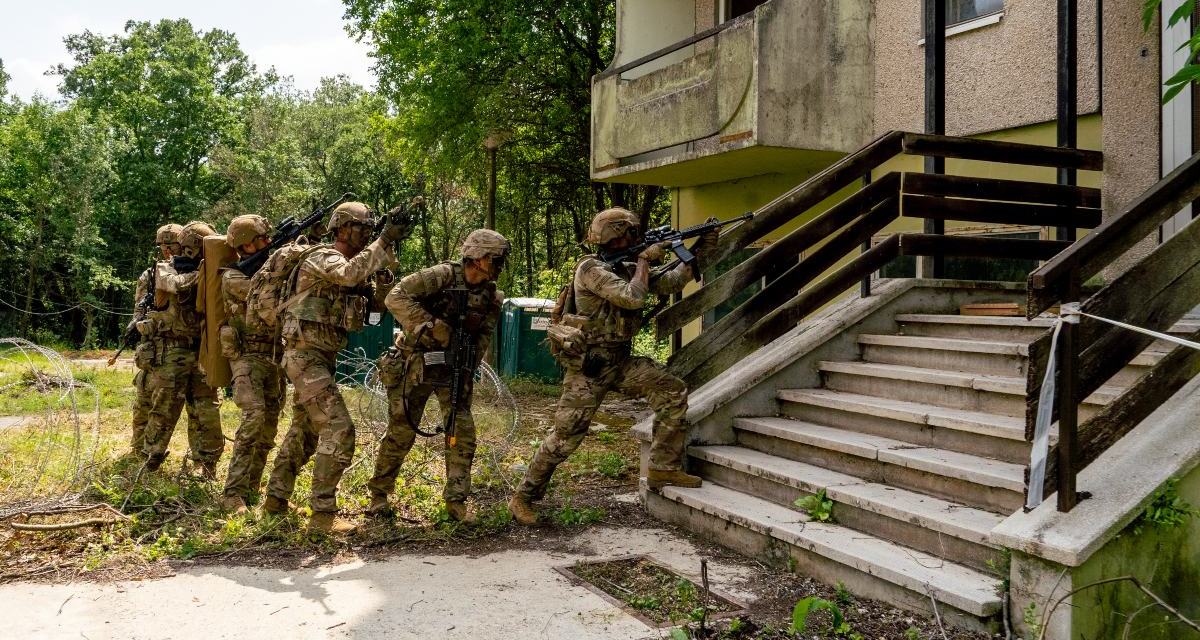
Which brings me to 2025. I was recently standing with a battalion commander from one of the most elite ground forces in the United States Army. We were watching a daytime company live-fire attack on a small urban objective. Four buildings. Multiple rooms. A wire obstacle. Artillery initiated the attack. Smoke followed. In the distance, a controlled explosion marked the breach of the wire. Machine guns opened up to suppress the enemy. Infantry flowed forward, maneuvered through the obstacle, stacked in four-man teams on each building, and cleared rooms with live fire. It was well rehearsed, well executed, and safely controlled. It was also nearly identical to what I did as a private in the 1990s.
In daylight, with no aerial threat and no electromagnetic threat, the attack looked like something from a different era. There was not a single drone overhead. Not one drone observing the breach of the wire. Not one drone overwatching the sprint from the breach to the buildings. Not one drone flying inside the buildings ahead of the entry teams preparing to flow into rooms. There were many explanations for this. Training constraints. Acquisition rules. Electronic warfare considerations. Range restrictions. Funding. Planning. Safety. I have heard every one of them for more than two decades.
To be sure, steps are being taken to procure and use drones in training. But the steps are incremental, simply adding drones onto long-held doctrinal and institutional ways of doing things is insufficient, and drone fielding remains far too limited across the force. Range restrictions, installation policies, doctrine, and the many other constraints continue to make far too many training events look like the one I witnessed, where the bottom line was unmistakable. This attack looked exactly like something we would have executed on a company objective in 1993.
Earlier this year, Secretary Pete Hegseth offered what he called the 1990 test—essentially, an effort to identify specific ways the military has changed over the past thirty-five years and determine whether each change was driven by operational requirements (and should therefore be retained), or by some other force (and able to be discarded). But a sort of inverse, battlefield-centric version of this test is also valuable. If a platoon or company attack today looks identical to the way we did it in the 1990s, that is a failure. And if any unit charged with fighting tonight looks this way, that is a strategic risk.
During the company live-fire attack, the first artillery round on that objective would have eliminated any element of surprise if it were a real battle. No soldier in Ukraine, Nagorno-Karabakh, or Gaza stacks neatly outside a doorway once the enemy has been fully alerted. The moment modern combat begins, soldiers are observed by multiple drones. Every movement is tracked. Every casualty is mapped. Every piece of terrain is contested. And long before any soldier approaches a breach, all three drone layers should already be in the air. A strategic drone observing the broader environment. An intermediate drone identifying likely enemy positions, weapons systems, and movement corridors. And a tactical drone clearing the next ten meters, the next doorway, the next corner. This is not a luxury. It is not a niche capability. It is the basic requirement for modern close combat.
We should apply this test to every mission set we train. This company attack vignette is just one example. Urban operations are the most lethal environment a soldier can enter. The cost of not adapting is measured in lives. If a unit can deploy tomorrow, then its training cannot mirror the techniques of a world without drones, ubiquitous sensors, precision munitions, or adaptive enemies who fight from tunnels, from basements, from rooftops, and inside the electromagnetic spectrum.
We cannot wait for the next war to force us to learn these lessons under fire. The units I have seen in Ukraine, in Nagorno-Karabakh and Azerbaijan, in Israel, and across multiple battlefields are adapting faster than the institutions meant to support them. They are building drone architectures on the fly. They are rewriting tactics during combat. They are learning in weeks what should have been taught in years. Meanwhile, some of our most elite formations are training as if the sky above them is empty.
Again, this test is simple. If nothing about how we conduct a mission has changed since the 1990s, then we are doing it wrong. If nothing about how we integrate drones into the platoon and company fight has changed, then we are ignoring one the most important enhancements to warfighting in our era. If we do not change it now, we will ask the same question Scales asked about a Taliban ambush in 2007. Why was nothing over that unit?
Because in modern urban warfare, if we do not see first, and kill first, we do not survive.
John Spencer is chair of urban warfare studies at the Modern War Institute, codirector of MWI’s Urban Warfare Project, and host of the Urban Warfare Project Podcast. He served twenty-five years as an infantry soldier, which included two combat tours in Iraq. He is the author of the book Connected Soldiers: Life, Leadership, and Social Connections in Modern War and coauthor of Understanding Urban Warfare.
The views expressed are those of the author and do not reflect the official position of the United States Military Academy, Department of the Army, or Department of Defense.
Image credit: Spc. Carlos Marquez, US Army