
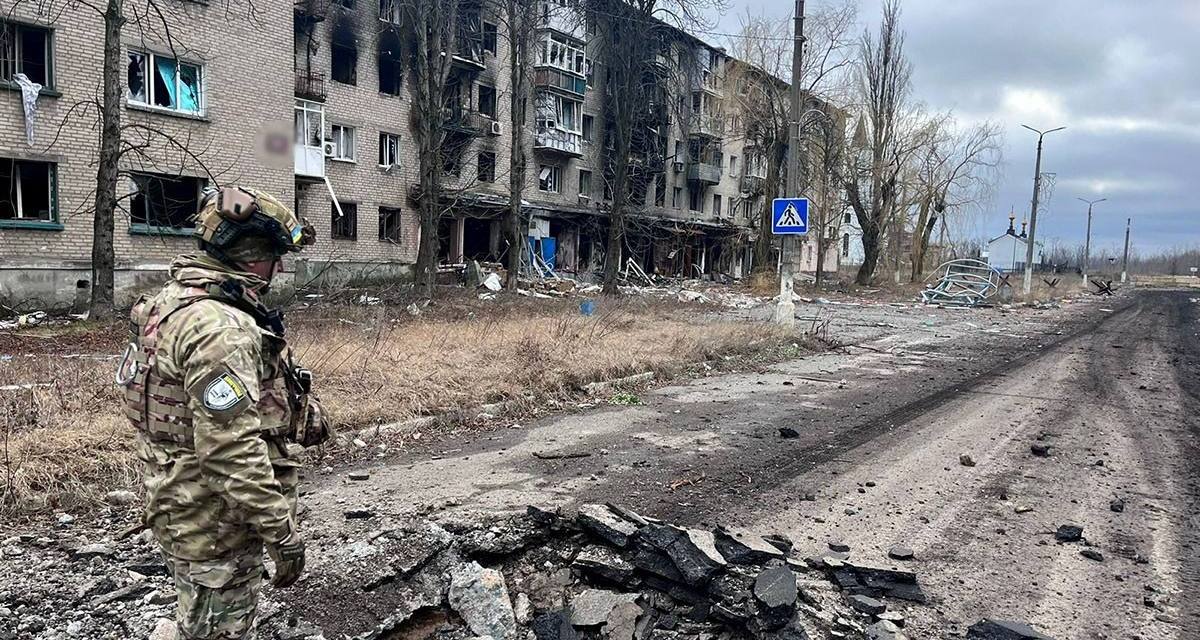
Battlefield 6, the newest big first-person shooter video game, cost $400 million to produce and grossed nearly that much in its first month. The video game industry now dwarfs Hollywood and the Battlefield games are one of its biggest franchises. But in the film world a real first-person shooter is also on offer, made at a fraction of the cost and, unfortunately, earning a fraction of the attention. Filmed almost entirely through the helmet cams of Ukrainian soldiers and by its courageous director, 2000 Meters to Andriivka offers one of the most visceral and haunting portraits of the Ukraine war to date.
After the global success of his 2023 film 20 Days in Mariupol, Ukrainian filmmaker Mstyslav Chernov returned to his country’s front lines to tell a new story. As Ukraine began its heavily telegraphed 2023 counteroffensive, Chernov’s roaming eye alighted on a single platoon from 3rd Assault Brigade, which had been tasked with liberating the ruined village of Andriivka.
To the poor bloody infantry tasked with executing their piece of a much larger operation, the mission was simple: Take ground. Ground is what Chernov gives his viewers from the opening frame, as a high-explosive shell lands just yards from a pair of soldiers in a trench, showering the camera lens in dirt. Their comrades pile in and out of armored personnel carriers, then advance on foot through shell-churned mud one minute, dense brush the next. Though fighting on his native soil, one Ukrainian soldier says, “It’s like landing on a planet where everything is trying to kill you.”
Unmanned systems provide some of the most stunning visuals in the film. A vast cemetery, flags flying over every grave, shifts to a forest of spectral trees, filmed from a drone’s thermal camera. Early on, slow-scrolling drone footage of the forested battlefield lays it out as a green carpet to the objective. Choppier drone videos from later in the battle show only stumps and shell holes, and the soldiers crawling between them.
That particular ground made the assault on Andriivka almost comically straightforward. An extremely narrow strip of forest, flanked on both sides by heavily mined open ground, ran from Ukrainian lines to the Russian-held village. “That damned forest,” Chernov told me during a conversation last month, was no wider than most theaters he has shown the film in. To get to Andriivka from their lines, the platoon had to cover just two thousand meters: a ten-minute run, a two-minute drive, or a thirty-five-second mortar round flight.
Those two thousand meters took them three bloody months. When Andriivka was finally liberated, there was hardly a spot fit to raise a flag. The blue and yellow banner was eventually fixed to a three-sided brick shell. Andriivka is back in Russian hands today.
The soldiers who won this pyrrhic victory are Chernov’s real focus. “Freak,” a native Russian speaker from Myrnohrad in Donetsk Oblast, can’t keep a smile off his face as he banters with the filmmaker during a break in the fighting. He rejects the fatalism common in fighting men. “Sheva” is forty-six, a grandfather and military policeman who left a safe job to volunteer for 3rd Assault Brigade at the beginning of the counteroffensive. He worries about his smoking and his wife and is self-conscious about appearing on camera in his first battle. Both men survived Andriivka. Neither is alive today.
2000 Meters to Andriivka, though, is already a sepia picture of the war in Ukraine. The basic nature of the fighting feels immediately familiar to anyone who has watched modern war, real or fictional, on-screen. Within the tight confines of the forest, Ukrainian and Russian soldiers collide in frenzied, close-quarters combat. Ukrainians taunt and curse the invaders from yards away, then negotiate the surrender of a Russian bunker. A severely wounded friend, bandaged up by his comrades but unable to be immediately evacuated, is threatened: “Don’t even think about blowing yourself up!”
But just thirty months after the documentary was filmed, the proliferation of unmanned systems has dramatically altered the character of frontline combat in Ukraine. Drones, to be sure, are not absent from Chernov’s film. Ukrainians endure a near miss from a Russian first-person-view drone, then are aided by their own remote pilots, eyes constantly overhead, talking soldiers on to target locations and reporting the actions of the Russians they are assaulting.
Today drones do the vast majority of the killing in Ukraine. The largely static trench lines still prompt facile comparisons to World War I, but the instruments of death are very different. According to frontline Ukrainian commanders, traditional infantry combat accounts for as little as 2 percent of Russians killed in action today. Unmanned systems cause at least eighty percent of casualties. To be uncovered in daylight near the front line, on foot or in a vehicle, is to court death. Chernov told me frankly that he would not be able to make the film today. It is already “time stamped.”
Still, despite the millions of drones produced and expended, the man, and sometimes woman, in the mud remains paramount. Ukraine’s theory of victory still rests on the soldiers in the line, but not as assault troops—even if they are still labeled and honored as such. Instead, Ukrainian soldiers are holding ground, dodging Russian strikes while identifying targets for their own drones. The strategy is not to win a war of attrition. There is little hard evidence that Russia is nearing the bottom of the well of expendable rural men that it is feeding into the front lines, even if the price to get them in uniform is rising. Ukraine, though, is coping with a broken mobilization system and a critical shortfall of soldiers. The country’s hope lies in its soldiers holding the line long enough for its campaign of economic punishment to pay dividends, disrupting and destroying enough oil infrastructure to get Russia to accept far different peace terms than the ones it has just proposed.
The film closes with a memorial service, as the platoon commemorates its soldiers killed in the liberation of Andriivka. Unlike in American military memorials, in Ukraine the senior sergeant’s roll call for the dead does not hang in the air. Their comrades pronounce them present, in their hearts and in their memories.
But just seconds before, in the film’s penultimate scene, Chernov himself asks aloud: “What if this war is until the end of our lives?” As dusk gathers in the shattered village, the question goes unanswered.
Author’s note: 2000 Meters to Andriivka premiered Tuesday, November 25, 2025 on PBS FRONTLINE and can be viewed on the PBS FRONTLINE website, the PBS app, Prime Video, YouTube, and PBS stations (check local listings).
Gil Barndollar is a former MWI research fellow, US Marine Corps veteran, and serving National Guardsman.
The views expressed are those of the author and do not reflect the official position of the United States Military Academy, Department of the Army, or Department of Defense.
Image credit: npu.gov.ua

_01.jpg)