Last month, news headlines were dominated by reports that North Korea would supply Russia with thirty thousand troops, ostensibly for an offensive in the fourth summer of Russia’s invasion of Ukraine. Ukrainian intelligence now reports signs of those troops in Russia. In addition to the manpower, the North Koreans arrived with twelve million 152-millimeter artillery rounds for Russia’s arsenal. With these reinforcements’ battlefield appearance reportedly nearing, the question of where and when they will arrive at the front line remains. Will Russian President Vladimir Putin return the troops to the Sumy region, where the initial wave of Pyongyang’s soldiers were decimated by the Ukrainian defensive line? Or does Putin have a more calculated plan in place?
In the fall of 2024, Russia recruited assistance from Pyongyang for its struggling invasion of Ukraine. Frustrated by the lack of permanent progress in the war, Russia turned to an increasingly close ally for over ten thousand troops to assist in the fight. These reinforcements applied added pressure to Ukrainian defenses as they struggled to hold strategic lines against advancing Russian ground forces.
Fast forward to July 6, 2025, when Russian Foreign Minister Sergey Lavrov met with North Korean leader Kim Jong-un again in Wonsan during a three-day visit. While in North Korea, Lavrov also met with his North Korean counterpart, Choe Son-hui. According to the Russian News Agency, TASS, Lavrov was quoted as saying, “Our Korean friends confirmed their firm support for all the objectives of the special military operation, as well as for the actions of the Russian leadership and armed forces. In turn, we once again expressed our sincere gratitude for the contribution of Korean People’s Army servicemen to the successful liberation of the Kursk Region from Ukrainian Nazis and foreign mercenaries.”
Just a few days before Lavrov’s visit, North Korea pledged to triple its military contribution, sending an additional twenty-five thousand to thirty thousand troops to the front lines in Ukraine. These reinforcements are expected to arrive in the coming months. Approximately four thousand of the original ten thousand troops Pyongyang sent have been killed or injured. Ukrainian defense intelligence has reported seeing signs that Russian military aircraft are being refitted to carry personnel, possibly for the task of carrying tens of thousands of foreign troops to the front lines. Moscow is likely paying the impoverished North Koreans a minimum per head for their troops as well as providing North Korea with technology that Pyongyang cannot produce itself.
This drastic escalation of North Koreans’ contribution to the Russian war effort comes at a strategic time. In the past month, Russia launched an unprecedented 728 drones and thirteen ballistic missiles against Kyiv. The attack and Putin’s continued aggressive moves have drawn significant frustration from President Donald Trump, as Russia continues to be uncooperative with the US leader’s insistence on a ceasefire. Moreover, Western leaders likely worry Russia will provide North Korea with sensitive technologies that would enhance North Korea’s nuclear and missile programs in exchange for troops and munitions.
Observers, of course, are looking to identify what North Korea’s troop commitment to Russia’s war comes will mean for the Russian-Ukrainian war.
In June, approximately 640,000 Russian soldiers were actively fighting in Ukraine, an increase of forty thousand over a November 2024 Ukrainian Intelligence estimate. In this ruthless war of drones and attrition, Russia still has an advantage in numbers despite suffering approximately 970,000 troops either killed, captured, wounded, or missing in action since the initial invasion in 2022. An additional thirty thousand North Koreans to the front lines provides Putin with an expendable workforce advantage, timed to exploit the summer’s operational window before winter slows the war again.
Last fall, roughly two of every five North Korean troops were killed or injured under Russian command. With an additional two or three divisions of reinforcements making their way to the front, a massing of troops and major effort by Russia to disrupt the largely static pattern the war has taken on and undertake an advance is anticipated. Likely viewed as expendable, the North Koreans would lead the charge, and the offensive would likely be among the most aggressive yet, preceded by massive missile strikes unseen at this point in the war.
The totality of current circumstances—Putin’s unwillingness to agree to a ceasefire unless it comes with what amounts to a Ukrainian surrender, the largest drone and ballistic missile attack on Kyiv, and now a shipment of thirty thousand North Korean troops—all point to the likelihood that Russia aims to chip away, continuing the war of attrition while also seeking a larger breakthrough than has otherwise been possible, until it wins. Given Kim Jong-un is also likely being rewarded with Russian technology that North Korea could not have built on its own, the door is not closed to further manpower additions. In 2023, North Korea’s army was believed to number around 1,280,000 active personnel, with an additional three million in reserve. With those figures, and a similar—even stronger—view of troops being expendable, further waves of reinforcements in the tens of thousands are not unlikely. Could Ukrainians reclaim and defend their territories before additional Russian offensives in the spring of 2026?
By conventional wisdom, defending territory is less manpower-intensive than launching an offensive campaign, and Ukrainian forces enjoy a commitment imbalance vis-à-vis their Russian opponents by virtue of the imperative of defending their homeland. Viewed through that lens, the introduction of a large new cohort of North Korean troops is likely an effort to simply shift the battlefield calculus. Russia has lost nearly one million people, either killed or injured, while Ukraine has only lost approximately four hundred thousand. According to an Institute for the Study of War report, as of February Russia occupied only 20 percent of Ukrainian territory. The report estimated that it would take Russian forces over eighty-three years to capture the remaining 80 percent of Ukrainian territory at the current rate of advance, and with Russian soldiers being killed or wounded at nearly a 2.5x rate than that of Ukrainian fighters. This is clearly an unacceptable status quo for Putin, one that the Kremlin hopes to change.
Russia’s deepening reliance on a foreign military manpower from North Korea signals its intent to chip away at Ukraine through attrition until it secures victory on its terms. With Putin unwilling to agree to a ceasefire absent Ukrainian surrender, and Kim Jung-un rewarded with advanced Russian technology, the alliance is transactional, brutal, and ultimately very repeatable. Trading future Russian for North Korean casualties will play well domestically. With North Korea absorbing the brunt of the fighting, Moscow can prolong its war effort at a fraction of the political cost. The heavily state-controlled Russian media can boast a sharp decline in domestic casualties even as the summer offensive intensifies, framing the war effort as both successful and sustainable. As the Trump administration continues to seek an end to the war—and despite the hopeful possibility that US pressure could yet bear fruit—both sides continue to prepare for a protracted conflict, especially as kinetic operations primarily come to a pause during the winter. Putin isn’t turning to Kim Jong-un out of desperation, but to apply cheap, sustained pressure on the Ukrainian trenches and to shift the psychological balance. Whether an end to the fighting, or even a pause in it, comes before the arrival of North Korean troops on the front lines remains to be seen. If not, the war could be set for wave after wave of new troops as Russia looks to chip away before winter.
Jared Martin is a US Army veteran and intelligence analyst, supervising a counterintelligence team with the U.S. Department of State. He is pursuing a master of international policy and practice at the George Washington University. His work focuses on geopolitical risk, emerging threats, and modern military strategy, and he was recently featured on BBC News Arabic and writes the American Political Substack.
The views expressed are those of the author and do not reflect the official position of the United States Military Academy, Department of the Army, or Department of Defense.
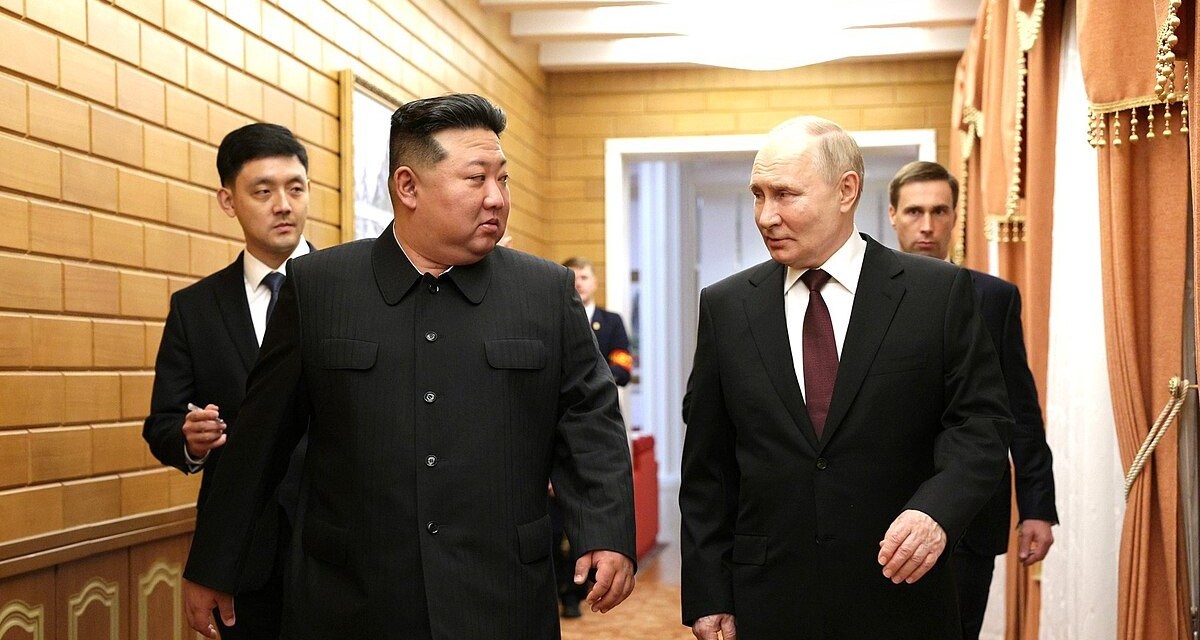
Image credit: kremlin.ru, via Wikimedia Commons