The most important battlefield in the Iran War was not inside Iran at all. The United States and its partners demonstrated that they could strike Iranian targets. Iran demonstrated that it could impose costs in return. Neither outcome was surprising. The more important question is whether technologically accelerated warfare can remain politically controllable when the systems surrounding the battlefield begin to move faster than the political and military leaders responsible for managing them.
Although this conflict has been framed by most observers as a conventional fight, that question goes to the heart of irregular warfare. The Defense Department’s 2025 irregular warfare instruction describes irregular warfare as a form of conflict involving indirect, asymmetric, and coercive activities that can erode an adversary’s legitimacy, influence, and political will while strengthening those of allies and partners. In other words, irregular warfare is not only about destroying enemy forces. It is about shaping the political conditions under which force can be used, sustained, and translated into strategic effect.
The Iran War showed how far that logic has expanded. Irregular warfare is no longer confined to proxy attacks, covert action, terrorism, sabotage, or gray-zone pressure. Those remain central, but they now operate inside a wider strategic environment: commercial shipping, insurance markets, cloud infrastructure, data centers, munitions production queues, fertilizer flows, host-nation confidence, AI-enabled targeting, and alliance allocation politics. The battlefield has expanded into the systems that make military power usable.
The lesson for US planners is not simply that Iran is dangerous or that the Strait of Hormuz matters. Both were already known. The actual lesson is that adversaries do not need to defeat Western forces outright if they can make the surrounding political-economic system absorb unsustainable pain. The Iran War offers ten broader lessons for irregular warfare and strategic competition.
1. Iran lost militarily inside Iran while moving the center of gravity outside Iran.
Iran’s strongest strategy was not to win a conventional military contest against the United States or Israel. It was to make the war harder to contain. Persian Gulf capitals, shipping insurers, energy markets, fertilizer markets, data centers, US allies, and domestic political audiences all became part of the battlefield.
Tehran responded to US and Israeli operations both horizontally and vertically. The Islamic Republic widened the geographic scope of the war while raising the value and sensitivity of targets. Horizontally, this meant expanding pressure across additional geographies and systems, including commercial shipping, energy markets, insurance networks, and regional political relationships. Vertically, it meant placing consequential economic and political interests at risk, thereby raising the potential costs of the conflict far beyond the immediate battlefield. In doing so, Tehran shifted the war away from areas where the United States held clear military advantages and into political, economic, and commercial systems that were more difficult for Washington to control. The Islamic Republic applied this familiar irregular warfare logic at strategic scale. Doing so allowed an adversary that could not otherwise match US military power directly to impose costs horizontally—geographically, economically, and politically. The objective was not necessarily battlefield victory: The Islamic Republic is an endurance regime, built to survive. Thus, the objectives were survival, cost imposition, and the displacement of pressure onto more vulnerable systems. The result was a war that increasingly spilled into commercial shipping, insurance markets, Gulf infrastructure, and other systems beyond the immediate battlefield.
The US planning implication is clear: In a future conflict, the adversary may not need to defeat the joint force. It may only need to make the surrounding system too costly to sustain.
2. The United States had air superiority, but not commercial sea-control superiority.
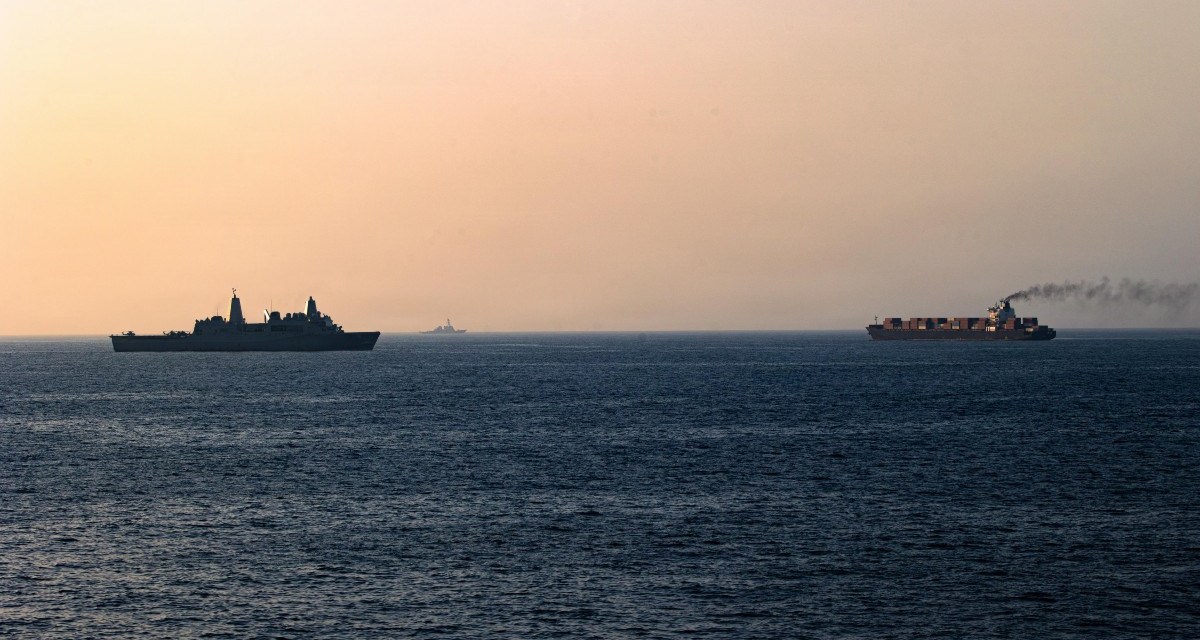
One of the most important Hormuz lessons is that sea control is no longer only a naval question. The United States and its partners may be able to strike military targets at scale, but commercial transit can still become functionally impossible if insurers, shipowners, crews, charterers, and energy markets no longer believe passage is safe.
Within twenty-four hours after the US and Israeli attacks against Iran commenced on February 28, transits of all vessel types through the Strait of Hormuz were down 81 percent compared with February 22. Crude tanker movements fell to just four vessels on March 1, down from a January daily average of twenty-four. By March 12, Kpler vessel-tracking data showed tanker transits had collapsed by approximately 92 percent compared with the week before the war began. Kpler also reported that, as of March 2, approximately 6 percent of global tanker deadweight capacity sat stranded in the Persian Gulf while approximately 22 percent of the global fleet’s capacity sat in the broader Middle East region. The World Trade Organization’s Strait of Hormuz Trade tracker further underscores the chokepoint’s significance: By early March, it recorded outbound trade in crude oil down 95 percent, liquid natural gas down 99 percent, and fertilizer almost completely halted, categories that individually account for roughly 20–33 percent of global volume.
That is a different kind of control. Iran did not need conventional naval superiority to affect behavior in the strait. It needed enough mines, missiles, drones, threats, uncertainty, and demonstrated willingness to raise the perceived cost of transit.
The Houthis demonstrated a related dynamic in the Red Sea after November 2023. Their attacks did not defeat the US Navy, but they forced commercial firms to reroute around the Cape of Good Hope, raised insurance and shipping costs, and showed how a nonstate actor could create strategic effects by manipulating commercial risk rather than winning naval battles. Risk analysts noted that war-risk premiums and shipping risk spiked as Houthi attacks intensified, while shipping companies faced continued uncertainty over whether Red Sea transit would remain commercially viable.
The key question is not only whether the Navy can defeat an opposing fleet. It is whether the United States can make commercial actors believe movement is safe enough to resume. Commercial confidence is now part of sea control.
3. Persian Gulf bases were not the real target; the Gulf economic model was.
Iran’s pressure on the other Persian Gulf littoral states was not only about US-linked military bases. It was about the premise that Gulf states can function as secure, investable, globally connected platforms while living next to Iran. Airfields and ports mattered, but so did airports, desalination facilities, energy infrastructure, cloud services, logistics hubs, and public confidence. In the Persian Gulf, desalination is not background infrastructure; it is a strategic vulnerability. A campaign that threatens power, water, airspace, and ports can affect host-nation confidence even if US forces operating from those states remain tactically capable.
This is a critical irregular warfare lesson. Host-nation resilience is not separate from military operations. It is part of them. A base does not function in isolation from the society, economy, energy grid, water system, and political bargain around it. The 2025 Iranian missile attack on Al Udeid Air Base in Qatar illustrates the point. Qatar intercepted the attack, and US forces avoided catastrophic damage, but the strategic effect was broader than the base itself: The strike placed a host nation, its population, its airspace, and its political relationship with Washington inside the war. Forty-four US soldiers were at the base with roughly two minutes to respond during the attack, underscoring how base defense, host-nation security, and political signaling collapse into the same problem.
For US planners, base defense should be understood more broadly. Protecting a deployment site also means protecting the host-nation systems that allow that site to remain politically and operationally usable.
4. Cloud Geography became campaign geography.
The Iran War highlighted a major shift: Data centers, cloud regions, commercial AI providers, logistics platforms, and software infrastructure are now part of the defended battlespace. They are no longer rear-area civilian background systems. They help enable military operations, financial flows, communications, targeting, logistics, and regional economic confidence.
Open-source reporting supports three levels of escalation against digital infrastructure: rhetorical targeting, threatened targeting, and reported physical strikes. Iranian and Iran-aligned media identified US technology firms—including Google, Microsoft, Palantir, Amazon, Nvidia, and Oracle—as potential targets. These firms maintain offices, data centers, cloud infrastructure, and research facilities across the Middle East, including in the UAE, Israel, and Bahrain. Wired and Euronews also reported threats against US technology companies as the war expanded into infrastructure and cyber domains. The Royal United Services Institute went further, reporting that Iranian strikes affected AWS-linked facilities in the UAE and in Bahrain, illustrating how commercial digital infrastructure increasingly occupies strategic terrain.
This creates a hard problem for the US military. Much of the infrastructure that enables modern operations is privately owned, globally distributed, legally complex, and only partially under military control. The companies involved may not think of themselves as combatants, but adversaries may not grant them that distinction.
The planning implication is that cloud resilience, data sovereignty, cyber defense, commercial dependency mapping, and private-sector coordination are no longer technical support issues. They are operational planning requirements that sit alongside traditional force protection.
5. AI accelerated targeting but also accelerated the legitimacy problem.
The obvious lesson is that AI is being used in war. The more important lesson is that AI compresses military timelines faster than legal, political, intelligence-sharing, and evidentiary systems can adapt.
AI-enabled targeting may help commanders process information and act faster. But speed creates its own strategic risk. Coalition warfare depends on legitimacy, explainability, civilian-harm mitigation, and confidence that targeting decisions are lawful and politically defensible. If the pace of targeting outruns the ability to explain, audit, or justify decisions, operational advantage can become a strategic liability.
Recent debates surrounding AI-assisted targeting in Gaza illustrate the challenge. Much of the controversy centered not on whether AI could accelerate targeting, but on whether military and political leaders could adequately explain how targets were generated, reviewed, and approved. As AI-enabled systems become more common, the legitimacy of the decision-making process may become as strategically important as the speed of the decision itself. Recent legal and humanitarian scholarship has warned that AI-enabled decision-support systems may reshape proportionality assessments, accountability, and the quality of human judgment in targeting. AI governance requires states to build capacity to understand and manage the technology’s consequences, not merely adopt it.
For US planners, the AI question is not only whether the force can target faster. It is whether it can target faster while preserving legal compliance, public legitimacy, civilian-harm mitigation, and political control. In irregular warfare, legitimacy is not a public-relations afterthought. It is part of the contest.
6. Magazine depth became strategy.
The Iran War reinforced a lesson already visible in Ukraine: Munitions are not just military inputs. They are political commitments. Long-range fires, air defense interceptors, and precision weapons are finite resources that must be allocated across theaters, allies, and time horizons.
A Middle East campaign does not happen in isolation. Rebuilding key US missile inventories after the Iran campaign will be a multiyear project, with demand for Tomahawk, THAAD, and Patriot intersecting with Ukraine, Indo-Pacific planning, Gulf partner reassurance, and US homeland defense requirements. The United States may need three or more years to restore several critical weapons systems to prewar levels.
This is not just a procurement or political issue. It is a strategic vulnerability. A Middle East campaign affects the Western Pacific. Support to Ukraine affects air defense availability elsewhere. Gulf partner reassurance competes with US homeland and theater requirements. When multiple theaters are active or at risk, every interceptor becomes a political decision.
The strategic implication is straightforward: Munitions planning is now strategy. The United States needs clearer precrisis mechanisms for deciding how to allocate scarce interceptors, long-range fires, and air defense systems when several theaters demand them simultaneously.
7. The hidden coercive weapon was fertilizer.
Oil was the obvious pressure point. Fertilizer was less obvious but potentially more politically explosive over time.
The World Trade Organization’s Hormuz Tracker follows fertilizer-related products, including sulfur and ammonia, through the strait alongside crude oil, natural gas, and agricultural goods. That matters because disruption to fertilizer flows can move quickly from maritime security to food prices, food insecurity, humanitarian need, migration pressure, and diplomatic alignment in the Global South.
This is exactly the kind of second- and third-order pressure that irregular warfare exploits. An adversary may not need to create a battlefield defeat if it can generate cascading political costs through food, energy, insurance, and supply-chain systems.
The US planning implication is that the next energy crisis may not present primarily as an energy crisis. It may present as food inflation, agricultural instability, humanitarian demand, political unrest, or diplomatic erosion outside the immediate theater. Those dynamics belong in strategic planning, not only in economics ministries.
8. Reconstitution, not destruction, set the strategic clock.
Battle damage is only the first clock. The more important clocks are repair, replacement, retraining, rerouting, insurance normalization, industrial backfill, and political recovery. This matters because adversaries can exploit the gap between battlefield success and system recovery. A target may be destroyed in minutes but take months or years to replace. A shipping route may reopen formally but remain commercially unattractive. An air defense system may perform effectively in combat even as replacing the interceptors it expends takes months or years. A damaged energy facility may require contractors, parts, and equipment already committed elsewhere.
The 2019 attack on Saudi Aramco’s Abqaiq oil-processing facility illustrates the point. Although oil production recovered more quickly than many analysts initially expected, the attack highlighted how strategic effects extend beyond physical damage to questions of repair capacity, insurance, investor confidence, spare-part availability, and long-term resilience. Recovery, not destruction alone, determines how long uncertainty persists and how quickly confidence returns.
The munitions example provides a contemporary illustration. If US weapons inventories take years to restore, then the operational success of a strike campaign can still create a postwar vulnerability window. The same logic applies to ports, energy infrastructure, cloud facilities, air defense systems, and commercial shipping networks.
For US planners, battle damage assessment should include a broader question: How long until the system works again, and what other global supply chains must be cannibalized to repair it?
9. War termination became a portfolio settlement, not a ceasefire.
A simple ceasefire does not end this kind of war. Once conflict spreads across nuclear issues, maritime access, sanctions, frozen assets, Persian Gulf security, Israeli priorities, Hezbollah, Iraqi militias, energy markets, and domestic political narratives, termination becomes a portfolio problem. Reopening Hormuz will ease global energy markets, but it will not automatically resolve issues of enrichment, missiles, proxy activities, sanctions, Gulf economic security, or competing regional narratives.
This is another irregular warfare lesson. The fighting may stop before the coercive systems stop. Markets may not normalize. Enrichment questions may remain unresolved. Regional actors may interpret the outcome differently. Each party may claim victory while preparing the next phase. Armed networks may also retain their own incentives, domestic constituencies, command relationships, and escalation ladders even if Washington and Tehran reach a formal pause.
The broader lesson is that war termination cannot be treated as a diplomatic afterthought. It has to account not only for state-to-state bargaining, but also for proxy networks, commercial recovery, maritime access, sanctions relief, and competing victory narratives. Operational planning needs a war-termination cell from day one, because military action can create bargaining problems that no one is prepared to solve later.
10. The war accelerated both learning networks—the friendly and the adversarial one.
Every modern conflict is now a rapidly distributed learning event. Lessons spread far beyond the belligerents themselves. Ukraine, Gulf states, Israel, Iran, Russia, China, North Korea, private technology firms, militias, insurers, and logistics companies all absorb lessons at different speeds. This may be the most important point for US planners. The US military often learns through formal doctrine, procurement cycles, exercises, after-action reviews, and lessons-learned processes. Adversaries and private actors may learn faster. They copy tactics, adapt commercially available technologies, test thresholds, and circulate knowledge through looser networks.
Ukraine’s battlefield adaptation offers the clearest example: Cheap drones, counterdrone systems, electronic warfare, mobile air defense, and rapid software updates have evolved in weeks or months rather than on traditional acquisition cycle timelines. That is the benchmark against which US learning systems are now being judged. Iran, Russia, China, North Korea, and nonstate actors are also watching and adapting. So are insurers, shipping firms, cloud providers, and defense technology companies.
For the United States, the question is not whether the national security community is learning. It is whether it can learn as fast as the ecosystem around it.

The Iran War did not mainly teach us that Iran is dangerous or that Hormuz matters. It taught us that modern war runs through hidden systems: insurance markets, cloud regions, fertilizer flows, missile-production queues, host-nation confidence, commercial shipping decisions, AI audit trails, and alliance allocation politics. Airpower can dominate the target deck and still leave the strategic system contested. That is the core irregular warfare lesson.
The central challenge for the United States is therefore not only how to strike, defend, deter, or reassure. It is how to maintain strategic control when adversaries can impose costs through systems that sit outside the traditional battlefield but inside the political logic of war. Modern irregular warfare contests the conditions under which military power remains usable.
The planning implications are concrete. US campaign design should map commercial dependencies before a crisis, not after one begins. Base defense should include host-nation infrastructure, public confidence, and continuity of essential services. Maritime planning should measure commercial confidence, insurance behavior, and shipping decisions alongside traditional naval metrics. AI-enabled targeting should be paired with auditability, civilian-harm mitigation, and explainability mechanisms that can survive coalition and public scrutiny. Munitions planning should include precrisis allocation rules across theaters. Finally, war termination planning should begin at campaign design, because the coercive systems activated by irregular warfare rarely stop when the shooting pauses.
The side that understands those systems fastest may not win every battle, but it may control the strategic outcome.
Neda Bolourchi, JD, PhD is a Middle East historian and national security, law, and policy advisor whose work focuses on strategic competition, emerging technologies, and regional security. She writes on the intersection of conflict, political control, and military strategy.
The views expressed are those of the author and do not reflect the official position of the United States Military Academy, Department of the Army, or Department of Defense.
Image credit: US Navy