
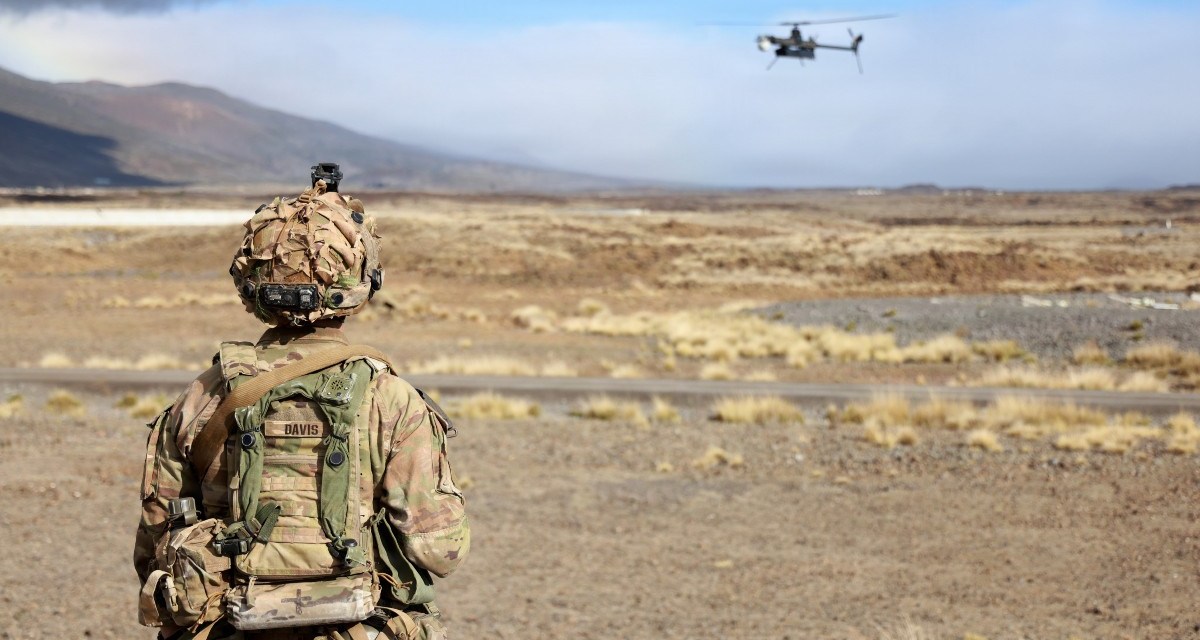
In the ongoing Russo-Ukrainian War, drones now define the conflict—from the ubiquitous small commercial reconnaissance quadcopter drones that give units down to the squad level persistent situational awareness to the relentless strikes by first-person-view and bomber drones that have rendered massing for ground attacks suicidal and created a kilometers-wide gray zone where concealment and dispersion are critical to survival. Both sides use drones for command and control, both for ground units and as relay links to other drones. Long-range one-way attack drones conduct deep strikes against strategic targets, and both sides are fielding kinetic drone interceptors to stop them. On the ground, drones emplace minefields, deliver supplies, and even evacuate the wounded.
The proliferation and lethality of drones have driven a ruthless cat-and-mouse cycle of adaptation in electronic warfare defenses and GPS jamming, countered by creative command-and-control links through drone retransmission, controlled reception pattern antennas, civilian satellite communications and cell phone receivers, and fiber-optic control. To give a sense of the speed of this cycle, fiber-optic drones were something of a novelty in 2024, seen occasionally in open-source intelligence reporting. By 2025, Russian production of just one model of fiber-optic drone, the Vandal, reached at least six thousand units per month, enabling strikes across the 1,600-kilometer front line.
Beyond technological innovation, organizational changes are happening too. Ukraine has created a separate service branch, the Unmanned Systems Forces, and separate tactical drone strike and reconnaissance units from the platoon to regimental level. During my time at Security Assistance Group–Ukraine, I have been fortunate to be able to witness the prevalence and variety of drone operations and observe the constant reciprocal adaptations driving technological and organizational changes.
Clearly, as the Russo-Ukrainian War has demonstrated, drones are changing the character of warfare. In the face of this change, the key question for the US Army is how best to integrate emerging drone technologies into its formations and operations. The question is not without historical precedent—the introduction of the tank drove a similar change in the character of warfare and a similar imperative to optimize their employment. If we use history as a guide, we should treat unmanned systems as a critical addition to the combined arms team, not as either a technological silver bullet or a simple toy to bolt on to the existing force. By considering the examples of French and German integration of tanks into their militaries between 1918 and 1940, three lessons stand out, which should inform US Army drone integration: focused institutional energy must be directed to studying the lessons of the Russo-Ukrainian conflict to feed doctrinal updates; a separate unmanned systems branch of the Army should be established; and immediate, rigorous, and continuous experimentation should be devoted to creating new drone-enabled formations.
Tanks and the Interwar Period
At the end of World War I, nations were working to digest the lessons recently learned at immense cost and incorporate them into their armies. The French War College focused narrowly on learning from the more successful French campaigns of 1918 and concluded that only the massive application of firepower could secure freedom of maneuver, which would require tight coordination and synchronization of arms with precise command and control. The resulting doctrine was known as “methodical battle.” In this system, the tank was not an independent arm, but a firepower delivery system. The 1918 manual “Provisional Instruction on the Employment of Tanks as Infantry Weapons” first codified this vision of the tank as a fire support platform for the infantry, concluding that tanks cannot hold terrain and therefore must enable the infantry. A 1921 French manual on the tactical employment of large units stated that the tank was “designed to augment the offensive power of the infantry.” French military organization also reflected the firepower-centric view, with the French Army’s artillery directorate responsible for tank development until 1928, at which point it transferred to the infantry directorate. In 1929, the doctrinal publication “Instructions for the Use of Combat Tanks” solidified the role of the tank as infantry support fixed firmly within the methodical battle framework. France was not against technological innovation, but its doctrine constrained its ability to conceive the full possibilities of the tank.
After Germany regained the industrial Rhineland territories in 1930, France knew this implied German rearmament and began building extensive fortifications to protect its own industrial heartland. Fortification along the Belgian border was not politically feasible, since building forts behind Belgium would communicate that France was leaving its ally to fend for itself. Instead, France decided to motorize five divisions that would be able to react quickly to any crisis in that direction. However, once they arrived, they were still bound by the same methodical battle doctrine that limited all operational planning to the rate of advance of dismounted infantry supported by artillery.
There were patches of innovation, though. French leadership realized that this motorized force required an equally mobile cavalry formation to conduct reconnaissance and security ahead of it, and after experimentation, France created the 1st Light Mechanized Division (1st DLM, Division Legere Mecanique) for this purpose in 1933, along with the first prototype scout cars. This in turn drove the publication of France’s first motorized cavalry doctrine in 1935, which asserted that armored and motorized units could now perform traditional cavalry roles. Unfortunately, this was not enough to break armored units free from the orbit of methodical battle, as the pace of the infantry formations the DLM was screening for still set its tempo. Additionally, the 1936 doctrinal update for the tactical employment of large units still stated that the main function of the tank was to support the infantry advance. This update did, however, take the incremental step of mentioning the possibility that there might be times when tanks could operate independently.
It was not until 1937 when French leadership began seriously discussing armored divisions, after a successful field exercise of 1st DLM against a replicated German panzer division. In 1938, France drafted a concept for a heavier armored division called the division cuirassee (DCR). Unfortunately, the organization stayed on paper until the German invasion of Poland in September 1939 generated a sudden sense of urgency. The first and second DCRs formed on January 16, 1940, and the third DCR formed two months later, on March 20. While they bore many similarities to the German panzer divisions, they formed up only a few months before war came to France. The DCRs tragically demonstrated the outcome of insufficient time to form, train, experiment, and improve when time ran out and Germany invaded France on May 10, 1940.
France’s rapid defeat at the hands of the German Army, spearheaded by the panzer divisions, was not as simple as France having inferior equipment or technology. Ironically, as Williamson Murray puts it, the French “put considerable effort into developing the tank as a weapon; in 1940 they possessed more tanks than the Germans, and some of their tanks were superior. . . . But since French armored development occurred within a doctrinal straitjacket that aimed at maximum control over operations, the French failed to see the tank’s potential.” This failure to see the tank’s potential was at heart a failure of imagination. As demonstrated above, the French could only imagine the tank as an addition to their existing army, to support that army in the method of battle it wanted to fight and was designed to fight. Simply, France did not allow the tank to reshape its core doctrine.
Germany was also dedicated to learning the lessons of World War I. Its effort to do so was an exhaustive, thorough one involving fifty-seven committees comprised of four hundred officers (10 percent of Germany’s postwar officer corps), and directed by the army’s senior leadership, General Hans von Seeckt. The critical difference from the French was the questions he wanted answers to: “a) What new situations arose in the war that had not been considered before? b) How effective were [Germany’s] prewar views in dealing with the above situations? c) What new guidelines have been developed from the use of new weaponry in the war? [And] d) which new problems put forward by the war have not yet found a solution?” The committees’ answers to these questions resulted in a doctrinal foundation that emphasized maneuver, offensive mindset, decentralized operations, and junior leader judgment calls and initiative. The German Army published the results as Army Regulation 487, “Leadership and Battle with Combined Arms” in 1921. Importantly, the doctrine did not fixate on the tank itself, but combined arms to enable a war of movement, with the tank as an enabler. This was the doctrinal environment that German tank development and broader mechanization occurred in, allowing for relatively free experimentation within a combined arms framework.
The next developments were driven by General Oswald Lutz, inspector of the German Army’s motorized troops. His key insight, after exercises in 1931 and 1932, was to approach the problem of tank integration by flipping its terms: Instead of limiting tanks to the speed of the infantry, why not make the infantry faster? This was the genesis of the concept of mechanized infantry that could move and, more importantly, fight at the tempo of an armored formation. Following further field experiments with armored vehicles in 1932–1933, Lutz proposed the formation of a panzer division, and that panzer troops should be an independent arm like infantry or artillery. These proposals were far ahead of the equipment available; the armored vehicles in the experiment were mostly placeholders. Similarly, the German Army’s doctrine wrote ahead of its fielded equipment based on both its own experimentation and observation of foreign exercises. The 1933 publication of the doctrinal manual “Unit Command” (Truppenführung) stated that sticking too closely to the infantry “reduces the advantage of the speed of the armored vehicles,” and that “the senior commander synchronizes the combat operations of the armored vehicles with the coordination of the other arms. The deployment of the other arms should conform to the operational requirements of the armored vehicles.” This went to print at a time when the German Army did not possess a single tank within its borders.
In July 1934, Germany officially established the Armored Troops (Panzertruppe) Command, and in October 1935, it formed the first three panzer divisions and began exercises with them, despite still incomplete equipment. In 1936, a former signal officer who jumped to tanks, Heinz Guderian, advocated for putting radios in all vehicles of the panzer division as exercises revealed the complexity of coordinating rapidly moving combined arms attacks. The first exercise with a fully equipped panzer division occurred in the Mecklenburg training area in fall of 1937 with stunning results against a traditional infantry division, validating many of Germany’s operating concepts. The invasion of Poland in September 1939 was the first true combat test of the panzer division. While the campaign was a success, German after-action reviews discovered that logistical reach of the new formations was a key shortcoming. The reviews also identified deficiencies in doctrine, training, and materiel. By the time the panzer divisions again entered combat in May 1940 against France, they had experienced multiple cycles of experimentation, review, and refinement.
Overall, the German incorporation of the tank succeeded because it developed within an experience-informed doctrinal framework whose core principles of maneuver, initiative, and decentralized operations allowed for the creation of mechanized combined arms formations that maximized the tanks’ strengths. This is a critical distinction from centering on the technology of the tank itself and attempting to build the army on top of it.
The willingness of German leadership to rapidly test and refine experimental units in the field also resulted in far more available time to hone the concept in comparison to the French, who wasted valuable years before approving armored divisions of their own. The integration of other new technologies such as the radio served as a force multiplier for the formations. And crucially, creating a separate branch within the army for armored troops circumvented much of the parochial infighting seen in France over which branch would own them, allowing them to develop quickly and independently but still in cooperation with the other arms. Essentially, Germany applied the technology of armored vehicles to the principles of doctrine born from thorough study of lessons from the last war, and was willing to build new types of combined arms teams that brought the other arms up to the tanks’ offensive tempo.
Marc Bloch, a French historian and World War I veteran recalled to active service for the new war, perhaps best summed up the results: “Our own rate of progress was too slow and our minds were too inelastic for us to ever admit the possibility that the enemy might move with the speed which he actually achieved.”
A Path for Drone Integration in the US Army
Like the advent of the tank at the end of World War I, the United States, its allies, and its adversaries have grasped the significance of drone technology and are watching the war in Ukraine, all trying to gain an edge for their future forces. How, then, can the US Army successfully integrate drone technology ahead of our rivals?
First, at the foundational level, the Army must ask the right questions to learn the right lessons. The war in Ukraine is currently at a stalemate, and the explosive development of drones has not broken it. However, there is much to learn. Like von Seeckt, we should be dedicating our institutional time and effort to discover what new situations this war provides that we do not currently account for, how effective existing equipment and methods have been in these situations, what new tactics, techniques, and procedures have developed to fill the gaps, and what problems remain unsolved. We then must allow the answers to inform rewriting of our existing doctrine where needed. This will broaden our horizons beyond either fixating on unmanned systems as a standalone panacea or confining them to our existing doctrine and organizations, and it will help guide the inclusion of drones as another valuable component of the combined arms team.
Downstream from this, the Army should make unmanned systems an independent branch on an equal footing with infantry, armor, artillery, and the rest. This will circumvent the branch infighting that plagued tank development in many nations between the world wars and prevent viewing drones only through the lens of the branch that ends up owning them. Like the infant tanks in 1918, there are few leaders with the technical background to fully grasp the range of possibilities for drones beyond their own training and experience. Making unmanned systems independent would allow more rapid, unconstrained, and innovative development that incorporates the best of each branch background.
Finally, the Army should rigorously and frequently conduct field experiments with combined arms drone formations. The transformation in contact model provides a solid framework for evaluating and disseminating experimentation results. This step is the key to achieving true integration, where the Army can refine the theory of drones as a combined arm through experimental formations and collision with real-world friction. To truly learn the right lessons, the training facilities used for testing must be able to accommodate the airspace, electronic warfare jamming, and other considerations needed. Like discovering the need for radios to coordinate armored maneuver, this process will uncover unforeseen issues and drive improvements and innovations.
Fortunately, the US Army is starting this race with key advantages: It has a strong doctrinal tradition of combined arms and independent action, vast training ranges to host experimentation, and technologically astute soldiers and leaders. However, the Army will waste these advantages if we do not take institutional action in time. Our adversaries are also racing, and we do not know when time will run out.
Major Eric Johnson is a field artillery officer with the 56th Theater Multi-Domain Command in Wiesbaden, Germany currently serving as the fire support coordinator. Recently, he served with Security Assistance Group–Ukraine from 2024 to 2025 as an operational fires advisor. He holds an MS in operational studies, and his previous operational deployment experience includes Iraq, INDOPACOM, and EUCOM.
The views expressed are those of the author and do not reflect the official position of the United States Military Academy, Department of the Army, or Department of Defense.
Image credit: Pfc. Jose Nunez, US Army