Lord of the Flies premiered on television this year, a four-part BBC adaptation that aired in February and hit Netflix in May to reviews far kinder than anything the boys extend each other. The series keeps faith with what William Golding penned—and frankly propagandized—in 1954: Leave boys without authority and they will tear each other apart. Golding served through the war in the Royal Navy, D-Day included, and he presented the novel as a report on what those years taught him. Anyone who came through them without understanding “that man produces evil as a bee produces honey,” he wrote later, had been blind or wrong in the head. His biographer found the queasier detail. As a schoolmaster after the war, Golding once split his pupils into rival gangs on a field trip to an Iron Age fort and let them go at each other to see what boys would do. The book is that experiment, rerun with a plot and no chaperone. I had my obligatory read as a high school junior, and the assignment worked on us as a teenage catechism: This is what waits underneath a person once the adults are gone.
There is competing data on the other side of that proposition. In June 1965, six boys from a boarding school in Tonga borrowed a fishing boat (borrowed in the sense that its owner did not know), got caught in a storm, and washed up on ’Ata, an uninhabited rock in the South Pacific. They were there fifteen months. They kept a signal fire going for more than a year, planted a garden, stored rainwater in hollowed tree trunks, and worked a strict roster in teams of two: garden, kitchen, guard. When two of them quarreled, the standing rule sent them to opposite ends of the island until they cooled off. One boy slipped off a cliff and broke his leg; the others climbed down for him, setting the leg with sticks and leaves, and it healed straight. The Australian captain who found them in September 1966 brought home six healthy young men. Rutger Bregman dug the story out of old newspapers and a reunion tape for his 2019 book Humankind and offered it as the answer to Golding.
My second reading of Golding happened at Fort Benning, about ten years ago. I had reported for basic training and was rereading Lord of the Flies—slim pickings at the PX. The counterstory reached me years later, when Bregman surfaced it, and it went off like a delayed fuze: Eighteen months of training I thought I understood rearranged themselves around a question nobody in that time had asked out loud. What do we believe people fundamentally are, and what is that belief doing to the way we lead?
My first sergeant had a category for a question like that. He called it a no sh*t statement, and if you said something he judged self-evident, he handed it straight back to you. I admired the man and still do. But obvious is not the same as seen, and it is nowhere near understood. As a platoon leader I gave my squad leaders long leashes, and most weeks they made me look like a genius, which takes a lot of doing. A friend of mine ran his platoon prescriptively, down to the packing list, and his platoon performed too. “No sh*t, sir: different leaders, different styles.” Roger, First Sergeant. Except the difference between us was never technique. We were acting on different theories of what a soldier is, mine closer to ’Ata, his closer to the island Golding invented, and no course either of us ever sat through asked us to state the theory, much less defend it.
The Army has run that experiment at scale. George McClellan built the Army of the Potomac into a beautiful machine after Bull Run and then could not bring himself to risk it. On the eve of Antietam he told Washington he faced a rebel army of “not less than 120,000 men”; the real figure was closer to a third of that. The number came from Pinkerton’s agents, and nobody in the headquarters audited it, because it confirmed what the commander already believed. Five weeks after Antietam the army had barely stirred, Lee was refitting across the Potomac, and Lincoln’s patience gave out in a telegram: He had just read McClellan’s dispatch about sore-tongued and fatigued horses, and would the general pardon him for asking what the horses of his army had done since the battle of Antietam that fatigue anything. Eighteen months later, Ulysses S. Grant, newly general-in-chief, wrote William T. Sherman, then commanding the western armies, that he would not lay down a plan of campaign for him, only the work to be done. Grant could write that letter because the account was already settled by two years of watching Sherman deliver from Shiloh to Chattanooga. A year and five days after the letter, Lee surrendered at Appomattox.
Here is the thing I keep pointing at in my professional military education, so far to not great effect: Every officer carries a working theory of what people are like under pressure, covering her own soldiers, the enemy, and the partner force down the road when there is one. The theory decides how much decision authority she pushes down, and it colors every assessment of enemy intent that goes out over her signature. Professional military education trains doctrine and it trains ethics, and it leaves this layer alone, so the layer runs on default. It takes its shape based on temperament, mostly, plus the last hard training rotation or deployment—and the rotation is less a teacher than a Rorschach test. Two officers come home from the same deployment carrying opposite convictions about people, because what an experience teaches depends on what its student was prepared to see.
The gloomy half of the argument has a pedigree. Thomas Hobbes wrote Leviathan with the English Civil War at his back, and his claim was that without a sovereign holding force over everyone, life slides into a war of all against all: solitary, poor, nasty, brutish, and short. Golding’s island stages Hobbes with schoolboys, the conch shell standing in for the sovereign: whoever holds it has the floor, the assumbly holds while the rule holds, and the real killing starts once the shell is smashed. A battalion commander who believes, somewhere below the level of speech, that people drift without supervision is running the same model at battalion scale. He pulls decisions up the chain and adds a back brief, then another, because tight feels diligent. The formation under him reads the same behavior as distrust and adjusts to it: Initiative dries up first, then candor. He may even be right; some formations, in some months, need the tight rein, and plenty besides belief pulls decisions upward anyway, career risk and lawyers among them. He is still running a bet about people: a working model of what a human being is, sitting underneath the standard operating procedures, deciding which reports he trusts and which he reads twice.
Mission command cuts against that instinct. Army Doctrine Publication 6-0, Command and Control turns on disciplined initiative within the commander’s intent, and the assumption underneath is that a subordinate given room will mostly use the room well. The lineage is practical: The Prussian general staff built Auftragstaktik because armies had outgrown any single commander’s voice. John Locke had already made the deeper argument against Hobbes in his Second Treatise: People can reason, self-govern, and keep their word with no sovereign standing over them. Our doctrine never cites him, but strip it to its load-bearing assumption and the rhyme is hard to miss. Put plainly, my bias is that inside our formations, the Lockean bet is usually the better one. The same test applies to me. Show me a few years of survey data where the tight rein outperforms, or my squad leaders were pitbulls more than retrievers, and I likely rethink my position. Mission command has been doctrine for decades, and command climates that smother it keep appearing anyway. I doubt another reading of the manual is the missing piece.
To be fair to the Hobbesians, control has won real wars. Bernard Montgomery scripted set-piece battles down to the barrage timetable and won them, and a low-trust conscript force may answer to nothing else. The bet gets made either way; what separates commanders is whether they know they are making it. And the terms keep tilting: A force that fights across more domains and specialties than any one commander can master has to borrow judgment from the edge of the formation, a case students of complex systems have made for a generation and a former commander of Joint Special Operations Command relearned in Iraq against a networked enemy.
Part of my Army time is on the intelligence side, where an officer’s theory of people gets typed up and signed. An analyst who believes force is the only language the other side hears reads every signal of restraint as weakness or a trick, and recommends pressure. His counterpart, sure she is watching a calculating actor, spends the same afternoon hunting for the off-ramp. Daniel Kahneman catalogued the mechanics of this split in a short piece on why hawks tend to win the argument: We attribute an adversary’s conduct to his nature and our own to our circumstances, and our optimism runs hottest exactly when it should not. Analysts get plenty right where the evidence is thick—equipment counts, movement timelines, the location of the artillery. The prior does its damage one level down, at intent, where the evidence thins and a theory of the man across the table fills the space.
Doctrine itself splits the enemy picture into what he can do and what he means to do, and the two halves get built differently. A staff briefs enemy capabilities with real rigor: order of battle, ranges, sustainment math. The intent assessment, one paragraph over, is careful guesswork. I have written that paragraph, and the guesswork runs on the assessor’s standing theory of what people do when they are frightened, cornered, or winning. The most expensive recent version of the problem did not even involve an enemy. The Afghan security forces stood at some three hundred thousand on paper in the summer of 2021, and the withdrawal plan leaned on an assessment of what those men would do once the Americans left. SIGAR’s postmortem on the collapse reads mostly as a study of morale and cohesion, and of the conviction after Doha that the future had already been traded away. We briefed that force in numbers. What those men would actually do never got its own slide.
Rule by fear has also been tested outside the seminar room. Primatologists who spent decades with chimpanzee colonies found that the alpha who rules through raw intimidation gets deposed, reliably, by two weaker rivals who learn to cooperate, and the Army’s own leadership surveys keep arriving in the same neighborhood: Counterproductive leaders corrode trust and retention in the units they run, year after year in the data. Bregman’s larger claim is that cooperation is the species’ superpower, and that a person who has never once been taken advantage of is probably not trusting enough to get its full use. In this profession the objection writes itself: Some of the people across the wire genuinely want to kill us. True, and it locates where the anthropology applies. The generous prior belongs inside your own formation and in your reads of intent, where the evidence backs it. Contact is a different problem; you can believe cooperation built the species and still return fire. What you cannot do coherently is run your own battalion on a theory built for enemies.
If I had to guess at why we never inspect this layer, and it is only a guess, I would say politeness. A colonel’s beliefs about human nature feel like her private property, closer to her religion than to her staff work, and questioning them feels like questioning the person. But we hand young officers authority over other people’s lives on the strength of exactly those beliefs, which makes them operating assumptions, and expertise offers no immunity from holding them badly; the stronger the reasoner, the more confidently he finds his prior in the data.
The ’Ata boys, for their part, are a data point on what a small group does when the chain of command is a swamped fishing boat at the bottom of the Pacific. Log the caveats honestly, because they are real: six classmates from one school, same faith, same culture, a long way from Golding’s assorted strangers, and no single case builds doctrine. Anecdotes can be cherry-picked forever, which is fair. So how does a staff handle evidence that can force-fit to prove our priors? It keeps a record, duh! When a course of action comes around for the fourth time, some major at the table says, “Sir, this one has been frustrated three times running, here is the record.” The line lands because somebody kept the record, and a ledger is what turns dueling anecdotes into a track record. Beliefs about people can be kept in one just as easily as schemes of maneuver. The officer who trusts nobody because he read Golding at sixteen owes his ledger an entry for ’Ata, and entries for every partner platoon that held and every source who showed up when he said he would. The account runs both ways; the entries that cut against the generous prior belong on the page too.
None of this requires a philosophy seminar in Annex B. The discipline is narrower and cheaper: Name the belief, then treat it the way the profession already treats terrain and weather. Mission analysis already forces a staff to write its assumptions down. “The partner force will hold.” “The population will cooperate with us.” “He folds under sustained pressure.” Those are beliefs about human beings, and they belong on the list explicitly, each with the indicator that would show it failing (desertion reporting, pay delivery, whether the partner battalion’s officers sleep inside the same compound as their men) and a decision point hanging on the indicator—the same treatment we already give a bridge classification or a weather window.
Any assessment of what an adversary intends to do should be able to answer the question, What would change your mind? If the honest answer is nothing, then what the commander is being handed is a conviction with formatting, and he should know it. The intelligence community has already built the tool: After Iraq, the key assumptions check went into standard analytic tradecraft, and a decade of forecasting tournaments keeps finding that people who state falsifiable views and update them beat credentialed experts who do not. The tool has simply never been aimed at beliefs about people.
The schoolhouse version costs almost nothing. Somewhere at the career course, an officer should have to write one paragraph stating what she believes people do under pressure, then defend the paragraph with ’Ata and Golding both on the table. Career courses already make officers write a leadership philosophy; this is the missing first page of it. Other professions run the drill without embarrassment; medicine makes its residents rehearse their failures out loud at morbidity and mortality conference. Most officers have never once been asked. Nobody asked me either, for what it’s worth. The officer who waves the exercise off has usually been running on default longer than anyone has noticed, including her.
Over a career, the theory of human nature an officer never examines quietly becomes her command style and her threat picture. The ’Ata question, what do people do when the structure comes off, is one she is already answering with every delegation withheld and every intent paragraph signed. So answer it on paper. Write the belief down, hand it to the people paid to argue with you, and keep the account: which assumptions about people held this rotation, which folded, what the record does to next year’s paragraph. The boys with the signal fire go into the ledger as one entry among many, weighed like the rest of the evidence. The whole apparatus costs a page and a habit. And the next time somebody in the room reaches for Golding to justify the short leash, the officer who kept her books can reach for the record.
Ted Delicath is a military intelligence captain in the US Army Reserve. His writing has appeared in Small Wars Journal and From the Green Notebook.
The views expressed are those of the author and do not reflect the official position of the United States Military Academy, Department of the Army, or Department of Defense.
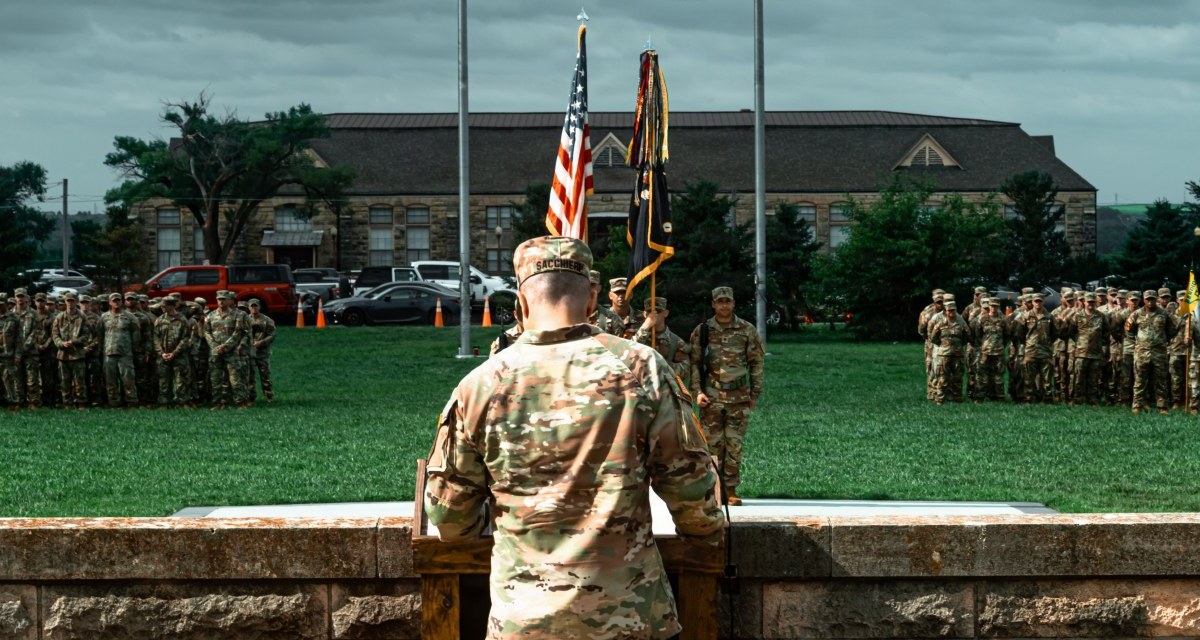
Image credit: Sgt. Chase Murray, US Army