
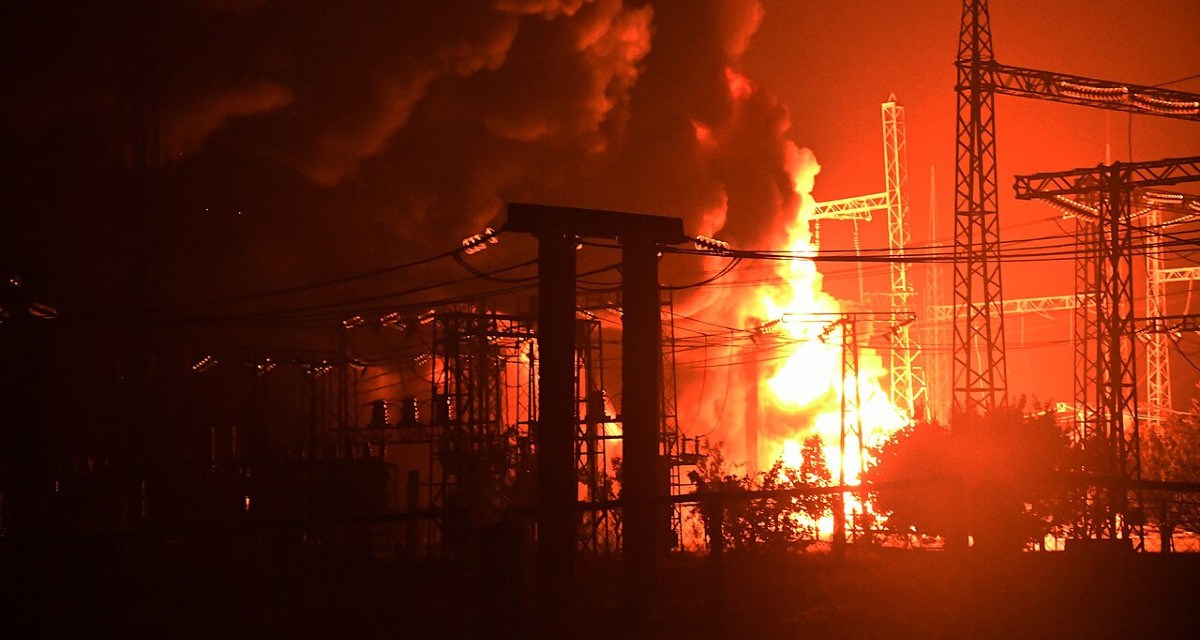
One of the biggest marvels of the twentieth century has been the centralized power grid. Increasingly, it is also a major vulnerability in modern warfare. Since October 2022, Russia has systematically attacked Ukraine’s grid, in effect making it a world laboratory for energy warfare. What Ukraine has experienced, and what the 2026 Iran War confirmed, is that the economics of precision strikes have permanently shifted the balance between attacker and defender. Legacy grids are structurally unable to survive this shift, making it essential to rethink what a defensible energy architecture would require.
From Disruption to Destruction: The Anatomy of Energy Warfare
Russian strikes on Ukraine’s grid are not opportunistic. They flow directly from established Russian military thinking, which for more than twenty years has specifically conceptualized a category of “strategic operation to destroy critically important targets” (SODCIT). The goal of SODCIT is to use massed, long-range precision strikes to paralyze the critical infrastructure of an opponent and thereby compel political capitulation without needing a battlefield breakthrough.
Moscow’s application of SODCIT against Ukraine evolved through two calculated phases. The first phase (from October 2022 to the winter of 2023–24) was focused on grid disruption. Russia initially targeted high-voltage substations, autotransformers, and transmission nodes. The objective was to fracture the distribution lines connecting power plants to cities. However, transmission networks are inherently redundant. Ukrainian engineers adapted, bypassing destroyed nodes and cannibalizing damaged equipment for spare parts to keep the power flowing.
The second phase (beginning in the spring of 2024) changed the targeting logic. Realizing that transmission bypasses were blunting the impact of SODCIT, Moscow shifted to destroying generation assets directly. Precision salvos targeted the turbine halls, boiler houses, and control systems of major thermal and hydroelectric plants. The total destruction of the Trypilska power plant in April 2024 eliminated the main power supplier for the Kyiv region. A single three-month wave in mid-2024 removed roughly nine gigawatts of capacity, approximately half of Ukraine’s 18.5-gigawatt winter peak demand.
The distinction between these phases is important to digest. A damaged substation can be repaired in days. A destroyed turbine hall takes years of specialized engineering and millions of dollars to rebuild. By pivoting from disruption to destruction, Russia converted a manageable energy crisis into a structural, long-term national emergency. Direct damages now exceed $16 billion, with full restoration estimated at $50.5 billion. The International Criminal Court has issued arrest warrants for senior Russian military leaders in connection with the campaign.
The Economics of Electrical Attrition
The Russian shift from the first phase to the second exposes the fact that the economics of attacking electrical generation overwhelmingly favor the attacker. This asymmetry is driven by two factors: the cost-exchange ratio of munitions and the industrial lead times for heavy equipment.
Countering inexpensive drone with expensive interceptors is an unsustainable proposition. Russia’s mass-produced, Iranian-designed Shahed-136 drones cost Moscow about $20,000 each. Western Patriot PAC-3 interceptors, by comparison, cost around $4 million per missile. Ukraine’s unprecedented wartime innovation and exponential growth of interceptor drone production has brought a degree of balance to this drone-counterdrone cost-exchange ratio, but it has not reversed it to the point of deterring Russia from launching waves of drones.
And while Patriot missiles are not suited to countering large-scale drone threats, they are still indispensable for protecting the sky from Russia’s ballistic and hypersonic missiles. Here, too, the math favors the attacker: Russia can produce 120 ballistic missiles a month, whereas current US PAC-3 MSE production capacity is less than half that—six hundred per year. Even US efforts to boost that production to two thousand per year leave little room for missed intercepts. With enough saturation, missiles and drones will inevitably leak through air defenses to damage and destroy critical infrastructure, much as Iran overwhelmed air defenses of US allies by successfully hitting data centers with missiles and drones in March 2026.
For the energy sector, capacity depends on physical hardware. A single high-voltage autotransformer weighs over two hundred tons and costs millions of dollars, but is not mass-produced. There is no global stockpile of this specialized equipment; they are built to order, and lead times for large power transformers exceed twenty-four months.
Emergency aid packages cannot resolve this in a timely manner. Without a domestic industrial base capable of rapidly manufacturing heavy electrical equipment, a resilient energy grid is a hollow idea. Ukraine has only survived this electrical shortfall because it was able to tap into the European ENTSO-E grid, importing electricity and emergency hardware from neighboring EU states, and because of the bravery and innovation of Ukraine’s energy sector workers and Western support for recovery efforts. If a country whose grid is comparatively much more isolated—like Taiwan, for instance—were facing a similar invasion scenario, there would be no such contingency.
Resilience Over Interception: Rethinking Energy Defense
As modern energy warfare increasingly favors the attacker, the traditional defensive playbook needs a twenty-first-century update. For too long, military planners assumed critical infrastructure could be guarded with surface-to-air missiles and tactical point-defense systems like the ship-borne CIWS (close-in weapon system), its land-based equivalent, the C-RAM (counter rocket, artillery, and mortar), or other short-range air defense systems. Ukraine shattered that illusion and the 2026 Iran War further reiterated the near impossibility of defending every single piece of critical infrastructure. Simply put, it is economically and militarily impossible to build a Patriot dome over every node of a national power grid. Achieving this level of survival requires a strategy built on three core pillars.
First, decentralization and microgrids can be used in high-risk areas or regions. Under attack, these nodes automatically decouple from the damaged main grid and operate as isolated islands, ensuring hospitals, water treatment facilities, military bases, and other important infrastructure is powered.
Second, passive hardening and redundancy must be prioritized for massive generation assets that cannot be decentralized. This means constructing reinforced physical blast walls and netting around high-voltage autotransformers, burying critical control systems underground, and maintaining redundant warm standby equipment that can instantly assume the electrical load if the primary system is hit. It also requires layered kinetic and nonkinetic defenses including directed-energy weapons like lasers and microwave guns to maximize survivability of infrastructure that is hard to fix and replace.
Third, civilian-military integration is essential. Energy resilience is a clear national security priority. Governments must incentivize private energy providers to build structural redundancy into their networks, not just for profit.
The United States and its allies must stop treating energy security as a secondary logistical concern. In the precision-strike era of cheap drones and missiles, the grid is now effectively a frontline target.
Beyond Ukraine: Future Wars Will Threaten More Power Grids
The energy warfare in Ukraine and the Middle East is a preview of future wars. For decades, the United States and its allies have operated under the assumption that international laws and norms prevent the targeting of civilian power because it was perceived as a war crime. Such sanctuary for power grids and other critical infrastructure is over. The democratization of cheap, long-range precision strikes has rendered these assumptions irrelevant.
There should be serious concerns about what will be targeted in a future war and what infrastructure is the most vulnerable. For example, if Beijing attempts to reunify Taiwan, it does not necessarily need to launch a risky, bloody amphibious invasion. Instead, China could launch salvos of massed ballistic missiles, loitering munitions, and cyber operations. Such an operation could systematically disintegrate Taiwan’s highly centralized and vulnerable power grid. Without electricity, the island’s semiconductor fabrication facilities, water systems, and military command networks would grind to a halt within days. Chinese energy denial could force Taiwanese capitulation without a massive naval armada.
Such a similar vulnerability also extends across the Persian Gulf. The 2026 strikes on Qatari and Iranian energy hubs showed how energy chokepoints can be crippled without ground forces. A localized conflict in the region effectively triggers global economic shockwaves by taking oil and gas production offline via cheap, massed drone attacks.
Additionally, along the Eastern European flank, the idea of a rear echelon as a sanctuary is gone. If Russia were to expand the war beyond Ukraine, the massive NATO logistics hubs in Poland and Germany, which rely on centralized civilian grids and fuel delivery systems to move troops and ammunition east, could be targeted by long-range Russian fires, to include drones.
As Robert Pape famously noted in Bombing to Win, strategic air campaigns rarely coerce populations into political surrender. Russia’s failure to break Ukrainian resolve confirms this. However, Ukraine’s experience reveals that while strategic bombing may not break the will and morale of a population, modern precision strikes on energy systems make for deep scars.
The United States and its allies must reform their approaches to infrastructure and focus on rebuilding a resilient defense. This is more than just building more missile interceptors or developing more robust cybersecurity guidelines. It requires the hard, physical work of rebuilding domestic industrial manufacturing capacity for heavy electrical hardware, decentralizing high-risk parts of power grids, and accepting that energy infrastructure will be targeted regardless of international laws and norms. The US government and those of its allies must now adapt—or prepare to go dark in the next crisis or conflict.
Olga Khakova is a nonresident senior fellow at the Atlantic Council’s Global Energy Center.
Morgan D. Bazilian is the director of the Payne Institute for Public Policy and professor at the Colorado School of Mines.
Macdonald Amoah is an independent researcher with interests across critical mineral supply chains, advanced manufacturing gaps, the industrial base, and geopolitical risks in the mining sector.
Jahara Matisek, PhD, is a US Air Force command pilot, senior fellow at the Payne Institute for Public Policy, and a visiting scholar at Northwestern University. The views in this article are his own and do not represent those of the US Air Force, Department of War, or any part of the US government.
The views expressed are those of the authors and do not reflect the official position of the United States Military Academy, Departments of the Army or Air Force, or Department of Defense.
Image credit: Dsns.gov.ua

.jpg)