Eisenhower was right—wars are won or lost on logistics. Nowhere is that more apparent than in the Indo-Pacific, where America’s long-standing military advantage could evaporate from a failure to sustain the force. The theater’s staggering distances, its complex logistics, and the growing threat of China’s military modernization demand a forward-postured combat capability ready to defend American interests and guarantee a free and open Indo-Pacific. Sustaining a joint force in this region poses an unparalleled strategic challenge, and the urgency has never been greater.
In April, Admiral Sam Paparo, commander of Indo-Pacific Command, highlighted the pressing need to address the escalating threat posed by China’s aggressive military modernization and assertive behavior. He emphasized that Beijing’s provocative maneuvers around Taiwan are not mere exercises but “dress rehearsals for forced unification.” This assessment aligns with US intelligence, indicating that Xi Jinping has ordered the People’s Liberation Army to be ready to invade Taiwan by 2027, and Beijing drove the point home when it began its largest wargames yet around the island just days ago.
The joint force has no alternative: It must be prepared for large-scale combat operations in a contested environment encompassing nearly half of the Earth’s surface—and projecting and sustaining combat power will be crucial to ensuring this preparedness. Robust, flexible, and resilient sustainment networks are urgently required to deter our enemies and, if necessary, fight and win decisively. And the Army will play an integral role.
The Army’s Role in Joint Logistics
The United States Army provides the foundation for joint sustainment in the Indo-Pacific by setting the theater, including establishing logistics partnerships, beginning or refining host-nation service agreements, and gaining access to critical infrastructure nodes. Sustainment supports the Army’s strategic role of prevailing in large-scale ground combat operations by providing freedom of action, prolonged endurance, and extended operational reach. “The Army’s role in theater-wide sustainment cannot be overstated,” Admiral Paparo noted earlier this year. “As the Department of Defense’s executive agent for much of our logistics enterprise, the Army provides the backbone of our ability to sustain combat power across the region.”
Given this obligation, it’s significant that almost 80 percent of the Army’s combat support and combat service support units reside in the reserve components. The 1993 “Offsite Agreement” created a new division of labor, with the National Guard largely mirroring the Regular Army, and the Army Reserve specializing in combat support and service support at the corps level and above. Considering the magnitude and complexity of potential sustainment demands in the Indo-Pacific, the Army’s combat elements cannot fight and win without essential theater support capabilities that are situated almost exclusively in the Army Reserve. Despite this reality, Army Reserve formations remain largely underutilized in the Indo-Pacific. If the Army’s logistical backbone sits mainly in the reserve, can the joint force risk operating without it?
Integrating Army Reserve Strategic Enablers and Logistics in the Indo-Pacific
Comprised of 172,000 soldiers delivering more than 56 percent of the Army’s sustainment, medical, and distribution capabilities, the Army Reserve will play a pivotal role in every future contested environment. Nearly ten thousand Army Reserve soldiers are mobilized or deployed to support combatant commands worldwide. However, very few deploy to support the Indo-Pacific Command under Title 10 mobilization authority, leaving critical enabling capabilities on the sidelines. The joint force has an opportunity to mitigate strategic risk by proactively mobilizing tailored Army Reserve sustainment formations west of the international date line. The key to leveraging this opportunity is the creation of a new operational construct: the Army Reserve Strategic Enablers and Logistics (ARSENAL) concept.
The ARSENAL concept offers an innovative, proactive solution to address critical Indo-Pacific sustainment gaps. By mobilizing specialized Army Reserve units under Title 10 authority, ARSENAL would deliver enduring, cost-effective support to joint operations while providing reserve soldiers meaningful operational experience. This initiative would align strategic priorities with operational demands to keep the joint force agile amid emerging threats. By leveraging the Army Reserve’s existing force structure and employing it in the priority theater now, this proposal would help the joint force achieve positional advantages that become clear when considered through the lens of the operational factors of force, space, and time.
Force
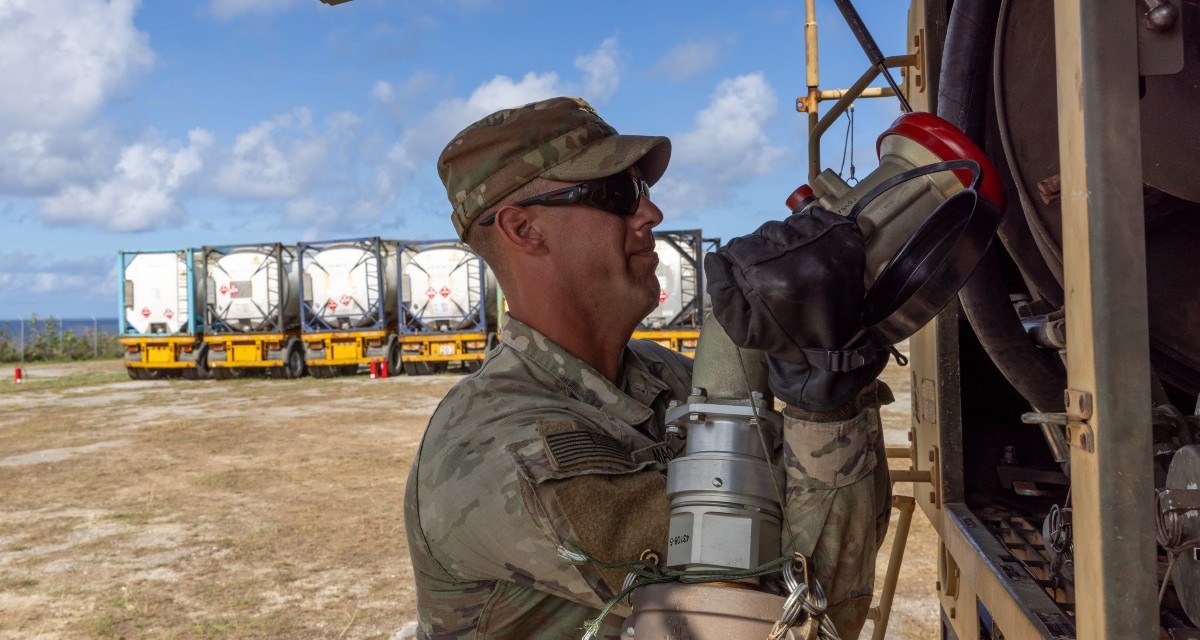
Deploying enduring ARSENAL forces would provide critical capabilities that enhance operational effectiveness in the Indo-Pacific. The Army Reserve boasts the most force structure in key support enablers, including quartermaster, transportation, medical, civil affairs, and psychological operations. Unique, low-density ARSENAL formations and equipment can conduct theater-opening operations, distribute ammunition, provide maintenance support, and establish water purification sites. The Army Reserve contains approximately 85 percent of the Army’s bulk petroleum capacity and 59 percent of its medical forces, essential capabilities needed at the outset of hostilities.
The ARSENAL concept would also provide invaluable training opportunities, delivering soldiers real-life sets and reps in the priority theater. Although the Army Reserve participates in several exercises in the Indo-Pacific theater, barriers limit full integration. For example, Title 10 limits service on active duty during Ready Reserve training periods thirty days each year. With travel distances, time zone acclimation, and equipment integration, valuable training days are consumed quickly. With enduring ARSENAL forces in the area of responsibility, risk to force would be significantly reduced.
Additionally, reserve forces can help facilitate Indo-Pacific campaigning activities through joint theater distribution center operations. Anchored by modular distribution hubs, these centers provide essential capabilities like multiclass warehouse storage, central receiving and shipping points, motor transportation, and container management. Army Reserve units like the adaptive and versatile transportation theater opening elements can conduct command and control, conduct terminal operations, and establish initial distribution networks at joint theater distribution centers to enable force projection.
Employing ARSENAL units would improve logistics networks, provide realistic in-theater training, and increase campaigning activities in the priority theater. Although the efficient use of force is crucial for maximizing combat effectiveness and sustaining military operations, units must be postured to exploit positional advantages.
Space
US Army Pacific’s theater strategy outlines four key geographic regions that codify joint interior lines of communication: the northern, central, southern, and western approaches. Aligning the requisite logistics capabilities with these four approaches bolsters combat credibility while empowering operational-level commanders to execute a myriad of contingencies.
The proving ground? Operation Pathways—a series of international training exercises involving over forty multinational engagements led by US Army Pacific. The theater army uses this initiative to test and rehearse sustainment tasks, including joint reception, staging, onward movement, and integration, and joint logistics and petroleum over-the-shore operations with reserve, joint, and multinational partners. Established Operation Pathways exercises in Australia, the Philippines, Thailand, and Japan are excellent potential ARSENAL locations due to their strategic axes of approach. Plus, US forces already operate in these countries, lowering the threshold for host-nation diplomatic acceptance.
Finally, placing ARSENAL units in geopolitically and operationally relevant locations, alongside programmed Pacific Deterrence Initiative infrastructure investments, would strengthen logistics networks and reduce implementation costs. The revived Enhanced Defense Cooperation Agreement with the Philippines and the updated Compacts of Free Association with the Marshall Islands, Palau, and Micronesia create new opportunities for ARSENAL units to maintain a presence in key terrain. In 2023, the Philippines and the United States revived their agreement, granting the Department of Defense access to nine Philippine bases, including four near the South China Sea. This renewal shows a shared commitment to regional deterrence and aligns with US Army Pacific’s plans for positional advantage. The renewed Compacts of Free Association strengthen US military cooperation with three strategically located nations. Palau has even requested a US military presence and encouraged the secretary of defense to use the compact to facilitate stationing. With growing interest in US force presence and construction projects planned in the Philippines, Palau, and Micronesia, the joint force can leverage these agreements and Pacific Deterrence Initiative infrastructure to station ARSENAL soldiers while limiting costs.
The Indo-Pacific region encompasses more than half of the world’s population, 65 percent of its oceans, and 25 percent of its land. Distributed sustainment concepts are crucial for mitigating risk and ensuring the joint force can effectively project and sustain combat power. By leveraging Operation Pathways exercise locations and geopolitical opportunities, ARSENAL could reinforce key geographic approaches and reduce risk to large-scale combat operations.
Time
As Napoleon aptly noted, “The loss of time is irreparable in war. . . . Operations only fail through delays.” The ARSENAL concept would offer a solution to mitigate critical time constraints that often hinder large-scale mobilization operations and reliance on strategic military lift. By maintaining an enduring presence in the Indo-Pacific, ARSENAL units can lessen the time required to position unique sustainment capabilities, ensuring the joint force is better postured to respond swiftly to contingency conflicts.
In a study of reserve component mobilization for the First Gulf War, the RAND Corporation estimated that Army Reserve units can be airport-ready within twenty-four days, with sealift deployments taking twenty-nine to forty-two days, depending on unit equipment density. Given these timelines, reserve units will be unlikely to be fully mission-capable in theater with their gear within forty-five days of a contingency conflict. A more recent 2019 report confirmed these findings: Based on time-phased force and deployment data, the report’s authors concluded that even smaller reserve units are likely to have trouble meeting demands in the first thirty to sixty days of a conflict, assuming there is no early mobilization. Compounding the issue, a finite number of available trainers and training space constraints at mobilization sites can limit the number of reserve units that can mobilize at any given time. With ARSENAL units already in place, the joint force would significantly mitigate risk to mobilization time.
Additionally, past efforts to test large-scale mobilization operation preparedness should serve as a harbinger of its potential complexity. In 1978, Exercise Nifty Nugget was the first set of exercises to stress the mobilization pipeline, involving over two thousand personnel from multiple federal agencies. Nifty Nugget exposed several readiness gaps, including bureaucratic redundancies, a lack of coordination in troop and equipment movement, and ineffective transportation platforms and logistics infrastructure.
Shortfalls in strategic lift capability also present unacceptable risks. The US military’s sealift capacity relies on an aging fleet, with vessels averaging over forty years old. A 2019 exercise revealed that only 40 percent of Military Sealift Command and Maritime Administration vessels were ready to support a sealift operation within five days, which could severely delay reserve unit deployments.
Time is the most significant risk to large-scale combat operations. In a contested logistics environment, adversaries can impose time delays by hindering mobilization operations from home station to training site, from fort to port, and from point of embarkation to debarkation in theater, underscoring the need for action.
The Operational Reserve Value Proposition
Critics may contend this approach will overburden the Army Reserve and prove too costly to implement. However, the Total Force Policy developed in the 1970s enables the rapid organization of Army Reserve units tailored to support a full range of missions, including overseas contingency operations. And building and deploying unique Army Reserve formations is not a novel concept. The Army Reserve validated the feasibility of the ARSENAL concept in 2020 by creating and mobilizing tailored urban augmentation medical task forces to support US hospitals during the COVID-19 response.
Moreover, mobilizing reserve components instead of maintaining active component rotational forces is inherently cost-effective. A US Government Accountability Office report highlights the cost savings, concluding that reserve personnel generally cost less than active personnel when in use. Additionally, with a slight increase in overseas operating costs, ARSENAL can save operations and maintenance dollars by providing in-theater maintenance and sustainment support, making campaigning more cost-effective.
Finally, valuable data from ARSENAL operations can help inform artificial intelligence algorithms and train machine learning models to support predictive logistics initiatives. Collecting data from a broader range of locations enhances the accuracy and effectiveness of predictive analytics by providing a more comprehensive and diverse dataset. For example, during Operation Mojave Falcon, the largest training event in the Army Reserve’s history, an operational data team was employed—a forward-leaning initiative that integrates advanced data analytics into Army operations. Incorporating these teams in ARSENAL operations can empower commanders and staff by rapidly transforming massive amounts of operational data into actionable insights, enabling faster, more informed decision-making. By leveraging AI-driven analytics, the Army can more accurately anticipate soldiers’ needs, ensuring that vital supplies reach their destination on time and in the right location, ultimately providing an advantage to the warfighter.
Recommendations
Force: Moneyball Logistics
Employing cost-effective ARSENAL units with low-density, high-impact logistics capabilities will strengthen sustainment networks and reinforce joint interior lines of communication. The joint force can leverage Title 10 authority to request tailored ARSENAL units, equipped with the personnel and resources necessary to achieve initial operational capability, while maintaining the flexibility to rapidly scale up to 100 percent full operational capability when required.
Space: Consider the Approach
Aligning ARSENAL units with each of the four theater army avenues of approach ensures that the right capabilities are in the right place at the right time. Furthermore, overlaying those forces on joint theater distribution centers in geopolitically advantageous key terrain will bolster positional advantages and lower implementation costs.
Time: Augment Rapid Home Station Mobilization
Optimizing the rapid home station mobilization model can improve the flow of reserve forces into the region by bypassing legacy mobilization sites. Growing this initiative across the Indo-Pacific would address the need for rapid mobilization without relying on mobilization force generation installations stateside.

World War II in the Pacific theater was a war of distances and advanced bases, driven and constrained by logistics. By 1945, over 1.8 million ground soldiers were serving somewhere in the Pacific or Asia. Historians note that the US military was ill-prepared logistically for such a large-footprint, manpower-intensive Pacific campaign at the outset of World War II. Shall we allow history to repeat itself?
If achieving positional advantages is foremost to the theater army’s success, we must be postured to sustain them. As currently organized, the Army Reserve contains a significant portion of the Army’s total logistics capability. Despite its ready-made mobilization capacity, reserve formations aren’t optimally positioned for large-scale combat operations, and deployment to the Indo-Pacific will undoubtedly face delays. The ARSENAL concept would mitigate strategic risk, reinforce combat credibility, enhance the joint force’s integrated deterrence, and facilitate campaigning. Indo-Pacific Command needs an ARSENAL. America’s Army Reserve can deliver.
Joshua Koncar currently serves as an executive officer in the Army Reserve. He is a former Senate Fellow and a graduate of the MIT Center for Transportation & Logistics Fellowship. Joshua earned his undergraduate degree from Thiel College and holds advanced degrees from the George Washington University, the US Naval War College, and Liberty University.
The views expressed are those of the author and do not reflect the official position of the United States Military Academy, Department of the Army, or Department of Defense.
Image credit: Staff Sgt. Tristan Moore, US Army