
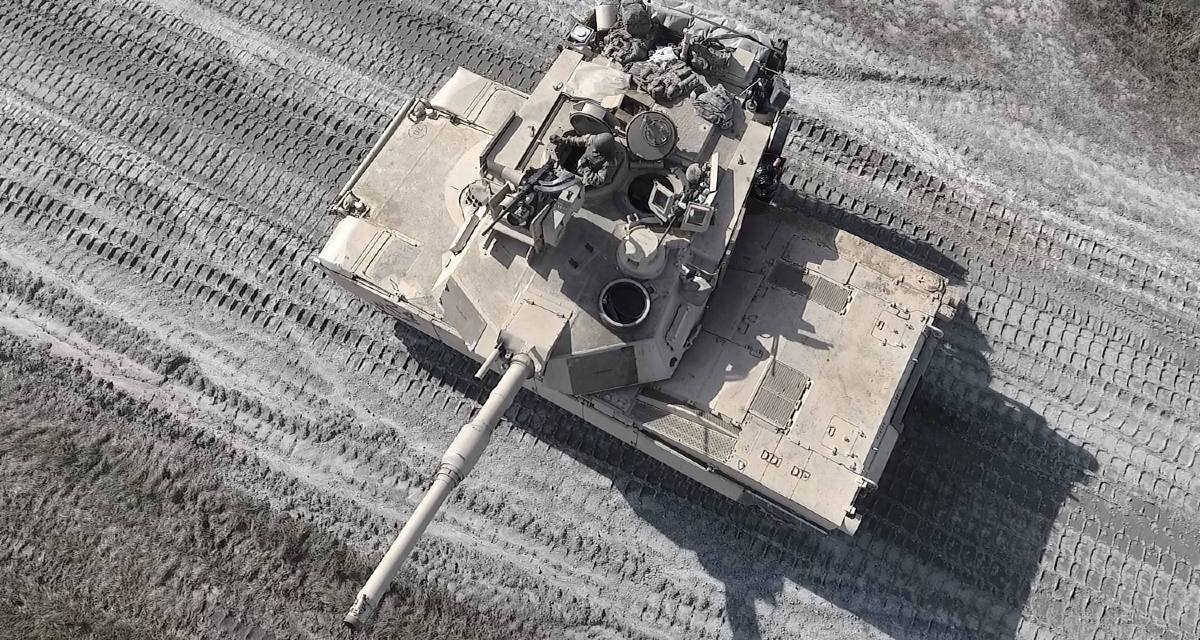
Dawn broke over the rolling hills of Eastern Europe as Task Force Loki, a combined arms battalion, prepared to breach a fortified enemy defensive belt. Intelligence reports confirmed that an enemy motorized rifle regiment had emplaced antitank ditches, minefields, and dismounted infantry armed with antitank guided missiles and supported by artillery. Instead of pushing scouts blindly into the kill zone, the battalion launched a swarm of rotary-wing unmanned aerial vehicles (UAVs) from the turrets of the lead tanks and fixed-wing drones from the battalion’s organic multidomain reconnaissance element. Within minutes, overhead feeds revealed camouflaged fighting positions, artillery hides, and an unseen second belt of defense two kilometers to the rear.
One drone, a loitering munition linked to the battalion’s AI-enabled targeting system, locked onto a thermal signature of personnel in a tree line confirming the presence of a fighting position. A second drone armed with advanced imagining systems and pattern recognition software queued and confirmed the presence of a wire-guided antitank weapon system. Seconds later, the enemy antitank team was gone. This process was rapidly repeated over a dozen times in a matter of minutes as surveillance UAVs communicated targeting information in real time to additional loitering munitions. Another UAV dropped decoy electronic emitters mimicking armored formations maneuvering to a breach point, drawing enemy artillery onto empty ground. As enemy sensors fixated on the deception point, the true breach force moved up under cover of smoke and UAV overwatch. Thermobaric munitions impacted enemy bunkers and pillboxes just prior to direct fire suppression from Bradley Fighting Vehicles. Combat engineers, guided by real-time drone feeds, cleared a safe lane through the obstacle belt. An M1A2 platoon surged forward, supported by dismounted infantry and Apache attack helicopters conducting synchronized fires on vehicle positions identified by UAVs. The vulnerability of the attack helicopters was reduced through the employment of cheap, small UAVs whose purpose was to serve as targets for enemy air defense systems.
As enemy positions collapsed, the battalion’s UAVs pushed deeper to the next phase line, feeding targets for follow-on exploitation forces and long-range precision artillery. Transparent to the tankers and infantrymen in the fight, signals intelligence scrapes from battalion reconnaissance drones operating near their release points helped illuminate enemy brigade and division headquarters nodes. Seamlessly, the information about the command-and-control locations was fed to joint targeting working group and serviced by a combination of air- and sea-based long-range precision strike munitions. In less than an hour, Task Force Loki had shattered a layered defense without a single vehicle crossing the line of departure blind. UAVs did not just support the breach; they shaped it, cleared it, and protected it.

In the wake of Russia’s 2022 full-scale invasion of Ukraine, some observers questioned tanks’ continued battlefield utility. Three and a half years later, though, tanks have stubbornly held on as a feature of the war, even as their modes of employment have changed. The battlefields in Eastern Ukraine are an excellent case study of the economics of modern war. The Ukrainian military is gladly trading UAVs that cost in the thousands for multimillion-dollar armored systems. Rather than being made redundant by antitank weapons and proliferating drones, therefore, armored formations today face the imperative to adapt to overcome these new challenges. Reports of tanks’ demise, it turns out, have been greatly exaggerated—but this will only remain true for armies able to solve the riddle of teaming them with cutting-edge technologies.
The fictional scenario above helps illuminate how this teaming can play out. Undoubtedly, tanks and armored fighting vehicles still provide unmatched survivability, mobility, and firepower on the modern battlefield. However, as the fog of war grows thicker in environments saturated with antiarmor threats, loitering munitions, and long-range fires, even the mightiest armored column risks becoming a vulnerable target. To survive and dominate, armored formations must evolve. Not by replacing tanks with cheaper, more expendable systems, but by fusing the two through manned-unmanned teaming. This imperative is about survivability, lethality, and increasing the tempo capable of armored formations to ensure that tank commanders are informed decision-makers who can see, shoot, and maneuver faster than the enemy. Teaming UAVs with armored formations is no longer a luxury or a science project. It is a necessity for prevailing in twenty-first-century conflict.
One of the enduring challenges armored units face is terrain masking their line of sight. The decision-making of a platoon leader cresting a ridge is informed only by his or her optics and line of sight. A UAV, even a quadcopter launched from a turret rack, can provide over-the-hill reconnaissance without exposing combat vehicles to enemy fires. Larger UAVs operating at tactical and operational levels can extend that reach further by identifying enemy positions and mobility corridors long before first contact. This vertical situational awareness is not abstract. In Ukraine, commercial drones have been used with stunning tactical effect for targeting and immediate poststrike battle damage assessments. Imagine what a combined arms battalion could do with dedicated UAVs designed to plug into its battle management systems.
Modern antitank guided missiles, artillery, and loitering munitions make it perilous for armored units to mass or advance blindly. The summer offensives by Western-equipped Ukrainian brigades in 2023 serve as a powerful case study. UAVs enable standoff in both sensing and striking. By pushing unmanned systems into contested zones first, armored units can preserve their combat power and choose when and where to fight. This is particularly critical in the deep area, where reconnaissance by traditional cavalry formations becomes increasingly dangerous. By using UAVs to probe these areas, armored units can map threat envelopes, detect enemy concentrations, and shape the battlefield before committing forces. This creates opportunities for precision fires and synchronized maneuver, which are core tenets of multidomain operations.
Teaming UAVs with armored formations also enhances precision. Target acquisition no longer depends solely on ground observers or forward scouts. UAVs equipped with advanced sensors, laser designators, and AI-enabled target recognition can identify and nominate targets faster than human scouts ever could. When linked to long-range precision fires or loitering munitions, UAVs become force multipliers. They allow armored units to act as spotters and finishers. Imagine an M1A2 commander using a small drone to detect a mechanized column, immediately calling for fires from HIMARS, and maneuvering around the debris before the enemy forces even understand what hit them. This kind of kill chain is no longer hypothetical. Experiments like the Army’s Project Convergence and the Next Generation Combat Vehicle program are proving that integrated sensors, AI, and fires can reduce decision timelines from minutes to seconds. UAVs are central to that equation.
UAVs do not replace the judgment of a seasoned tank commander or the adaptability of a scout platoon. They augment it. The future is not about robots replacing humans. It is about robots extending human reach, reducing risk, and accelerating decisions. Teaming requires more than colocation. It demands integrated networks, interoperable control systems, and shared training. Vehicle crews must train to fly, fight, and interpret data from UAVs as second nature. UAV control consoles must be built into future armored vehicles, not bolted on as afterthoughts. Units must integrate UAV operations into their battle drills. A breach or attack should automatically include UAV overwatch. A deliberate defense should assume constant aerial reconnaissance. Leaders must get comfortable making decisions based on drone feeds, trusting their sensors as they trust their scouts. When will UAVs be integrated into expert soldier or infantry badge testing? Which armored brigade combat team will be the first feature UAVs in its spur ride? For all the promise of UAV-armored teaming, there are operational and institutional challenges that must be overcome. These obstacles are not insurmountable, but they require deliberate design choices, leadership buy-in, and sustained investment across doctrine, organization, training, materiel, leadership, personnel, facilities, and policy.
In a peer fight, UAVs will not operate in permissive conditions. Russian jamming in Ukraine has shown that even commercial drones can be rendered useless by aggressive electronic warfare. To mitigate this, the Army must field UAVs with secure, low-probability-of-intercept communications, onboard autonomy for lost-link scenarios, and electromagnetic resilience built into their design. Airspace deconfliction presents another challenge. In fast-moving fights, especially near artillery and rotary-wing aircraft, UAVs risk fratricide or disruption of fires. This demands tighter integration into digital fires networks and standardized tactical airspace control measures. Breaking from the practices of command supply discipline, UAVs must be viewed as expendable and consumable in training and combat. They will crash, get jammed, and require frequent replacement. Armored formations must treat drones like ammunition, which is an essential and replenishable asset. Sustainment systems must include spare parts, batteries, and trained UAV technicians within the maintenance footprint.
Perhaps the most important opportunity lies in connecting armored UAV operations to the broader joint kill chain. UAVs must not only share what they see with company and battalion commanders but also feed data to air, naval, cyber, and space assets. Likewise, they must be taskable from joint fires cells and theater-level intelligence fusion centers. This demands joint interoperability standards, shared data protocols, and joint training. Army UAV operators should routinely train with Air Force JTACs, Navy surface fire controllers, and cyber support teams—because multidomain synergy cannot wait until wartime. Finally, institutional inertia may be the hardest challenge. Armored leaders must embrace UAVs not as external enablers but as integral parts of their formation. Doctrine, field manuals, and leader development courses must evolve to reflect a future where every armored vehicle is part of a sensor network and every maneuver decision is informed by persistent aerial data.
Armor remains the cornerstone of decisive land combat. But because the future belongs to those who can see first, strike first, and decide first, only those armored formations with fully integrated UAVs will be best positioned to maintain their role as the combat arm of decision. Not only will this enable armored units to act with greater speed, precision, and survivability, but it will teaming them with UAVs at echelon will also integrate them seamlessly into the joint force and its kill web. We should not wait for the next war to learn this lesson. The time to team steel and silicon is now.
Major Charlie Phelps is a Special Forces officer and currently serves as a Company Commander in 10th Special Forces Group (Airborne).
The views expressed are those of the author and do not reflect the official position of the United States Military Academy, Department of the Army, or Department of Defense.
Image credit: Master Sgt. Erick Ritterby, US Army