My safety as a member of a liaison monitoring team for KFOR in the Balkans once depended on a single, unspoken truth. The sky belonged to us. That certainty has vanished. Today, rapid technological change means threats no longer just come from the ground. They descend from above, reshaping the battlefield and upending the very idea of sanctuary. The rise of autonomous drones and democratized airpower has forced us to rethink every assumption about security, risk, and survival.
Of course, this observation is not a novel one. In recent years, the digital pages of outlets like this one have hosted intense discussions about this fundamental change and how militaries should respond. But much of that examination focuses on high-intensity conflict scenarios. Quite naturally, given the increased emphasis on large-scale combat operations, services like the US Army tend to consider the issue of countering drone threats in a battlefield context; where soldiers are deployed to wage war, the already plentiful adversary threats they face now also extend to the skies above. But what about the many other places US military personnel are sent, for missions other than combat—missions like security force assistance?
Over the course of my career, I have witnessed threats shift from being ground based to emerging from the sky. At the Defense Intelligence Agency, I was tasked with interpreting the signals of a changing battlefield, where the rise of autonomous systems and the democratization of airpower demanded new frameworks for both analysis and action. Later, while directing humanitarian operations in East Africa, I witnessed the kinetic reality of those assessments. I have observed how drone threats have reshaped civil wars, stoked simmering sectarian conflicts, and heightened threats in areas the US military would have previously categorized as semipermissive or even permissive environments.
For US advisors in places like East Africa, this marks a turning point. The era of sanctuary for forces engaged in security force assistance is over. The fundamental premise of operating with a small, safe footprint is obsolete as well.
The Democratization of Air Superiority
The Sudan conflict highlights how a civil war zone can function as a sort of laboratory for drone warfare. Just this month, an attack killed six United Nations peacekeepers in Kadugli, Sudan. It was not a precision strike by a state air force, but an attack blamed on the paramilitary Rapid Support Forces that employed low-cost drones. The group has also weaponized drones for complex attacks that have struck key infrastructure. Moreover, this technology and successful employment tactics do not respect borders, with reports indicating they are migrating south.
For two decades, drone operations in Africa were defined by American MQ-9 Reapers. According to the African Center of Strategic Studies, the proliferation of military drones has fundamentally altered the operational environment for both state and nonstate actors. From Ethiopia to the Sahel, the proliferation of Bayraktar TB2s and commercial drones has created a budget air force, a trend documented in recent studies on African battlespaces. Nonstate actors utilize these for both kinetic strikes and intelligence, surveillance, and reconnaissance. Somali National Army forces intercepted al-Shabaab surveillance drones in February 2025, confirming that the group has moved to tactical reconnaissance.
Alarmingly, the Islamic State in Somalia conducted armed drone attacks in January 2025. This democratized airpower is now within reach of cells near US advising locations. As I noted in a recent publication, we have entered a new era of conflict. UK Parliament research confirms this proliferation challenges established defense postures.
The End of Transparency for Advisor Missions
US advising missions have relied on low visibility for decades. Special Forces often operate from austere outposts, using camouflage for concealment against visual observation. However, the operational assumption I operated under in the Balkans—that threats were terrestrial—has collapsed. Cheap surveillance drones have overturned the traditional approach to force protection and have fundamentally changed the risk calculus for advisory missions. The advisor is no longer the watcher. The advisor is the observed. Congressional research highlights the urgent need for scalable counterdrone solutions to address this evolving threat.
In June 2025 testimony before the House Armed Services Committee, General Michael Langley, then commanding general of US Africa Command, noted that collaboration between terrorist groups is accelerating. Force protection by obscurity has failed. A $200 drone can now expose even small-scale US training exercises or advising activities. Furthermore, operator-controlled first-person-view drones can strike observed locations with precision, and these munitions cost less than a soldier’s rifle. For today’s advisor teams, even the most isolated outpost is no longer a sanctuary.
The Logistics of Survival
The traditional response to air threats is multilayered air and missile defense. Yet, my work directing global medical supply chains in the East African region has highlighted a critical reality. Whereas in the military sector, we relied on air supremacy for protection, in the humanitarian sector, we rely on permissiveness. Now, both are gone. When the sky is denied, logistics are forced back to the ground, into the territory of predatory actors. Drones have become the ultimate interdiction tool. This enables insurgents to block aid or demand passage without ever appearing at a checkpoint. This is not merely a logistical challenge; it is the weaponization of supply chains.
In August 2023, operational realities forced my organization to cancel a vital surgical mission to Ethiopia. A deadly airstrike in Finote Selam demonstrated how aerial threats can disrupt essential logistics and deny critical care. This was not merely a safety incident; it was a successful blockade. The humanitarian sector now faces unprecedented challenges, with organizations like Drone Wars UK calling for international regulation to mitigate civilian harm.
Whether for humanitarian or military operations, complex logistical trails break at the last mile. The distributed nature of security force assistance missions means that strategic air defense assets like Patriot batteries cannot be fielded at every team site or clinic. We are structurally unprepared to counter this threat. Even if exquisite air defense capabilities were available to deploy everywhere the US military has a presence, shooting down a $500 drone with a multimillion-dollar missile is a losing strategy. And the cost of failing to have an answer for this threat is the inability to move the supplies that stabilize fragile regions. If we cannot secure the airspace, we cannot secure the supply chain.
Adapting for the Challenge
The US Army is beginning to recognize this shift. Senior leaders are pursuing reliable, cost-effective counterdrone tools. And troops are training on counterdrone tactics. But what is needed is for countering drone threats to become a core competency. Survival in this new environment requires widespread adaptation. US advising missions must embrace three key changes to remain effective and resilient.
- First, we must adopt digital camouflage. Advisors must minimize electronic signatures to evade overhead surveillance.
- Second, we must pursue democratized defense. We need low-tech flak solutions rather than waiting for high-tech air defense.
- Finally, we must adopt a “red air” mindset. Drawing on lessons learned from deployments to Africa, security force assistance doctrine and standard operating procedures must reflect that air superiority is no longer guaranteed. Patrol routes and base layouts must change, and we must design operations to mitigate drone observation.

The recent drone strike in Kadugli was part of a precedent. A senior United Nations official cited it along with others as he described indiscriminate drone strikes as a primary driver of civilian harm and regional instability. The safe advising mission is a relic of the past. As the cancellation of the Finote Selam mission proves, the consequences extend beyond force protection; they threaten our ability to project stability itself.
In this new era, survival depends on our willingness to rethink old assumptions and embrace innovative solutions. Unmanned systems are proliferating through East Africa. The US Army must prepare advisors not only to survive but to sustain operations under a sky that is no longer ours. As recent research from the Defense Information Systems Agency highlights, the evolving landscape of conflict in Africa demands innovative solutions and robust civil-military coordination.
In the end, the lesson is clear. The era of uncontested airspace is over. Future success will depend on our ability to adapt, survive, and thrive in a world where every movement is observed and every sanctuary is temporary. The sky may no longer be ours alone, but with foresight and resolve, this fact need not limit our reach.
Darryl Scarborough is a director at an international development nonprofit specializing in East Africa. A former intelligence officer with the Defense Intelligence Agency and a US Army veteran, he has extensive experience in civil-military operations and irregular warfare. He holds a master of public affairs from the University of Minnesota.
The views expressed are those of the author and do not reflect the official position of the United States Military Academy, Department of the Army, or Department of Defense.
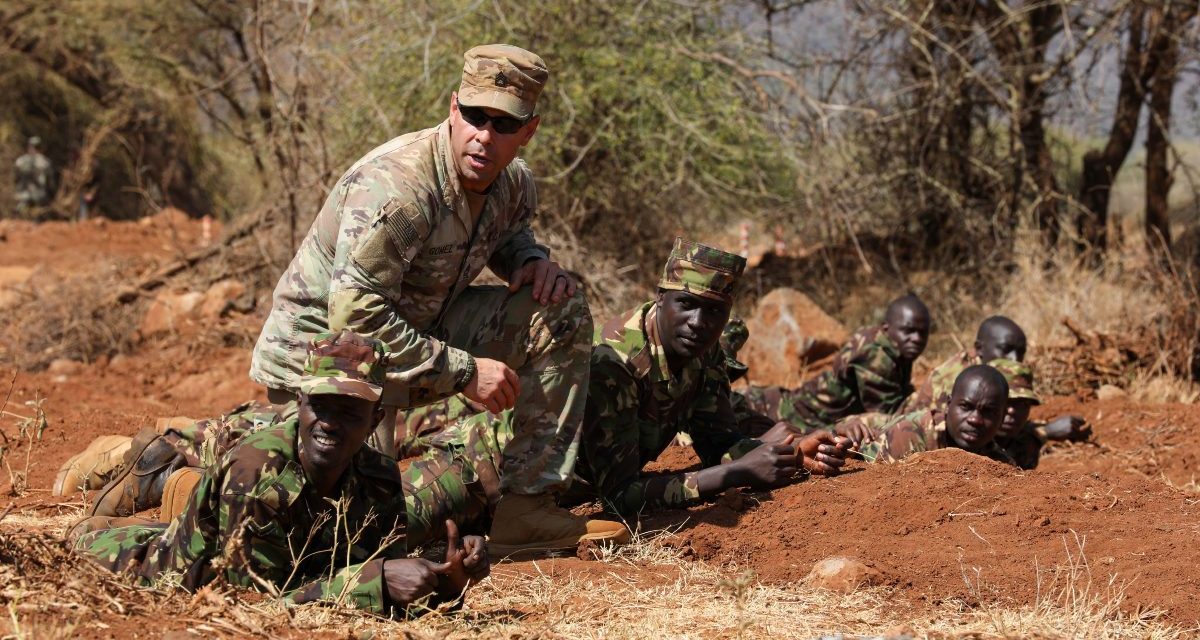
Image credit: Sgt. N.W. Huertas, US Army