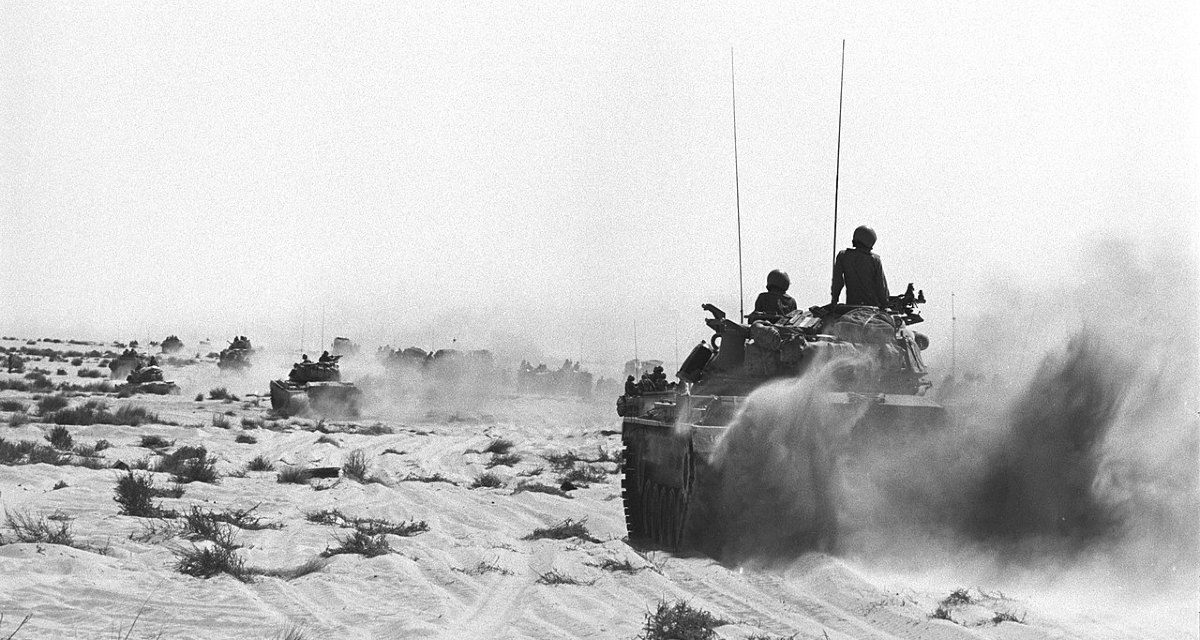
The 1973 Arab-Israeli War confronted Israel’s military with a sudden and existential crisis. Initiated by simultaneous Syrian and Egyptian offensives from the north and south, the bitter conflict demonstrated the value of operational endurance as each side sustained unexpected attrition. Within hours, Israeli assumptions about intelligence overmatch, maneuver superiority, and air dominance collapsed under the weight of the Arab assaults. Responding to significant losses in men and materiel, Israel subsequently initiated a painful process of battlefield regeneration to recreate combat power and establish conditions for large-scale counteroffensives that could end the war on favorable terms. While combatants on both sides demonstrated courage and commitment in the face of daunting challenges, the Israeli capacity to persevere ultimately paid the highest dividends and yielded a conditional strategic victory.
How did the Israel Defense Forces (IDF) achieve, albeit at a tremendous societal cost, this systemic regeneration across both ground and air services while continuously engaged on multiple active fronts? The Israelis’ desperate response to simultaneous crises in the Sinai and the Golan Heights—which derailed prewar plans for synchronized air-ground maneuver designed to achieve rapid decision—combined important aspects of veteran leadership, logistical resiliency, and strategic adaptation with critical functions of tactical recovery and tiered mobilization to achieve formation reconstitution at echelon. Characterized, as US Army General Donn Starry described it, by “enormous equipment losses in a relatively short time” and “lethality at extended ranges,” the conflict now underscores the enduring imperative for military institutions to avoid the quicksand of wishful thinking and instead prepare to fight, and win, in the bitter crucible of attritional combat.
Recovery, Regeneration, and Reconstitution
Israel’s military posture in October 1973, which followed its dramatic success in the Six-Day War, reflected an unquestioned faith in the qualitative superiority of its active duty force of 75,000 service members and its rapidly mobilizable component of 350,000 reservists. When Egypt and Syria launched their surprise offensives on October 6 against the dramatically outnumbered defenders, the IDF found itself facing much larger and well-armed Arab armies with vastly improved technological and tactical capabilities. The Egyptian use of Sagger antitank missiles and surface-to-air missiles, in particular, decisively defeated Israeli armor and airpower in the Sinai during the opening phases. By the third day of fighting, the stunned IDF had lost 40 percent of its tanks and dozens of fighter-bomber aircraft, and was left grappling with the unexpected losses.
In response, Israel executed a full-scale, societal mobilization that benefited from the way local communities had gathered in centralized locations to celebrate Yom Kippur. The IDF General Staff, under intense pressure to stabilize the collapsing northern front and rescue besieged forts along the Suez Canal, activated over 300,000 reservists into tiered combat formations within seventy-two hours. While some soldiers joined units already at the front as replacements, others formed entirely new units to reinforce the bloodied divisions along the Suez Canal or across the Golan Heights. However, though the reinforcements proved vital for restoring the irreplaceable armored divisions that had suffered in previous days, the chaotic mobilization resulted in the haphazard and desynchronized arrival of critically needed artillery, infantry, and engineer forces to the front.
The Israeli requirement to enact large-scale reconstitution across separate fronts benefited from Operation Nickel Grass, a massive American resupply effort that provided replacement platforms and ammunition to the struggling Israeli Army and Air Force. While the transfer of almost one hundred aircraft that included F-4 Phantoms, A-4 Skyhawks, and C-130 Hercules provided immediate replacements for fighter-bombers and transports downed by surface-to-air missiles, the provision of artillery and tank munitions in massive quantities allowed the battered armored forces to keep fighting into the second and third week of the war. In total, the American delivery of more than twenty-two thousand tons of supplies by airlift and more than thirty-three thousand tons by sealift, despite most of the tank replacements arriving too late to be of impact, enabled the IDF to regenerate combat capability with enough mobility and firepower to seize the initiative in both the ground and air domains.
This plan for rapid force regeneration extended beyond mobilization statistics and timetables and into human considerations. IDF leaders confronted the daunting psychological challenge of rebuilding bloodied tank crews that had suffered high losses in men and materiel. Commanders and noncommissioned officers, many who were veterans of the Six-Day War and the 1956 Suez Crisis, reconstructed tactical cohesion even as they were engaged in active fighting. As tank losses became critical, the IDF brigades sent recovery teams, at great risk, forward at night to retrieve battle damaged platforms to be repaired and returned to service. These aspects of reconstitution, centering on the psychological as much as the physical, would prove vital for allowing the battered Israeli forces to rebuild capability and transition to offensive operations.
Aggressive leadership by engaged leaders proved essential in allowing Israel to recover from the initial setbacks and transition to offense. Division, brigade and battalion commanders, operating under mandates to limit further attrition, developed innovative tactics to defeat or isolate Egyptian and Syrian forces, which now included substantial armored reinforcements from Iraq and Jordan. In the Golan, the IDF’s 7th Armored Brigade, under Avigdor Ben-Gal, endured heavy losses while employing innovative tactics to repel multiple Syrian armored divisions and retake the heights. In the south, the restored 143rd Reserve Armored Division, under Ariel Sharon, led an ambitious crossing of the Suez Canal to establish a bridgehead in Africa. These attacks, though complicated by quarreling senior commanders and stubborn Arab resistance, revealed nuanced operational art designed to posture Israeli political leaders for advantageous negotiations.
By mid-October the IDF had transitioned from reactive defense to synchronized counteroffensives by countering Egyptian and Syrian standoff firepower with integrated artillery suppression, infantry support, and most importantly, attacks from an Israeli Air Force that had likewise recovered from initial losses and learned how to reduce surface-to-air missile threats. On the northern front, the Northern Command recaptured the Golan Heights, invaded Syria proper, struck Damascus, and defeated major Iraqi and Jordanian counterattacks. In the south, the Southern Command crossed the canal, reduced the feared Egyptian surface-to-air missile networks, encircled the battered Egyptian 3rd Army to the south, and held the besieged Egyptian soldiers as leverage to negotiate a favorable ceasefire. These successes were only made possible by extraordinary efforts to reconstitute broken formations and regain operational initiative over the first week of the destructive conflict.
Reconstitution: A Strategic Imperative
The 1973 Yom Kippur War, which saw the IDF lose more than eight hundred main battle tanks and one hundred attack aircraft in three weeks of fighting, validated the timeless imperative for modern militaries to maintain systematic reconstitution as a vital capability. Faced with total collapse, the Israelis regenerated combat power, restored operational initiative, and transitioned from a stunned defensive posture to execute decisive counteroffensives across separate fronts. As argued by Avraham Adan, commander of the 162nd Armored Division, which recovered from severe losses to lead the IDF breakout in Africa, the Israelis “fought back, accumulated strength, attacked, and forced the enemy to ask for a cessation of hostilities.” This costly recovery depended not on any single technological offset or tactical innovation, but on an integrated approach that synchronized societal mobilization, formation reconstitution, crew rebuilding, and battlefield adaptation in ways that recreated cohesion and combined arms capability.
These capabilities, though on display by the IDF in a war more than half a century ago, remain relevant even amid the evolving character of warfare in the twenty-first century. As seen in the 2017 Battle of Mosul, the Second Nagorno-Karabakh War of 2020, and the extraordinarily destructive Russo-Ukraine War, battlefield attrition remains a fundamental feature of modern combat. This means that contemporary militaries, regardless of expectations for technological or decision dominance through qualitative superiority, must train to execute mobilization, deployment, reconstitution, and organizational recovery in order to extend operational endurance and ensure strategic flexibility. As cautioned by the late theorist, Dr. David Johnson, this means that the US military and its partners must “challenge existing assumptions, concepts, and capabilities” rather than “validate current approaches” that may reflect wishful thinking or obsolete conceptions.
For modern militaries, the Israeli experience offers enduring lessons on preparing for high-intensity and protracted conflict in contested environments. The capacity to reconstitute under fire, both in terms of restoring platforms and replacing human capital, will determine success in future wars that may be characterized by surprise, complexity, and destruction. General Starry defined this capacity as the “timely regeneration” of “people, organization, command structure, and material” for “battle and sustainment of the force,” and the IDF’s volatile campaign provides an instructive example of the adaptation and perseverance required for it. If the Israelis fell victim to the temptation to plan for the perfect outcome in 1973, their response to unexpected losses demonstrates how military forces must be prepared to persevere through the first shocks of battle, however costly, and fight through to victory on the other side.
Lieutenant Colonel Nathan Jennings is the executive officer to the provost of Army University. He served combat tours in Iraq and Afghanistan and holds a PhD in history from the University of Kent. Jennings is a graduate of the School of Advanced Military Studies and is a LTG Dubik Writing Fellow with Army University Press.
The views expressed are those of the author and do not reflect the official position of the United States Military Academy, Department of the Army, or Department of Defense.
Image credit: Israel Defense Forces