Editor’s note: This is a short work of fiction depicting a realistic scenario on NATO’s northern flank. The author wrote a short companion piece in which he extracts five real-world lessons from the story for US and allied military forces, which you can read here.
Prologue: The Missed Approach
The first warning does not come from an intelligence summary. It comes from a missed approach over Vilnius. On the operations floor of the new Multi-Corps Land Component Command Northwest in Mikkeli, Finland, Captain Henrik Nyman watches a civil aviation display he is not supposed to care about. It lives in the corner of his screen as context, a way to judge how commercial traffic is flowing around military transit routes.
A Boeing on final approach to Vilnius drops through one thousand feet, hesitates, then claws its way back into the sky and bends west. A few seconds later the Lithuanian aviation authority pushes an advisory into the Eurocontrol feed. Suspected GNSS (global navigation satellite system) interference on final approach. Aircraft diverting to Warsaw. Nyman tags the incident in the ever-growing PNT log—the staff has a whole column for disruptions to positioning, navigation, and timing systems now. His cursor slides to another window, a heat map that overlays the Baltic Sea and the Gulf of Finland.
Colored blotches show where receivers are losing lock, where ships and aircraft are reporting spoofed positions. The blotches have been getting larger for weeks. Tonight they pulse, especially along the Russian coast and around Kaliningrad. A small icon on his screen marks the suspected source of the worst interference near Kaliningrad. The intelligence section has given it a polite label: “probable long-range electronic warfare system.” Everyone just calls it the jammer.
Nyman adds a note to the log: “Suspected Russian GNSS jamming impacting civilian arrivals to Vilnius. Consistent with previous incidents.” He hits save and walks the printout across the operations floor to his boss.
Chapter 1: A New Northern Warfighting Headquarters
Brigadier Erik Halvorsen reads the line twice. He has watched similar reports stream across his desk for months. MCLCC-NW is NATO’s newest land headquarters. Officially it is Multi-Corps Land Component Command Northwest, subordinate to Joint Force Command (JFC) Norfolk. Unofficially it is the alliance’s experiment in running a land fight in the high north and the Baltic approaches with a Nordic-led staff.
The walls of the Mikkeli headquarters still smell of pine cleaner. Finnish Army Command used to live here. The coffee is still Finnish and strong enough to stand a spoon in. The national flag outside now shares a flag stand with NATO’s blue banner. Halvorsen walks to the main map board. On the board, the northern region is split into command seams. JFC Norfolk owns the northwestern regional defense plan, which now includes Finland, Sweden, Norway, Denmark, Iceland, the United Kingdom, and the adjacent seas. JFC Brunssum handles the central region. JFC Naples watches the south.
Under JFC Norfolk, the maritime fight belongs to the naval component, the air campaign goes to the air component, and land goes to MCLCC-NW. That is the theory. In practice, the details are still being hashed out. Halvorsen looks up from the printout Nyman just brought him. “We have another diverted flight,” he says.
Nearby, the United States Navy liaison officer, Commander Nathan Lewis, looks up from his laptop. “Vilnius again?” he asks.
Nyman nods. “Suspected Russian jamming. Lithuanians reported loss of satellite approach guidance. Exact pattern matches last month’s spike.”
A large monitor on the wall shows the same heat map Nyman had viewed on his screen, and Halvorsen taps it. “Kaliningrad and the Saint Petersburg area,” he says. “Same Russian systems. Same aim. Make life harder for civilians and military alike. Make our planning harder.” He looks at Lewis. “Does JFC Norfolk still treat this as background noise?” he asks.
Lewis grimaces. “Norfolk is updating its assumptions,” he says. “The new regional defense plan annex assumes persistent PNT degradation over the Baltic Sea, the Gulf of Finland, and parts of Finland and Sweden in crisis. They expect land forces to treat Russian GNSS jamming as a standing condition.”
Halvorsen nods slowly. “Good,” he says. “Because this is starting to look less like weather and more like shaping fires.”
* * *
Two hundred kilometers northeast, an American battalion executive officer feels the effects long before anyone in Norfolk signs an annex. Major Elena Ruiz, United States Army, stands in a Finnish brigade command post with one hand on a paper map and one eye on the digital common operational picture. Her battalion is subordinate to the Finnish brigade and is the first US maneuver battalion operating under MCLCC-NW.
On the screen, blue force tracking icons drift. The sustainment company convoy moving along Route KARHU slides three hundred meters into the forest, then snaps back. The graphic for a Finnish engineer company duplicates itself and appears in two places at once before resolving into one. A drone feed tags a stand of birch trees with a coordinate that, on the printed 1:50,000 map, sits squarely in the middle of a lake.
The brigade operations officer, Major Jari Laaksonen, leans over. “Your system thinks our engineers can teleport,” he says. “I just spoke to their commander on the radio. He is at the crossroads near the old sawmill. Your satellite picture says he is straddling the river.”
“So Russian spoofing again,” Ruiz says.
“They have been working the spectrum over the gulf for weeks,” Laaksonen answers. “We have reports from civil aviation, from ferries, from truckers. Now they are leaning into it.”
The Finnish brigade commander took the reports seriously enough to update his guidance that morning. All subordinate units are to assume degraded PNT across the brigade’s area of responsibility in eastern Sodankylä. All units will include PNT status and GNSS interference incidents in their daily reports. Russian electronic warfare systems near the Russian-Finnish border and in the Kola Peninsula are named explicitly in the threat notes. Ruiz has the printed guidance folded in front of her. Underneath it she has written in capital letters:
PNT STATUS: GREEN / AMBER / RED
GNSS INTERFERENCE: EXAMPLE REQUIRED
On the big map projected into the white-painted wall, they shade a ring in dry-erase where Finnish authorities report the strongest jamming. The circle overlaps civilian trouble spots where airliners have abandoned approaches to small eastern airports and where ferries and other civilian vessels have complained about losing positional data. “We need to assume the Russians will keep the knob turned up,” Ruiz says. “Not just flick it on for exercises.”
Laaksonen nods. “They are testing us,” he says. “Testing Finland as a new ally. Testing Sweden. Testing our new commands. Seeing how we react before any tanks cross any borders.”
* * *
On the Baltic Sea, the Russian test feels like an invisible hand on the compass. The Swedish corvette HSwMS Härnösand runs a patrol east of Gotland, listening for any submarine that might decide to get familiar with cables and pipelines. The sensors officer, Lieutenant Sofia Tamm, flicks her gaze between the acoustic screens and a small display that shows GNSS integrity. The bars on the integrity display rise and fall. When the ship’s course takes them closer to the central shipping lanes, the bars falter more often.
“Jamming intensity increasing,” Tamm says. “Pattern consistent with emissions from Kaliningrad and the eastern gulf. Likely Russian Krasukha or similar long-range system.”
Commander Ingrid Björk, the captain, glances toward the island. Gotland is a low dark line on the western horizon. “Plot our position using radar ranges and depth soundings,” she says. “No decisions based on satellites alone tonight.”
The navigator acknowledges. Old skills come out. Bearings to lighthouses and radar reflectors, depth under keel, inertial navigation system checks.
When Sweden was outside NATO, Björk wondered whether the island would ever attract the attention it deserved. Since Sweden joined the alliance, Gotland has become an exercise magnet. American airborne brigades drop in on its airfields. Polish and British units practice amphibious landings. Staff officers from across Europe come to brief in front of large maps that show arrows stretching from the island toward the Baltic states.
Those same maps now carry new annotations—small icons for Russian electronic warfare units along the coast of Gotland, circles that show where their jamming should be strongest. Tonight those circles sit right under the Härnösand’s plotted track. Tamm watches the GNSS display flicker again. “Our civilian ferries are complaining,” she says. “They call it ‘ghost steering.’ Their autopilots try to compensate for fake positions. We keep telling them to trust their eyes and radar.”
Björk thinks of the NATO staff officers who use the same phrase. Trust your sensors, but know which ones the Russians can lie to. “Send our nav anomalies to the maritime operations center,” she says. “Flag them as likely Russian hybrid activity. And tell them land forces might want to know that their rail ferries and roll-on/roll-off ships will be navigating by eyeball.”
* * *
Thousands of kilometers away, at JFC Norfolk, another watch floor comes to life around the same interference pattern. JFC Norfolk is NATO’s newest operational-level headquarters, responsible for the security of the Atlantic sea lines of communication and, since the new regional defense plans, for the broader northwestern region that includes the Nordics and the Baltic approaches. It is across the ocean from MCLCC-NW, but the workflows crisscross constantly.
On the giant screen at the front of Norfolk’s operations center, the duty director brings up the Baltic overlay. Color-coded reports from aircraft, ships, and land units show where GNSS is being jammed or spoofed. The density of incidents over the Gulf of Finland and around Kaliningrad looks like someone spilled ink.
The duty director nods to the intelligence watch officer. “What’s the assessment?”
The intel officer steps forward. “Same Russian electronic warfare systems, sir,” she says, gesturing to the screen. “We see overlap with known 1RL257 Krasukha deployments and other theater systems. They’ve been probing since 2022. This is the heaviest pattern yet.”
The deputy commander, a British three-star, listens while his staff describes how civil aviation has diverted flights, how ferries and tankers are reporting positional anomalies, how the European Union has sent formal complaints about Russian hybrid attacks on navigation and safety. “Good. The complaints help bring this to our attention, but now we have to do something about it,” he says. “The problem we have to solve is what happens when reinforcement forces try to cross that sea and land in those ports under a contested spectrum.”
He turns to his land advisor. “How is MCLCC-NW incorporating this?” he asks.
“We just spoke to Brigadier Halvorsen,” the advisor says. “He is building PNT reporting into every land unit’s battle rhythm. He is treating Russian GNSS jamming as a constant, not a spike.”
“Good,” the deputy says. “We built these new commands to handle exactly this. New allies, new headquarters, new operating environment. This is our test run before things get kinetic.”
He looks back at the map, at the triangle formed by eastern Finland, Gotland, and Latvia. “Make sure the maritime and air components are seeing the same PNT picture,” he says. “If land is treating these events as deliberate targeting, the rest of us need to as well.”
* * *
By evening, the pattern is clear enough that nobody at MCLCC-NW calls it coincidence.
The intelligence section brings an update to Halvorsen. “Russian jamming intensity has increased over the last twelve hours,” the senior analyst says. “Airliners diverted in Lithuanian and Estonian airspace. Swedish and Finnish maritime agencies reporting serious interference in the Baltic Sea and Gulf of Finland. Civilian GNSS receivers near the Kola Peninsula are showing similar anomalies.”
The analyst taps a second slide. “We assess with high confidence that Russian electronic warfare brigades in Kaliningrad, the Saint Petersburg region, and the Kola Peninsula are deliberately targeting GNSS as part of a hybrid campaign. Likely objectives are to intimidate civilian populations, stress critical infrastructure, and test NATO’s reaction in the Nordic and Baltic region.”
Halvorsen listens, then makes the decision that turns analysis into orders. “All right,” he says. “From this point forward, for all land units under MCLCC-NW, we will treat Russian GNSS jamming as a standing condition. Not an inject.” He looks at Nyman. “Draft a fragmentary order,” he says. “Directive one. All headquarters will incorporate PNT status into their routine reports. Directive two. All units will identify which of their systems are most vulnerable to Russian jamming and report mitigation measures. Directive three. Exercise analog navigation and time discipline in the next twenty-four hours.”
He pauses. “And make sure JFC Norfolk sees that we are acting on their assumptions, not waiting for perfect clarity.” The FRAGO races out over secure nets, riding systems that themselves depend on the same sky the Russians are poisoning.

Chapter 2: Trial by Jamming on the Baltic-Nordic Front
In the Finnish brigade command post, Ruiz hears the new guidance summarized over the divisional net. “MCLCC-NW assesses Russian GNSS jamming as persistent,” the voice from division reads. “All units will adjust plans accordingly. PNT status will be reported as routinely as fuel and ammunition.”
Ruiz flips to a fresh page in her notebook and writes as she listens. “PNT status line in SITREP,” she says. “Green, amber, red, with example. Explicit mention of Russian jammers. Command emphasis.”
Her US battalion commander, Lieutenant Colonel Samir Patel, nods. “We already knew this,” he says. “Now higher is admitting it.”
They gather the staff around the projected map. Ruiz shades their sector again, darker this time. “Inside this ring, we assume Russian jamming is active,” she says. “Their electronic warfare brigades in the Western Military District and Baltic Fleet are trying to make our own systems unreliable. We treat every GNSS-enabled device as suspect unless proven otherwise.” The staff moves quickly.
Staff members make changes to routes. They adjust movement plans so that phase lines align with geographic features and not just grid lines. Checkpoints are buildings and intersections, not anonymous waypoints. They write instructions in plain language: “Turn east at crossroads with three birch trees and a red barn on the northwest corner.”
They make changes to fires. The fire support officer marks systems that are most vulnerable to spoofing. Counterbattery radars that depend on precise timing. Tablets that calculate firing solutions based on target coordinates pulled automatically from a network. The staff members drill a simple rule: If a target comes only from a system that could be fed bad PNT by Russian jammers, they will confirm with a second method before engaging.
They make changes to communications. The signal officer builds a PNT-aware primary, alternate, contingency, and emergency communications plan. The staff notes which radios and waveforms depend on accurate time from satellites and which can operate on manual time hacks. Net operators rehearse time-of-day changes not by trusting their screens, but by taking time from one designated master clock in the tactical operations center.
On a handful of vehicles, the battalion runs an experimental assured-PNT kit—a black box bolted under the radios that fuses inertial sensors, wheel encoders, multiple GNSS constellations, and whatever civilian signals of opportunity it can hear, from cellular towers to broadcast transmitters. When GNSS degrades, the box dead reckons position and time well enough to keep fire missions and movement orders coherent. The signal officer jokes that it is a University of Texas professor’s revenge on the jammer belt around Kaliningrad, a nod to research that proved you could navigate by the city’s radio noise alone.
And they make changes to reporting. The battle captain updates the battalion situation report template. PNT status sits between ammunition and casualty lines.
The command sergeant major writes a new task organization on the whiteboard. “Platoon sergeants are now map instructors,” he says. “Tonight, every convoy and every dismount lane is run in ‘red PNT’ condition. No tablets. No phone nav. Wristwatches, compasses, eyes.”
* * *
Just after midnight, the invisible barrage peaks. In Estonia and Lithuania, pilots on approach call go-arounds when their GNSS-guided approaches show erratic behavior below one thousand feet. In Finland, regional carriers decide that it is safer to divert than to trust jumpy needles. Baltic maritime agencies issue urgent notices that warn of “serious positioning disturbances” in the Gulf of Finland and central Baltic Sea. Captains are told to rely on radar, depth, and visual marks. Ferries and tankers report ghost tracks, their instruments showing them miles from where they know they are.
Along the seabed, sensors attached to subsea cables between Sweden and Latvia, and between Finland and Estonia, record sharp spikes. One cable’s traffic drops suddenly. A second shows increased error rates. Whether dragged anchors or something more deliberate is to blame is unclear. In a headquarters near Saint Petersburg, a Russian electronic warfare brigade commander watches his own screens glow brighter as his systems push more power into the sky. He knows civil aviation authorities will complain. That is part of the point. He knows NATO’s new commands will have to react. That is the more interesting part.
The same signatures appear in three NATO headquarters at once. In Mikkeli, MCLCC-NW’s PNT display lights up. In Virginia, JFC Norfolk’s plots of GNSS reliability over the North Atlantic and the Baltic spike in red over the Gulf of Finland and Kaliningrad. At Allied Air Command in Ramstein, Germany, staff officers received increased reports from Combined Air Operations Centre Bodø of navigation problems on NATO air policing.
Secure chat windows bloom with messages. MCLCC-NW pushes an immediate update to subordinate land formations: “Russian GNSS jamming intensified over Baltic region and eastern Finland. All units execute ‘red PNT’ procedures. Provide PNT SITREP in two hours.”
JFC Norfolk sends guidance down to its components: “Treat Russian PNT interference as coordinated hybrid action. Maritime and air components adjust routing to account for degraded navigation. Land component to report impact on movements in Finland and the Baltics.”
Allied Maritime Command directs warships and maritime patrol aircraft to move closer to critical cable junctions and chokepoints. The Swedish and Finnish navies coordinate patrols to look for suspicious vessels and unusual anchor patterns. Allied Air Command adjusts air policing routes and tanker tracks to avoid the worst interference zones. Crews brief non-GNSS approaches and backup procedures for Baltic and Nordic airfields.
For the first time, all three components are reacting to Russian jamming as a shared operational problem rather than as isolated technical faults. The new commands, the new allies, and the new regional defense plans are being tested in contact. Halvorsen looks at the reports on his screen. “Get me a consolidated land PNT status report from Finland, Sweden, and the Baltic states,” he says. “And send our mitigation measures to JFC Norfolk. If this is a rehearsal, we need to show that the new structure can adapt.”
* * *
On the ground, the orders become friction. Patel’s battalion gets its tasking from the Finnish brigade at three in the morning. Secure a major rail junction and adjacent highway interchange that feed west toward ports and south toward the capital region. Be prepared to move onward to reception areas for allied reinforcements from Sweden and the United Kingdom.
The battalion’s lead company rolls out along forest roads before dawn. Platoon leaders use intersection counts, terrain association, and kilometer markers to track their progress. Tablets ride in rucksacks, ready for use when they can be trusted. “PNT status amber,” one company commander reports to the battalion headquarters at the first checkpoint. “Our icons are drifting up to one hundred meters. We are on route by terrain. One drone team reports target coordinates jumping when they cross Phase Line FOX. They are using terrain reference instead.”
“Report that as your example,” Ruiz says on the net. “Higher wants concrete cases of Russian effects.”
The sustainment convoy follows behind, its drivers unhappily familiar with the route from the previous night’s analog rehearsal. In the lead truck, a specialist slid his thumb across a dead screen like it might wake up, then gave up and held the paper map under a red light. “Feels like we trained for the eighties,” he said, because the blue dot was gone and the world had gone back to bearings, landmarks, and intuition.
The truck commander answered without looking over, telling him to “call the next intersection off the map, not the tablet.” A moment later, he added, more quietly, that the screen can come back when it wants, but the convoy still needs to reach its destination.
In a rail yard, civilian dispatchers stare at screens that show trains ghosting in and out of stations. Their own backup paper logs say something different. Patel assigns one liaison officer to sit with them and reconcile reality. “Treat Russian GNSS spoofing as enemy artillery,” Ruiz tells her. “These are the effects. You are the counterbattery.”
Chapter 3: Lessons from the Signal Storm
The next day, the external situation calms slightly. The GNSS interference levels drop from extreme to merely bad. Civil aviation authorities continue to divert flights around the worst areas but resume some approaches. Maritime warnings remain in effect. Cable operators keep extra eyes on sensor feeds.
Inside NATO, the crisis leaves a mark. JFC Norfolk convenes a secure video session with MCLCC-NW, Allied Maritime Command, and Allied Air Command. On the screen behind the JFC commander, the Baltic map shows three layers at once: Russian electronic warfare platforms, GNSS interference patterns, and NATO movements. “Russia just conducted a PNT live-fire exercise,” the JFC commander says. “They targeted civil trust, critical infrastructure, and our new command arrangements. We need to treat this like an after-action review, not a weather report.”
Halvorsen briefs from Mikkeli. “Land units that performed best were those that assumed Russian jamming from the start,” he says. “They built analog navigation into training, made PNT status a routine report, and fused civil interference reports with military ones. Units that treated interference as an exception struggled more.” Allied Maritime Command reports on how Swedish, Finnish, and allied ships adapted by reverting to visual and radar navigation and by increasing patrols around critical subsea infrastructure. Allied Air Command presents data from diverted flights and from NATO air patrols that had to adjust for spoofed signals.
As staff officers capture lessons, a colonel from the science and technology staff directorate briefs options for hardening navigation and timing: accelerated fielding of mounted assured-PNT systems that blend inertial navigation units, miniature atomic clocks, and signals from multiple satellite constellations and low-earth orbit PNT payloads; leveraging the results of experiments in the Nordic countries that use 5G and Internet of Things infrastructure as a giant, passive triangulation grid; and capitalizing on renewed European debates about employing terrestrial systems such as eLORAN, an enhanced version of the LORAN hyperbolic radio navigation system introduced during World War II, along the North Sea and Baltic coasts as a hard-to-jam backup layer.
The JFC commander looks at the overlay one last time. “Russia just tested our newest allies and our newest commands,” he says. “Finland and Sweden are living inside the contested electromagnetic environment we wrote doctrine about. MCLCC-NW and JFC Norfolk were designed for exactly this. The good news is that the structure held. The bad news is that this was only jamming. Next time it might be jamming plus something else.” He concludes with a task. “Within one week, I want updated PNT annexes from land, sea, and air,” he says, “based on what you just lived. This is not a technical issue. This is force employment.”
* * *
In central Finland, the crisis already feels like a preview instead of a climax. Patel’s battalion drops to a slightly lower readiness posture. The fuel trucks are full. The maps are worn at the creases. The young leaders are more comfortable saying, “I am at the red barn just north of the crossroads” than reading off a string of digits from a suspicious device.
Only a few vehicles carry the experimental assured-PNT boxes. Everyone else still lives on a mix of paper, habit, and skeptical use of digital systems. Ruiz and the signal officer make a note: If the kit proves its worth under real Russian jamming, the battalion will fight for more. Ruiz walks through the motor pool as the command sergeant major posts the next week’s training schedule.
“More no-GNSS drills?” she asks.
“More living like the Russians are still jamming us,” he answers.
One of the platoon leaders shakes his head. “Ma’am, it feels like cheating to turn the GPS off on purpose.”
“It is the opposite of cheating,” Ruiz tells him. “Russia is already doing that for you. We are just getting ahead of it.” She thinks of Mikkeli and Norfolk, of maritime patrols around Gotland, of air controllers juggling diverted flights over Vilnius.
“They are watching how we react,” she says. “They just saw that the newest allies and the newest commands can keep moving when the sky lies. That is a message.”
Lieutenant Colonel James J. Torrence, US Army, is the commander of the 39th Strategic Signal Battalion in Chièvres, Belgium. He holds an MS in strategic design and management, an MS in cybersecurity, a master of military art and science, and a doctorate in strategic security. Torrence is a LTG (Ret) James M. Dubik Writing Fellow. He has deployed twice to Afghanistan as a battalion communications officer and has served in various military leadership positions in the United States, Germany, Belgium, Korea, and Israel.
The views expressed are those of the author and do not reflect the official position of the United States Military Academy, Department of the Army, or Department of Defense.
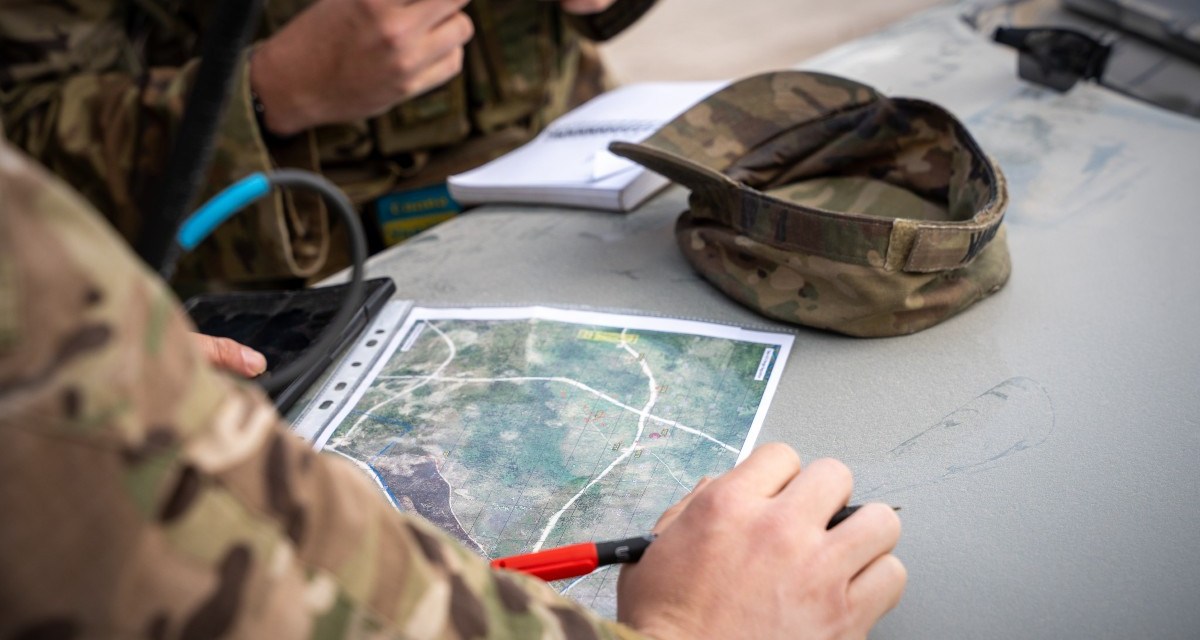
Image credit: Sgt. Tom Lamb, US Army