“Amateurs talk tactics, professionals study logistics.” Recent wargames, studies, and operational analyses consistently reinforce this maxim, warning that future conflicts against peer competitors will be fought under conditions of both contested and congested sustainment. Ports will be targeted, airfields disrupted, and supply routes denied. The lesson is clear: Logistics will not be permissive, and assuming uncontested movement is dangerous.
But this diagnosis suffers from a fatal blind spot.
Much of today’s logistics debate focuses on what happens after production: moving equipment, munitions, and spare parts through contested domains once a crisis begins. This frames logistics as an operational problem of distribution and endurance. Professionals rightly worry about sealift capacity, aerial refueling, forward basing, maintenance cycles, and the survivability of supply nodes under fire.
But true logistics does not begin at the rail station, seaport, or airport; it begins months or years earlier in what might best be described as a prelogistics phase—in the mines, refineries, and factories that create military power in the first place. By the time war matériel is ready to move, this foundational layer may have already been constrained by an adversary, turning off or limiting the material inputs required for surge production.
The United States has experienced this recently. Peacetime supply chain disruptions caused by the pandemic and Chinese export controls created unexpected industrial choke points that slowed production both in civilian and military sectors. These are reminders that the defense industrial base operates on timelines governed by industrial physics, not just operational demands.
Logistics may indeed be an operational problem to solve, but its strategic dimension cannot be ignored. So while logistics professionals focus on moving forces once a fight begins, strategists must widen their aperture.
Before logistics becomes contested conventionally, it is often contested long before at the source. And with China appearing to plan for “national total war,” this means the totality of the American economy, military, and society will likely be targeted.
Quiet Assumptions, Loud Defeat
Modern wargames have done the defense community a service by repeatedly highlighting how fragile logistics becomes under peer competition. A prominent 2023 wargame concluded that in a defense of Taiwan, the United States would likely exhaust its inventory of critical long-range precision munitions in less than one week. Similarly, analyses from RAND underscore the vulnerability of key logistical hubs like Guam and Kadena Air Base to missile strikes, creating immense choke points. Across these scenarios, similar patterns emerge: Transportation networks clog, maintenance backlogs grow, and attrition outpaces resupply. The conclusion is almost always the same: Forces that cannot replenish under pressure will quickly lose combat effectiveness.
Still, in most cases, the industrial base is modeled as latent capacity waiting to be activated.
This assumption is understandable. Wargames illuminate operational choices; they can’t replicate the full complexity of industrial economics. But the result is a systematic blind spot. By focusing on how forces move and sustain themselves once conflict begins, wargames often obscure whether the material foundations required for that sustainment actually exist.
When logistics fails in these games, it typically fails downstream: ports overwhelmed; airlift insufficient; and convoys interdicted. These are real and serious problems. However, they represent only one layer of vulnerability. Another layer sits upstream, where production timelines are measured in years, and where bottlenecks cannot be bypassed through improvisation, heroic effort, or piles of money.
This distinction matters because most constraints on military power are often not visible at the operational level. A shortage of airlift or sealift is obvious. A lack of surge capacity for specialized components is not. Industrial dependencies accumulate quietly, shaped by sourcing decisions, processing concentration, regulatory friction, and capital scarcity. By the time a crisis forces them into view, options are limited.
If wargames are to inform strategy rather than merely rehearse tactics, they must grapple with this reality. Contested logistics is not just a problem of movement under fire. It is a problem of production under constraint. And that constraint is increasingly imposed ahead of conflict.
The Real Contest Begins at the Industrial Base
Once logistics is understood as a problem of production, the strategic picture shifts. The contest moves upstream from the battlefield into the realm of prelogistics, where the shaping of competition begins in peacetime. This is where an adversary can shape outcomes long before any shots are fired.
This dynamic is why competition with China looks fundamentally different from past periods of strategic rivalry. Beijing can impose costs on American military power long before a crisis. China can interdict nonkinetically upstream, quietly and incrementally, by controlling critical industrial inputs inside any modern weapon system or munition. The effect is not dramatic interruption, but delay, uncertainty, and constraint.
This strategy targets the reality that modern military capability depends on specialized materials over which China has established dominance, particularly in midstream processing. For example, while China mines about 60 percent of the world’s rare earth elements, it processes over 90 percent of them into the metals and permanent magnets essential for the guidance systems in Javelin and Tomahawk missiles, radar for most any weapon system, and the electronics within the F-35. Beijing has already demonstrated its willingness to use this leverage. Its 2023 export controls (and subsequent actions) on gallium and germanium were a direct warning shot. These materials are essential for US military systems, including radars, missile seekers, night-vision systems, and satellite solar arrays.
This vulnerability is no longer just anecdotal; it is structural. Recent modeling studies by our research team confirm that in a high-tension environment, the binding constraints on US power are not raw ore availability, but midstream processing bottlenecks. Across multiple high-tension scenarios, the study finds the same materials repeatedly binding US military output—including antimony, tantalum, graphite, and rare earths—where a lack of domestic refining capacity causes cascading failures in munitions and intelligence, surveillance, and reconnaissance platforms. A prime example is lanthanum. While not a fuel itself, this rare earth element is the essential catalyst for the fluid catalytic cracking units that refine crude oil into JP-8. Without the ability to process this input, the industrial base loses the flexibility to surge jet fuel production, effectively capping American airpower at the refinery gates.
This is why solving the problem of contested logistics means it must first be reframed as an industrial problem. For example, it can take about twenty-nine years to bring a new mine on line in America. Likewise, the Pentagon’s process to qualify a new defense-grade component or supplier is a notoriously complex three- to five-year endeavor designed to ensure reliability. Capital remains risk-averse in sectors with episodic demand, and such industrial constraints simply do not respond to operational urgency. From this perspective, China’s approach to competition looks less like traditional interdiction and more like anticipatory shaping. By controlling material inputs and midstream processing, Beijing can influence the rate at which the United States converts economic capacity into military power.
For strategists, the implication is stark. The decisive logistics contest may already be underway, and it means there might be not much to move from “forts to ports” in a crisis. Until industrial base resilience is treated as a core element of strategy rather than a supporting concern, the United States will discover homeland logistical and supply chain problems when trying to project power.
Why Real Strategists Talk Industrial Base
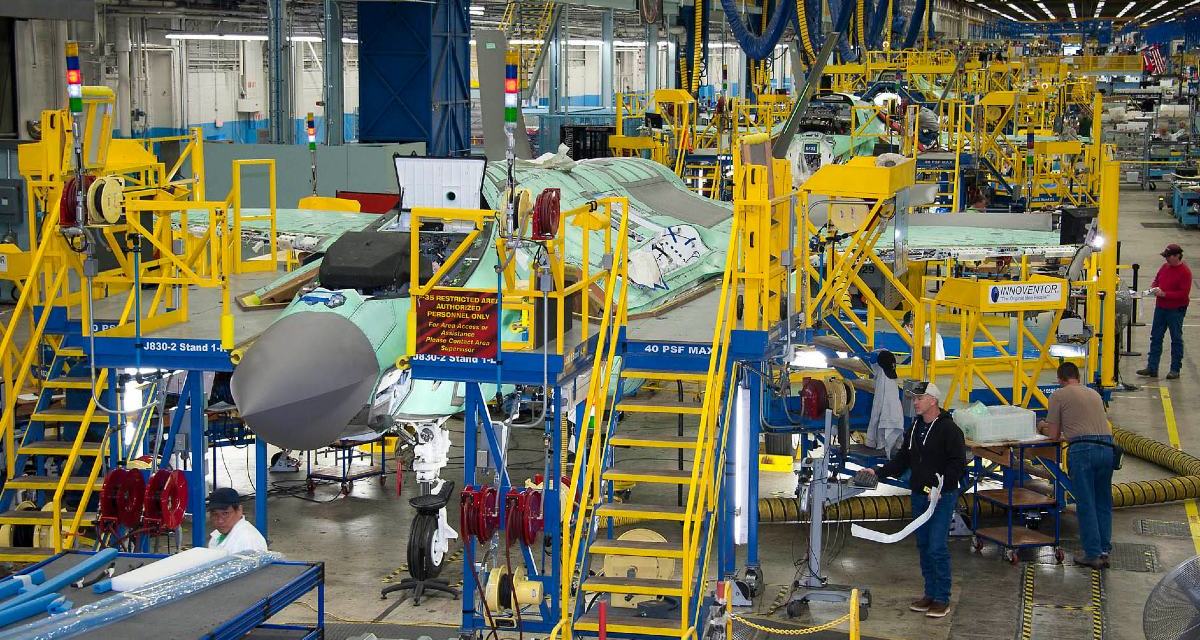
Efforts to arm Ukraine revealed that dormant production lines for Stinger missiles would take years to restart due to component obsolescence. Submarine manufacturing has struggled to meet production goals due to shortages in skilled labor and specialized components. And the F-35 program has faced delays trying to remove Chinese parts. These were not wartime shocks.
This distinction about the base of logistics matters because it reshapes how we think about risk and competition. An adversary that can slow production or deny surge gains leverage without firing a shot. The contest shifts from battlefield interdiction to anticipatory shaping. By the time operational logistics comes under fire, the strategic problem will already have been put firmly in place in the form of constraints imposed by industrial realities and driven by key decisions made years earlier.
For the United States, this means industrial base resilience cannot be a supporting function but must be integrated into how strategists think about deterrence, force design, and campaign endurance. Wargames that illuminate congested ports but assume unconstrained production diagnose failure at the wrong layer of the system.
Professional logistics work becomes even more critical where margins are thin. But strategic neglect of the industrial foundations severely compromises the nation’s ability to prevail once a war breaks out. Moving faster does not help if there is less war matériel to move.
The uncomfortable truth is that choices about future military power exist outside traditional defense debates. They are embedded in trade policy, permitting timelines, and capital allocation that few strategists are trained to analyze. Yet these choices determine whether the United States can translate economic strength into military power under pressure.
The old maxim is now incomplete. Mastering prelogistics—the industrial base itself—is now also the domain of the strategist. In this new era, talking logistics alone is for amateurs; real warfighting professionals and strategists have to talk industrial base.
Macdonald Amoah is an independent researcher with interests across critical mineral supply chains, advanced manufacturing gaps, the industrial base, and geopolitical risks in the mining sector.
Morgan D. Bazilian is the director of the Payne Institute for Public Policy and professor at the Colorado School of Mines, with over thirty years of experience in global energy policy and investment. A former World Bank lead energy specialist and senior diplomat at the UN, he has held roles in the Irish government and advisory positions with the World Economic Forum and the International Energy Agency. A Fulbright fellow, he has published widely on energy security and international affairs.
Lt. Col. Jahara “Franky” Matisek (PhD) is a US Air Force command pilot, nonresident research fellow at the US Naval War College and the Payne Institute for Public Policy, and a visiting scholar at Northwestern University. He is the most published active duty officer currently serving, with over 150 articles on industrial base issues, strategy, and warfare.
The views expressed are those of the authors and do not reflect the official position of the United States Military Academy, Department of the Army, or Department of Defense.