
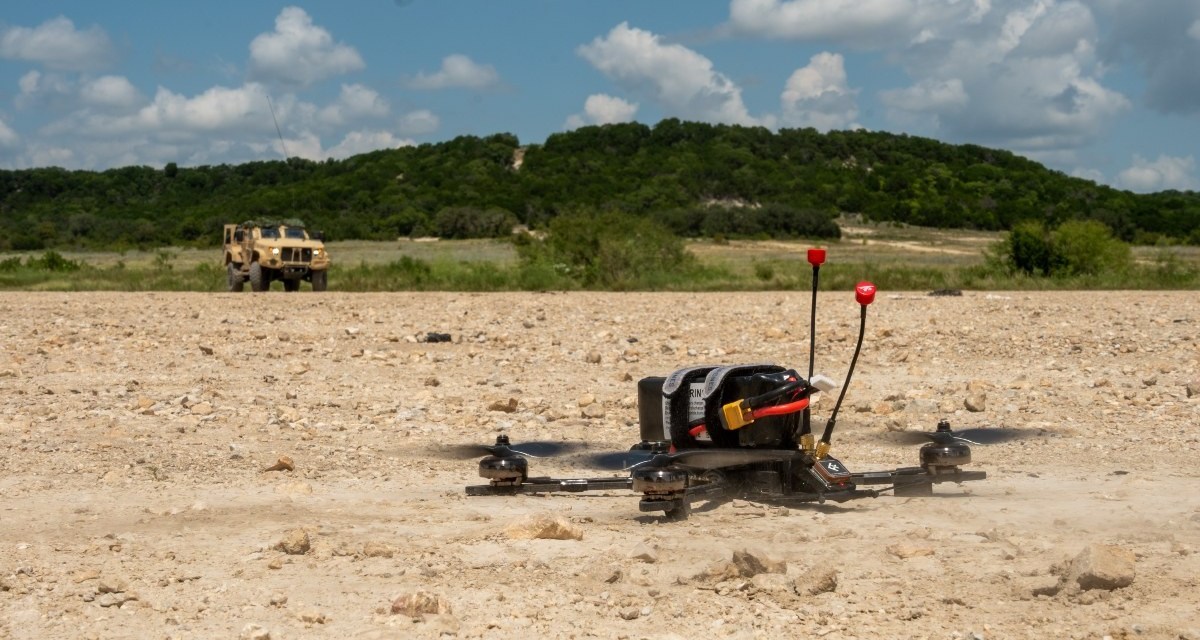
The ridgelines were jagged and unforgiving, carved by centuries of wind and water. On a narrow plateau above a coastal highway, Task Force Wolfhound had just completed hasty defensive preparations. The task force, built around a reinforced infantry battalion with attached fires, engineers, and expeditionary sustainment support, faced an adversary division equipped with armor, long-range artillery, and rotary-wing aviation in support, advancing south. Task Force Wolfhound had been deployed on a Pacific Pathways rotation in US Indo-Pacific Command’s area of responsibility, but was quickly caught in the middle of a cascade of geopolitical events. The venerated Wolfhounds of the 25th Infantry Division rapidly transitioned from executing operations in competition to doing so in crisis—and now found themselves on the cusp of armed conflict. By every conventional measure, Task Force Wolfhound was outnumbered and outgunned, but it possessed a decisive edge: small unmanned aircraft systems (sUAS) integrated at echelon from fire teams to the battalion headquarters. As a derivative of the Army Transformation Initiative, efforts within the Army’s Maneuver Capabilities Development and Integration Directorate, and Project Convergence, the Wolfhounds were determined to not relive the memory of Task Force Smith.
Upon receiving the directive to dig in and fight, the task force commander had ordered every company to seed engagement areas with hundreds of sUAS of varying size and purpose. Soldiers referred to it as “the swarm,” though in reality it was a carefully orchestrated ecosystem of sensors, decoys, and strike-capable platforms. Some drones were the size of a person’s hand, operating at treetop level and tasked with finding enemy scouts and screening elements. Others were Group 2 quadcopters, equipped with thermal cameras and loitering munitions. Still others carried electronic warfare payloads to jam adversary GPS signals or spoof targeting radars. Critically, these systems were operated at the company, platoon, and squad levels, allowing leaders to direct their employment to meet commander’s intent.
The Wolfhounds built their engagement areas not only on terrain, obstacles, and fires, but on data. By midafternoon, drone operators had mapped every approach route with high-resolution imagery, tagging choke points where engineers emplaced obstacles and mining systems. Real-time aerial feeds confirmed when enemy reconnaissance patrols attempted to breach these obstacles. A platoon leader from Borzoi Company received a drone alert showing adversary sappers clearing a lane through a minefield. Within minutes, he retasked a loitering munition to destroy their breaching vehicle, forcing the enemy main body to halt. This was the essence of Task Force Wolfhound’s defense: drones extending eyes, ears, and weapons far forward of the line of contact, disrupting tempo before the first artillery rounds landed.
The task force did not view sUAS as stand-alone assets, but as a bridge across domains. The fires cell coordinated with higher headquarters to align long-range precision fires on targets first identified by drones. The electronic warfare section, using drone-mounted jammers, disrupted the enemy’s tactical radio nets long enough for Wolfhound artillery to execute time-on-target missions. At sea, a joint task force destroyer adjusted its missile defense posture based on drone intelligence of adversary drone launch patterns. In the air, US Air Force strike aircraft followed drone cues to deliver standoff precision strikes. In this way, Wolfhound’s sUAS employment transformed a local fight into a truly joint, multidomain operation. The sUAS were not simply overhead cameras; they were extensions of the task force’s fires, information, and maneuver systems.
Another element of the swarm focused on deception. Hundreds of 3D printed, ultracheap drones, barely more than styrofoam wings and GPS chips, buzzed toward enemy formations broadcasting false signatures. Some carried heat packs to mimic vehicle infrared signatures; others transmitted spoofed radio traffic suggesting a US mechanized brigade was massing just beyond the ridgeline. The adversary’s radar operators reported swarms of contacts that cluttered their picture, forcing them to extend radar queuing and emission while expending expensive surface-to-air missiles on worthless targets.
On the ground, infantry squads carried small quadcopters as organic kit, no different from radios or night vision. When enemy forces launched an armored thrust along the highway, Coldsteel Company deployed a screen of drones to fix their movement. Drone operators identified gaps between enemy vehicles and relayed target grids directly to Javelin and 120-millimeter mortar teams. A flight of one-way attack drones harassed the lead tanks, forcing them to button up and slow down. Meanwhile, heavier Group 3 systems provided target-quality data to a regionally aligned multidomain task force with seamless integration. Instead of waiting for higher headquarters reconnaissance, platoon leaders had persistent, localized intelligence, surveillance, and reconnaissance at their fingertips, collapsing the kill chain from minutes to seconds and significantly expanding their combat power and the lethality of their engagement areas.
Even in the chaos of battle, Task Force Wolfhound employed disciplined risk management. Each company maintained a restricted operating zone overlay—ensuring drones avoided fratricide with friendly artillery trajectories—that were nested with their engagement area planning. Airspace coordination measures were constantly updated via digital broadcasts, enabling safe layering of sUAS with crewed aviation. The risk of midair collisions was real, but through disciplined planning and real-time airspace deconfliction, the swarm operated without grounding Army helicopters or Air Force jets.
From above, it looked like the battlefield itself had turned against the enemy as every gap was exploited and every vulnerability seized. When the smoke cleared, the larger enemy formation was in disarray, its advantage in numbers and equipment squandered. Task Force Wolfhound held the ridgeline. Following the battle, to the Wolfhounds it was clear: Drones had not just provided an asymmetric advantage; their employment represented the culmination of a doctrinal shift in maneuver warfare and the adoption of a facet of the revolution in military affairs by the US Army.

Task Force Wolfhound’s fictional battle underscores several truths. First, sUAS can extend the reach and lethality of conventional units, transforming small formations into multidomain effects generators. Second, effective employment of unmanned platforms requires more than the hardware. The Army must adapt and innovate doctrine, risk management, and synchronization of fires and maneuver planning to incorporate massed and widespread sUAS employment. Finally, installations and garrisons must pave the way for the adoption of unmanned platforms by brigade combat teams by providing training airspace, facilities, and air traffic management systems.
In the last two decades, the US Army has made remarkable progress in fielding unmanned systems, from large fixed-wing platforms like the MQ-1C Gray Eagle to hand-launched reconnaissance drones such as the RQ-11 Raven. Yet, despite their rapid growth and operational utility, unmanned systems still occupy a niche in Army training culture. They are too often treated as exotic add-ons, brought out for specific missions or rehearsed in controlled conditions, rather than as ubiquitous, everyday tools of combined arms warfare. Nowhere is this gap more apparent than with sUAS. Platforms such as quadcopters, small fixed-wings, or hybrid designs have more than demonstrated their utility in large-scale combat in Ukraine. sUAS have provided palpable advantages in surveillance, targeting, and battlefield coordination as they are cheap, adaptable, and, in the hands of well-trained soldiers, lethal. If the Army is serious about winning in large-scale combat operations against peer adversaries, it must build an institution-wide culture of sUAS competence. This cannot be achieved by sporadic contractor support, stovepiped training events, or leaving it to individual units to improvise. It requires systemic change: Army installations and garrisons must become the hubs of sUAS training. They must provide the airspace, the infrastructure, the facilities, and the regulatory frameworks that allow soldiers to fly drones frequently, in realistic conditions, at scale. In short, the Army must let them fly.
Modern large-scale combat operations will be characterized by speed, dispersion, and contested domains. Units will have to operate across wide frontages, under constant surveillance, and with degraded communications. In that environment, having eyes in the sky at the squad and platoon level will not be a luxury, but a necessity for survival. Small drones provide real-time reconnaissance, enabling squads to see over ridgelines, inside buildings, and across open terrain without exposing soldiers. In Ukraine, they cue indirect fires, relay communications, identify enemy ambushes, and even deliver lightweight munitions. Just as radios transformed maneuver warfare in the twentieth century, drones are transforming it in the twenty-first. A rifle squad without a drone in 2025 is as handicapped as a rifle squad without a radio in 1945.
Adversaries already understand this. Russian and Ukrainian units are flying thousands of drones daily. Many are commercial, off-the-shelf quadcopters, while others are military-grade systems integrated into fire support networks. The lesson is unambiguous: sUAS are no longer a boutique capability. They are mass-produced, rapidly lost, and rapidly replaced. Their power lies in their ubiquity. To keep pace, the US Army must normalize their use across all echelons. But normalization requires training. Soldiers must be comfortable assembling, flying, troubleshooting, and repairing drones under pressure. Leaders must integrate drone feeds into decision-making cycles and fire missions. Units must practice with dozens of drones in the air at once and not just one or two at a time. All of this demands places to fly, people to manage risk, and facilities to sustain operations. This is where Army garrisons come in.
Today, Army units receive limited sUAS training with certification often occurring in initial training events, after which operators fly only sporadically, constrained by airspace restrictions and limited facilities. Units rarely get the chance to practice mass employment of drones, test operations in electronic warfare environments, or integrate them into combined arms teams. Installations themselves are not configured for large-scale drone use. Airspace is tightly controlled with strict separation between manned aviation, artillery, and ground maneuver. Small drones fall through the cracks. Army posts are already the backbone of training culture; they manage ranges, maneuver corridors, airspace, and safety oversight for live-fire systems. With targeted investments and policy reforms, they can do the same for drones.
The first requirement for scaling sUAS training is access to land and airspace. Soldiers need to fly drones often and in varied conditions, but installations must enable this while safeguarding other aviation, protecting civilians, and managing risk. The key tools are NOTAMs (notices to airmen), restricted operating zones (ROZs), and robust risk assessment protocols. NOTAMs are the Federal Aviation Administration’s means of sending real-time alerts to pilots and flight crews regarding hazards or new flight activities. Issuing NOTAMs is routine for live-fire events or aviation training. The same logic should apply to sUAS. Installations should coordinate with the FAA to publish standing NOTAMs for training areas and ranges to support sUAS training. There is also potential to assist in airspace control and risk mitigation through operator programing and geofencing of sUAS systems. Additionally, disabling return-to-home functions and pilot flight protocols such as maximum flight ceilings will assist garrisons in ensuring safe training.
ROZs provide additional flexibility. By designating sections of training areas as permanent or on-demand zones for sUAS the Army can begin to generate sUAS capability for combat at the tactical, small-unit level. Garrisons can and should aggressively move to create safe bubbles where drones fly without interfering with helicopters, artillery, or civilian traffic. These ROZs should be scalable from company-level boxes to brigade-wide corridors, allowing dozens of drones to operate simultaneously, and designed to make sUAS flight as easy as possible for the lowest echelon. By institutionalizing NOTAMs, ROZs, and risk assessments, installations can transition from ad hoc drone flights to a predictable, worry-free training environment. Units, garrisons, and the Army as an institution should also not underestimate the value of flight simulator training. At relatively low cost, formations can acquire simulator programs, goggles, and controllers to give soldiers the opportunity to practice, rehearse, and gain skill in a risk-free environment.
Garrisons need to commit to the creation of dedicated drone training areas. Drone operators need the facilities and space to fly. Targets, courses, nets, and enclosed drone barns would improve the accessibility and effectiveness of sUAS pilot training. Garrisons could aggressively strive to build drone courses that replicate operational environments, such as the construction of standing trench lines. Which garrison will be the first to introduce moving targets dedicated to sUAS employment to provide soldiers a venue to practice terminal flight and strike piloting skills? Employment of live munitions from sUAS adds additional considerations, including updated environmental impact statements, demolition pads for live munitions, and the development of risk management and safety procedures like crash cone and surface danger zone planning. The Army must get to a place where armed one-way attack flights are akin to running a mortar or javelin range.
The future battlefield will be awash in drones—ours and the enemy’s. To win, we must train to see, strike, and survive better than our adversaries do. That requires installations built to normalize drone proficiency, not relegate it to the periphery. Let drone sorties be as routine as live-fire events, drone training areas as prevalent as maneuver live-fire ranges, and drone feeds as indispensable as radio channels. Empower every team leader, squad leader, platoon leader, and company commander to train the skills that future war will demand. Our adversaries aren’t waiting. The Army shouldn’t either. Let them fly.
Major Charlie Phelps is a Special Forces officer and currently serves as a company commander in 10th Special Forces Group (Airborne).
The views expressed are those of the author and do not reflect the official position of the United States Military Academy, Department of the Army, or Department of Defense.
Image credit: Spc. Hector Blanco, US Army