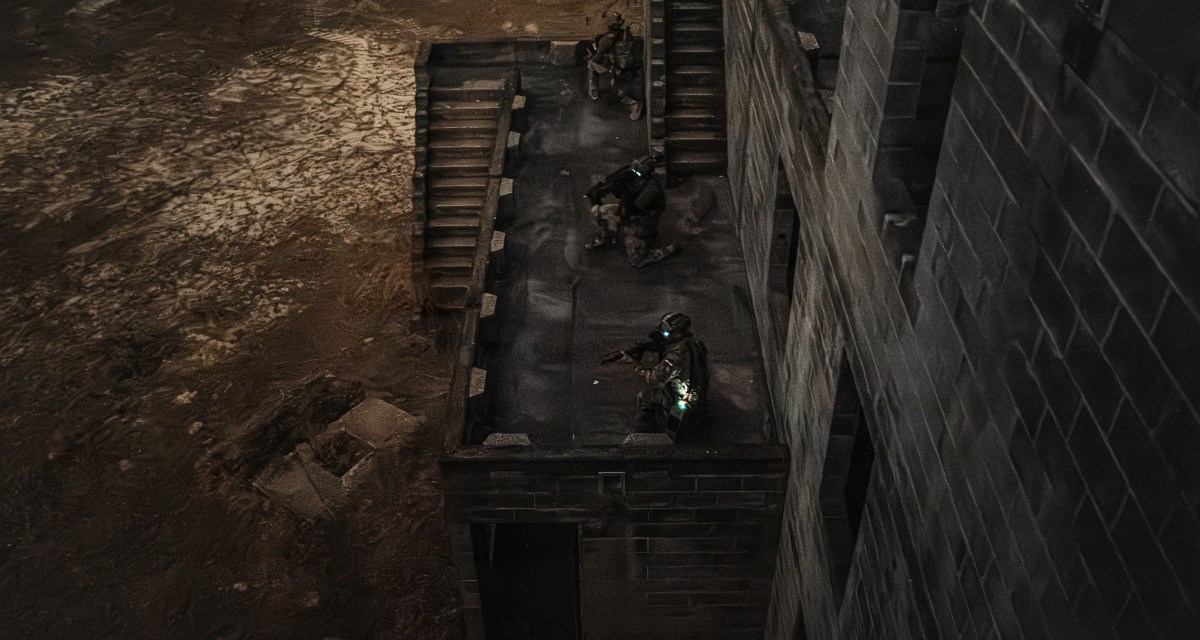
A sprawling urban center deep within contested territory had become a critical node in the adversary’s war machine. Captured and subsequently retained by enemy forces during the initial phases of the conflict, its dense urban terrain concealed command-and-control facilities, logistics hubs, and a key air defense system that shielded the surrounding region from US and allied airpower. For weeks, satellite imagery and electronic intelligence had confirmed that the city was the linchpin of the enemy’s ability to sustain operations across wide sections of the front. The joint force commander needed the enemy capabilities in the city to be neutralized, but a combination of distance, terrain, and limited forces presented significant obstacles. The solution: a US Army Special Forces team tasked with conducting deep area operations and deep strike to disrupt, degrade, and dismantle the enemy’s capabilities from within—Operation Iron Shadow.
The team infiltrated the city under the cover of darkness. Their insertion was facilitated by local resistance fighters who had been cultivated during the past several years of competition, when tensions were horizon, war loomed on the horizon, but conventional warfare had yet to break out in the region. The team consisted of a dozen operators with expertise in demolitions, communications, reconnaissance, medical training, and advanced weapons employment. Each operator carried specialized equipment including a diverse array of first-person-view drones.
Upon arrival in city, the team established a support site in an abandoned apartment complex overlooking the city’s central district. From there, they launched their first small drones, which buzzed silently through the maze of alleys and rooftops, scanning for enemy patrols, identifying key infrastructure, and pinpointing the location of the air defense system’s radar array. The drones revealed a heavily guarded logistics hub where ammunition and fuel were stockpiled, as well as a command center hidden within a municipal building. The drones’ advanced sensors reduced their operating signature while semiautonomously generating targeting data.
With their targets identified, the team initiated phase one of its mission: sabotage. Under the cover of night, the demolitions experts infiltrated the logistics hub, planting timed explosive charges on fuel tanks and ammunition stockpiles. As the operators exfiltrated the objective, the explosions lit up the night sky, sending plumes of fire and smoke into the air. Enemy reinforcements scrambled toward the logistics hub, unknowingly leaving other critical sites vulnerable.
Phase two began immediately. Using the chaos induced at the logistics point as a diversion, the team leader led the team to the municipal building housing the command center. Upon reaching the target, a sniper eliminated two sentries, clearing the way for the demolitions experts to breach the facility. Inside, the team neutralized enemy personnel and secured critical intelligence from the command center’s servers. They planted additional charges to ensure the facility was destroyed.
The final phase targeted the air defense system’s radar array. Using the reconnaissance drones to find and fix the crucial components of the air defense system, the team piloted six attack drone systems to deliver precision strikes to disable critical radars, launchers, and the control center for the system. These strikes occurred within minutes of a joint force sortie that had layered multidomain effects rendering the defenses completely overwhelmed. As the team exfiltrated the city, the operators watched from a safe distance as precision-guided munitions obliterated remaining enemy infrastructure.
Operation Iron Shadow was a resounding success. The sabotage of the logistics hub disrupted enemy forces’ supply chain, the raid on the command center severed their ability to coordinate operations, and the destruction of the air defense system enabled the joint force to regain local air superiority. This operation shaped the operational environment to allow a conventional corps to regain momentum in the offensive while also illuminating additional targets for processing by the regionally aligned multidomain task force.

The global security environment is reshaping, forcing military planners to contend with the prospects of large-scale conflict. That has led to significant debate regarding the future of US Army Special Forces and their role in such a conflict. The fictional Operation Iron Shadow points toward a near future in which that role is clearly defined and Special Forces are as indispensable as they were during twenty years of low-intensity conflict during America’s post-9/11 wars. Adversarial states such as China and Russia have developed advanced capabilities, including antiaccess and area-denial systems, cyber warfare tools, and robust command-and-control networks, all designed to challenge the ability of the United States and its allies to project power and achieve dominance. While conventional forces remain the primary means of achieving decisive outcomes in this contested environment, Army Special Forces offer unique capabilities that complement and amplify the effectiveness of the joint force. Specifically, by conducting deep area operations and deep strike, Special Forces can disrupt adversary systems, shape the battlespace, and create dilemmas for enemy commanders well beyond division and corps fire support coordination lines. These operations, grounded in Special Forces’ expertise in unconventional warfare, extend the joint force’s operational reach and enable it to achieve strategic objectives in ways that conventional forces alone cannot.
Deep Area Operations
The value of Special Forces in large-scale conflict is rooted partly in their ability to operate in the competitive gray zone, the space between peace and war, where adversaries often seek to achieve their objectives without triggering a full-scale military response. Special Forces’ expertise in unconventional warfare and working “by, with, and through” local partners presents options for action at the onset of hostilities to set the conditions for success in large-scale conflict. These include deep area operations—activities conducted in enemy forces’ rear areas to disrupt their ability to command, sustain, and maneuver forces—which have been a hallmark of Special Forces for decades.
Special Forces teams are uniquely trained to prepare the battlespace in denied areas through reconnaissance, intelligence collection, and relationship-building with local populations. This enables commanders to make informed decisions and synchronize operations across a given battlespace. For example, during the Gulf War, Special Forces teams infiltrated deep into Iraqi territory to conduct reconnaissance and provide targeting data for coalition airstrikes. These efforts contributed to degrading Iraq’s command-and-control capabilities and setting the stage for the ground invasion.
In large-scale conflict, Special Forces can also conduct unconventional warfare to destabilize adversaries from within. By organizing, training, and advising resistance movements or insurgent forces, Special Forces create irregular maneuver elements that tie down enemy forces and disrupt their ability to mass combat power. These efforts force adversaries to divert resources and attention away from the main effort, creating opportunities for the joint force to exploit. A historical example of this came during the early stages of Operation Enduring Freedom. Special Forces teams worked with the Northern Alliance to overthrow the Taliban regime, leveraging local forces to achieve strategic objectives with a limited US footprint. In a future large-scale conflict, Special Forces would employ similar tactics, in support of joint force objectives, to work with resistance movements in areas occupied by a peer adversary.
Special Forces’ ability to operate undetected by an adversary in contested environments allows them to establish networks and build relationships that endure over time. These networks become a lever to influence key populations, gather intelligence, and conduct sabotage operations, all of which shape the operational environment in favor of the joint force. For example, during World War II, the Office of Strategic Services, a precursor to modern Special Forces, worked with resistance movements in Nazi-occupied Europe to disrupt German operations and gather intelligence for the Allied invasion of Normandy. In a contemporary context, Special Forces could play a similar role in preparing the battlespace for a conflict with a peer adversary, such as China in the Indo-Pacific region.
Deep Strike
Deep strike complements deep area operations by targeting high-value assets, critical infrastructure, and key nodes within these systems. This capability can allow Special Forces to degrade the enemy’s ability to fight effectively while enabling the joint force to seize the initiative. Deep strike involves targeting critical nodes and high-value assets within the enemy’s systems to achieve disproportionate effects. Special Forces teams are uniquely suited for these missions due to their ability to infiltrate deep into enemy territory, operate autonomously, and integrate with joint fires and cyber capabilities. Deep strike operations complement conventional fires by extending the joint force’s reach and enabling precision targeting in denied areas.
High-value assets, such as command-and-control nodes, logistics hubs, and air defense systems, are often difficult to locate or access with conventional forces, making Special Forces an essential enabler of precision fires. For example, during the 2003 invasion of Iraq, Special Forces teams conducted reconnaissance missions to locate and destroy Iraqi Scud missile launchers, which posed a significant threat to coalition forces and regional stability. These missions required the teams to operate deep behind enemy lines, often with limited support, to achieve key objectives and enable the operational campaign plan.
Special Forces can also disrupt the enemy’s ability to command and control forces by targeting critical infrastructure, communications networks, and key leaders. These operations degrade enemy forces’ ability to coordinate their efforts, creating cascading effects. For example, during the Vietnam War, Special Forces teams conducted cross-border operations into Laos and Cambodia to disrupt the Ho Chi Minh Trail, a critical supply route for North Vietnamese forces. These operations forced enemy leaders to divert resources and attention away from the main effort, reducing their ability to sustain combat operations in South Vietnam. In addition to reconnaissance and sabotage, Special Forces teams are trained to execute direct-action missions against key objectives. Deep strike is characterized by precision and speed, minimizing collateral damage while achieving maximum operational effects.
It is important to acknowledge two critical factors that will influence Special Forces’ ability to generate effects for the joint force by operating in deep areas: risk of compromise and risk to force. In the age of smartphones, Discord servers, and the application of technology to internal security efforts, the likelihood of compromise in some operating environments may be unacceptable. It will be critical for units of action and commanders at echelon to assess the feasibility of penetration or access to deep areas and align resources to support infiltration. Additionally, operations behind enemy lines, potentially in the sovereign territory of an adversary, naturally limit traditional support vectors such as medical evacuation and quick reaction forces. If a unit of action suffers a nonambulatory injury behind enemy lines, are team members prepared to leave that casualty in place? To what degree are commanders potentially inducing moral injury if teams are compelled to violate the code of never leaving a fallen comrade.
These considerations are not negligible. And yet they do not change the fundamental truth that in large-scale conflict, Special Forces are uniquely positioned to conduct deep area operations and deep strike, thereby providing the joint force with critical capabilities that extend operational reach, disrupt adversary systems, and shape the battlespace. As strategic competition evolves and the possibility of a large-scale war remains on the horizon, the role of Special Forces in such a war will continue to be debated. What should not be debated is whether these forces have unique capabilities that, employed properly, will become increasingly important. Nowhere is that more true than in deep areas.
Major Charlie Phelps is a Special Forces officer and currently serves as a company commander in 10th Special Forces Group (Airborne).
Chief Warrant Officer 3 Joe Kelley is a Special Forces warrant officer and currently serves as a company warrant officer in 10th Special Forces Group (Airborne).
Sergeant Major Brian Fosjord is a Special Forces noncommissioned officer and currently serves as a company sergeant major in 10th Special Forces Group (Airborne).
Image credit: Pfc. Edgar Martinez, US Army