At a recent defense conference I was at, a senior military leader stood before a packed auditorium and made a compelling argument. America’s competitive advantage, he explained, was not its aircraft, ships, satellites, or weapons systems; it was its people. More specifically, it was their ability to think creatively and adapt faster than our adversaries. The audience nodded in agreement. Then the conference returned to discussing artificial intelligence, autonomous systems, hypersonics, acquisition reform, and modernization. Nobody seemed to notice the contradiction. If adaptive thinking is truly our competitive advantage, why do we spend so little time discussing how to create it?
This question has followed me through a decade of working with the US military, NATO, and allied defense organizations. Whether the conversation is in Washington or Brussels, I hear remarkably consistent language from senior leaders. The future will be uncertain. Technology will continue to accelerate. The next conflict will not look like the last one. Success will belong to those who adapt faster than their opponents. I agree. What I find less convincing is whether our institutions behave as though they believe it.
I call this the adaptability gap: the distance between how much an organization says adaptability matters and how much it invests in producing adaptive people. Every organization claims a competitive advantage. The interesting question is whether its investments support that claim. A fulfillment company succeeds through consistency, efficiency, and reliability, while a biotechnology company succeeds through discovery. One invests heavily in process discipline; the other invests heavily in experimentation, advanced education, and research. Neither approach is inherently better. Each reflects a different theory of competitive advantage. The important point is that competitive advantage eventually appears in the budget. Show me where an organization spends its money, develops its people, and rewards performance, and I can usually tell you what it believes will make it successful. A competitive advantage is not what you admire; it is what you fund.
This is where the military faces a difficult question. Senior leaders routinely argue that our competitive advantage is not technology, platforms, or weapons systems; it is our ability to think, learn, and adapt faster than our adversaries. If that is true, then adaptability is not simply a leadership trait; it is a strategic asset. And strategic assets are supposed to leave footprints. They appear in recruiting priorities, promotion systems, developmental assignments, professional military education, command screening, experimentation programs, and budgets. No CEO would tell investors that innovation is the company’s competitive advantage while being unable to explain how innovators are identified, developed, rewarded, and retained. Yet military leaders routinely describe adaptability as decisive without being able to identify where, how, or how much they invest in producing adaptive thinkers. That is the adaptability gap, and it matters because the future is rewarding adaptation, not answers.
Show Me Your Budget
As a business school professor, I’ve spent more than three decades advising organizations celebrated for their ability to innovate and adapt. One lesson appears with remarkable consistency: Organizations rarely fail because they misunderstand what creates competitive advantage; they fail because they overestimate how much of it they actually possess. I saw this dynamic up close while serving as a visiting professor at the Helsinki School of Economics, as Finland’s leading technology company, Nokia, confronted a profound test of its adaptability.
At the time, Nokia was widely regarded as one of the most innovative companies in the world. It had exceptional engineers, talented leaders, and a culture that supposedly thrived on innovation. When the smartphone revolution arrived, the problem was not that Nokia failed to recognize the threat. The problem was that the organization could not adapt as quickly as circumstances demanded. Internal silos slowed decisions. Existing incentives favored protecting current successes over creating future ones. The adaptive capability Nokia believed it possessed turned out to be weaker than the company imagined. The warning signs had been visible for years.
Budgets are beliefs made visible. If talent is your competitive advantage, show me your recruiting budget. If innovation is your competitive advantage, show me your experimentation budget. If adaptability is your competitive advantage, show me what you spend identifying, developing, rewarding, and promoting adaptive people. This is where claims of competitive advantage are put to the test—not in speeches or strategy documents, but in investments. And this is where the adaptability gap becomes visible.
Over the last decade, I’ve watched military teams solve problems in ninety days that larger organizations had struggled with for years. They were not better funded. They were not given extraordinary authorities. They simply had permission to challenge assumptions, experiment, and adapt in real time. The lesson was always the same: Adaptability improves when it is deliberately developed; it declines when it is merely admired.
If adaptability is becoming a warfighting requirement, it should leave a visible footprint across the force. Every critical capability does. Aircraft have pilot pipelines. Special operations has assessment and selection. Cyber has dedicated career fields and training commands. If adaptability is truly our competitive advantage, where is its footprint? Where do we identify it, develop it, reward it, and promote it? Or do we simply assume it will emerge when we need it?
Every military capability competes for resources. If adaptability is truly our competitive advantage, then it should compete successfully for resources as well. Otherwise, the adaptability gap grows. The problem is that organizations rarely discover these gaps until a crisis exposes them. That is what I witnessed at Nokia. The danger for the military is not that we underestimate adaptability. It is that we overestimate how much of it we have built.
Closing the Adaptability Gap
If adaptability is truly a quality that enhances warfighting, then leaders should treat it like one. Not by talking about it, but by testing for it, developing it, and rewarding it.
First, change what you measure.
Most military evaluation systems measure execution, compliance, and competence under expected conditions. Adaptability reveals itself under unexpected ones. An AI system recommends a course of action that contradicts doctrine. A new enemy tactic renders a trusted procedure obsolete. A mission changes halfway through execution. The question is no longer whether soldiers, leaders, and units can execute the plan. The question is whether they can recognize what has changed, update their assumptions, and adapt faster than the adversary. If adaptability is our competitive advantage, that is what we should be measuring.
Second, change what you practice.
Most exercises are designed to practice executing plans. Far fewer are designed to practice changing them. During your next rehearsal, tabletop exercise, or wargame, deliberately invalidate a critical assumption. Remove a key capability. Introduce conflicting intelligence. Change the mission. Force the team to rethink rather than execute. Adaptability develops when people operate under uncertainty and discover that yesterday’s assumptions no longer fit today’s reality. Future adversaries are unlikely to attack our strengths. They are far more likely to exploit our assumptions.
Third, change what you reward.
Most organizations reward flawless execution. Adaptive organizations also reward learning. At your next awards ceremony, recognize the team that identified a flawed assumption before it became an operational failure. Recognize the experiment that prevented a larger mistake. Recognize the leader who changed course when evidence proved the original plan wrong. What gets rewarded becomes culture. What becomes culture eventually becomes capability.
I believe senior leaders are correct when they say adaptability is our competitive advantage. But that belief raises a difficult question: If adaptability is our competitive advantage, where exactly are we building it? More importantly, are we building enough of it, fast enough?
Artificial intelligence is compressing decision cycles. Autonomous systems are reshaping the battlefield. Adversaries are adapting in days, sometimes hours. Yet many of our systems for recruiting, developing, evaluating, and promoting people still move at the pace of a more predictable era. We clearly produce adaptive leaders. But we do not yet produce adaptability deliberately, systematically, and at scale.
Process improvement helps us execute today’s plan more efficiently. Adaptability helps us recognize when the plan, the assumptions behind it, or even the problem itself has changed. One makes us better at doing what we already know. The other prepares us for what we do not yet understand. Those are not the same thing. Producing more adaptive leaders is only part of the task. We must build a force that adapts faster than its adversaries.
That requires treating adaptability not as a leadership slogan, but as a strategic requirement that must be deliberately built into the force. The adaptability gap is the distance between what we claim gives us advantage and what we actually invest in developing. It is the gap between rhetoric and resources, between aspiration and capability. The question is not whether military leaders value adaptability. The question is whether our systems do. Do our recruiting systems identify it? Do our evaluations measure it? Do our promotion boards reward it? Do our command-selection processes accelerate it?
Because the adaptability gap is not measured by what we say at conferences. It is measured by who gets recruited, who gets promoted, who gets funded, and who gets command. The next conflict will not care whether we intended to build a more adaptable force. It will reveal whether we actually did.
Jeff DeGraff is clinical professor of management and organizations at the Ross School of Business, University of Michigan. He has trained innovation leaders in the tech, biotech, and defense sectors, and developed programs used by the US military and NATO in over forty-five countries.
The views expressed are those of the author and do not reflect the official position of the United States Military Academy, Department of the Army, or Department of Defense.
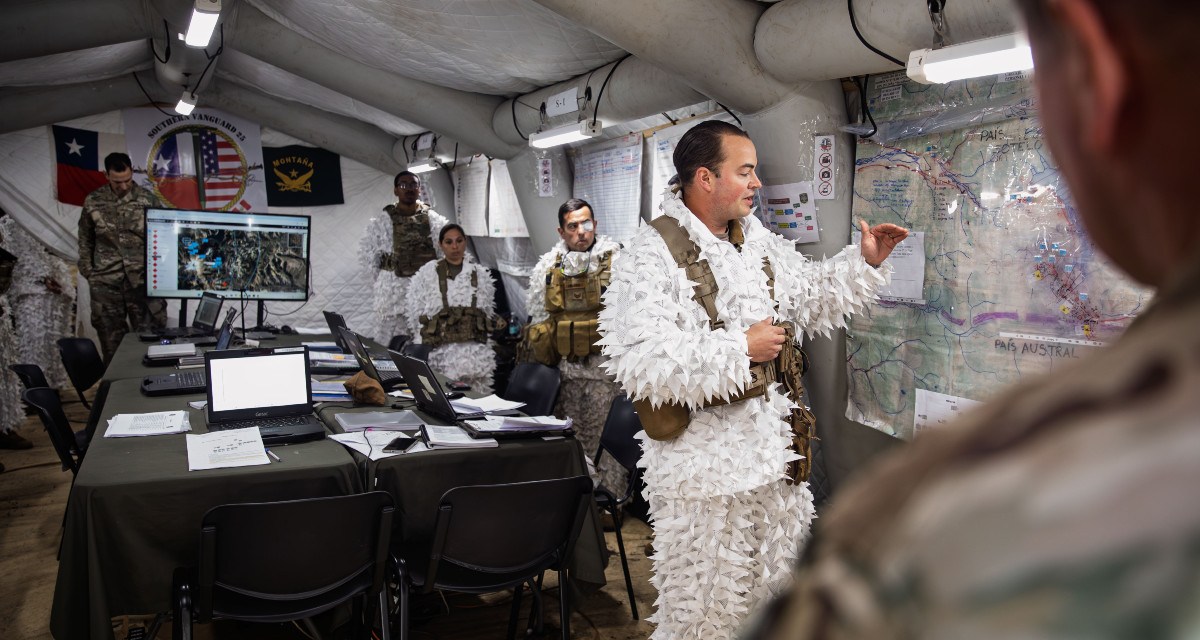
Image credit: Sgt. Jean Sanon, US Army