If the war in Ukraine has reinforced one truism of modern warfare, it is that artillery remains the king of battle. Its central role in Ukrainian combat operations has been sustained by the commitment of Ukraine’s international supporters. The extensive provision of artillery shells from the United States and other NATO members led to serious concerns about the depth of ammunition stockpiles and shell manufacturing capacity in both the United States and Europe. A production surge has at least partly mitigated concerns this year, but there remains a separate issue that has received far less public attention and yet is a critical one for NATO: ammunition interoperability.
Interoperability is a central tenet of NATO, and the key to interoperability is standardization. The alliance’s method of choice for achieving this is a set of standardization agreements, or STANAGs. Moreover, in 2009, the United States and four other major NATO members—France, Germany, Italy, and the United Kingdom, signed the Joint Ballistics Memorandum of Understanding (JBMoU), intended to “maximize the potential for the achievement of Interchangeability of the Participants’ 155MM Weapon and Ammunition Systems.” The war in Ukraine, however, has been a unique test of NATO 155-millimeter ammunition compatibility in a way that was not foreseen when STANAGS and the JBMoU were written. Instead of a national army using a supply of ammunition from another alliance nation in an emergency situation, Ukraine is continuously operating a vast array of howitzers and ammunition from across (and beyond) NATO within its own single national army. And Ukraine’s experience has made clear that NATO and JBMoU 155-millimeter howitzers and munitions are not truly interoperable. While they are physically compatible, in the sense that they will safely fire with approved shell, propellant, and fuze combinations, they are not truly technically interoperable until a howitzer battery can achieve accurate first-round effects with munitions from another nation or nations.
First-round effects are the goal of every artillery leader. Achieving first-round effects preserves ammunition, maintains the element of surprise, and improves survivability of friendly artillery units. To do so, artillery units must meet the five requirements for accurate predictive fire. In this context the key requirement is “accurate weapon and ammunition data.” This includes all factors regarding the cannon and ammunition components that have effects on ballistics, such as shell weight, fuze weight, propellant efficiency, barrel wear, and historic muzzle velocity with a given ammunition combination. This is difficult enough with only one nation’s equipment and ammo set.
Ukrainian forces operate seventeen different types of 155-millimeter howitzers manufactured by both NATO and non-NATO nations. They use ammunition from an even wider variety of sources, with nearly fifty models of high-explosive shells alone, in addition to multiple models of precision, smoke, illumination, and other rounds, which are then paired with an expansive array of propelling charges and fuzes. While STANAGs and the JBMoU provide technical interoperability between 155-millimeter munition components from different nations, this does not automatically ensure accurate fires delivery.
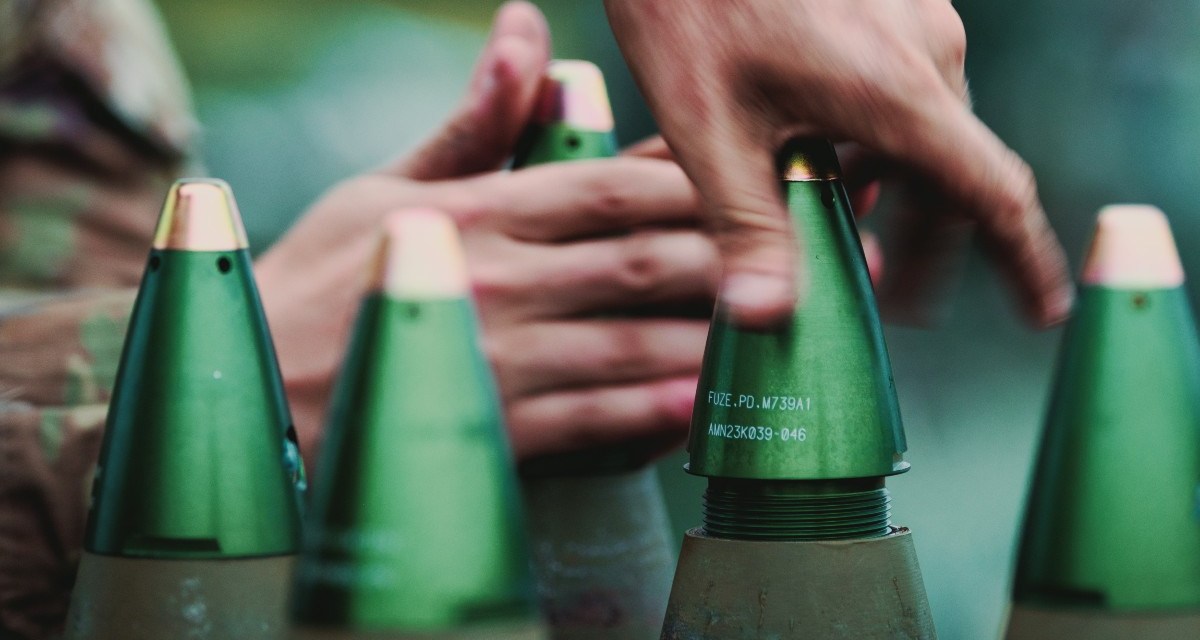
Sometimes, even STANAG compliance is insufficient to ensure technical interoperability. One issue involving inductive fuze setters arose that illustrates the point. STANAG 4369 and Allied Ordnance Publication–22 govern inductive fuze setting, standardizing fuze identification codes, message formats for fuzes and fuze setters, signal sensitivity, and power levels. However, Ukrainian forces found that they were unable to set the fuzes from a non-US NATO nation with their US-supplied inductive fuze setters. The reason was that even though both items were STANAG compliant, the fuze setter software did not have the allied fuze type programmed in and could not recognize it. To achieve actual interoperability, the manufacturer would have to produce a software update that included that specific fuze type.
Furthermore, it is beyond the scope of NATO STANAGs to address compatibility from a safety perspective. For example, the US M107 family of high-explosive rounds is the bread and butter of Ukraine’s 155-millimeter artillery ammunition. It was first approved for use in 1958, and has many ballistically similar cousins, such as the British L21 and German DM21 projectiles. Advances in propellants since that time have created issues though, since the M107 family of rounds cannot safely withstand the force of more modern high-zone charges such as M203 (Super 8), or high increments of modular charge systems. The US M232 Modular Artillery Charge System is packaged in canisters of five increments. However, M107 rounds can only be safely fired with up to four increments. This is not due to a flaw in the STANAG; each individual component is compliant. Nuances like this are multiplied across the huge array of guns and ammunition components in use by Ukrainian forces, with many recorded instances of equipment damage, as well as crew fatalities, due to unsafe combinations.
To address this issue, Ukrainian forces have produced a useful compatibility matrix that specifies mechanical and safety compatibility for known combinations. However, just because a particular charge, shell, and fuze combination is safe to fire through a given howitzer does not mean that the firing unit has accurate predictive firing tables that will deliver the rounds to the intended aimpoint. Lack of predictive accuracy drives up ammunition consumption by requiring multiple adjustments to get on target, as well as reducing effects by giving enemy units time to reposition once adjustment rounds impact.
From a US perspective, US Army Combat Capabilities Development Command has been a crucial part of developing tactical firing tables for combinations that involve US munitions or howitzers. These products are thorough and accurate, but require a significant investment in time to develop, which is increased by the necessity of coordinating for technical data with the nation(s) who produce the munition or howitzer the firing table is being built for.
Ukrainian forces have developed an expedient method of firing table generation as well. Their Kropyva system (a combination of command-and-control and fire-direction software) is capable of building a reasonably predictive tactical firing table based on two or three test shots of a given gun and ammo combination at maximum range. The actual points of impact are input into the system after firing, which then predicts the firing data needed for the rounds to impact the desired aimpoint at closer ranges. This is a digital equivalent to the graphical firing table setting taught in US manual gunnery, since the actual points of impacts are affected by other conditions, such as wind, temperature, barrel wear, and more. Essentially, this method gives greater accuracy, but only for the specific conditions that the test rounds were fired in. Still, this method will be more accurate than no data.
To move toward the goal of true interoperability, four lines of effort are crucial. First, as the United States and NATO plan for future large-scale combat operations, US Army Combat Capabilities Development Command and equivalent allied and partner offices should widely distribute the firing tables already developed for combinations used successfully by Ukrainian forces. Second, the same offices should begin work now to develop firing tables for howitzer and munition combinations that are known to be used by allies and partners in Europe and other theaters. This would help ensure that accurate firing data is available at the start of any conflict. Next, the United States and other NATO members should also consider an application that can generate predictive firing tables for unforeseen ammo combinations, similar to Kropyva. Finally, nations should investigate ways to further standardize not only the technical specifications, but the ballistic characteristics of 155-millimeter ammunition to achieve true interoperability in future ammunition components through means like coproduction and release of technical specifications.
As US production of 155-millimeter shells continues to ramp up and alleviate concerns about depleted stockpiles, it’s time to turn our attention to the other artillery lesson emerging from the war in Ukraine. If NATO or other US allies find themselves in a major war, they won’t just need to have enough artillery ammunition. They will need to be able to fire it, safely and effectively, in whatever gun and ammo combination is available.
Major Eric Johnson is a field artillery officer with the 56th Theater Multi-Domain Command in Wiesbaden, Germany currently serving as the fire support coordinator. Recently, he served with Security Assistance Group–Ukraine from 2024 to 2025 as an operational fires advisor. He holds an MS in operational studies, and his previous operational deployment experience includes Iraq, INDOPACOM, and EUCOM.
The views expressed are those of the author and do not reflect the official position of the United States Military Academy, Department of the Army, or Department of Defense.
Image credit: Spc. Noe Cork, US Army