
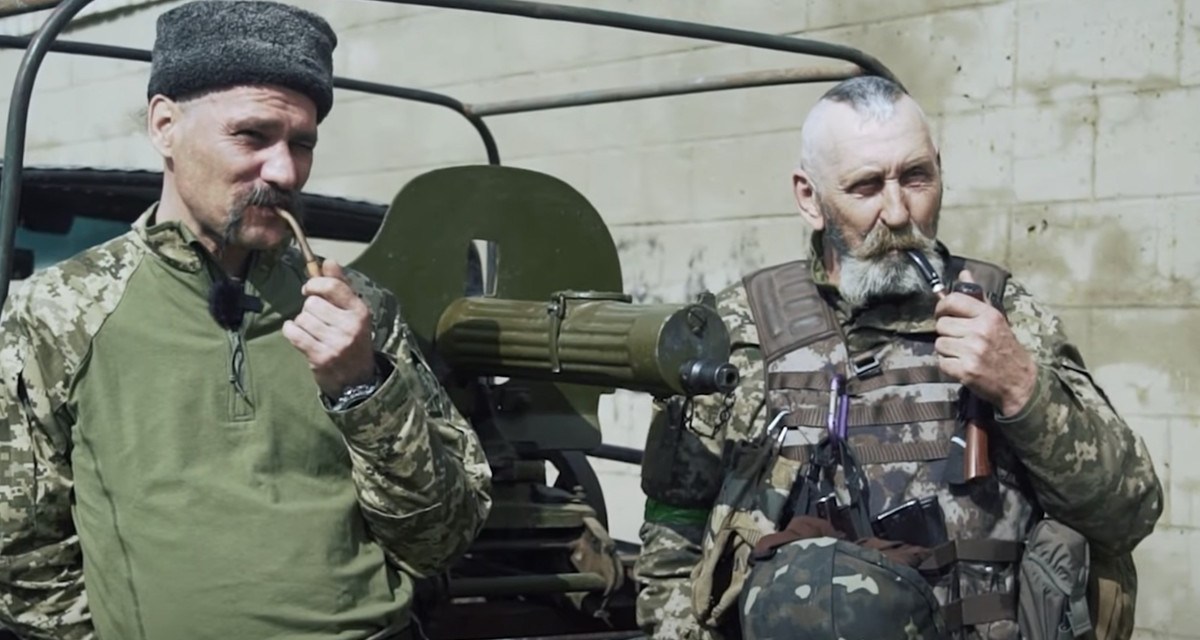
On a frosty night in eastern Ukraine, a German-made Gepard antiaircraft gun built decades ago and long retired in Germany itself, suddenly fires a burst that shreds a Russian drone. Elsewhere on both sides of the front, Soviet-era tanks equipped with makeshift cages rumble forward, and even century-old Maxim M1910 machine guns bark from trenches. These scenes are not nostalgia; they are everyday reality on a battlefield that is reminding us that modern wars are often waged with obsolete weapons.
Unsurprisingly, the word “obsolete” has a seductive finality for army professionals. The most obvious response when a weapon becomes obsolete is to dispose of and replace it. But reality seems to be far messier. Taking into account particularly the lessons from war in Ukraine, we tend to ignore that it’s not just innovative uses of modern first-person-view (FPV) drones that dominate the battlefield, but that these very drones are being shot down by systems otherwise considered obsolete. None of this is an accident, and it’s not pure desperation either. Rather, it is a reminder that obsolescence is a spectrum, not a definite verdict. And globally there are more than few examples when yesterday’s weapons still solve today’s problems.
Defense institutions often define obsolescence as a logistics issue: When spare parts or ammunition productions stops, a system is obsolete. That matters for sustainment, but it misses the wider operational picture. An unsupported platform on paper may remain combat‑relevant if stockpiles exist or if production can be restarted, but perhaps more importantly it can often be used if it is adapted to a new role. Take an RKG-3 antitank grenade equipped with 3D printed fins and dropped from FPVs as one example among many. The same logic sustains elderly aircraft like the DC‑3/C‑47 family, kept flying for decades around the globe on the strength of vast wartime spares. Availability does not equal utility—but neither does unavailability equal irrelevance.
To make better choices and prevent hasty disposal and replacement, militaries need a clearer vocabulary. Yet the field of obsolescence is a messy one. To narrow it, we should consider five categories of obsolescence: paradigmatic, conceptual, technological, functional, and physical. They overlap in practice, but each captures a different reason why a system falls out of use—and consequently points to different options for what to do next.
What War Looks Like When Old Still Works
The idea that obsolete weapons still matter in modern militaries sounds counterintuitive, especially on the pages of the Modern War Institute. But the real question is not whether technology is obsolete and useless, but which category of obsolescence fits what role.
Paradigmatic Obsolescence
Paradigmatic obsolescence is a clear‑cut case: weapons that belong to a different era of warfare. They no longer figure in doctrine or training. When paradigmatic obsolescence applies, reversal is unrealistic and these tools migrate to museums and ceremonies. History offers few examples of attempts to resist this transition. During the Second Italo-Abyssinian War, for instance, Ethiopian forces commonly armed with spears faced Italian troops equipped with tanks and chemical weapons. Today, such cases are exceedingly rare. Outside of ceremonial traditions, like the presentation of swords to graduating officers, paradigmatically obsolete weapons have long since disappeared from active service.
Conceptual Obsolescence
Conceptual obsolescence is more common and fickler. Conceptual obsolescence arises when the strategic rationale for a weapon’s existence is no longer aligned with contemporary doctrine. This is caused by a shift in warfare doctrines or externally imposed through treaty obligations. Conceptual obsolescence labels are, however, highly risky. Discarding a weapon because we believe that the concept for which it was created will never return has far too often proved a costly mistake. Tanks were written off by some as poor fits for expeditionary counterinsurgency, left in storage as tankers were repurposed as light infantry, before quickly returning to center stage when large‑scale conventional combat reemerged, only to again gradually disappear from Ukrainian battlefield recently. Yet it is safe to expect that this is not the last stage of the cycle either.
In a sense, keeping systems designed for a war we believe will never come in reserve is not sensible. Nevertheless, concealing stocks of restricted armament is not unheard of. After World War I, Germany, Austria, and Hungary clandestinely kept some prohibited artillery stocks in defiance of treaty restrictions. And Iraq employed similar tactics after the Persian Gulf War, burying prohibited missiles to circumvent UN mandates.
Adaptation offers a more legitimate path. The A-10 aircraft, originally designed for antitank missions, was reoriented toward general close air support following the Cold War’s end and is discussed as an ideal antidrone platform nowadays. Historically the battleship ceded primacy to carriers in World War II and spent its final decades providing naval gunfire support and fleet air defense before the last one left service in 1992.
Arms control treaties sometimes also require formal conversion. The START agreement led to modifications to strategic bombers and missile launchers, rendering them incapable of nuclear deployment. The B-1 bomber, for instance, was restricted to conventional weapons, while the LGM-118 Peacekeeper ICBM was repurposed as the Minotaur IV space launch vehicle.
The hard truth is that our ability to predict future conflicts is limited and prematurely discarding conceptually obsolete weapons can backfire. Yet, in the face of budget cuts, such warnings are too often ignored.
Technological Obsolescence
Technological obsolescence happens when a successor does the same job better, or new technology neutralizes a system’s function. Surface‑to‑air missiles superseded gun‑based air defense; satellites took over SR‑71‑style high‑altitude strategic reconnaissance; self‑propelled howitzers eclipsed many towed systems in high‑tempo maneuver; and FPV drones are (as it seems) replacing antitank guided missiles right now. Sometimes technological obsolescence is intentional—export variants stripped of sensitive features, or treaty‑constrained capital ships built under tonnage limits.
One might naturally assume that using weapons that have been surpassed by newer models is not the first, go-to option. Yet in terms of operational viability, technologically obsolete systems are an economically rational way to generate mass when reserve crews already understand the platform. As an example, both Ukraine and Russia have pulled numerous variants of T‑72 and T‑80 tanks from reserves. And this is also evident in NATO states, such as the Czech Armed Forces, which maintain older vz. 58 assault rifles in mobilization reserves.
Training is generally the quiet workhorse of legacy employment. Slovakia, Hungary, and the Czech Republic have received Leopard 2A4 tanks—technologically obsolete in the sense that newer Leopard variants exist—and put them to use for training. This is obviously not a new approach. The rapid pace of World War II technological change pushed plenty of tanks that were considered too light for combat into training fleets; Bulgaria even requested German Panzer I tanks as late as 1943 for that purpose.
Generation of mass and training with obsolete weaponry, no matter how common, is still a stopgap measure. However, adaptation offers another avenue. Technologically obsolete weapons are often reassigned to roles where their limitations are less critical. Russian forces have redirected legacy P‑35 (3M44 Progress) antiship missiles against land targets, while Ukraine reactivated T‑12 100-millimeter antitank guns and even older 85-milimeter D‑44 and D‑48 guns for indirect fire support. Even in NATO countries, older vehicles like the French VAB—introduced in the 1970s—continue to serve in logistics and support roles, proving that obsolescence is context-dependent.
Modernization efforts, while not cure-all, further extend the lifespan of these systems. Enhancing lethality through improved ammunition, survivability upgrades, or interoperability adjustments can transform outdated platforms into viable assets. Ukrainian Leopard 2A4s fitted with Kontakt‑1 explosive reactive armor in 2023 illustrate the principle.
And beyond modernization there is conversion. Technologically obsolete tanks have historically been repurposed into recovery vehicles, artillery tractors, or armored personnel carriers. Sweden’s Stridsvagn m/41 tanks were transformed into Pbv 301 armored personnel carriers; Israel turned captured T‑55s into Achzarit armored personal carriers. A more extreme type of conversion is weaponization of previously unarmed systems. Ukraine has converted obsolete reconnaissance drones, including the Tu‑141 and Tu‑143, into improvised cruise missiles and used these to strike deep inside Russia.
All these approaches illustrate that technological obsolescence is not the end of usefulness; it is rather an invitation to move the old tool into a different role where its residual strengths still matter.
Functional Obsolescence
Functional obsolescence in weapon systems is inherently linked to the unavailability of spare parts or ammunition. Politics can accelerate the process: Suppliers redirect parts elsewhere or adversary‑made spares for captured gear become unobtainable. Yet functional obsolescence is often reversible if production lines can be restarted. More recently, additive manufacturing provides a solution. And, as always, large stockpiles can extend service lives. Finnish planners until recently still saw value in D‑30 towed 122-millimeter field guns for regionally oriented troops precisely because ammunition was abundant.
Without the ability to reopen production lines for spares or ammunition this category of obsolescence seems like a dead end—but there are workarounds such as modernization of conversion. Working examples of Ukraine’s modernized antiair “FrankenSAM” systems exist in several modified forms, such as Soviet-era Buk M1 launcher with American RIM-7 Sea Sparrow missiles.
However, in many cases the abundance of spare parts and ammunition allows functionally obsolete systems to remain viable for reserve formations for a considerable time. Russian T‑62s have been employed by lower‑quality units as self‑propelled artillery. Is that optimal? No. Is it rational when you need steel that can move a gun and lob shells from relative safety? Yes. At the tactical level, commanders make these trades constantly. Even NATO military personnel would have hundreds of stories of an old chassis used in a secondary role (e.g., a small number of V3S trucks produced since 1953 and still used by Czech Armed Forces), which is still more valuable than a paper requirement for a modern capability you do not have. The difference between unsupported and useless is measured in what you have on the shelf and what you can credibly make tomorrow.
Physical Obsolescence
Finally, physical obsolescence is the true end state of weaponry. Airframes corrode; propellants and explosives degrade; welds fail; heavily used vehicles become unsafe to operate. Sometimes, expiration is built in—fuses that render captured munitions inert, or short-lived energetic compounds. Unlike the previous categories, physical obsolescence is irreversible. Once a structure exceeds its fatigue limits or deteriorates beyond safety margins, the weapon’s military life is over. Only gate guardians stand as a quite testimony.
However, symbolic status does not always preclude combat reactivation. World War II legacy M18 Hellcat tank destroyers and T-34/85 tanks saw combat in Yugoslav wars—albeit often only as a static artillery. And in Ukraine, those Maxim M1910s, once a hobby of curators, were pulled from collections and mounted again. These cases are rare and usually born of necessity, but they illustrate a larger point: The line between obsolete and useful is thinner than we like to admit when survival is at stake.
What This Means for Planners
Modernization is essential, but the fetish for new can have real battlefield impacts—soldiers killed, units destroyed, engagements lost. Real wars are contests of mass, endurance, adaptation, and time. In that competition, properly understood, maintained, and employed obsolete weapons still punch above their weight. What does this mean for modern military forces?
First, treat obsolescence as a diagnosis, not a verdict. Ask which category applies. A physically exhausted airframe is done. But a functionally obsolete gun with ample ammunition is not. A conceptually obsolete platform may be one adversary or one type of terrain away from renewed relevance. It is very often precision that opens new options—replace, upgrade, repurpose, or retire—while imprecision turns obsolete into a thought‑terminating cliché.
Second, preserve optionality. Stockpiles matter more than glossy brochures. Long wars reward the ability to restart ammunition production, fabricate spares, and integrate substitutes. Map the obsolete calibers, components, and subsystems that underpin mass firepower, and invest in bridging them—especially across alliances, where a partner’s old system might be your best short‑term path to generating combat power.
Third, align training and sustainment with what you keep. Do you keep your obsolete weapon in reserve? Then you most likely need personnel and tooling to run it. African militaries during the Cold War Africa offer cautionary tales: States that were donated sophisticated kits by their American or Soviet benefactors without building maintenance ecosystems watched fleets wither when outside technicians left. The opposite is also true: Preserve critical human skills and institutional knowledge, and you can safely extend service lives while modernization catches up.
Fourth, design portfolio road maps, not single‑thread replacement plans. Some systems should be replaced outright, but for others upgrade will suffice. Some may be adapted to niche roles, while a few can be converted to different ones. This mix is cheaper, faster, and more shock‑resistant than an all‑or‑nothing bet on future procurement cycles. It also improves the politics of assistance: Donors can transfer legacy equipment that partners can absorb immediately while planning transitions to common platforms later.
Finally, none of this romanticizes obsolescence. Survivability gaps, interoperability challenges, and legal and ethical concerns are real. In a dense reconnaissance‑strike environment, these platforms are liabilities on the front line. But the same platforms might be exactly what you need in defense in depth, deception, logistics protection, or training. Stop calling them obsolete. Start asking what problems they can still solve.
Captain Lukáš Dyčka, Ph.D., currently serves as a senior staff officer at the Czech Armed Forces Training Command – Military Academy. His previous assignments include head of the Department of Courses Management at the Czech University of Defence, six years as a lecturer in strategic studies at the Baltic Defence College, and advisor to the Czech minister of defence.
The views expressed are those of the author and do not reflect the official position of the United States Military Academy, Department of the Army, or Department of Defense.
Image credit: Суспільне Запоріжжя