Despite steadily heightening tensions, heated rhetoric, US strikes against alleged drug trafficking boats, and a buildup of US forces near Venezuela, news of the successful mission to capture Venezuelan President Nicolás Maduro still surprised the world. Much of the discussion since has focused on the geopolitical stakes, questions of international law, and the domestic political context. Such discussion will undoubtedly continue.
But apart from these, there is also a military lens through which to examine Operation Absolute Resolve. What can we learn from the raid, which from a purely operational perspective was stunningly successful? How should we understand the operation in the context of the United States’ strategic global military rivalry with Russia and China? And how do the capabilities on display during the few hours in Caracas figure in the context of a potential large-scale conflict with a peer adversary?
Eight main takeaways from the operation stand out.
SOF: The Enduring Hammer
Over the course of the post-9/11 wars, US special operations forces (SOF)—and particularly, the most elite units—were honed into a sharper tip of the spear than has ever existed in military history. The operation in Venezuela demonstrates that those elite units have retained those capabilities. But it would be a mistake to extrapolate from this narrow action (a raid, conducted by highly trained, exceptionally equipped units, as part of an interagency operation) to a wider mission set. SOF cannot do everything, and conventional forces cannot conduct this type of operation. The risk is that, from the perspective of US policymakers, SOF will remain a tempting hammer that makes everything look like a nail. That’s a poor substitute for strategy.
The View from Beijing
This operation will undoubtedly have a deterrent effect on US adversaries. It will also no doubt be a chilling reminder (if one was needed) that the US military is capable of doing certain things China and Russia simply cannot. However, elite units are a finite resource. Does this level of precise lethality make Beijing think twice about invading Taiwan? Perhaps. But as impressive as its execution was, this was a raid. In a large-scale, kinetic conflict, the ability to conduct this type of operation has extraordinarily limited utility. The gap between the United States’ most elite units and those of US adversaries is much larger than the gap between US conventional forces and theirs. That limits this operation’s deterrent effect.
Intelligence vs. Targeting
Several years ago, during a conversation with retired General Michael Hayden in MWI’s offices, the former NSA and CIA director pointedly told us that during the post-9/11 wars the US joint force shifted from doing intelligence to doing targeting. The implied risk was that our institutional memory of broader, all-source intelligence analysis would atrophy, leaving us unprepared for the intelligence requirements of a large-scale conflict. There is no evidence that that happened and the decade-long shift in focus toward large-scale combat operations has included a rewidening of how we conceptualize the role of intelligence. But as apparently successful the intelligence component of this operation was, it was, effectively, a large-scale targeting process. In a major war, that is one very narrow slice of the intelligence capabilities that will be required.
HUMINT Never Dies
Espionage, it is said, is the world’s second-oldest profession. And for much of history, intelligence and spying were largely one and the same. Of all the types of intelligence collection, HUMINT (human intelligence) is the only one that does not require technology to enable it. As technology has advanced, other disciplines emerged on the periphery of intelligence as an enterprise, and they have increasingly muscled HUMINT out of its central position, at least in terms of the way scholars and practitioners conceptualize intelligence. But no matter how sophisticated and proliferated sensors become, no matter how many communications channels can be intercepted, no matter how precise a view space-based collection assets can provide, there are times when nothing can replace the source on the ground. According to reports, that was true for this operation, with a recruited source inside Maduro’s inner circle and a network that reportedly enabled the operation by emplacing technical equipment like jammers in advance of US forces’ arrival.
Not a Good Look for Russian Air Defense
Venezuela fields one of the most advanced, extensive, and layered air defense networks in Latin America. And it is almost entirely composed of Russian weapons. A dedicated joint service command integrates all air defense capabilities and employs S-300 long-range surface-to-air missile systems, along with a complement of medium-range systems—Buk-M2E and Pechora-2M systems—and point defense weapons. That those systems could be so thoroughly neutralized as to allow more than 150 US aircraft complete freedom of the skies without a single one shot down (only one was even hit, and it’s unclear by what) will surely cause concern in Moscow. To be sure, Venezuela does not have the more advanced S-400 or the S-500 system Moscow claims to have begun fielding. But given the fact that Russia entrusts large portions of its air and missile defense to the same platforms Venezuela does, the Kremlin must, at a minimum, be concerned by just how poorly they fared. Of particular note is the role of US Navy EA-18G Growler aircraft, the joint force’s only electronic attack platforms, in disabling Venezuelan air defenses. Of all of the capabilities on display in the raid, those of the Growler are arguably the ones that would be most relevant in a large-scale conflict.
Incidentally, the operation’s success also casts a poor light on the performance of the Chinese-made sensors Venezuela integrates into its air defense network. The much-hyped JY-27A radar evidently failed to live up to Beijing’s claims that it can detect even stealth aircraft at a range of up to 150 miles.
Time on Target
Given how effectively Venezuelan air defenses were neutralized, it was presumably not vital to limit time on target to the briefest possible duration. Although reports vary somewhat, the entire operation likely took somewhere between two and three hours. Of this, the actual time spent on the ground by the forces that captured Maduro was almost certainly less than an hour. But even this is only possible when adversary capabilities are rendered so thoroughly ineffective. Even so, time on target mattered. The longer the action took, the greater the risk of hostile action or accident. But the risk pales in comparison to what US forces would face in a large-scale conflict, where if you can be seen you can be killed, and the gap between detection and destruction is being compressed by proliferated sensors, AI-enabled detection, and tightly constructed kill webs.
The False Promise of the Air-Ground Littoral
Almost immediately when the operation commenced, video spread around social media showing US helicopters flying low over Caracas. And the infiltration was conducted by Black Hawks and Chinooks that used terrain masking—effectively, flying nap of the earth—to approach the city. A major portion of this operation took place in the air-ground littoral—a zone that has taken on heightened importance since the 2020 Nagorno-Karabakh War and Russia’s invasion of Ukraine. This is a dimension of the battlespace that has been flooded with drones, threatening the survivability of manned aircraft. Operating at low altitudes for extended periods was possible in this operation. Attempting to do the same in a battlespace where an adversary can field drones in overwhelming numbers invites disaster.
Military Strategy ≠ Grand Strategy
Many international actors—including allies—are not happy about Operation Absolute Resolve, viewing it as affront to the norms and conventions that have undergirded the international order since the end of World War II. Such opposition is not a reason per se for a powerful state to avoid undertaking a unilateral, power-centric, norm-defiant military action. But it does entail costs that the powerful state needs to consider within the rational choice model for policymaking. There are longer-term regional security interests that have been actuated with this initial military success. Achieving these interests may require other instruments of national power whose employment logic may commend international cooperation and alliance management—the exact opposite of what we have seen to-date in Venezuela.
Colonel Patrick Sullivan, PhD, is the director of the Modern War Institute at West Point.
John Amble is the editorial director of the Modern War Institute at West Point and a former US Army military intelligence officer.
The views expressed are those of the author and do not reflect the official position of the United States Military Academy, Department of the Army, or Department of Defense.
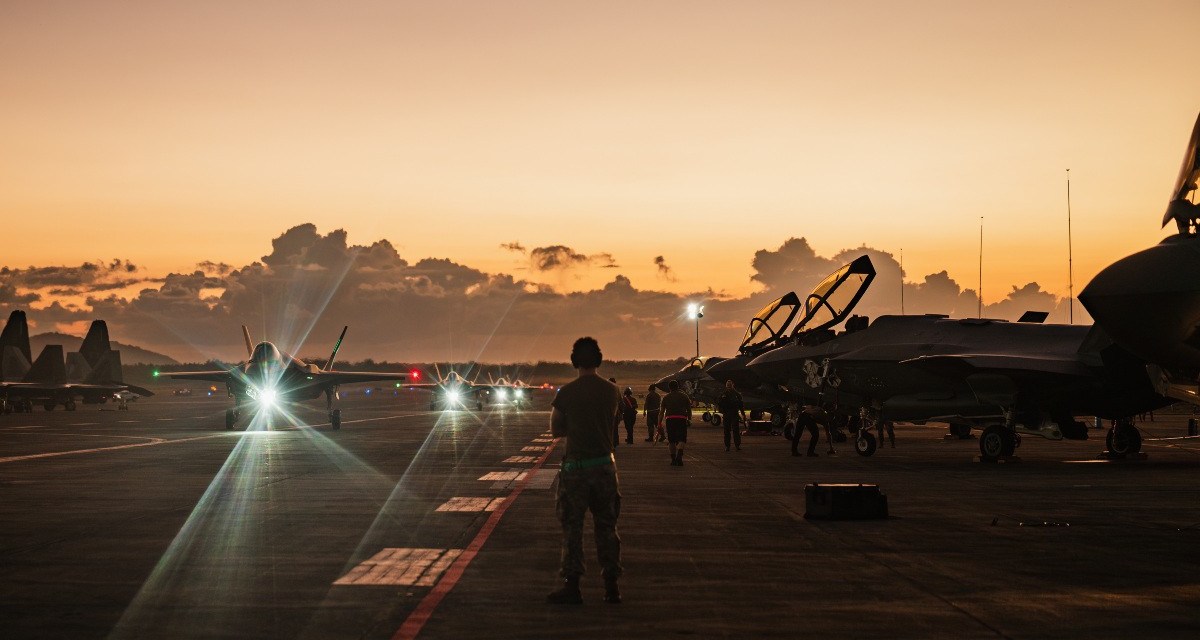
Image: US military aircraft taxi at Ceiba, Puerto Rico after participating in Operation Absolute Resolve (credit: Senior Airman Katelynn Jackson, US Air Force)