
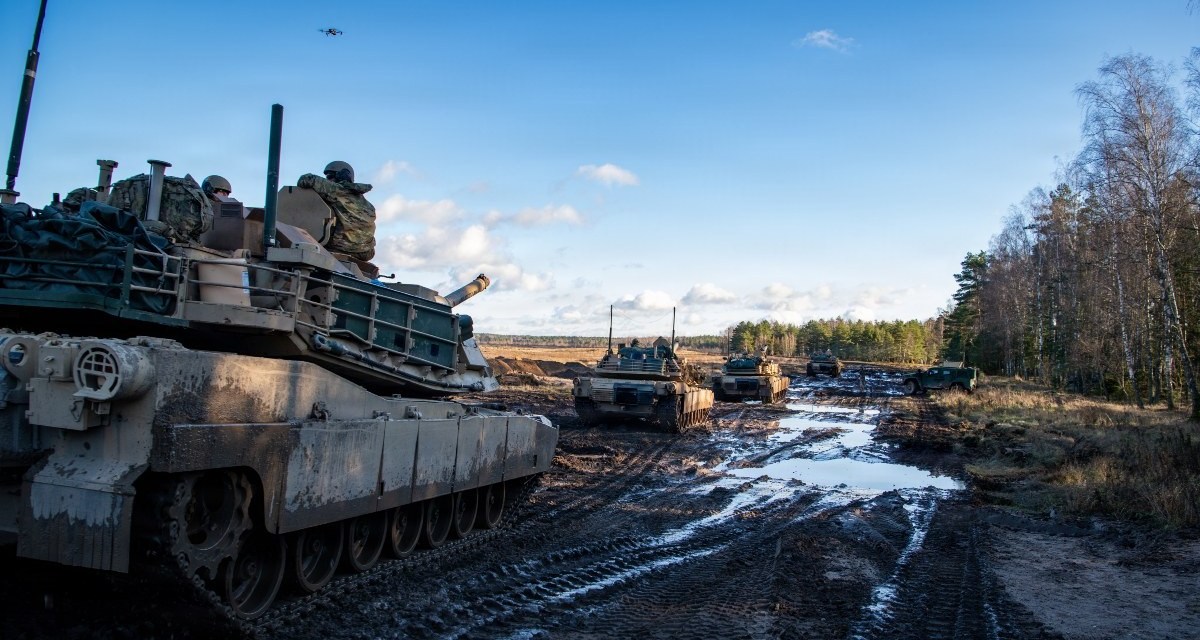
Drones won’t save us? That’s the argument Matthew Revels and Eric Uribe made in a recent MWI article urging caution as the US Army, reacting to the drone-saturated battlefields of the Russo-Ukrainian War, seeks to aggressively buy and integrate drones into its formations and operations. And their argument, that drones are misaligned with maneuver warfare, the Army’s preferred way of fighting, is compelling. They are correct to warn against learning the wrong lessons from Ukraine. Applying adoption-capacity theory, they question more broadly how innovation can clash with culture and urge resistance against the notion that drones are an all-purpose solution for retaining a decisive edge in modern land warfare. But in dismissing drones because they are misaligned with maneuver, their argument fails to recognize how these systems can be leveraged to amplify the Army’s strengths through increases in tempo, initiative, and precision. Their perspective overlooks the transformative potential of drones in supporting maneuver warfare and enhancing offensive capabilities, particularly in the context of future large-scale conflicts. Drones are not only compatible with the American way of war but are essential for maintaining dominance in future conflicts. Redirecting the Army’s focus toward countering enemy robotic systems risks rather than integrating its own means choosing not to arm maneuver formations with the very tools that will allow them to maneuver.
Revels and Uribe are correct in their fundamental assertion that maneuver warfare, as practiced by the Army, emphasizes rapid tempo, initiative, and the ability to disrupt adversaries through the offensive. But they follow this assertion by arguing that integrating drones into Army doctrine risks undermining these principles by shifting the Army toward the Russian preference for firepower and attrition. To be sure, Russian thinking, adaptations to doctrine, and application of emerging technologies like drones should not dictate that the US Army responds in kind. And they are correct in highlighting the Gulf War, the bombing campaign in Afghanistan, and the Yom Kippur War as examples highlighting the critical linkage between airpower and offensive maneuver that is foundational to the American way of war, which differs dramatically from Russia’s doctrinal preference for massed fires. It is incorrect, however, to assume that the Army’s current emphasis on the technical application of drones must naturally follow Russia’s in Ukraine and limit their use solely to improving firepower and “modernizing attrition.” The Army would be severely limiting the potential for drone application if planning and doctrine rest exclusively in one warfighting function. Drones at the tactical level can enhance maneuver warfare by providing real-time situational awareness to enable commanders to make faster and better-informed decisions. Drones can also act as a force multiplier, extending the reach and effectiveness of maneuver units without requiring a fundamental shift in doctrine.
One of the defining characteristics of maneuver warfare is the ability to act decisively in response to rapidly changing battlefield conditions. Drones can provide unparalleled situational awareness, allowing commanders to visualize the battlespace in real time. Reconnaissance drones equipped with advanced sensors can identify enemy positions, track movements, and detect vulnerabilities that can allow maneuver forces to exploit gaps in the enemy’s defenses. This capability aligns perfectly with the principles of maneuver warfare, which prioritize initiative and the ability to seize opportunities as they arise. For example, during the Gulf War, the US Army’s “left hook” maneuver relied heavily on intelligence to identify weak points in Iraqi defenses. Drones could have further enhanced this operation by providing persistent surveillance and reducing reliance on slower, more vulnerable reconnaissance assets. To this point, drones will support the principals of mission command by providing commanders at echelon enhanced situational awareness and thereby facilitating decision-making and initiative. Imagine if H. R. McMaster, leading a formation integrated with piloted and autonomous drones, had conducted a deliberate attack at 73 Easting instead of a react to contact.
Drones can also act as force multipliers, enabling smaller units to achieve effects traditionally reserved for larger formations. For instance, loitering munitions and first-person-view strike-capable drones can provide precision-strike capabilities to maneuver units, allowing them to neutralize high-value targets without waiting for air or artillery support. Deployed en masse, drones can overwhelm enemy defenses, saturate airspace, and create openings for maneuver forces. These systems can be used to target enemy command-and-control nodes, logistics hubs, and artillery positions, disrupting the adversary’s ability to coordinate and sustain operations. By integrating offensive drone capabilities into maneuver units, the Army can achieve effects that were previously unattainable without extensive air support or long-range fires at a cost-to-kill ratio significantly lower than the application of precision-guided munitions. This capability is particularly valuable in contested environments where air superiority may be challenged, as it ensures that maneuver forces retain offensive options even in the absence of traditional airpower support. Additionally, drones can be used to deploy electronic warfare payloads, disrupt enemy communications, and create confusion, further enabling maneuver forces to exploit the chaos and maintain operational tempo. As seen in the conflict in Ukraine, the application of emerging technologies like drones are only constrained by the limits of users’ creativity.
Investing instead in countering enemy drones, such as integrated air defense systems and electronic warfare, reflects a defensive mindset that risks ceding the initiative to adversaries. While counterdrone technologies are undoubtedly important, they should not come at the expense of offensive capability. In maneuver warfare, maintaining initiative is crucial. The ability to act faster than the enemy can respond often determines the outcome of engagements. Drones can help preserve initiative by enabling rapid and decentralized decision-making. We are not far from a future where small drones equipped with artificial intelligence can autonomously identify targets and execute strikes, reducing the time required to process information and act. Again, the decentralized nature of drone operations aligns with the Army’s emphasis on mission command, allowing subordinate units to act independently while adhering to the commander’s intent.
Future conflicts are likely to be characterized by a contested air domain, cyber domain, and electromagnetic spectrum. Adversaries will seek to disrupt the Army’s ability to project power and sustain operations. Offensive drone capabilities can help mitigate these challenges by providing flexible and resilient options for engaging the enemy. The diffusion of drone technology today is in fact a revolution in warfare in that the commanders of the future will have the potential to access more information than ever before. Far from being misaligned with the Army’s way of war, therefore, drones can amplify our strengths in tempo, initiative, and violence of action to ensure that maneuver forces retain their asymmetric advantage. By integrating drones into its operations, the Army can preserve its ability to dictate the terms to our adversaries, adapt to emerging threats, and achieve decisive outcomes on the battlefield. The Army should embrace the transformative potential of drones in the spirit of expeditionary and offensive operations while leveraging emerging technologies to maintain dominance in an increasingly complex and contested operational environment. The US way or war, which lives and breathes in how our platoons, batteries, and squadrons train, will be best preserved with maneuver on the future battlefield if leaders at echelons are armed with the technology that is changing warfare.
Major Charlie Phelps is a Special Forces officer and currently serves as a company commander in 10th Special Forces Group (Airborne).
The views expressed are those of the author and do not reflect the official position of the United States Military Academy, Department of the Army, or Department of Defense, or that of any organization the authors are affiliated with.
Image credit: Sgt. Eric Allen, US Army