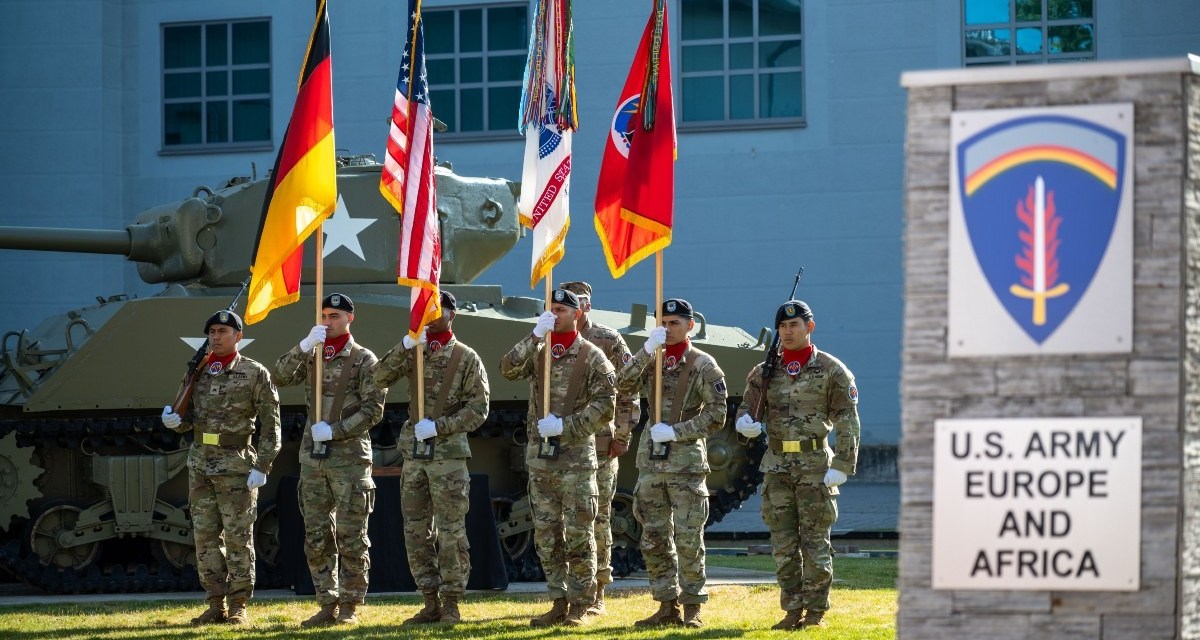
The headquarters of US Army Europe and Africa (USAREUR-AF) is at Clay Kaserne in western Germany, not far from Frankfurt and situated near the mighty Rhine River. The area has changed hands often; during the Allied occupation of the Rhineland after World War I, it was controlled by the French Army and then became the headquarters of the British Army of the Rhine from 1925 to 1930. Wiesbaden, the city that houses Clay Kaserne, was not bombed as heavily as Frankfurt by the Allies during World War II—largely because it was not a major industrial center—and has had a continuous US presence since 1945.
Today USAREUR-AF has responsibility for oversight of Army operations across two continents with a population of more than two billion people. Increasingly, it also has responsibility for preparing to fight a war against a Russia that three years ago violated the most basic principle of international law—the inviolability of borders—by invading Ukraine. Those brave souls in the invaded country are now fighting the biggest war in Europe since World War II.
The objectives of Russia’s imperial President Vladimir Putin do not stop in Ukraine, which shares its western borders with NATO members Poland, Slovakia, Hungary, and Romania. Putin has been clear that he wishes to restore the Soviet Union’s sphere of influence over Eastern Europe, including the Baltic states. He is resorting to sabotage against Western targets to try to convince NATO not to resist and building relationships with North Korea, China, and Iran to further his geopolitical ambitions.
Europe is waking up to the Russian threat and during our recent visit to USAREUR-AF, we saw signs that NATO is, as well. Though USAREUR-AF is technically an American headquarters it is inextricably linked with NATO through its role as a combined joint force land component command headquarters operating as a single team alongside NATO’s Allied Land Command. This makes it an ideal place to gain a nuanced sense of both USAREUR-AF’s and NATO’s priorities—an opportunity we recently had. As part of a small team of active duty and retired military officers from the United States Army War College, we recently taught some fifty staff officers from the headquarters something of the role their unit plays in peace and war.
The officers, noncommissioned officers, and civilians who were our students had on average perhaps a dozen years of service to the nation in a variety of roles including combat service in Iraq or Afghanistan. The weeklong Army War College course has been taught some two dozen times over the past four years to theater armies around the globe, sharing knowledge and experience, building ties across organizations, and improving readiness for war; the course concludes with a daylong wargame exercising the roles the students would play if USAREUR-AF had to deploy, support, sustain, command, medevac, and bury soldiers in war in Europe and Africa.
The scale of these activities in the event of a major war is something few if any of the students in the room have experienced in their professional lives; the faculty, including the retired Army major general who was the course senior mentor, were a generation older, senior enough to remember the waning days of the Cold War.
The Cold War is back. We had many discussions about whether USAREUR-AF is a warfighting headquarters; the consensus is that, while it hasn’t been for the past thirty-five years, it is transitioning back to that role. The Russian threat is real. Russia has more than two hundred brigades fighting in Ukraine today, perhaps double the number of Ukrainian brigades in the fight. NATO is badly overmatched, able to provide fewer than one hundred brigades today although it plans to build to 132.
Russia is not just larger; it is gaining experience and learning from its conflict in Ukraine. Moreover, despite heavy losses, Moscow is reconstituting remarkably fast. For example, Russia is recruiting approximately one thousand soldiers per day. Meanwhile, its tank production, especially of the modern T-90 model, has been increasing. Estimates suggest Russia produced about 140–180 T-90M units in 2023, possibly exceeding 200 per year in 2024, with some sources projecting as many as 280–300 annually.
Given the changing character of war and Russia’s larger military force, the West must search for comparative advantages. One such advantage is being smarter and thinking faster than the Russians can by integrating and using live data to sense, understand, act, and assess. Throughout history the side that can do this faster and better tends to win. The Maven Smart System is one way USAREUR-AF is doing this today as it seeks to move to a real-time, data-driven decision-making process enabled by live data feeds from across the staff.
Russia is not the only one learning from Ukraine. During our short time in Wiesbaden, we met with dedicated teams from USAREUR-AF and Security Assistance Group–Ukraine who are laser-focused on learning from the conflict—and more importantly feeding those insights across the Army and beyond, including to NATO allies. Their insights highlight the speed at which the character of warfare is changing and the critical importance of winning the adaptation battle. These efforts, and those of others to include students from the US Army War College, are all part of preparing the theater and broader joint force for future wars.
The Eastern Flank Deterrence Line (EFDL) is one of the most important ways USAREUR-AF is preparing for the future. At its core this concept is aimed at overcoming three key operational problems facing NATO: Russia’s ability to mass forces along NATO’s border faster than NATO can respond, the shortage of NATO forces in theater, and Moscow’s capacity to disrupt the flow of reinforcements from the United States. The solution blends NATO’s long-range precision fires, unmanned systems, and layered defenses to crack open Russian antiaccess/area-denial capabilities, attrit forward-deployed forces, and set conditions for a NATO counterattack to restore its borders. NATO has no intent, desire, or plan to invade Russia. The alliance’s advantage lies in the stronger form of war: defense. If NATO can show it can stop and defeat Russian aggression, it may prevent the Kremlin from trying in the first place.
The EFDL is a new concept driving planning for a headquarters that since the end of the Cold War has focused on adapting to NATO expansion and supporting the war in Afghanistan rather than on deterring war in Europe. The Russian invasion of Ukraine, and ongoing Russian sabotage efforts across Europe, have forced NATO to refocus on being ready to fight and win a conventional war on the continent.
Alongside these planning efforts, NATO is linking demonstrations and innovation directly to the EFDL. Project Flytrap trials are testing drone swarms, systems to counter drone threats, and rapid targeting tools in realistic operational environments, while Task Force X is experimenting with artificial intelligence, robotics, and data fusion to speed decision-making and joint effects. By embedding these demonstrations into the EFDL, NATO leverages a key advantage in collective innovation that spreads costs, accelerates learning, and scales production across the alliance.
The soldiers and civilians we met—from a number of nations—are beginning to take the threat of Russia seriously. Their work may determine whether we face an even bigger war in Europe than the one Ukraine has been fighting for three and a half years.
Colonel Chase Metcalf is an assistant professor at the United States Army War College.
John Nagl is the General John J. Pershing chair of warfighting studies at the United States Army War College.
The views expressed are those of the authors and do not reflect the official position of the United States Military Academy, Army War College, Department of the Army, or Department of Defense.
Image credit: Sgt. Terry Vongsouthi, US Army