The current threat environment is driving the US armed services toward operating concepts that distribute combat power to complicate adversary targeting, create multiple axes of attack, and disrupt enemy decision calculus. The Air Force’s agile combat employment, the Navy’s distributed maritime operations, the Marine Corps’s expeditionary advanced base operations, and the Army’s multidomain operations approach the problem differently, but all place greater demands on movement, maneuver, and the logistics system that enables them. Concentrated forces are easier to target. Distributed forces preserve options and present multiple dilemmas to an adversary. However, these operational concepts increase the logistics burden across the joint force. That burden will fall on a network that is still being built while under attack. An operational plan should drive the support architecture, but once combat begins, disruption can reverse that relationship. Lost access, damaged airfields, closed distribution routes, or constrained capacity can narrow the commander’s available options. In execution, the support architecture can define the maneuver envelope.
The central joint problem is that setting the theater will occur simultaneously with major combat operations. In recent conflicts, the United States often had the luxury of establishing much of the theater before large-scale combat began. In a future major conflict, the logistics network will still be expanding while the joint force generates, sustains, and regenerates combat power. Forces will arrive as operating locations are opened, repaired, or expanded. Strategic aircraft will launch toward destinations that may become unusable before they arrive. Therefore, the joint force needs a logistics architecture designed to operate while the theater is still being set and the force is actively engaged in combat.
The Pacific campaign in World War II demonstrated this requirement long before the term contested logistics existed. When Marines landed on Guadalcanal in 1942, Henderson Field had to be repaired and operated while Japanese forces repeatedly attacked it. Seabees repaired bomb and shell damage fast enough to keep the airfield in almost continuous operation. The pattern continued across the Pacific. At Tarawa, engineers returned a shell-damaged airfield to operation within fifteen hours. At Saipan and Tinian, construction and repair continued while combat was still underway. Setting the theater and fighting were not sequential activities. The Allies built, fought from, repaired, and expanded the network at the same time.
The joint force still maintains forces designed to create mobility capacity when and where a campaign requires it. During the opening months of Operation Enduring Freedom, US forces opened locations in Afghanistan as combat operations expanded. Mazar-e-Sharif opened in December 2001, followed shortly by Kandahar and Bagram. The enduring point is that an airfield becomes operationally useful only when the joint force can receive and process the flow of forces and matériel and connect it to the theater distribution network that delivers combat power to the supported force.
Our adversaries understand that 85 percent of America’s combat power is based in the continental United States and will make every effort to delay, deny, or degrade those forces before they reach theater. General Jacqueline Van Ovost, while commanding US Transportation Command (USTRANSCOM), described contested logistics “from the homeland to delivery” as a present reality and emphasized that global mobility begins with domestic infrastructure before extending through a network of allies and partners. Her successor, General Randall Reed, likewise warned that adversaries can extend the contested environment across the globe and into the homeland to disrupt USTRANSCOM’s strategic reach. Therefore, the joint force will have to generate combat power through a network contested from origin to destination, not merely where forces are vulnerable to kinetic attack.
Operation Nickel Grass, launched during the 1973 Arab-Israeli War, shows why the global network matters as much as the lift moving through it. Over thirty-two days, the air bridge delivered 22,305 tons of equipment and supplies on 566 C-5 and C-141 missions. In 1973, the United States possessed substantial C-5 and C-141 capacity, but access constrained how that capacity could be used. European governments denied many of the landing and overflight rights needed for the air bridge, making Lajes Field in the Azores indispensable. The network of access, basing, and overflight constrained America’s ability to fully utilize its available airlift capacity, much like cyberattacks, infrastructure disruption, or other adversary actions could constrain force projection from the homeland during a future conflict.
The closer forces get to the fight, the more kinetic effects will disrupt operations. Ukraine demonstrates how quickly airfields become vulnerable when air defense is limited. General James B. Hecker, former commander of US Air Forces in Europe–Air Forces Africa and NATO Allied Air Command, recalled asking the Ukrainian Air Force chief how Ukraine had kept so many aircraft from being destroyed on the ground. The answer was simple: “You never take off and land in the same airfield.” Hecker immediately identified the other side of the problem. Even with many airfields, he said, “I can only protect a few of them.” Strategic airlift operates at a different scale than combat aircraft, but an aircraft can launch toward one destination and face a very different threat picture hours later.
Therefore, air and missile defense is critical for determining which locations can support persistent, high-throughput operations under attack. A theater may have many usable runways but only enough layered defense to protect a portion of them. Geography determines how many of those locations are actually useful. The Indo-Pacific offers relatively few strategically useful locations across enormous distances, while Europe offers many more airfields and a much denser transportation network. The limiting factor will not be the same everywhere. Some locations will warrant substantial protection because of the capacity they provide, while others will rely more on mobility, deception, hardening, or rapid recovery. The objective is not maximum dispersion. It is enough usable and protected capacity to continue generating combat power.
This combination of threat, access, geography, and finite protection calls for a hub-and-mesh logistics network. High-capacity gateways remain necessary because they can receive strategic flow at a scale that cannot be reproduced everywhere. Relying on those hubs alone, however, concentrates too much capacity in too few locations. Maximum dispersion creates the opposite problem by spreading protection, support, and throughput across more locations than the theater can effectively sustain. A hub-and-mesh architecture preserves the capacity of major gateways while providing alternate locations and routes when one is threatened, damaged, or unavailable. The goal is not to eliminate hubs. It is to prevent the loss of one hub from stopping the flow of combat power.
A resilient mesh must absorb displaced demand, not simply provide alternate airfields. Diverting an aircraft to another aerial port of debarkation (APOD) preserves the aircraft and keeps the requirement moving, but it does not complete the mission. The requirement still has to reach the same supported force on the timeline required to generate combat power. Therefore, the mesh must connect alternate APODs to viable theater distribution paths that can deliver the requirement to that force in time to support the commander’s scheme of maneuver.
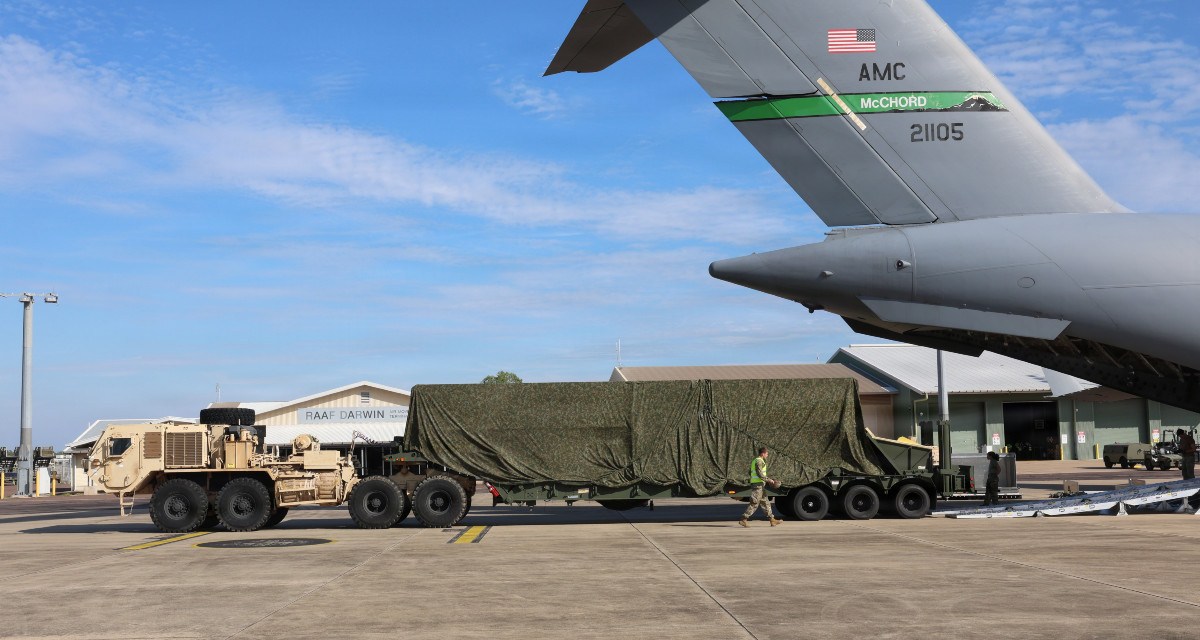
Northern Australia contains several strategically important airfields, including Darwin and Tindal, that could support operations across the Indo-Pacific. Their geography is advantageous, but much of Australia’s deeper repair, storage, munitions, and support capacity remains thousands of kilometers south. Raelene Lockhorst’s recent Australian Strategic Policy Institute study highlights the vulnerability created by the limited north-south distribution system, including the Stuart Highway and the single-track railway linking Adelaide and Darwin. The Stuart Highway is a limited-capacity route subject to seasonal flooding and repeated closure, underscoring how difficult it is to sustain operations in northern Australia at scale. Therefore, the value of those airfields depends on the network behind them. Stockpiles do not create combat power unless they can reach the fight.
The same problem extends beyond the APOD because getting cargo into theater is not the same as getting it to the fight. Following the breakout from Normandy in 1944, Allied armies advanced faster than their logistics network could comfortably support them. Fuel and ammunition existed, but the distance between the supply base and the fighting force grew rapidly. The Red Ball Express became an around-the-clock trucking network pushing supplies forward as the front moved. Drivers sometimes reached their planned destination only to discover that the supply point had moved farther east, forcing the distribution system to continue adapting to the fight. The planned destination was only a point on the route; the requirement was to reach the force.
Operation Iraqi Freedom in 2003 showed that the same seam persists in modern joint operations. Government Accountability Office reviews found that matériel arriving in theater still encountered problems with visibility, prioritization, and onward distribution before reaching supported forces. Poor asset visibility also persisted despite the use of radio frequency identification (RFID), contributing to broader Department of Defense efforts to improve RFID-based in-transit visibility. The details were different from Normandy, but the principle remained the same. Strategic movement can deliver cargo into theater without completing the operational requirement.
A hub-and-mesh network also requires visibility of the requirement moving through it. Knowing where an aircraft is located is not enough. Commanders need to understand what it carries, who needs it, when it must arrive, and which alternate distribution path can still deliver it in time to generate combat power. That information becomes increasingly important when the destination APOD changes after launch.
A resilient mobility mesh must connect alternate APODs to alternate distribution paths, not simply identify places where aircraft can land. If the destination APOD becomes unavailable, the best option is the one that keeps the requirement moving toward the supported force, even if another airfield is geographically closer or easier for the aircraft. The Red Ball Express demonstrated the same principle on the ground. The planned destination was often only a link in the distribution chain; the requirement was to deliver supplies where the force actually needed them. Similarly, in a mesh system, an aircraft diversion must still preserve delivery of the operational requirement to the force that needs it without routing the cargo back through the original APOD.
Preserving that connection between strategic movement and theater distribution creates a command relationship problem because those functions are parts of the same mission but fall under different commanders. USTRANSCOM provides strategic transportation across the global network, while the geographic combatant command is responsible for distribution within the theater. The theater knows the supported requirement and which distribution paths remain viable inside the area of responsibility. USTRANSCOM knows the condition of the strategic mobility network and the cascading effects that changes to one mission can have across follow-on missions. When the destination APOD becomes unavailable after launch, USTRANSCOM’s strategic mobility responsibilities and the theater’s distribution responsibilities converge on the same time-sensitive decision.
The command relationships required to operate the mesh must be established before the network is disrupted. The joint force should know which alternate APODs remain connected to the supported force, how much displaced demand they can absorb, and who has authority to shift the flow. The exact arrangement will differ by theater, but the requirement will not. Therefore, the receiving theater must be able to redirect distribution as quickly as the mobility enterprise redirects aircraft. This coordination is critical to ensuring the aircraft reaches a viable destination and the requirement reaches the force that needs it.
In a hub-and-mesh network, bypassing a damaged APOD should buy time to regenerate capacity or shift throughput elsewhere. Henderson Field remained valuable because engineers repeatedly restored enough capacity to keep aircraft operating despite attack. We must plan for adversary actions that disrupt airfields and distribution routes or reduce available capacity. Resilience is not preventing every disruption. It is restoring or redistributing enough capacity to keep generating combat power. Designing the mesh and its decision-making construct before disruption occurs will reduce the time required to restore or redirect flow.
In a future large-scale conflict, aircraft will already be airborne when their planned destinations become unusable and the theater will not have time to redesign the logistics network under attack. Diverting the aircraft keeps the requirement moving, but the alternate APOD must remain connected to the supported force through the theater distribution network. If it does not, lift capacity becomes tied up moving the same requirement again, increasing exposure to the threat while reducing the capacity available to move the next requirement. The alternate pathways and command relationships required to redirect the flow must already be in place. Therefore, we must design and implement that architecture now.
Colonel Matthew M. Andrews is a director at the 618th Air Operations Center, where he leads global mobility operations in the Department of Defense’s largest 24/7 command-and-control organization. A US Air Force weapons officer and career mobility operator, he has spent more than two decades leading complex operations where capacity is constrained, consequences are real, and decisions must translate strategy into execution.
The views expressed are those of the author and do not reflect the official position of the United States Military Academy, Department of the Army, or Department of Defense.
Image credit: Staff Sgt. Brandon Rickert, US Army