What does a $1,000 Ukrainian drone have to do with a Russian strategic aircraft worth hundreds of millions? The former can destroy the latter—and that asymmetry requires defense planners to think differently. Recent Ukrainian and Israeli strikes have shown that expensive, high-value assets are increasingly vulnerable to cheap, distributed threats. The threat is not just from drones, however; a similar dynamic is on display as Chinese DF-21 and DF-26 and Russian 3M54 Kalibr missiles pose increasing risks to US surface combatants. Yet, as strategic rivalry increasingly heats up in the high latitudes, the US Arctic strategy still hinges on a troubled program to produce a handful of costly, vulnerable, and delayed Polar and Arctic Security Cutters (PSCs and ASCs). That is a strategic liability.
The United States must reassess its Arctic strategy and defense acquisitions model, shifting from costly, vulnerable systems to a distributed, resilient, and NATO-integrated force. A credible strategy demands not only deeper NATO integration but also a new acquisition model that prioritizes modularity, mobility, survivability, affordability, and interoperability. These elements are essential to confronting asymmetric threats in the High North while deterring China and Russia across multiple theaters.
The Arctic in Strategic Context: An Ancillary but Critical Theater
The strategic importance of the Arctic is readily apparent when viewing a globe from the top—where the United States and Russia become neighbors, and Greenland’s strategic value becomes unmistakable. The Arctic, once locked in permanent pack ice, is suddenly much more accessible due to climate change. Thus, the fabled Arctic sea routes are becoming increasingly realistic, reducing transit times by as much as a third. Likewise, the Arctic holds many potential riches including an estimated $1 trillion in minerals, 30 percent of the world’s undiscovered gas reserves, and 13 percent of its undiscovered oil reserves. Recent headlines have discussed the Norwegian king’s visit to Svalbard, President Trump’s proposal to annex Greenland, and joint Chinese and Russian air and naval patrols to the region.
The Arctic has long held strategic importance. Russia first discussed moving its naval fleet via the Arctic in 1897, just before the Russo-Japanese War. During World War II, the Arctic was an important, albeit ancillary, theater, which is perhaps best illustrated by the 8,500 Japanese troops stationed in the Aleutian Islands, prompting deployment of four hundred thousand US troops to Alaska. Hitler’s occupation of Norway required over three hundred thousand German troops—tying down forces needed elsewhere. Lend-Lease Arctic convoys underscored the importance of Arctic sea lines of communication—as well as an icebreaker’s potential as an air defense platform, with the Soviet vessel Krasin shooting down two German fighter planes. Finally, during the Cold War the region served as the primary vector for intercontinental ballistic missiles and bombers as the Soviet Union and the United States squared off under the strategy of mutually assured destruction.
Today, the Arctic has returned to the forefront as a territory for strategic competition between China, Russia, and the United States. The main theaters in that competition are Europe and the Indo-Pacific region, but the Arctic remains a critical ancillary theater that serves as a strategic enabler—shaping outcomes elsewhere. Russia’s threat to NATO’s High North extends from the Gulf of Finland to the Barents Sea. The Russian Navy also poses considerable risk to Svalbard, the GIUK (Greenland, Iceland, United Kingdom) Gap, and the broader North Atlantic. By securing NATO’s northern flank and constraining Russian naval operations in the Arctic, the United States reduces the risk of a two-front maritime conflict—freeing up forces to sustain pressure on China in the Indo-Pacific.
Meanwhile, China is expanding its Arctic influence through investments, many with dual-use potential. It has also shown a growing pattern of strategic activity in the region, from air and naval patrols to expanding icebreaker acquisitions and deployments.
In short, as the recent US Air Force Arctic Strategy asserts, “the Arctic’s capacity as a strategic buffer is eroding.” It is a pivotal flank in a world of global, multidomain strategic competition—one that demands US strategy and acquisitions rapidly evolve to meet the challenge.
Why Big Ships Alone Can’t Win the Arctic for the United States and NATO
Captain Alfred Thayer Mahan argued that national power is directly tied to maritime supremacy, asserting that control of the seas enables power projection, economic strength, and global influence. His framework for seapower included geography, overseas bases, national will, and a powerful navy coupled with a merchant marine. While Mahan’s name is often associated with large fleets and capital ships, his core argument was more nuanced: achieving control of the sea to support national objectives.
Admiral James Stavridis, in Sea Power, echoes Mahan in the modern context, writing, “The Sea is One, meaning that no matter how large or small a given body of water is upon the oceans, in the end it is connected and a part of a single system.” Therefore, Arctic fleet acquisitions cannot be made in isolation. Rather, they must support US goals in the Pacific, Atlantic, and beyond. This involves ensuring survivability, mobility, adaptability, and the production of sufficient platforms for use in potential great power conflicts.
Admiral Stavridis warns that modern naval operations are threatened by increasingly sophisticated antiaccess/area-denial (A2/AD) systems like drones, long-range antiship missiles, and submarines, many of which are now in the hands of US adversaries. In the increasingly contested Arctic waters, large PSCs and ASCs may struggle to survive where drones, missiles, and submarines render them vulnerable, slow-moving targets. In this context the United States must ask: Do current Arctic investments enhance or undermine our broader Indo-Pacific posture? Could smaller, modular, ice-capable vessels integrated with allied forces offer greater value? Additionally, should the United States look to purchase a nonmilitarized polar icebreaker?
As Christian Brose writes in The Kill Chain, the United States remains overly reliant on “large, expensive, exquisite, heavily manned, and hard to replace platforms”—a model increasingly misaligned with modern warfare and fiscal reality. Elbridge Colby and Rush Doshi echo this, asserting that competing in a new era of great power rivalry requires scalable, resilient, and coalition-ready force structures.
If the United States is serious about pivoting to Asia to counter China’s rise in an era of increasing budget constraints and troubled procurement projects, then every acquisition needs to be judged according to its ability to meet the core threat. The Arctic should not be an exception.
A Modular Arctic Strategy: Mobility, Survivability, Affordability, and Interoperability
The United States faces a significant icebreaker gap in the Arctic, with China and Russia collectively operating around forty-five icebreakers—depending on how they are counted—versus two aging and one commercially procured icebreaker in the US fleet. The disparity remains stark even if the comparison is limited to Russia’s seven nuclear-powered icebreakers. This shortfall impacts not just presence but also emergency response capabilities, logistics support, and the ability to secure sea lines of communication.
Yet, as Andreas Kuersten argued almost a decade ago, the icebreaker gap is not a “defense readiness” gap. This fact remains true today. The US Navy is even on record stating that a lack of icebreaking capability “would have minimal impact.” If the United States wants to “out-compete” China and constrain Russia—it must evaluate its acquisitions and strategies to align with these goals.
Both Brose and Colby argue that the United States’ most demanding strategic objective is countering China’s goal of hegemony in the Pacific. Brose details that in the event of a conflict, “US and allied forces would have to close the kill chain against 350 Chinese ships during the first three days of a conflict.” Yet, as Rush Doshi warns, “the United States cannot compete with China symmetrically—that is, dollar-for-dollar, ship-for-ship.”
The United States and its allies must rethink their approach to great power conflict. Instead of centering Arctic strategy on a few vulnerable, high-cost platforms, the United States should pursue a modular and diversified force posture emphasizing survivability, scale, and allied interoperability to achieve US strategic objectives. First, the United States should invest in modular, ice-capable patrol ships that can be adapted to a variety of missions, from intelligence, surveillance, and reconnaissance and A2/AD to humanitarian support. Canada’s Harry DeWolf–class and Finland’s forthcoming Pohjanmaa-class offer affordable, proven templates that could be adapted for US needs.
Second, Arctic-deployable A2/AD systems should be part of the foundation of regional deterrence. These systems’ mobility provides flexibility not only in the Arctic but also in the lower latitudes. Capabilities like the Terminal High Altitude Air Defense, the Patriot Missile System, the Typhon, and Precision Strike Missiles (PrSM) provide credible deterrence and layered protection against peer adversaries.
Third, the United States and NATO must also prioritize dual-use Arctic infrastructure investments like airfields, ports, and satellite stations that support both civil and military operations. NATO’s benchmark of spending 1.5 percent of GDP on, among other things, security infrastructure should include these assets.
Fourth, persistent Arctic domain awareness is essential. The United States should leverage relatively low-cost, scalable, and sometimes commercially available solutions like unmanned aerial vehicles, unmanned undersea vehicles, undersea sensors, and satellites.
Finally, the United States must strengthen partnerships with its allies. Alliances remain the cornerstone of US strategic strength. As others have argued, the United States must work to empower NATO, particularly its Scandinavian allies, to take the lead in Europe’s High North, thereby allowing the United States and Canada to pivot to the Indo-Pacific. Additionally, the United States and its allies need to leverage their respective defense industrial bases and consider shared procurement strategies to increase economies of scale—rather than designing three separate heavy icebreakers for the United States and Canada.
A force built on modular ships, mobile missiles, alliance partnerships, and multinational logistics will survive first contact, deter aggression, and let the United States keep its strategic main effort on China—without ceding the High North.
The Risk of Forgoing PSCs/ASCs Altogether
The United States needs heavy polar icebreakers and the Coast Guard’s current capability is insufficient to meet the current demand signal. The Congressional Budget Office notes that icebreakers support nine of the service’s eleven missions: ports, waterways, and coastal security; aids to navigation; search and rescue; living marine resources; marine safety; defense readiness; maritime environmental protection; ice operations; and law enforcement. Admiral Stavridis makes a strong case for a minimum of four heavy and four medium icebreakers. The Congressional Research Service notes, “A 2023 Coast Guard fleet mix analysis concluded that the service will require a total of eight to nine polar icebreakers.”
The problem is that the current program is overbudget by 61 percent and delayed by at least six years. Much of this can be attributed to a failure to use a mature design and shifting requirements, including transitioning from a standard icebreaker to a heavily armed security cutter—the utility of which is still under debate. Retired Canadian Admiral Mark Norman recently questioned the strategic thought process behind Canada’s pursuit of heavy, armed icebreakers, asking what strategic objective the government was trying to achieve. Rob Huebert said of the same project, “If you are actually in a shooting conflict, you’re going to find out where the icebreaker is right away. If you’re going to be putting money into something, put it into a submarine and give it some form of perhaps anti-missile capability.” Andreas Kuersten makes a similar argument, noting that “icebreakers contribute to U.S. Arctic security by providing human, economic, and environmental security, not by meaningfully enhancing northern defense capabilities.” Rather than transforming PSCs/ASCs into warships, the United States should ensure ice-capable patrol vessels have modular self-defense suites, providing enough deterrent value without compromising affordability or survivability.
This is not a failure of the Coast Guard. Rather, as Brose describes, the service is following an acquisitions process that incentives it to count “people and things, especially platforms” to “compete for money in the budget process. ”The civilian leadership, in this case Congress, needs to take a more coherent systems view of defense acquisitions, capability, and strategy.
Congress should revise 14 U.S.C. §1151 and 10 U.S.C. §8679 to allow the building and operation of foreign icebreakers, thus freeing up domestic shipyards to focus on submarines and high-end surface combatants. Then it should direct the Coast Guard to pursue the procurement of foreign vessels like the Finnish icebreaker Polaris, which is a heavy icebreaker with a reported cost of approximately $150 million, compared to the more than $1.6 billion for the current PSC design. According to the Wilson Center, “Finland’s shipyards have the capacity to produce icebreakers quickly and at a reasonable cost. It is estimated that compared to US icebreaker production underway, the average Finnish icebreaker would cost about a fifth of the price and be completed in about twenty-four months after a contract is signed.” While politically sensitive due to US shipbuilding interests, it is possible for Congress to grant exceptions, and it is essential for it to do so given the “pacing challenge” presented by China.
Purchasing unarmed, off-the-shelf Finnish icebreakers would quickly deliver needed capability, while freeing up US shipyards to focus on high-end naval platforms—where bottlenecks already pose serious risks.
A Combined Joint Arctic Strategy Aligned with Global Security Demands
In an era of constrained budgets and intensifying global competition, the United States must ruthlessly align its military investments with its central strategic objective—preventing Chinese hegemony in the Indo-Pacific. At the same time, warfare is undergoing a profound shift to an era where low-cost, rapidly deployable platforms can threaten expensive, slow-to-build platforms. The principle of economy of force has gained new urgency in an era where a $1,000 drone or a relatively cheap antiship missile can destroy a platform worth hundreds of millions—and there is no geographical exception for the Arctic.
The current US Arctic strategy—centered on a small fleet of delayed, expensive, and potentially vulnerable PSCs/ASCs—has failed to adapt to today’s dynamic threat environment and that is a liability. It reflects a legacy acquisition mindset ill-suited to the speed, scale, and asymmetry of modern warfare. Rather than doubling down on sunk costs in the PSC/ASC acquisition program—the United States should redesign its Arctic posture to a more affordable and agile force design like that advocated by thinkers like Brose, Colby, and Doshi. This includes off-the-shelf, ice-capable patrol ships, rapidly deployable A2/AD capabilities, low-cost domain-awareness systems, and dual-use infrastructure investments.
Simultaneously, the United States must deepen its reliance on allies to share burdens and close capability gaps. NATO should take the lead in securing the European High North flank, allowing the United States and Canada to focus on the Indo-Pacific. Cooperative procurement—rather than duplicative efforts—can reduce costs, speed delivery, and improve interoperability. Congress should revise current laws to permit the acquisition and operation of proven, off-the-shelf, foreign-built icebreakers, enabling the Coast Guard to field urgently needed Arctic-capable platforms in a fraction of the time and at a fraction of the cost.
Congress, the Department of Homeland Security, and the Department of Defense must act now to recalibrate Arctic defense investments—or risk falling behind in a critical theater of twenty-first-century strategic competition. If current PSC/ASC delays continue and the United States fails to field sufficient Arctic platforms it may cede the initiative to Russia and China, risking an unchecked buildup of adversary Arctic capability in the High North with corresponding risks of the potential of denial of access to the region in a crisis.
Jeremy M. McKenzie is a retired US Coast Guard officer and aviator. His last military assignment was as a researcher at the US Coast Guard Academy’s Center for Arctic Study and Policy. He previously served as an Army aviator and has a master of public policy from Brown University as well as a master of social science from Syracuse University.
The views expressed are those of the author and do not reflect the official position of the United States Military Academy, Department of the Army, Department of Defense or Department of Homeland Security.
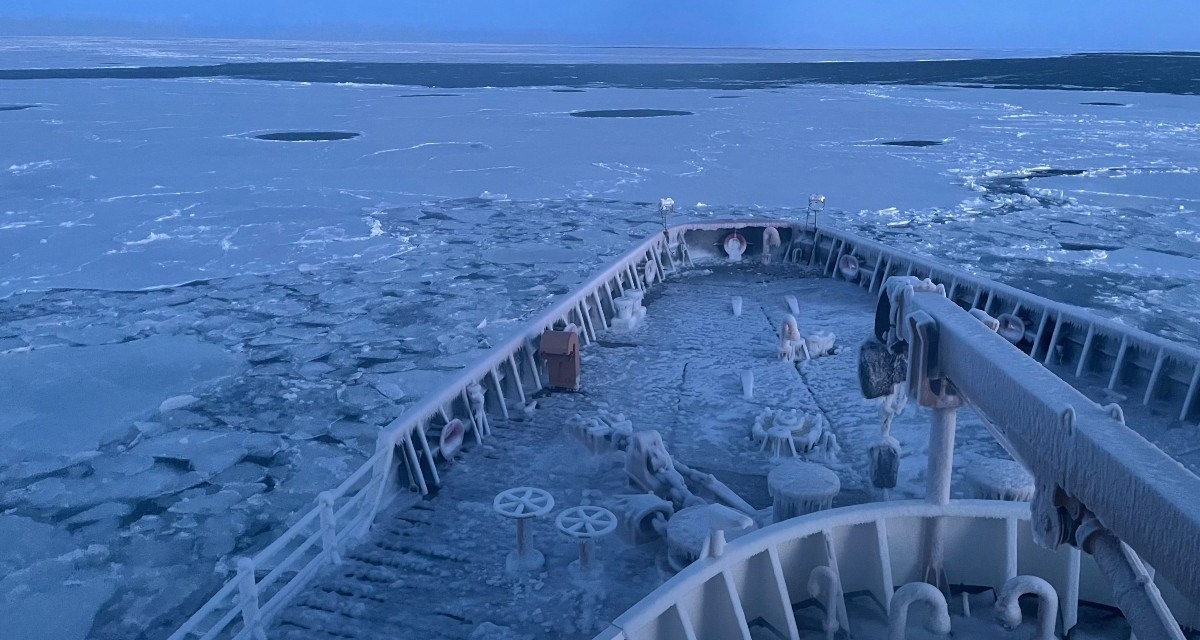
Image credit: Lt. Jared Payne, US Coast Guard