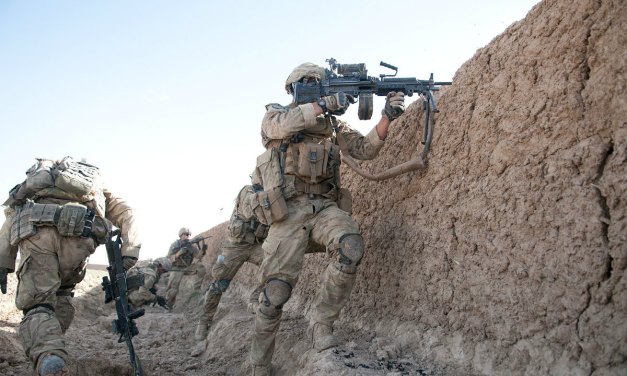
Baptism by Fire: A Survey of First Combat Experiences
When soldiers have been baptized in the fire of a battlefield, they have all one rank in my eyes....
Read More
When soldiers have been baptized in the fire of a battlefield, they have all one rank in my eyes....
Read More
With increasing complexity on future battlefields, adopting the characteristics of complex adaptive systems could provide US military forces a vital asymmetric advantage.
Read MoreBy Lieutenant Colonel Aaron Bazin
Recently in Washington D.C., Army strategists gathered to discuss their profession. Discussions revolved around issues important to the Army’s Functional Area 59 and its civilian equivalent, Career Path 60. Among topics such as promotions and assignments, the group discussed areas such as ISIS in Iraq and the growth of the cyberspace domain.
One panel’s discussion focused on the question, what does the Army strategist of 2030 look like? On this point, the panel’s dialogue revolved around what separates a strategist from other specialties (such as Advanced Military Study Program planners), the need (or non-need) for a well-defined brand, and the current policy on what strategists do across the Army and joint force. Many traits needed by successful strategists came up over the course of three days of discussion, including the need for strategists to lead change, think strategically, and speak truth to power.
The discussion of professional identity is a valuable one, and is paramount to the future of the field. This brief article seeks to neither reconcile all of the disparate opinions in one model, nor suggest that one model is even possible. This article simply provides one point of view for future discussion and debate. Moreover, the hope is that this article serves as a point of departure that individuals can use to determine their own beliefs on what a strategist should be, know, and do.
Read MoreSince even before the Greeks used deception to sack Troy, information, disinformation, secrets, and lies have played a central role in military operations. Arguably, an officer’s primary weapons system is information. To bring to bear the warfighting functions and accomplish any mission, an officer must think critically and continually communicate information up and down the chain. Equally, any military action conveys a message to adversaries and other key stakeholders. So, if information holds a fundamental place in officer business, just how should an officer integrate information operations and tactical kinetic actions?
The world of information operations is complex and getting even more so every day. As such, there are many different opinions on what exactly comprises information operations and many officers conflate and confuse with information operations with cyber. To diverge from a known point, joint doctrine currently defines information operations as:
The integrated employment of electronic warfare (EW), computer network operations (CNO), psychological operations (PSYOP), military deception (MILDEC), and operations security (OPSEC), in concert with specified supporting and related capabilities, to influence, disrupt, corrupt or usurp adversarial human and automated decision making while protecting our own.
The first portion of this definition describes the tools in the toolbox (EW, CNO, PSYOP, MILDEC, and OPSEC). The second portion describes the desired outcomes (to influence, disrupt, corrupt, usurp, or protect). This definition provides the means at an officer’s disposal and describes desired ends. Next, to get after the real question, this post will discuss some of the nuanced ways to handle information operations in the contemporary context.
Understand Authorities and Redlines
Many of the tools of information operations are extremely powerful. As such, very high levels of command tightly control their employment. First and foremost, officer’s must know what the limits what they are allowed to do and what they cannot do. Just like any centrally controlled support capability, (e.g., artillery, CAS, etc.) it is incumbent on the tactical commander to request what capability they need. In the future, tactical commanders may have more authority to synchronize local information operations independently, but today that is the exception not the rule.
Read More