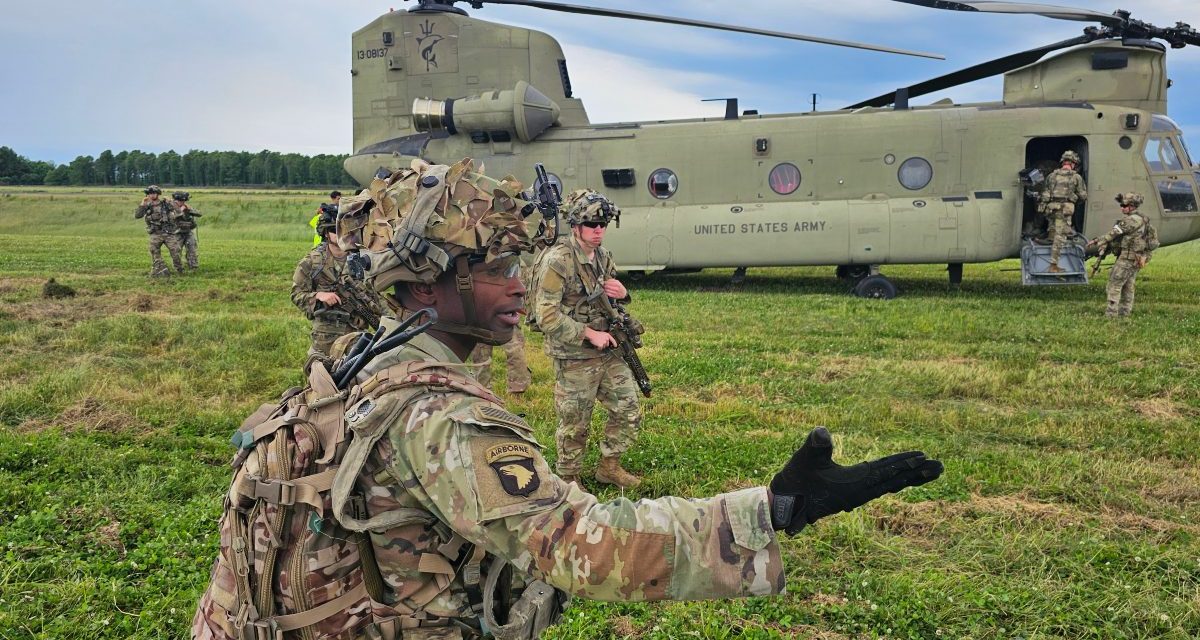
As the helicopters departed from the expeditionary refueling point, I looked down at the joint digital common operational picture displaying a live feed of troops, aircraft, and organic unmanned aircraft systems. I realized what we as a ground force had done for our combat aviation partners. Our light infantry company was taking part in Operation Storm Surge, an exercise built around securing a temporary forward location for aviation sustainment. Our mission had been simple: Land in a disaggregated landing pattern, secure and prepare a landing zone for incoming aerial refueling assets, receive an inbound aviation package that quickly refueled and departed toward the division’s simulated deep area. Our defining result was not simply that soldiers had reached the objective; this is commonplace in an air assault division. It was that our ground mission helped make the next aviation movement possible.
For the 101st Airborne Division, the usual relationship runs the other way. Helicopters give infantry reach: They carry soldiers over terrain obstacles and place combat power at distant objectives. Storm Surge posed the reciprocal question. What if infantry could make a piece of ground available so that aviation could operate farther forward? For a brief period, terrain held by a ground force became the connection between an expeditionary refueling capability and a follow-on aviation mission. The objective mattered not for the ground alone, but for what the supported force could do because the ground was controlled.
A helicopter’s range is not the same thing as the distance over which an Army division can fight. An aircraft may be able to reach a distant objective yet lack the fuel, armament support, endurance, or operating conditions required to accomplish its mission. The more relevant metric is operational reach: the distance and duration across which a force can successfully employ its capabilities. That reach belongs to a functioning military system, not to an aircraft’s specifications.
The 101st Airborne Division (Air Assault) has spent years demonstrating how far it can move infantry by helicopter. Storm Surge presents the reciprocal question: How can the division use infantry to make aviation and other capabilities—including joint capabilities—effective farther into the operational area? The answer may lie in a familiar infantry function—seizing or securing key terrain—but with a more deliberate operational purpose. Air assault infantry can establish temporary ground access for expeditionary aviation sustainment and potentially other capabilities whose employment depends on access to terrain. When that access makes a previously unavailable forward refueling or rearming capability usable, a tactical ground mission may expand the options available to a division or corps commander.
This is not a proposal to convert rifle companies into refueling crews, or to make the infantry solely an enabling arm. It is an argument for developing infantry-enabled operational reach as an additional specialization of the 101st: using the division’s ground maneuver expertise to create access that extends the useful employment of other combat power.
Terrain Is Valuable Because of What It Enables
Infantry has always fought for terrain, but not every objective matters for the same reason. A bridge allows follow-on forces to maneuver. An airfield provides access for additional aircraft and troops. A port opens a sustainment route. In each case, physical control of a limited location produces an advantage for a larger force. The tactical requirement is to control the ground; the operational benefit is what control permits others to accomplish.
The same logic can apply to an expeditionary forward arming and refueling point (FARP). A FARP is a temporary aviation support facility that supplies fuel and, when required, ammunition to aircraft away from their established bases. The related area for forward arming and refueling (AFAR) concept reflects the Army’s efforts to make aviation sustainment more adaptable under contested conditions. A FARP can itself be temporary, so the distinction is not simply permanent versus mobile. Compared with a more established FARP, the AFAR approach emphasizes brief use of a location for a specific mission, followed by rapid displacement. Both provide fuel and ammunition; the AFAR approach seeks to limit the time aircraft and sustainers remain exposed at one site. Neither is simply a helicopter landing site. Both depend on qualified personnel, equipment, supplies, technical standards, and an operating environment that permits aircraft to use the support being offered.
Aviation sustainers can possess the technical capability to refuel aircraft but lack usable access to the terrain on which that capability would have to operate. That creates a ground maneuver problem. Infantry can contribute by establishing the required degree of control of the location. It does not create additional fuel or change aircraft performance; it may make an otherwise unavailable support option accessible. The operational question is whether that option permits a mission that could not otherwise be accomplished—or makes it materially more effective.
The concept is consistent with the Army’s existing understanding of key terrain, which derives its value from the advantage its control affords a combatant. But it requires a change in what is measured. The meaningful outcome is not the ground held or the distance of the insertion. It is the additional combat power the larger force can employ because the ground was controlled.
Eagle Eclipse Demonstrated the First Half of the Relationship
The 101st has already demonstrated formidable proficiency in aviation-enabled force projection. During Operation Eagle Eclipse in January 2024, the 101st Combat Aviation Brigade supported an air assault associated with a Joint Readiness Training Center rotation in Louisiana. According to the participating aviation leaders’ published account, seventy-six aircraft accumulated 743 flight hours while covering approximately five hundred nautical miles during the initial operation. Helicopters delivered 481 soldiers, twenty Infantry Squad Vehicles, and five M119 howitzers; follow-on lifts increased the ground force to 838 soldiers and additional equipment.
Eagle Eclipse was not simply a long helicopter flight. It required a carefully planned chain of refueling, maintenance, staging, command-and-control, and transportation support. The aviation brigade’s account describes multiple sustainment nodes supporting the movement from Fort Campbell toward the training area. The operation’s principal achievement was to place and reinforce a substantial infantry force at operational distance. Forward aviation sustainment enabled the ground force to arrive and fight.
The expeditionary access concept addresses a different problem: Can a ground force establish access that makes forward aviation sustainment possible? Instead of employing an extensive support network principally to move a large infantry formation, a smaller infantry formation would provide a ground-control capability supporting an additional aviation sustainment option. The supported aviation mission, rather than the concentration of infantry at the objective, becomes the principal operational benefit. Eagle Eclipse and this concept are complementary, but they should not be confused. The difference is purpose, not simply numbers of aircraft or nautical miles.
The Historical Precedent Is the 101st’s Own
This relationship is not without precedent. On February 24, 1991, infantry from the 101st conducted an air assault more than one hundred kilometers into Iraq to establish Forward Operating Base Cobra. In an account published in Infantry, the commander of a battalion involved in the effort described how the ground force had to establish control of terrain that was vital to subsequent division operations. FOB Cobra became a forward aviation refueling and support location enabling additional air assault operations toward the Euphrates River Valley.
The division’s official history also records how its support command established a helicopter rearm and refuel capability at Cobra. The point is not that a contemporary force can reproduce the 1991 operation unchanged. The coalition enjoyed advantages that cannot be assumed against a modern adversary employing pervasive sensors, integrated air defenses, electronic warfare, and precision strike. Rather, Cobra establishes the operational framework: infantry established ground access; sustainers exploited that access; the division acquired additional options for employing aviation.
The Army has continued refining the sustainment part of that relationship. In 2021, senior sustainment officers argued that conventional, concentrated FARPs would be vulnerable in large-scale combat and that refueling proficiency needed to extend beyond aviation support formations. More recently, a July 2026 Army Sustainment article reported that the 101st Division Sustainment Brigade had certified more than two hundred personnel in an effort to distribute FARP and AFAR capability. That initiative develops the technical supply side. Infantry-enabled operational reach addresses the complementary issue of ground access.
Connecting Close Battle to Strike and Endurance
The October 2026 “How the Army Fights” guidance supplies an especially useful framework. It identifies four interdependent operational elements: convergence, strike, close battle, and endurance. Close battle establishes physical control of terrain. Strike attacks enemy systems at range. Endurance sustains and projects combat power across time and distance. Convergence, primarily a corps and theater army responsibility, integrates effects across domains to create opportunities for operational maneuver.
The guidance explicitly states that strike depends on ground maneuver for supporting functions and on expeditionary sustainment for continued employment. An infantry force may therefore contribute to the deep fight without possessing the long-range weapon that delivers the effect. The ground force performs its assigned tactical mission. Aviation sustainers provide the technical support. The supported formation employs its capability. The higher headquarters directs the operation and assesses whether the resulting advantage matters.
This relationship requires careful terminology. The infantry’s task is not to conduct corps-level convergence or independently control the deep strike. A division’s deep operations influence future close operations and protect rear operations by affecting enemy capabilities beyond the immediate fight. A corps operates across a broader framework and sequences the efforts of multiple divisions. Neither division deep nor corps deep is a fixed mileage band. These are commander’s operational frameworks, not distances automatically reached when an aircraft crosses a line on a map.
A 101st company operating at distance would remain a tactical ground force supporting a higher commander’s purpose. Its potential value is that it makes a support or employment option available within the larger system. This is exactly the kind of relationship the new guidance asks Army formations to understand: Tactical success must become operational advantage.
The institutional question extends beyond the rifle company or aviation brigade. A brigade may plan and execute a deep attack, but the division must synchronize the support that allows that mission to contribute to the larger operation. Infantry-enabled access should therefore be evaluated as a division capability, with ground maneuver, aviation, sustainment, protection, and higher headquarters contributing to a shared operational purpose. Experimentation should assess whether those contributions produce a useful and repeatable operational advantage.
Nor should the concept be confined to forward arming and refueling points. Aviation sustainment provides a concrete starting point, but the broader proposition is that temporary control of terrain may enable other capabilities to operate at greater depth. Potential applications involving sensing, communications, or launched effects warrant examination without presuming their feasibility or survivability. The division should define the operational problem first, then test whether infantry-enabled access offers an advantage over available alternatives.
The Hard Problem Is Survivability, Not Arrival
The most serious objection to forward expeditionary sustainment is not whether helicopters can reach a location or infantry can occupy it. It is whether the resulting support capability can operate in the modern reconnaissance-strike environment. Ground security does not equate to protection from unmanned systems, precision fires, or enemy air defenses. A location free of enemy soldiers may remain vulnerable to enemy observation and attack. Aviation fuel and aircraft concentrations can themselves become liabilities.
This is the larger dilemma identified in modern analyses of basing: A position may confer reach and endurance while imposing costs, risks, and commitments that eventually outweigh its value. Temporary access is not inherently survivable, and it does not automatically provide sustained operational endurance. A single successful refueling event is evidence of a function; it is not proof that a division has gained a viable deep-strike capability under combat conditions.
The right question is comparative: What can the commander accomplish with infantry-enabled access that cannot be accomplished, or cannot be accomplished as effectively, through available alternatives? Evaluating the concept requires consideration of the supported mission’s availability, operational benefit, reliability, survivability, and resource costs. Forward access is only useful when it translates into mission-effective combat power.
A Divisional Specialization Worth Testing
The 101st should treat infantry-enabled operational reach as a candidate for institutional experimentation. The concept warrants further development, but its value depends on whether temporary ground access can produce a useful and repeatable operational advantage. Three recommendations would help the division examine that proposition before pursuing permanent changes.
First, define the capability by the operational effect it enables, rather than by a particular FARP package or insertion method. The starting point should be a mission the division needs to accomplish and the constraints preventing it from doing so. A forward refueling location, for example, matters because it may allow an aviation formation to reach an objective, remain available longer, or support a subsequent mission. Framing the concept around that contribution would also leave room to examine applications beyond aviation sustainment, including sensing, communications, or launched effects. In each case, experimentation should establish what temporary control of terrain adds to the commander’s options and whether another available capability could provide the same benefit more effectively.
Second, develop a shared understanding among ground maneuver, aviation, sustainment, and higher headquarters of what each contributes and where each responsibility ends. Securing terrain is only one part of making a forward location usable. Sustainment forces must be able to provide the required support, aviation formations must be able to employ it, and the division must synchronize those activities with the larger operation. A brigade may plan and execute a deep attack, but the support necessary to make that attack effective can extend beyond the brigade’s authority and resources. Developing the concept jointly would help identify those dependencies and clarify which headquarters must resolve them. It would also allow the division to assess the demands placed on the entire force, rather than judging the concept solely through the performance of the infantry company or supported aviation formation.
Third, evaluate the operational effect against available alternatives under demanding, representative conditions. A successful insertion or refueling event demonstrates that a particular function worked; it does not establish that the division gained a viable capability for combat. Assessment should extend through the supported mission and consider reliability, survivability, and the forces and resources committed. It should also examine whether the advantage can be repeated as conditions change and an adversary responds. Comparing those results with other ways of supporting the same mission would help distinguish a useful specialization from an approach whose costs outweigh its benefits. The evidence should then guide recommendations for training, doctrine, or organizational changes, with the scale of any proposed change reflecting how much experimentation has actually demonstrated.
The 101st has already shown that aviation can carry its infantry an extraordinary distance. FOB Cobra demonstrated decades ago that infantry can make forward aviation sustainment possible. The next institutional question is how reliably the division can connect those two competencies under the conditions of modern war.
The future measure of an air assault should not be only how far infantry flies. It should also be what the joint force can accomplish because infantry arrived.
Captain Chris Lajeunesse is a US Army infantry officer serving as a light infantry company commander in the 101st Airborne Division (Air Assault). Captain Lajeunesse is a West Point graduate and Ranger-qualified officer. He has served in modernization and innovation roles and is actively developing company-level experimentation connecting ground maneuver with expeditionary aviation sustainment.
The views expressed are those of the author and do not reflect the official position of the United States Military Academy, Department of the Army, or Department of Defense.
Image credit: Master Sgt. Anthony Hewitt, US Army