“You musicians of Mars must not wait for the band leader to signal you. . . . You must each of your own volition see to it that you come into this concert at the proper place and at the proper time.”
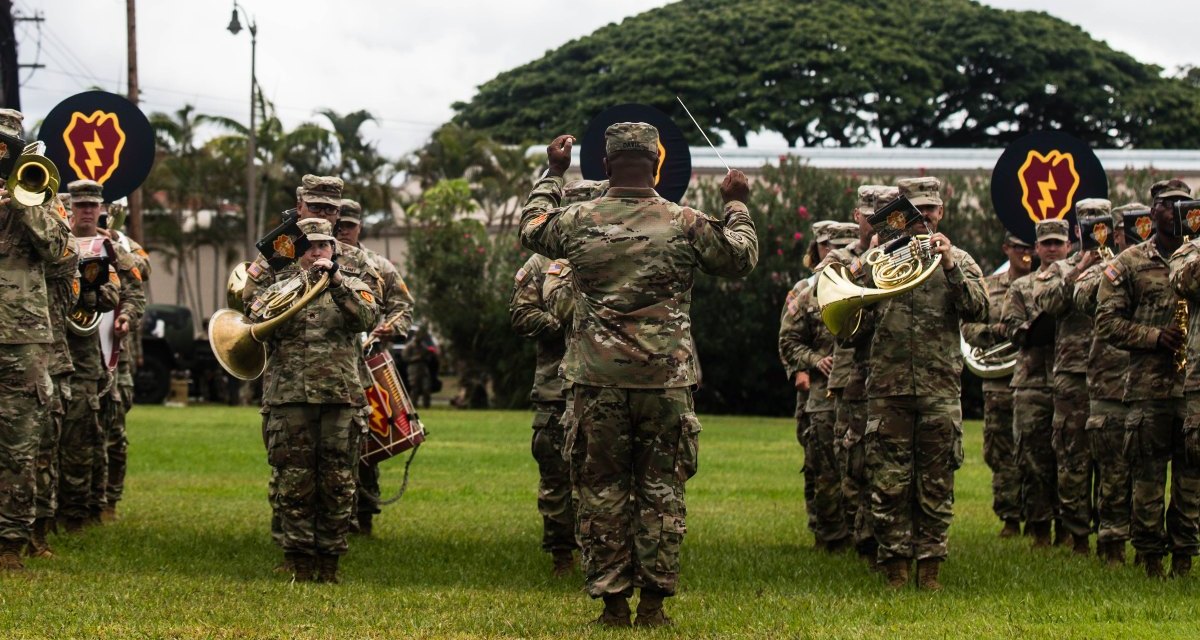
You may have seen a version of this quote from General George S. Patton before, potentially in a 2022 article publicizing the enshrinement of multidomain operations as the Army’s current operational concept. But if you saw it there, you did not see the whole quote. The authors omitted Patton’s guidance to “not wait for the band leader to signal you” and to act “of your own volition.” The article paired the abbreviated quote with a drawing of Patton as a conductor, baton raised, personally orchestrating multidomain capabilities. In doing so, they mischaracterized Patton’s meaning. He described a jazz band improvising with initiative. They implied an orchestra synchronizing to a commander’s direction.
By portraying commanders as battlefield conductors, the article echoed the French interwar doctrine of la bataille conduit, which, while often translated as “methodical battle,” literally means “conducted battle.” The French Army believed it had developed and validated a doctrine that met the changing character of war. It viewed war as increasingly lethal and artillery as central to that lethality; however, its doctrine was ill-suited to its strategic context, just as the US Army’s multidomain operations doctrine is ill-suited to its current context.
The Army needs to be optimized to meet the threats against which it would have the least amount of time to adapt, which means a Chinese joint island landing campaign. To meet that threat, the Army needs decentralized, flexible forces that can counter Chinese strategic surprise, deny Beijing a fait accompli, and regain the initiative.
Conducting Convergence
Instead, in its efforts to transform for multidomain operations, the Army has moved toward a centralized orchestra. To align its force design for multidomain operations, the Army announced a new plan intended to optimize the service around the requirements the future (specifically, 2030) would impose on it. Senior leaders argued that while in Iraq and Afghanistan the brigade combat team was the Army’s primary tactical formation, in the future divisions would serve as the primary tactical formation. The Army 2030 plan, they claimed, recognized that only divisions could effectively synchronize maneuver with effects on the modern battlefield. Moreover, they wrote that “delivering the enabling capabilities to the division level allows these commanders to allocate the weight of the main effort and shift quickly to support brigade combat team commanders in the close fight.”
Behind the assertion of the authority of divisions and corps is a tacit belief that modern commanders must conduct the battlefield—synchronizing dispersed forces through centralized control of intelligence, fires, and decision-making. This belief rests on a critical assumption: that headquarters at echelons above brigade are best positioned to handle the complexity of a future battlefield. However, the Army’s evidence for this assumption largely comes from corps and division-level Warfighter exercises, which are simulations with little grounding in the fog and friction of war.
Freeing Brigades?
With a hint of doublespeak, Army 2030 portrayed the centralization of assets as liberating for subordinate units: “These commanders are therefore freed to concentrate on maneuvering their forces, offloading the more complex allocation and coordination challenges to division commanders.” In exchange for this supposed freedom, brigades sacrifice the ability to rapidly integrate fires, conduct independent reconnaissance, and employ engineering assets without an additional layer of coordination and oversight.
Of course, divisions could provide such assets to a brigade, and a recent article argued that the Army’s main problem in meeting Army 2030 is that it needs to educate staff officers to task organize better. But staff work cannot replace cohesion. During Warfighter exercises, staffs move units like interchangeable parts. In real life, to effectively fight, units need to train together. They need to develop techniques, standard operating procedures, and mental models that act as lubricants amid the friction of war. The Army already impedes such developments by constantly moving personnel. Army 2030 will further undermine the cohesion necessary for disciplined initiative.
During World War II, General Lesley McNair believed that capabilities could be pooled at higher echelons and efficiently moved between units as required. In practice, units formed enduring relationships because cohesion proved essential in combat. Divisions created persistent combat teams of infantry, artillery, engineers, and tanks. The triangular infantry division, validated in World War II and Korea, provided a 105-millimeter artillery battalion in direct support of each infantry regiment and retained a 155-millimeter artillery battalion for general support. In combat, the Army learned these enduring relationships mattered.
In previous wars, the Army also recognized that adding layers to processes slows them. Every minute matters in a fight. During World War I, the US Army initially adopted the French doctrine of centralizing artillery, but during the more mobile fighting of the Hundred Days Offensive, General John Pershing decentralized his artillery after recognizing that fires needed to be responsive to the needs of the infantry.
Recently, one of this article’s authors observed a division-level National Training Center rotation during which artillery was centralized, resulting in fire missions averaging over thirty minutes and illustrating how additional layers slow responsiveness. During that event, it took three hours to approve a scatterable minefield. The division headquarters approving the minefield would have been long overrun if the opposing force had not been administratively halted. Despite all the dreams of digitalization, in the real world, even without the threat of electronic warfare and cyberattacks, communication breaks down.
Think Deep
In “freeing” brigades from thinking about the deep fight, Army 2030 sacrifices an essential element of modern warfare. All units need to think in depth to shape the battlespace for their subordinates. Army 2030 artificially separates deep and close fights, assigning depth exclusively to higher echelons. However, the Army should not view deep fights as a function of echelon, but by capability to shape the battlefield. Every echelon that can conduct reconnaissance and fires, whether with HIMARS (high-mobility artillery rocket system) or 60-millimeter mortars, should shape the fight for its subordinate units. On the modern battlefield, as each echelon fields unmanned systems with differing capabilities, the Army needs a framework that understands how brigades, battalions, companies, and even platoons shape the battlefield.
The Ukrainian armed forces blunted Russia’s aggression by primarily fighting at the brigade level. In the authors’ discussions with Ukrainian officers, they reported that artillery batteries were often assigned in direct support of infantry battalions to ensure fires within three minutes. Ukraine’s Kropyva system—which has been described as “Uber for artillery”—links observers directly to firing units, enabling fires within minutes.
Ukraine did not even formalize an echelon above the brigade level until 2025. Even now, Ukrainian corps centralize select, scarce assets, such as 155-millimeter artillery, HIMARS, or the fixed-wing Hornet unmanned system. Corps fight 100–150 kilometers deep, but brigades still fight out to thirty kilometers. Brigades retain artillery battalions with 152-millimeter artillery, 122-millimeter rockets, and 105-millimeter artillery. They regularly have an unmanned systems battalion, an engineering battalion, an air defense artillery battalion, and an electronic warfare company. Ukrainian leaders understand that decentralized capabilities provide the responsiveness required to defeat Russian infiltration attempts and rapidly counterattack to prevent Russia from solidifying gains. Recognizing how Ukraine fights makes any argument that Army 2030 and its centralization of capabilities in divisions reflect the “changing character of warfare” a curious one.
The Army does indeed need to base force design on a forecast of the future character of warfare, but that forecast cannot myopically focus on technology. Instead, it must design units to prevail against its most dangerous adversary in the first days of a conflict. It needs to forecast the character of the fight based on its strategic context. When armies do not optimize units for their strategic context, they risk disaster.
Army 2030 or Armée 1930?
“To allow front-line leaders to concentrate on the close fight, division and corps commanders will have the responsibility and capability to visualize the larger picture.”
“The systemic allocation of all artillery to subordinate elements must be avoided; it constitutes an abdication of command.”
— Règlement de manœuvre de l’artillerie, 1926
The logic of methodical battle and Army 2030 echoes. They both deemed that due to the increasing lethality of the battlefield, senior leaders had a responsibility to ensure the efficient allocation of fires. Just like the US Army today, the French Army believed that the answer for increased battlefield complexity was centralization. The resource allocation and the synchronization of fires with maneuver could only be carried out by higher-echelon commanders. Confident in its analysis of World War I, the Spanish Civil War, and wargames, the French Army believed fires would dominate the battlefield and dictate movement. Advancing was only possible if French forces achieved a much greater concentration of fire than the enemy.
Methodical battle rested on two interdependent assumptions: first, that the French could mass matériel, men, and equipment at the chosen decisive points, and second, that they could control the tempo of operations. Ultimately, the Germans exposed the fallacy of both assumptions, causing a systemic breakdown in the centralized French Army, which, due to slow decision-making and a lack of unit cohesion, could not reestablish a coherent defense or mount an effective counterattack to seal Germany’s breakthrough.
Today, division leadership learns in Warfighter exercises that movement supports fires. Operations revolve around a targeting process that attempts to scientifically allocate assets ninety-six hours in the future. Through this process, divisions methodically apply combat power against multiple decisive points. It’s a system to efficiently synchronize a symphony of multidomain capabilities. But what happens when enemy forces do not play their designated role? What if they do not wait to be converged on?
The French faced an army that did not follow their tune. Instead of trying to methodically synchronize on decisive points, the Germans selected a single Schwerpunkt—an easily communicated geographic area—to weight their effort against. Each level broadly determined a Schwerpunkt in terms of width and length to provide maximum flexibility for subordinates operating under a shared vision.
To an American military attaché observing interwar German maneuvers, it seemed like chaos. The Germans did not adhere to timetables or worry about maintaining a continuous front: “At first the impression was given that these irregularities . . . were due to errors in carrying out the intentions and orders of superiors. But later it was proved to be done by intent.”
In turn, a German observer of French maneuvers wrote that the French placed “twice as much importance” on synchronizing combined arms as the Germans. He noted their slowness as higher headquarters controlled successive operations. The French Army tried to scientifically manage units, putting scant emphasis on cohesion. Germany prioritized unit cohesion, which provided the shared understanding necessary to operate with minimal guidance.
When Germany attacked in May 1940, it exploited the fluid battlefield created by French forces rushing to establish defensive positions in the Low Countries. Following the principle of Schwerpunkt, Germany aimed its breakthrough along the Meuse River at Sedan. German units did not wait for higher echelons to set conditions for a river crossing. Small units rapidly crossed the river and continued pushing deep into French lines. Not prepared for such a fluid fight, French fires were not responsive. Suffering a communication breakdown and fearing being overrun, the divisional artillery at Sedan displaced early and contributed little to the defense. Once the Germans broke through, French units attempted to reestablish a defense, but they arrived piecemeal. They could not effectively fight in such a context.
Surprisingly, French generals accurately forecast their strategic context, even predicting Germany’s likely breakthrough point in 1936. They debated the need for “seven mechanized divisions . . . [that] could render most valuable service in the first days of mobilization. They could go to the aid of the Belgian army . . . exposed on its southern flank in the Ardennes.” Due to bureaucratic inertia from siloing of strategic thought, doctrine, and force design, they aligned their forces to meet a vague, technological “character of war” rather than their specific strategic context.
The Character of War is Context Dependent
In certain contexts, armies should centralize their capabilities to achieve efficiencies and concentrate combat power. But careful synchronization only works when an army can dictate the tempo of a fight. While the methodical approach failed catastrophically for France, later Allied commanders succeeded with similar approaches. Field Marshal Bernard Montgomery applied careful synchronization at El Alamein to defeat the Afrika Korps. Similarly, General Dwight Eisenhower pursued a methodical, “broad front” strategy to minimize vulnerabilities against Germany. Even then, just like the Ukrainians today, the Allies did not centralize all assets at the division level and above.
After 1943, the Allies controlled the tempo of the fight. They could focus on synchronizing overwhelming combat power against the Axis. In a future fight against the People’s Liberation Army (PLA), the US Army would not have such a luxury.
The PLA can decide where and when to fight, and might dictate the tempo of operations. Xi Jinping has waged a decade-long campaign against the “Five Incapables” to ensure that the PLA can fight with flexibility and initiative. As part of those reforms, while the US Army has been centralizing assets, the PLA has decentralized its forces and made brigades its primary tactical echelon. Organized with organic reconnaissance, artillery, rocket, electronic warfare, air defense, and engineer capabilities, a recent US Army Transformation and Training Command report highlighted that a PLA combined arms brigade would “challenge [a US Army brigade’s] intelligence, fires, and protection warfighting functions.” Meanwhile, the PLA’s system destruction warfare would aim to isolate US Army brigades from their higher headquarters. The PLA has optimized to fight against a centralized, slow enemy.
The National Defense Strategy calls for the military to “build, posture, and sustain a strong denial defense along the [first island chain].” The Army needs to understand its role in deterrence by denial, which requires forward-positioned forces to prevent an initial fait accompli. Army forces in the first island chain cannot wait for convergence from divisions and corps. They need to be ready in the opening moments of a war to rapidly regain the initiative from a PLA joint island landing campaign. To do so, they need to be structured to fight decentralized.

While the US Army requires a decentralized force structure to deny an initial Chinese fait accompli, it may later have to centralize assets if China solidifies its position. After the initial period of every modern, major, prolonged war, a static battlefield emerges due to armies shoring up vulnerabilities that can be exploited by surprise and tempo. To address such contexts, Soviet interwar theorists recommended centralized capabilities to create a breakthrough. During World War I, the Germans consolidated artillery to create conditions for achieving initial breakthroughs at Riga, at Caporetto, and during the 2018 spring offensives, but then rapidly returned those assets to directly support advancing infantry battalions to maintain tempo.
Patton understood that war could shift between mobile and static conditions, but he prioritized preparing for a fluid battlefield. When a war becomes static and requires centralization to achieve a breakthrough, armies have time to reorganize forces. They lack such time in a faster-paced fight. Therefore, when planning, Patton insisted that “the situation must be considered mobile, since a mobile situation would be the most difficult. Anything which would work in a mobile situation without further refinement would work in a static one, while the reverse was not necessarily true.” It is easier to synchronize a jazz band than to command an orchestra to improvise.
Robert G. Rose is the chief research officer at the Modern War Institute. He holds an undergraduate degree from the United States Military Academy and graduate degrees from Harvard University and, as a Gates Scholar, from Cambridge University.
Matthew Revels is an Army strategist who serves as the Modern War Institute’s plans officer and as a senior instructor at the United States Military Academy. He currently teaches courses on military innovation and forecasting and gaming in decision-making.
The views expressed are those of the authors and do not reflect the official position of the United States Military Academy, Department of the Army, or Department of Defense.
Image credit: Pfc. Justin Hicks, US Army