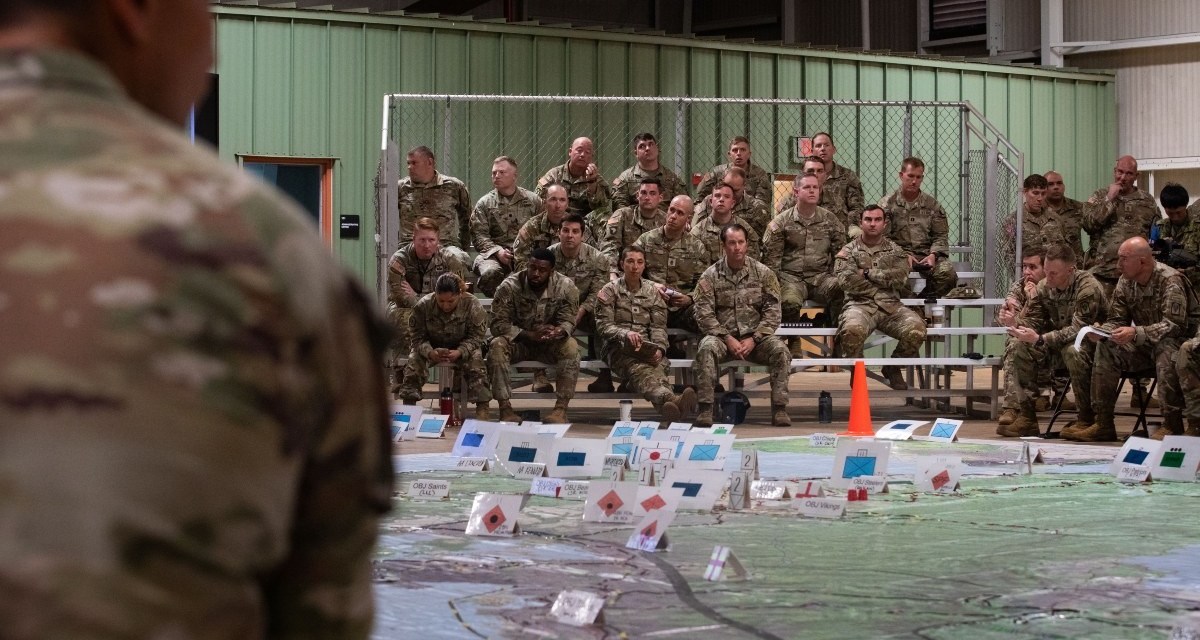
A division major updates a common operational picture during a campaign in the Pacific. An engineer company leaves one mobile brigade combat team and joins another on a different island. A signal package shifts with it. The icon moves in seconds. The operation does not. The gaining brigade now needs lift, fuel, maintenance support, communications integration, protection, reception, staging, onward movement, and rehearsals. The losing brigade now needs replacement capacity or a revised scheme of maneuver. The sustainment architecture changes across distance and water. The task organization decision looked simple. It reshaped the operation.
Major General James Bartholomees and Major Greg Scheffler’s recent Modern War Institute article captures the logic of the Army’s renewed division-centric approach. The Army is rediscovering the division as the warfighting unit of action. Divisions now hold and synchronize more artillery, intelligence, signal, cyber, electronic warfare, engineer, and sustainment capability. Brigade combat teams receive mission-tailored packages built for a specific fight. Division-separate battalions function as warfighting headquarters. Supporting formations stay mobile enough to keep pace with maneuver. Those principles fit the battlefield the Army expects to fight on. They also illuminate friction that senior leaders should address now.
The friction sits in command and control, in leader development, and in the institutional habits of an Army that learned to fight for two decades through large brigade combat teams with more capability living inside the brigade. The transformed division asks commanders and staffs to think in a different way. A task organization decision now drives movement planning, support relationships, sustainment demand, command-post design, communications architecture, and protection priorities. The Army needs leaders who can see those requirements early and staffs who can translate them into action during planning and execution.
The transformed division is a sound operational idea. The Army needs divisions that can integrate capabilities across depth and connect subordinate brigades to the larger campaign. The friction grows from execution. The Army has shifted responsibility upward faster than it has prepared the force to exercise that responsibility. The result appears inside division headquarters, between divisions and brigades, and across the institutions that educate the officers who fill those headquarters.
Where Senior Leaders Should Worry
The first source of friction is the burden on the division staff. The MWI article describes the movement of key capabilities upward from the brigade combat team to division-controlled formations. That change gives division headquarters more authority to build a force package tailored to any specific mission. It also gives the headquarters far more integrating work. A division staff now has to align engineers, signal, intelligence, sustainment, protection, and fires across multiple brigades while the operation moves. Every shift in task organization changes who supports whom, who commands whom, and who now has to move what across the battlefield. The headquarters does that work with roughly the same staff structure many officers knew before the new model matured. The chart changed. The integrating burden expanded faster.
The second source of friction is leader experience. Many field-grade officers, battalion commanders, brigade commanders, and general officers grew up in an Army where the brigade combat team held much of the capability it needed to fight. Those leaders learned to plan and command inside a structure that built many combined-arms relationships into the brigade itself. The new model demands different habits and a different mindset. Leaders now need to build a brigade package for a specific mission, define support relationships early, anticipate the sustainment and movement burden created by a reallocation of capability, and preserve tempo while those changes occur. Those are learned skills. The Army should teach them deliberately and rehearse them repeatedly.
The third source of friction is the seam between corps and divisions in the deep fight. Army doctrine places corps and divisions at the center of large-scale combat operations and directs Army forces to create and exploit advantages across depth. Army writers have also described the agile division as a formation that integrates capabilities across domains and enables subordinate maneuver formations to exploit windows of opportunity. That foundation is useful. Staffs still need sharper guidance on how divisions and corps divide work in practice. Fires sit inside that question. Sensing, sustainment reach, movement control, protection, command-post survivability, engineer support, and the transition of capabilities across distance sit there too. Staffs need repeated practice on who owns each part of that problem, who supports it, and how those responsibilities shift during a campaign.
Why the Pacific Makes It Harder
The Pacific sharpens this friction. Distance, water, limited infrastructure, and constrained distribution networks make task organization far more expensive than a slide suggests. Army sustainment writing on the Indo-Pacific has described the theater’s severe logistical complexity, the need for careful planning across dispersed positions, and the requirement to connect operational and tactical sustainment through formations such as division sustainment brigades and division sustainment support battalions. RAND has reached a similar judgment, identifying logistics and sustainment shortfalls as a critical barrier to US operational success in Southeast Asia. In that theater, a division major who moves an engineer company from one brigade to another may also trigger requests for airlift or sealift, revised port or beach support, altered distribution plans, different maintenance coverage, additional protection requirements, and a new communications problem across the formation. A small staff action can create a major operational ripple.
The same burden falls on brigade and battalion commanders. Those commanders receive capabilities that may not be habitual, integrate them quickly, and fight with them under pressure. They need to understand the logic behind the division’s task organization and help the staff see friction early. Battalion commanders will feel this sharply. A battalion may receive an engineer company, a mobility package, a signal element, or a sustainment slice that changes how it moves and fights. Commanders need enough understanding of the division’s concept to absorb that change without bleeding time during execution. The force needs a shared professional vocabulary from division commander down to battalion commander.
Education and Training Should Target the Friction
Education should address this problem directly. The Army needs field-grade education that teaches officers how a task organization decision changes an operation. Professional military education should place majors inside realistic planning problems where every shift in control or support forces them to account for time, lift, sustainment, communications, rehearsals, protection, and command relationships. Students should have to answer practical questions. What support relationship should govern this engineer company? What movement requirement follows from that decision? What sustainment burden follows? What protection requirement follows? What command post now needs to communicate with whom? When does the benefit of the new task organization justify the friction it creates? That is the education problem the transformed division has surfaced.
Collective training should reinforce the same lesson. Warfighter exercises already expose division and corps staffs to the pressure of large-scale combat operations. Mission Command Training Program observations from fiscal year 2025 continue to show the scale and complexity of the challenge. The Army should use those venues to force staffs to calculate the operational cost of every major task organization change. A headquarters should not move a company, a battalion, or a slice of enabling capability on a chart without also accounting for movement timelines, lift availability, sustainment redesign, signal integration, protection coverage, and the effect on the supported brigade’s tempo. Repetition will build the judgment the new model requires.
Doctrine and education should also define more clearly how divisions and corps enable the deep fight. Corps will retain authorities, capabilities, and responsibilities that reach farther and connect more directly to the joint force. Divisions will carry a different set of responsibilities closer to subordinate brigades. Officers need sharper guidance on where those seams lie during planning and execution. That guidance should describe how the two echelons divide sensing, sustainment reach, engineer support, movement control, protection priorities, and command-and-control architecture across depth. A clearer framework would help staffs understand what they own, what they request, and what they synchronize across echelons.
Recommendations
The Army should take four steps to reduce this friction. First, it should treat task organization for purpose as a core competency for field-grade officers. Majors on division and corps staffs need education that links command relationships to movement, sustainment, communications, and protection. Second, it should tighten doctrine and training on the seam between corps and division in the deep fight. Staffs need a practical framework they can use during planning and execution. Third, it should train staffs to treat every task organization decision as an operational action with physical requirements, not as a graphic update. Fourth, it should assess whether division headquarters have enough staff capacity, expertise, and preparation for the integrating burden the new model has created.
The division warfighting principles described by Major General Bartholomees and Major Scheffler give the Army a useful framework for the transformed division. But their article also exposes a command problem that deserves senior leader attention. The Army has moved capability upward. It now needs to educate leaders, refine doctrine, and train staffs to command that capability well. A division staff can move an icon in seconds. It needs the knowledge to understand what that decision will set in motion across the campaign.
Michael Carvelli is a US Army lieutenant colonel and engineer officer who writes from an operational planning, protection, and engineering perspective. He serves as an assistant division operations officer in First Army.
The views expressed are those of the author and do not reflect the official position of the United States Military Academy, Department of the Army, or Department of Defense.
Image credit: Staff Sgt. Tiffany Banks, US Army