Editor’s note: This article is the third in an eight-part series led by retired General James Mingus, the thirty-ninth vice chief of staff of the Army, on transforming the Army to meet the challenges of tomorrow’s battlefield. You can read other articles in the series here.
In 1981, Private Mingus, an Army artilleryman, relied on a $100 handheld calculator to compute fire missions on a linear, ground-based battlefield. Today, that linear fight is a thing of the past, just as the handy HP calculator has been replaced by digital systems with a billion times the compute power. The modern battlespace, from the plains of Ukraine to the littorals of the Indo-Pacific, is a dense web of thousands of sensors and shooters deployed from the ground to low-earth orbit as well as cyberspace.
To prevail in this environment, our Army must do more than just evolve. It must reimagine the fires warfighting function and move from a rigid kill chain to an integrated fires complex: a holistic framework that converges offensive and defensive fires and will win the counter-C2 (command and control) fight, win the counterreconnaissance fight, win the counterfires fight, and rapidly destroy the key systems the enemy needs to succeed.
The End of Sanctuary
For generations, we saw the battlefield in terms of lines and sectors. Today, ubiquitous sensing, hypersonic weapons, and electronic warfare have erased those lines, and the entire globe is now a weapons engagement zone. Preclusionary tactics, which deny an adversary options to maneuver or even initiate combat, have degraded the relevance of traditional geographic buffers. Sensors, from low-earth orbit satellites and swarms of drones to social media spotters, alert an adversary of friendly intentions or changes in posture. In return, adversaries can project power across continents instantaneously, denying our freedom of maneuver before the first boots hit the ground. We can no longer view fires as a supporting element in a sequential fight, but must prioritize an integrated approach to counter emerging threats, underpinned by a resilient communications architecture.
Achieving the Integrated Fires Complex
First, we need to establish an offensive mindset that designates fires as the key warfighting function. Soon, divisions will be able to strike out to five hundred kilometers with their organic capabilities, surpassing current sensing and maneuver ranges. This means winning the counter-C2, counterfires, and counterreconnaissance fight before introducing maneuver elements. We should move beyond the cumbersome C5ISRT (command, control, communications, computers, cyber, intelligence, surveillance, reconnaissance, and targeting) framework, to focus on streamlined, rapid, decisive actions that disrupt enemy decision cycles.
Synchronizing offensive and defensive fires in ways that converge domains and address the changing character of warfare is imperative. This is not simply about layering capabilities; it requires combining fire control and fire direction functions and creating a unified system that empowers leaders to think and act offensively from the outset. Convergence involves integrating a variety of capabilities into a single system: artillery, long-range hypersonics, manned aircraft and unmanned aircraft systems (UAS), counter-UAS, launched effects, and electronic warfare, all supported by a network of terrestrial and space-based sensors.
Moreover, to be effective in this environment, we must reimagine how we deconflict airspace, maneuver elements, and conduct clearance of fires. This multidimensional maneuver box will extend our traditional ground maneuver control measures up to low-earth orbit, allowing us to deconflict joint platforms, manned and unmanned aviation, artillery, and effects across the electromagnetic spectrum.
Lastly, an integrated and seamless C2 architecture is required to pass sensor and shooter data across the kill web. A hypersonic threat moving at Mach 5 does not respect our organizational charts; it does not allow time for manual notification or deconfliction. The sensor that detects the threat must be the same system that cues the offensive counterstrike.
Next Generation Command and Control (NGC2), enhanced with AI, will provide the backbone for the robust, flexible command-and-control platform required to manage this complexity. Artificial intelligence will enable us to automate time-intensive processes to accelerate decision-making. AI can consider high-priority target lists, environmental factors, firing tables, and munitions data to calculate the appropriate munition and response in milliseconds, notifying humans only for final launch approval, to ensure ethical and strategic oversight.
The Way Forward
The convergence of offensive and defensive fires to dismantle the threat’s eyes, ears, and ability to fight, is a pivotal step to deterrence in the modern battlefield. Our mandate is to fuse thousands of nodes, creating a new geometry of warfare defined not by space and time, but by speed of decision. While the fundamentals of field artillery remain—and must be consistently reinforced through military education—the tools and tactics must evolve. The calculator of 1981 solved the single-digit problem; the integrated fires complex must be the new calculator that solves thousands of multidomain problems in the blink of an eye.
Retired General James Mingus served as the thirty-ninth vice chief of staff of the Army.
Colonel John Weissenborn is the acquisition advisor to the vice chief of staff of the Army.
Major Peter Sulzona is the public affairs officer to the vice chief of staff of the Army.
The views expressed are those of the authors and do not reflect the official position of the United States Military Academy, Department of the Army, or Department of Defense.
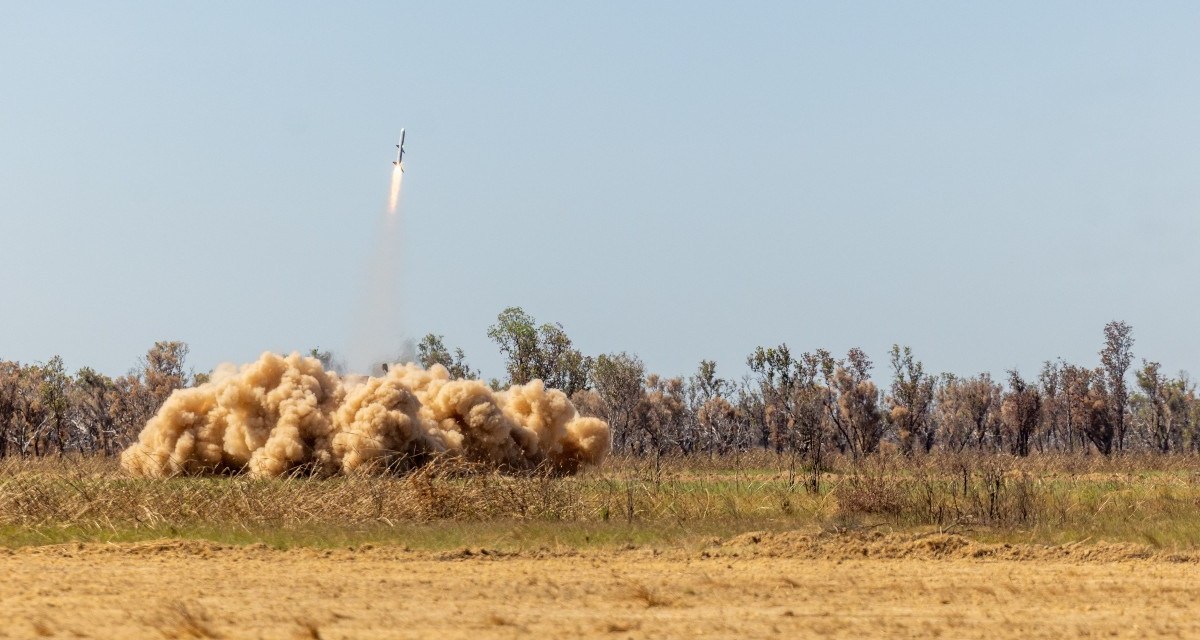
Image credit: Sgt. Ezekieljay Correa, US Marine Corps