For the better part of a century, the grand strategy of the United States has been predicated on a deeply entrenched, almost subconscious mental model: the belief that political order is the natural, baseline condition of human societies, and that chaos is an artificial aberration caused by specific malign actors. This event-based logic posits that stability is a self-righting mechanism; once the agent of disruption—be it a fascist dictator, a communist insurgent, or a terrorist warlord—is removed via decisive kinetic action, the society in question will naturally snap back to a state of equilibrium. In this view, war is a discrete event, a surgical incision to excise a tumor, after which the body politic heals itself with minimal postoperative care.
However, the first quarter of the twenty-first century has fundamentally shattered this illusion. From the sectarian slaughterhouses of post-invasion Iraq to the fragmented, militia-ruled wasteland of post-Gaddafi Libya, the United States has repeatedly demonstrated an unparalleled ability to win battles while losing wars. The military instrument has proven exceptionally efficient at breaking regimes, yet the national strategic apparatus has proven woefully inept at building the peace that is supposed to follow. In each case, the removal of the tyrant did not lead to the spontaneous emergence of Jeffersonian democracy or Westphalian stability. Instead, it unleashed a torrent of entropy—a durable disorder that proved far harder to contain than the original adversary.
This 20th-century paradigm of intervention—rooted in linear causality and the assumption of automatic order—is dangerously obsolete. Today’s operational environments are not static hierarchies but complex adaptive systems, characterized by deep interconnectivity, nonlinearity, and the capacity for chaotic emergence. In these environments, instability is not a bug to be fixed but a feature of the system. Chaos is the condition. Order is not a default; it is a fragile, laborious achievement that must be actively constructed, resource by resource, institution by institution, over decades.
US intervention strategy, therefore, is due for reevaluation. That requires tracing the intellectual genealogy of the order-as-default fallacy and contrasting the Westphalian model with the emerging reality of neomedievalism and durable disorder. That provides a forensic lens that can be applied to three historical case studies—Panama (1989), Iraq (2003), and Libya (2011)—allowing the variables that led to perceived success or catastrophic failure to be isolated. This, then, becomes a means of considering, for example, the capture of Nicolás Maduro and the risk that event-based logic might plunge the Americas into a chaotic quagmire of unprecedented scale. But ultimately and more broadly, it provides professional military practitioners and policymakers with a new intellectual framework—one that shifts the focus from controlling events to shaping systems, and from the illusion of quick victory to the reality of managed transition.
Theoretical Foundations: From Westphalian Order to Durable Disorder
The Westphalian Legacy and Linear War
The American way of war is inextricably linked to the Peace of Westphalia (1648), which established the state as the primary unit of international affairs. In joint planning doctrine, the state possesses a monopoly on the legitimate use of force within defined territorial boundaries. This framework simplified the strategic calculus: War was a contest between unitary actors. If one state (the United States) defeated the army of another (Germany, Japan, Iraq), the victor could dictate terms to the vanquished state apparatus, which would then implement them.
Classical strategic theorists like Carl von Clausewitz and Antoine-Henri Jomini operated within this state-centric paradigm. Clausewitz defined war as “the continuation of politics by other means,” a dialectic of wills between political entities. Jomini viewed war as a scientific endeavor, governed by geometric principles where seizing decisive points led to victory. This legacy instilled in US planners a linear view of cause and effect: Input A (invasion) leads to Output B (surrender and stability).
The twentieth century reinforced this model. The total victories of World War II, followed by the successful reconstruction of Germany and Japan, seemed to prove that a regime could be dismantled and rebuilt better. Even the Cold War, for all its proxy complexities, was a binary struggle that offered a grim form of stability. The Gulf War of 1991 was the apotheosis of this mindset: a limited objective, a decisive military campaign, and a restoration of the status quo. These experiences cemented the concept of the center of gravity—the idea that every enemy has a hub of all power and movement, on which everything depends. Destroy the hub, and the system collapses into a form that can be remolded.
The Neomedieval Shift and Globalization
The end of the Cold War did not create globalization or supranational governance, both of which had existed in earlier forms for decades. It did, however, accelerate and unmask their systemic effects. As bipolar competition receded, the stabilizing constraints imposed by great-power rivalry weakened, allowing long-latent dynamics to assert themselves. The monopoly of the state began to erode from above, as globalization intensified and supranational institutions assumed more prominent roles, and from below, through ethnic fragmentation, the expansion of transnational criminal networks, and the increasing privatization of violence. Political economist Philip G. Cerny captured this shift in his seminal 1998 analysis, describing globalization not as a force of convergence, but as a condition of “durable disorder.”
Cerny argued that the world was moving toward a “neomedieval” system—a fractured landscape of overlapping authorities comparable to Europe before the rise of the modern state. In this world, the state is often a hollow shell. Power resides in a complex web of warlords, criminal syndicates, religious militias, and transnational corporations. In such an environment, the security dilemma is internalized; civil war becomes the dominant form of conflict, and disorder becomes a permanent structural feature rather than a temporary crisis.
This shift has profound implications for intervention. In a Westphalian system, removing a leader changes the policy of the state. In a neomedieval system, removing a leader often dissolves the state entirely, leaving behind a vacuum that is rapidly filled by violent competition among micropowers. The state does not snap back; it evaporates.
Entropy and Complexity Science
To understand this new reality, strategists must turn to complexity science. Modern conflict zones function as complex adaptive systems. Unlike mechanical systems (e.g., a car engine), which can be disassembled and reassembled, complex systems are organic and dynamic. They are characterized by:
- Nonlinearity: Small inputs can have massive, disproportionate outputs (e.g., the self-immolation of a fruit vendor in Tunisia triggering the Arab Spring). Conversely, massive inputs (a US invasion) may be absorbed with little systemic change.
- Emergence: The behavior of the system arises from the interactions of its agents, not from a central command. Order and disorder emerge from the bottom up.
- Feedback Loops: Actions trigger reactions that loop back to influence the original actor, often in unpredictable ways.
Strategist Sean McFate, in The New Rules of War: How America Can Win—Against Russia, China, and Other Threats, argues that the world has entered an age of entropy where “durable disorder” is the norm. In this environment, the search for a decisive victory is a fool’s errand. The enemy is not a rigid hierarchy but a fluid network.
As Aaron Bazin argues in his analysis of complex adaptive operations, attempting to control such a system with linear, industrial-age warfare is akin to debugging a network by severing random connections. The system does not collapse; it reroutes, adapts, and continues to function, often in a more virulent form.
The US military’s failure to internalize this shift is the root cause of its strategic frustrations. Complex political problems continue to be treated as target sets to be serviced. The assumption persists that if the bad guys are eliminated, the good guys will naturally take over. But in a complex system defined by entropy, the removal of a dominant node (a dictator) often leads to system-wide cascading failure—a rapid descent into chaos that is self-sustaining and durable.
Panama 1989: The Deceptive Success
Operation Just Cause: The Archetype
The US invasion of Panama in December 1989, Operation Just Cause, stands as the high-water mark of the decapitation model. It is the case study most often cited by proponents of regime change to argue that military force can swiftly and effectively reset a wayward nation.
The operational parameters were clear: President George H. W. Bush ordered the invasion to protect American lives, defend democracy, combat drug trafficking, and protect the integrity of the Panama Canal treaties. The primary target was General Manuel Noriega, the de facto dictator whose regime had devolved into a narco-militocracy.
Militarily, the operation was a masterpiece of synchronization. Over twenty-seven thousand US troops, including elite Rangers and paratroopers, struck twenty-seven targets simultaneously. Within hours, the Panamanian Defense Forces were shattered. Noriega sought asylum in the Vatican nunciature but surrendered on January 3, 1990. In his place, the United States installed Guillermo Endara, the legitimate winner of the May 1989 elections, who was sworn in at Fort Clayton, a US base.
The Day-After Gap
However, the narrative of a flawless surgical strike obscures the immediate systemic shock that followed the regime’s collapse. As the Panamanian Defense Forces dissolved—the only institution capable of maintaining order—a profound security vacuum opened in Panama City and Colón. Widespread looting erupted, targeting businesses and infrastructure. The US military, focused entirely on combat objectives (the event), had not planned for a policing mission (the process).
Research indicates that the looting caused hundreds of millions of dollars in damage and persisted for weeks in some areas until US forces pivoted to a constabulary role. The surgical removal of the wart (Noriega) nearly killed the patient (Panama’s economy) through the secondary infection of anarchy. Order was restored not automatically, but through the extraordinary concentration of US forces in key urban areas, where troop density approached one soldier for every hundred residents—a level rarely achievable or sustainable in larger interventions.
Why Order Was Achieved
Despite the initial chaos, Panama did stabilize. By 1994, it had a functioning democracy and no standing army. This success was not due to the inherent validity of the decapitation strategy, but rather to unique systemic variables that are virtually impossible to replicate elsewhere:
- Preexisting Legitimacy: The United States did not have to manufacture a government. Guillermo Endara had a clear electoral mandate from the Panamanian people. The order was not imposed; it was restored.
- Institutional Reform: The decision to abolish the Panamanian Defense Forces and replace it with a civilian police force (the Panamanian Public Forces) was a critical process-based intervention that broke the cycle of military coups.
- Scale and Sphere of Influence: Panama is a small nation (with a population of approximately 2.4 million in 1989) deeply integrated into the US economic and security sphere via the Panama Canal Zone. The United States had a century of knowledge about the terrain and the actors.
The tragedy of Panama is that it taught the wrong lesson. Policymakers internalized the ease of the military victory while ignoring the unique context that allowed the political stabilization to succeed. They assumed that the Panama outcome (democracy) was a natural consequence of the Panama method (invasion), failing to see that Panama was an outlier, not a precedent.
Iraq 2003: The Systemic Shock
Hubris and the Linear Fallacy
If Panama was the false positive, Iraq was the catastrophic correction. The 2003 invasion was planned with the Panama mindset on steroids: a “rapid decisive operation” designed to decapitate the Saddam Hussein regime and leave the Iraqi state largely intact.
The assumptions underpinning the invasion were breathtakingly linear. Senior officials, including Vice President Dick Cheney and Defense Secretary Donald Rumsfeld, operated on the belief that Iraq’s disorder was solely a function of Saddam’s tyranny. Remove the tyrant, and the natural order of a wealthy, educated, secular society would emerge. As Michael O’Hanlon noted in his critique, this view dismissed the warnings of experts who saw Iraq not as a solid state but as a fragile sectarian mosaic held together by terror.
The Vacuum and Phase IV Failure
The military campaign, Operation Cobra II, achieved its tactical goals with blistering speed. Baghdad fell in three weeks. But the event of regime change triggered an immediate, systemic collapse for which the United States was totally unprepared.
The 3rd Infantry Division’s after-action report remains one of the most damning documents in military history: “Higher headquarters did not provide . . . a plan for Phase IV. As a result, [we] transitioned into Phase IV in the absence of guidance.” This was a cognitive failure. The planners did not believe Phase IV (stabilization) would be a phase of war; they thought it would be a victory lap.
When L. Paul Bremer, head of the Coalition Provisional Authority (CPA), issued CPA Order Number 2 dissolving the Iraqi military and intelligence services, he did not just fire four hundred thousand men; he destroyed the immune system of the Iraqi state. In a complex system, if you remove the primary regulator (the Ba’athist security apparatus) without an immediate replacement, entropy takes over.
The Emergence of Durable Disorder
The result was not democracy but anarchy. Looting devastated the ministries, erasing the administrative history of the state. The vacuum drew in every latent force of disorder: Shia militias backed by Iran, Sunni rejectionists, tribal warlords, and al-Qaeda. The power vacuum became the dominant strategic reality.
The United States spent the next eight years trying to retrofit a process solution (counterinsurgency) onto a botched event strategy. The 2007 troop surge was an attempt to introduce a new regulator into the system—a massive influx of troops and a shift to protecting the population. It achieved a temporary stabilization (on the surface, an achievement of order), but the underlying entropy remained. As soon as US pressure was removed in 2011, the system reverted to chaos, culminating in the rise of ISIS in 2014.
Iraq demonstrated that in a complex society marked by sectarian divides, the state is not a building you can occupy; it is a shared agreement on legitimacy. When that agreement is shattered, the result is not a blank slate, but a war of all against all.
Libya 2011: The Light-Footprint Disaster
The Responsibility to Protect (and Abandon)
The 2011 intervention in Libya was driven by a desire to avoid the quagmire of Iraq. The administration of President Barack Obama, wary of large-scale troop commitments, adopted a light-footprint strategy: US and NATO airpower would protect civilians and degrade Muammar Gaddafi’s forces, enabling local rebels to do the fighting on the ground.
This strategy was tactically efficient. It cost the United States roughly $1 billion and zero American combat lives. Gaddafi was captured and killed by rebels in October 2011. The event was a resounding success.
The Implosion of a Hollow State
Strategically, however, Libya was a disaster of omission. The United States failed to recognize that Gaddafi had spent forty-two years systematically hollowing out Libyan institutions to coup-proof his regime. There was no ministry of defense, no professional army, no parliament. The state was Gaddafi. When he died, the state died with him.
Crucially, the intervention plan included zero provision for a post-Gaddafi stabilization force. President Obama later admitted that “failing to plan for the day after” was his worst mistake. This failure was rooted in the same order-as-default assumption: Planners believed that the Libyan National Transitional Council (NTC) would naturally assume governance.
The Consequences of Abandonment
Instead, Libya fragmented into a kaleidoscope of rival militias. The rebels were not a unified army but a loose coalition of local brigades (Misrata, Zintan, Benghazi) with no loyalty to a central state. Without a neutral arbiter (like a US stabilization force) to enforce a monopoly on violence, these groups turned on each other.
The consequences were regional and durable. Gaddafi’s vast weapon stockpiles were looted and flowed south, fueling insurgencies in Mali and the Sahel. Libya became a bifurcated state with rival governments in Tripoli and Tobruk, a hub for human trafficking, and a sanctuary for ISIS.
Andrew Byers, writing in The Daily Economy, argues that the United States would have been better off doing nothing than triggering a collapse it was unwilling to manage. Libya proves that low-cost interventions are a mirage. The price of order is fixed; if a nation is not willing to pay it with stabilization, it will pay it in chaos.
Operational Design and Doctrinal Gaps
Over the past two decades, US military doctrine has increasingly acknowledged the limits of linear planning. Army Field Manual 5-0 and Joint Publication 5-0 both emphasize operational design as a means of grappling with complexity, encouraging commanders to develop system frames that map actors, relationships, and emergent dynamics. These documents explicitly caution against rushing to tactical action before understanding the broader system. As Huba Wass de Czege argued, design is not a method of control but a disciplined way of learning—accepting that complex systems can be influenced but not engineered into submission.
Yet the institutional lessons drawn from earlier interventions have often cut against this doctrinal logic. Operation Just Cause in Panama is commonly cited as a model of successful regime removal. But its apparent success masked the degree to which order had to be actively imposed through extraordinary force density, rapid transition to constabulary policing, and unusually favorable political and institutional conditions. What endured from Panama was not an appreciation for system management, but a simplified narrative: remove the leader, restore order, exit.
That misreading created a durable gap between doctrine and practice. While doctrinal manuals urge systemic understanding and restraint, institutional incentives continue to reward decisive, high-visibility action. Decapitation operations offer clear metrics of success and political payoff, even when they do little to shape the underlying system. The result is a force superbly optimized for winning events but repeatedly unprepared to manage what follows.
Iraq and Libya exposed the fragility of the Panama-derived model. In both cases, the event succeeded while the system collapsed. These were not failures of execution, but failures of strategic learning—applications of an event-centric template to environments where authority was fragmented, violence was networked, and disorder was not a temporary phase but the operating condition.
Recent events in Venezuela underscore how enduring the event-centric impulse remains. Even as US leaders emphasized that Washington would oversee a transition until a “safe, proper and judicious” outcome is achieved, the deeper strategic challenge persists: Decisive action may end an event, but it does not, in itself, shape the long-term trajectory of instability or order.
The US military remains essentially an industrial-age machine trying to operate in a biological age of warfare. It is optimized for the destruction of armies, not the management of entropy. As events unfold in Caracas, the Panama model is being applied to a Libya problem—a mismatch that historically leads to durable disorder.
Strategic Recommendations: From Event to System
To escape the cycle of tactical victory and strategic defeat, US intervention policy must undergo a Copernican revolution. The strategic center of gravity must shift from the event of war to the system of peace.
Recommendation 1: Institutionalize Phase IV as the Main Effort
Planning for the day after must be the primary filter for any intervention decision. When a military action with likely destabilizing effects—like Operation Absolute Resolve in Venezuela—is undertaken, resources must immediately pivot to Phase IV. The policing gap that doomed Iraq must be closed within days, not weeks.
Recommendation 2: Adopt a Regime-Evolution Strategy
In complex systems, total decapitation is often fatal to the society. Strategy should focus on regime evolution—using pressure to fracture the elite coalition and induce a managed transition that preserves the state’s administrative capacity. If the head must be removed, the body (bureaucracy, police) must be kept on life support to prevent anarchy.
Notably, the approach in Venezuela since Maduro’s capture—at least to date—reflects elements of this regime-evolution logic, as US actions have focused on removing the regime’s apex while leaving much of the administrative and security apparatus in place.
Recommendation 3: The Powell Doctrine for the Twenty-First Century
The logic of the Powell Doctrine—and the associated you break it, you own it concept—must be reinstated but updated for complexity. Leaders must be honest with the public: Intervention is not a raid; it is an adoption. It implies a responsibility to govern or support governance for a decade or more.
Recommendation 4: Design-Centric Professional Military Education
Professional military education must prioritize systems thinking over the military decision-making process. Officers should be trained in complexity science, sociology, and economics. Training must emphasize how armed actors function as social networks, not just as targets. Wargames should penalize kinetic victories that result in long-term instability, forcing students to grapple with the durable disorder that follows.

The close of the twentieth century and the opening of the twenty-first have proven to be a graveyard for the order-as-default assumption. From the looting of Panama City to the burning streets of Baghdad and the slave markets of Libya, the evidence is overwhelming: Chaos is the condition of the modern world. Order is not a natural right; it is a hard-won achievement.
Operation Absolute Resolve once again illustrates the central dilemma of modern strategy: the ease of decisive action and the difficulty of shaping what follows. The operation resolved an event, but it did not resolve the system. Whether order emerges, fragments, or simply mutates and metastasizes will depend less on the moment of intervention than on the sustained choices made afterward. The event is complete. The system’s response is only beginning to take shape.
J. William “Bill” DeMarco is a senior US Air Force civilian academic and strategist currently serving at Air University’s LeMay Center for Doctrine Development and Education. His work focuses on strategy, futures literacy, institutional adaptation, and the cognitive dimensions of modern conflict. He has published widely on military education, strategic culture, and emerging forms of competition.
The views expressed are those of the author and do not reflect the official position of the United States Military Academy, Department of the Army, or Department of Defense.
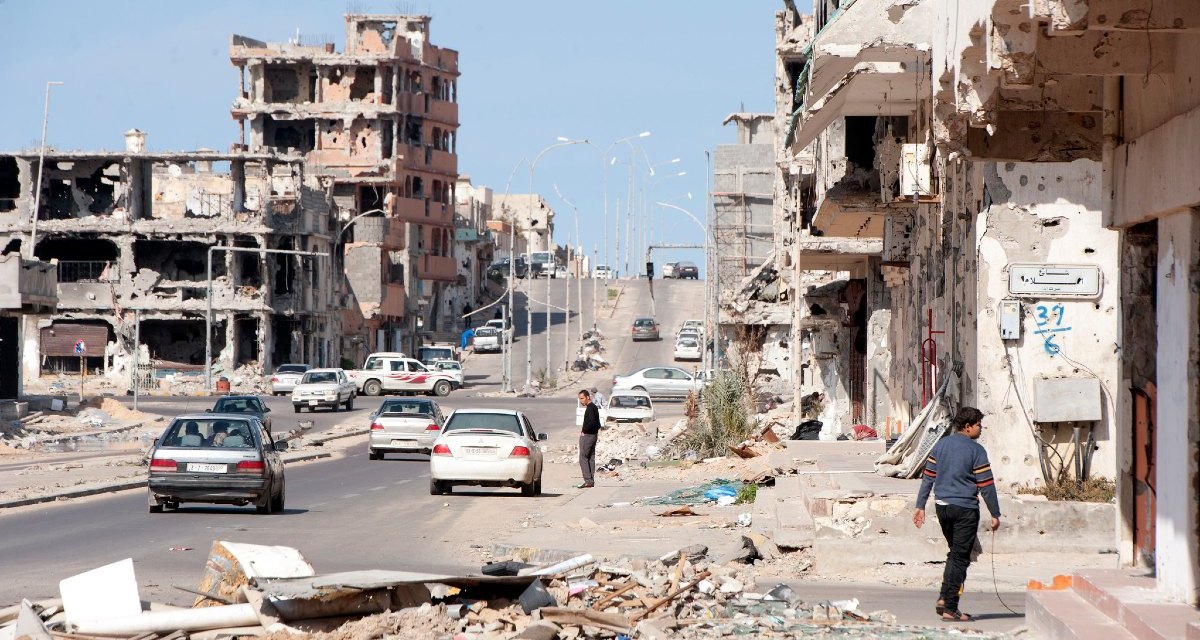
Image: Destruction in Sirte, Libya after fighting between pro-regime forces loyal to Muammar Gaddafi and rebels (credit: EU Civil Protection and Humanitarian Aid)