
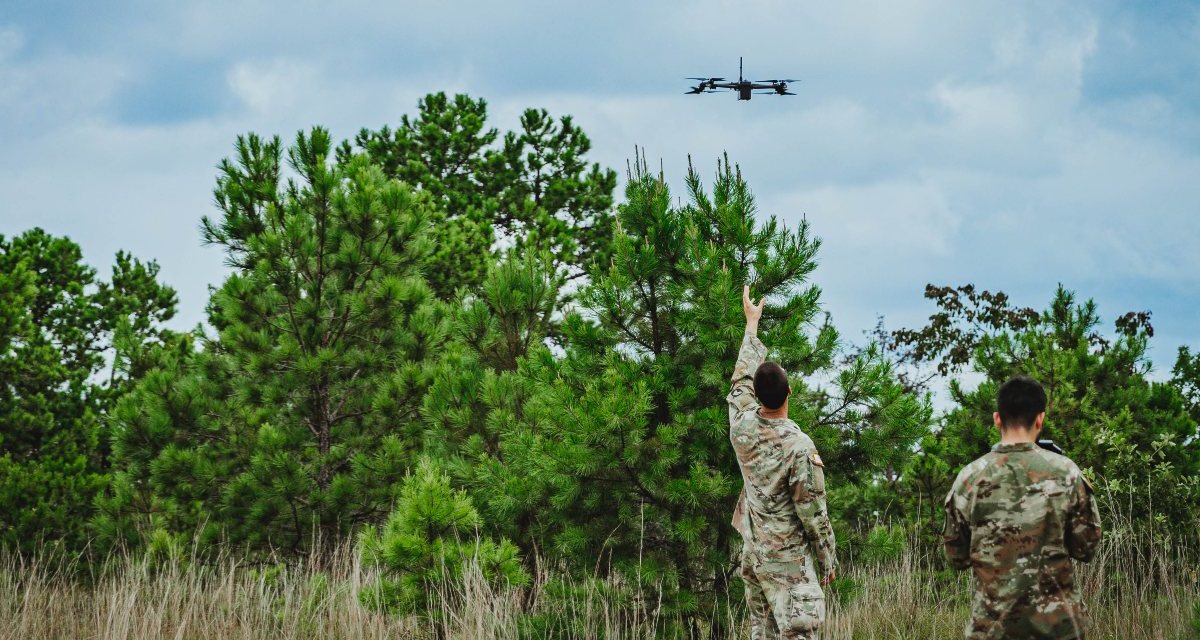
The US Army remains anchored to an era when its technological and qualitative superiority ensured dominance on the battlefield. Yet battlefield losses and grinding attrition in the Russo-Ukrainian War reveal the growing vulnerability of platforms such as the Big Five, which have long defined the Army’s approach to land warfare. The Department of War’s recent drone dominance initiative reflects the growing sense that small drones have reached a critical demonstration point—one capable of transforming the character of land warfare and challenging the conceptual foundations of the Army’s preferred way of fighting. As potential challengers for land dominance integrate small drones into their arsenals, the Army must determine whether to adopt or counter the ongoing innovation to help it maintain its asymmetric advantage in maneuver warfare.
As the world’s leading military power and defense spender, the US armed services are actively working to adopt drone innovations diffusing from Russia and Ukraine, driven by their technophile military culture. But the quest to rapidly adopt small drones and make the attendant organizational changes to optimally employ them ignores the capital required to do so and fails to recognize that Russian and Ukrainian employment methods are misaligned with the US Army’s preferred way of war. Unfortunately, the assumption that the United States must adopt the innovation misses the alternative—one far more aligned with the American way of war—of countering the drone revolution to restore maneuver to the battlefield. Reestablishing the Army’s land dominance and tilting the balance of power in America’s favor will require pursuing counterinnovations in the form of counterdrone integrated air defense systems that restore tactical and operational maneuver. Succeeding on the future battlefield does not necessitate the blind acceptance of new technologies and concepts, but rather a consideration of which innovation response leverages the state’s advantages and mitigates its strategic limitations. Seeking to counter recent drone innovations will provide the US Army with the capabilities to restore its asymmetric advantage on the battlefield—rapid maneuver, sustained by a high operational tempo and massed armored penetration forces.
The Drivers of Diffusion: Assessing the Impact of Critical Task Focus on Organizational Capital
Assessing the potential diffusion of Russian and Ukrainian drone innovation to the United States requires examining Michael Horowitz’s adoption-capacity theory. This theory consists of two key factors that determine the strategic innovation a given power will pursue: the financial intensity and the organizational capital required to adopt. The questions of financial intensity is important—not least because although the Army possesses the monetary resources to acquire small drones in large quantities, there are questions about its ability to sustain implementation in a large-scale combat operation. But examining this factor must be done after determining whether the innovation aligns with the organization’s more complicated and entrenched cultural preferences. To do so, we turn to Horowitz’s second factor: organizational capital.
Organizational capital includes critical task focus, organizational age, and experimentation. The latter factors are not the subject of this article because they are easier to measure and require less of a nuanced understanding of the organization’s culture and preferences. An organization’s age is unalterable unless it undergoes a catastrophic military defeat or broader societal changes lead to radical transformation, as occurred during the French Revolution. There are also relatively straightforward methods for determining a military’s willingness to experiment, measured by investments in innovation and suborganizations focused on developing novel technologies or concepts. This leaves us with the Army’s critical task focus, an ill-understood concept that is often overlooked by leaders when attempting to adopt new ideas and doctrine.
In simple terms, an organization’s critical task focus is its primary goal—what it seeks to achieve—which in turn limits the means (innovations) it will adopt to achieve that goal. Organizations that can broadly define their critical tasks and disentangle the ends they seek from the means they are willing to pursue are more likely to adopt innovations. In his work, Horowitz explains that the Army possesses a narrow focus and defines it as relying on “massing firepower to win conventional wars.” In effect, this is the way the Army seeks to fight. So by examining a military force’s critical task focus, we are essentially identifying the state’s way of war, because it will dictate the means and methods that state uses to pursue its military objectives.
Antulio Echevarria offers the most succinct definition of a state’s way of war, describing it as “general trends in the conduct of, and preferred modes of thinking about, war.” Though each nation has specific nuances that define its approach to war, there are often blocs of states that seek to emulate a particular military example, forming larger groupings of countries with relatively similar characteristics. For instance, former Soviet Bloc countries emulate a Russian way of war, and Western states follow traditions initiated by Napoleon Bonaparte and Helmuth von Moltke. Other analysts further clarify that the way of war refers to the mental frameworks or paradigms through which we aim to plan, prepare, and fight future conflicts. A state’s way of war will manifest itself at each level of war, from strategic documents to operational planning concepts to tactical-level doctrine. Ultimately, this way of war corresponds with how an organization—a military service like the US Army—believes it should pursue its primary objective, or critical task focus.
The Russian Way of War: Modernizing Attrition
In 2023, Chief of Staff of the Army General Randy George emphasized that strengthening the Army profession requires turning “lessons observed into lessons learned.” The challenge for the US Army is to draw insight from the Russo-Ukrainian War in ways that enhance the American way of war, without internalizing the adaptations of a fundamentally different force. As Krisztián Jójárt noted in the Journal of Strategic Studies, the lessons Russia draws from this conflict, particularly regarding drones, will not align with Western interpretations, nor should they. Understanding how Russia interprets these lessons, within its organizational DNA, is key to avoiding misapplied imitation.
The Russian Armed Forces are adapting within the boundaries of their institutional DNA, which remains distinctly “artillery-centric.” Russian ground forces conduct maneuver-by-fire and massed strikes to impose attrition on adversaries. This identity has long defined how Russia wages war, stretching from the Great Patriotic War’s concept of deep battle to the preeminence of fires for operational and strategic tasks within active defense, and even to its invasion of Ukraine in 2022. Although the current conflict’s positional nature initially reduced Russian fires to unsynchronized volleys, the proliferation of drones has revived and deepened, rather than diminished, Russia’s reliance on attrition over maneuver, reaffirming artillery and fires as the “God of War.”
Russia’s preferences stand in stark contrast with those of the United States, whose way of war centers on maneuver enabled by airpower and precision. For example, in Ukraine, the Russian Aerospace Forces function as an extension of fires, conducting standoff artillery bombardments with unguided rockets or glide-bomb strikes that mirror ground artillery rather than supporting or enabling ground maneuver. Russia’s airpower divergence does not reflect an inherent lack of capability, but a deliberate doctrinal preference for massed fires as the core of tactical and operational lethality. Consequently, one of Russia’s most notable innovations lies in its use of small, cheap first-person-view drones, reconnaissance drones, and loitering munitions to expand the effects of artillery. These systems saturate the battlefield, provide real-time targeting, and deliver precision effects that amplify fires at minimal cost. For Moscow, drones are not substitutes for airpower but economical instruments for perfecting its fires-based way of war.
Western analysts and military observers alike recognize this shift in restoring the coherence of Russian fires with drone innovations. Dara Massicot of the Carnegie Endowment recently observed that the Russian military institutionalized over 450 updates to combat manuals, many focused on artillery tactics and drone-enabled targeting, to reestablish fires as the decisive warfighting function. Likewise, the US Army’s ATP 7-100.1, Russian Tactics explains that while Soviet-era forces relied on sheer mass, modern Russian units integrate drone reconnaissance, extended-range fires, and automated command and control to achieve similar effects. These reforms demonstrate the logic of Russian lessons learned: Drones have modernized attrition, not maneuver.
Yet, even as Russia adapts and innovates, its armed forces have suffered catastrophic losses in Ukraine, widening the military power gap with the United States and NATO. To offset those losses, Moscow is accelerating development of aerial drones and other uncrewed systems to supplement combat power and sustain an attrition-based approach against numerically superior NATO forces. The Army must resist simply mirroring these adaptations. Replicating tactics born of a stagnant, attritonal war risks diluting our own asymmetric advantage of maneuver. The Russian military seeks to paralyze movement through drone-enabled fires; the US Army’s task is to preserve it.
The American Way of War: Enabling Armored Maneuver through Close Air Support and Direct Fires
Standing in sharp contrast to Russian military preferences, where strategic and organizational tendencies remain consistent with a land-based power that projects force over shorter distances and with shorter lines of communication, the American way of war emphasizes the necessity of rapidly shaping the operational environment through airpower. As a result, the US Army relies on airpower to attrit enemy forces and set the conditions for offensive operations at its chosen time and place. This reliance on airpower to enable maneuver and the priority placed on qualitatively superior armored forces to outflank an adversary combine to produce an organizational culture that leaves the US Army ill-prepared to adopt the current innovations diffusing from the conflict in Ukraine, as it runs counter to its preferred way of war.
As a long-distance force projector, the United States disproportionately relies on its Air Force to deliver precision-guided munitions, attrit enemy forces, and set the conditions for ground maneuver. Unlike the Russian military, which primarily fights along its continental periphery, the US military must deploy expeditionary forces over vast distances, meaning that it is unable to rely on indirect fires assets to set conditions. Key to the US military’s theory of victory is establishing air dominance over its adversary and heavily attriting enemy forces. Examples include the lengthy air campaign before the Gulf War in 1991, the bombing campaign in Afghanistan, and the US military’s operations in the Middle East since 2001. Additionally, the US Army has long neglected its indirect fire capabilities, as evidenced by glaring disparities when compared to the Russians, in favor of employing exquisite airpower to achieve rapid results. Though the service is advancing its long-range fires capabilities, the Army and the American way of war still rely on airpower to set the conditions for operational maneuver. As the Army seeks to deepen its integration of small drones into its planning and doctrine, it risks undermining the air-ground integration it has placed at the center of its way of war. Overcoming entrenched beliefs about airpower may require more organizational capital than the Army can provide amid ongoing transformation.
The second key characteristic is the emphasis on maintaining a qualitatively superior armored force capable of massing and striking the enemy’s flanks. The US Army’s reliance on armored forces to sustain maneuver operations began in the wake of the Yom Kippur War, with the development of the Army’s Active Defense doctrine. At the time, the Army quickly developed operational concepts that enabled it to fight a numerically superior foe in the Warsaw Pact. Active Defense’s emphasis on defensive operations and firepower over maneuver drew significant criticism for its misalignment with the preferred way of war. Doctrinal rejection led to the development of AirLand Battle in 1982, a concept that still looms large over American operational planning. AirLand Battle restored the centrality of gaining the initiative through initial disruption, then maneuvering armored formations on the enemy’s flanks to engage follow-on echelons and disrupt enemy forces in depth. In 1991, the Army executed this doctrine against a woefully outclassed Iraqi military by fixing Saddam’s forces in Kuwait and implementing the “Left Hook” on Iraq’s flanks. The Army also utilized modified versions of AirLand Battle during its invasion of Iraq in 2003, with the caveat that Iraqi forces mostly withdrew into urban areas. It makes sense then that the Army would return to a doctrine that enabled such lopsided victories as it shifted back to an emphasis on large-scale combat operations. Unfortunately, the Russo-Ukrainian War highlights the vulnerabilities of armored formations and the risks of massing one’s forces to achieve the operational objectives of America’s preferred way of war.
In the case of AirLand Battle, catastrophic success led to the development of cultural norms and an American way of war that relied on rapid armored maneuver to overwhelm adversary ground forces. The Army’s fixation on this norm helps to explain the litany of articles that attempted to draw early conclusions about the role of armored forces on the future battlefield after Russia invaded Ukraine. Recognition that the Army may be unable to mass armored forces has created a sense of doctrinal paralysis because the Army is unable to overcome the capability gap that exists within its current way of war. Adoption-capacity theory would thus demonstrate the futility of pursuing innovations misaligned with a military organization’s way of war, and yet, the US Armed forces are aggressively pursuing innovations that prioritize firepower over maneuver. Army leaders should recognize the misalignment between their service’s organizational culture and the lessons from Ukraine, which should in turn lead them to consider the alternative: countering the innovation.
Preserving Maneuver in the Drone Age
Preserving the American way of war in a drone-saturated environment requires a framework at the strategic and operational levels to begin understanding how counterinnovations can provide asymmetric advantages on the future battlefield. Strategically, the United States should pursue counterinnovations that leverage the technical expertise of the defense industrial base and develop sophisticated single-use military solutions that will not easily diffuse. To this end, prioritization must be given to a counterdrone integrated air defense system, electronic warfare, and deception capabilities designed to neutralize an adversary’s drones. Prioritizing and investing in these systems, along with the organizational restructuring that will follow, will raise the financial and technological barrier to entry for state and nonstate actors alike to employ drones in the manner we have seen in the Russo-Ukrainian War, while restoring tactical and operational maneuver, the US Army’s asymmetric advantage. Restoring land dominance requires a strategic reallocation of resources to ensure the United States can reverse the trend toward the democratization of military capabilities.
Operationally, the US Army must begin developing concepts and doctrine that protect maneuver in an environment dominated by persistent drone presence. The framework for these concepts can include integrating the prioritized technology above—such as drone air defenses, short-range air defense, and electronic warfare—into maneuver units to enable the domination of the air littoral while preserving maneuver. Concepts may even extend to how units operate within electronic warfare–protected environments, cut off from incoming or outgoing transmissions, and operating off the commander’s intent with no radio communication after the start of operations.
The diffusion of drone technology today is not a revolution in warfare but reaffirms its enduring truths. Nations and military forces will innovate within the boundaries of their strategic and organizational cultures. Not every new drone emerging from Ukraine or Russia aligns with the United States’ strategic logic. The US way of war, preserving maneuver through tempo, initiative, and integration, must guide the Army’s approach as to which lessons to draw from the Russo-Ukrainian War. Rather than chasing mere parity, the US Army should pursue counterinnovations: systems and concepts that render Russia’s embrace of drones irrelevant and obsolete. The task ahead is to learn from Russia’s adaptations and innovations, without mirroring them, and restore the Army’s ability to maneuver on the future battlefield.
Matthew Revels is an Army strategist who serves as the Modern War Institute’s plans officer and as a senior instructor at the United States Military Academy. He currently teaches courses on military innovation and forecasting and gaming in decision-making.
Eric Uribe is a major in the US Army and a foreign area officer with an area concentration in Europe. He holds a master of arts in security studies from Georgetown University’s Walsh School of Foreign Service with a concentration in international security.
The views expressed are those of the author and do not reflect the official position of the United States Military Academy, Department of the Army, or Department of Defense.
The views expressed are those of the authors and do not reflect the official position of the United States Military Academy, Department of the Army, or Department of Defense.
Image credit: Capt. Stephanie Snyder, US Army