
The ongoing war in Ukraine has underscored a brutal truth: Modern warfare demands speed, adaptability, and technological superiority. We must take lessons learned and quickly adapt. From the widespread use of drones and electronic warfare to the vulnerability of legacy armored platforms, the conflict has exposed the limitations of traditional military doctrine and equipment. In response, the Army Transformation Initiative represents a bold shift toward a more agile, lethal, and resilient US Army, capable of facing near-peer adversaries in fast-changing, multidomain battlefields. Grounded in the hard lessons of the war in Ukraine, where static command structures, outdated logistics, and insufficient drone defenses proved costly, this initiative looks not just to modernize, but to reimagine how the Army prepares for the wars of tomorrow. As it does so, we must ensure we are using the right lens to examine how we modernize. If we do not take the time to fully understand the complex environments within which we will be operating, we may fail to innovate in the correct space. This will cost us time, money, and American lives if we get it wrong.
The False Parity Assumption
As analysts and think tanks across NATO assess the war in Ukraine, a common framework has emerged—that Ukraine’s resistance offers a template for modern defense against large-scale aggression. The lessons often highlight resilience, asymmetric warfare, long-range fire support and the tactical value of drones and dispersed infantry. However, much of this analysis proceeds from a flawed assumption, namely that NATO forces would begin a future conflict with the same capability disadvantages that Ukraine faced in February 2022. This misreading by some distorts strategic insights. Ukraine entered the war without air superiority and with limited precision-strike systems, a degraded logistics base, and no access to integrated battlefield management systems at NATO standards. Russia, by contrast, launched its offensive with a full suite of conventional tools: massed artillery, airpower, armored formations, and electronic warfare assets. The key lesson is not how to replicate Ukraine’s success; instead, it is to be found in how the battlefield might have looked if Ukraine had NATO-level capabilities from the outset.
Unequal from the Start
When Russian forces crossed into Ukraine on February 24, 2022, they did so expecting a short, decisive campaign. That assumption reflected an assumed—and accurate—military strength disparity on the ground. Ukraine’s military was courageous and more prepared than in 2014, but it lacked critical enablers. The Ukrainian Air Force fielded aging MiG-29s and Su-27s, with no modern radar, no airborne early warning systems, and no beyond-visual-range weapons. Air defense relied on Soviet-era S-300 and Buk systems with diminishing inventories of stockpiled air defense missiles. Ukraine also had no long-range precision-strike capability. Artillery units relied on legacy 152-millimeter and 122-millimeter systems, most of which lacked digital fire control or guided munitions. Ukraine’s domestic command-and-control system was a promising innovation, but in early 2022, it lacked integration with satellite and signals intelligence, or real-time joint fires coordination. Logistically Ukraine’s defense industrial base was constrained. Stockpiles were thin and ammunition production and spare parts were insufficient for high-intensity, sustained combat.
In contrast, Russia deployed an invasion force estimated at over 190,000 troops. Artillery, air, and electronic warfare supremacy supported this combined arms army. Russian forces fired tens of thousands of shells per day in the early phases of the war, leveraging doctrinal focus on massed fires. Russia also committed hundreds of fixed- and rotary-wing assets to the campaign and employed jamming, GPS denial, and cyberattacks with concurrent rocket and missile strikes throughout the country. Large stockpiles of armored vehicles ensured Russia had the advantage in tanks and infantry fighting vehicles, prepositioned along multiple fronts. The initial result was predictable: rapid Russian gains in the south and east, deep penetrations toward Kyiv, and encirclements of key cities like Mariupol. Ukraine resisted effectively but did so from a structurally disadvantaged position.
The Slow Arrival of NATO Capabilities
Ukraine mounted a ferocious defense of its territory, halting the initial Russian advance towards the capital. Ukraine was outmatched in every conventional aspect of military operations and had to rely on asymmetric tactics, urban defense, and agility to slow Russian progress. Western support was instrumental in Ukraine’s sustained defense, but it arrived in waves and often too late to change the early dynamics of the war.
In the first months of the war, NATO support emphasized defensive systems. US-made Javelins and British-produced NLAWs enabled Ukrainian infantry to blunt Russian armor in forested and urban terrain. Stinger man-portable air defense systems helped degrade Russian rotary-wing operations at low altitude, while commercial drones and loitering munitions, such as the Bayraktar TB2 initially purchased in 2019, but resupplied following the invasion, offered limited but critical reconnaissance-strike ability. These systems helped slow the Russian advance but could not challenge artillery dominance or deny Russian airspace control.
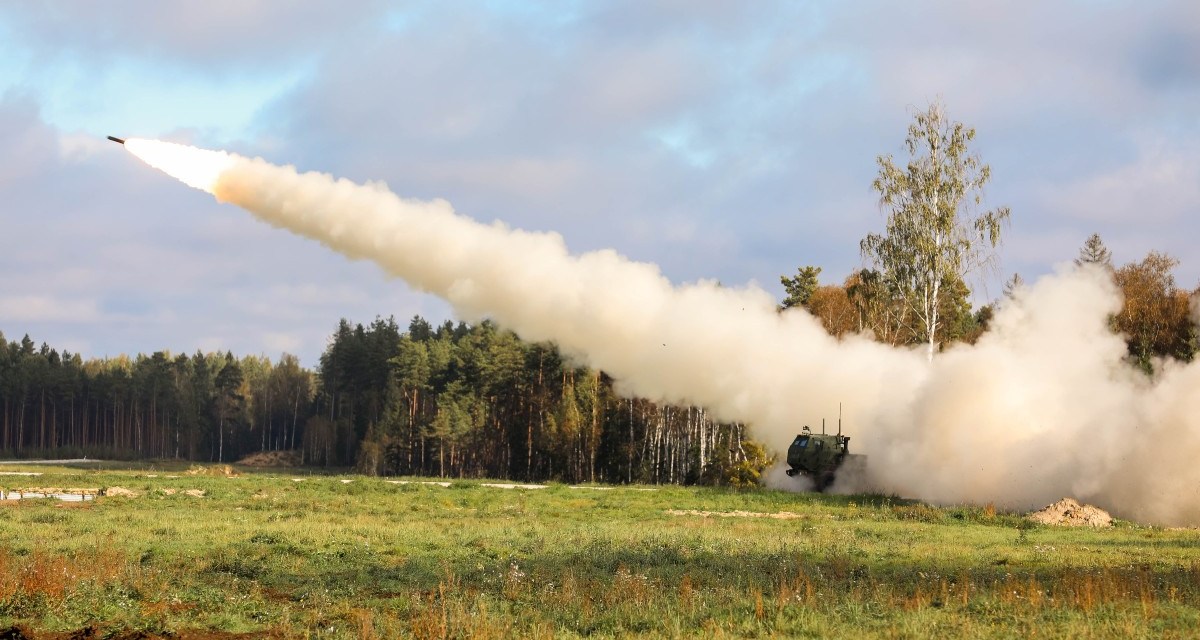
By mid-2022, the delivery of high-mobility artillery rocket systems (HIMARS) changed the strategic calculus. With ranges exceeding seventy kilometers and GPS-guided munitions, Ukraine could now target Russian ammunition depots, command centers, and logistics nodes far behind the front lines. This new capability also allowed Ukraine the ability to degrade Russian forces’ artillery advantage by attacking storage sites and reducing their rate of fire. According to Ukrainian defense officials, HIMARS attacks on Russian depots caused a major disruption in Russian logistics operations.
In late 2022 and into 2023, NATO deliveries expanded. Howitzers, air defense systems, and armored vehicles began arriving from Western nations. Updated howitzer systems extended range and accuracy. Air defense systems like NASAMS and Patriot provided improved protection, though in limited numbers. Main battle tanks and infantry fighting vehicles, including Leopards, Abrams, and Bradleys, were pledged in 2023, but training and delivery delays meant few were operational by the end of the year. More advanced aviation assets have been promised by multiple NATO countries and are expected to arrive in limited numbers by late 2025.
A Different War: If Ukraine Had NATO Capabilities from Day One
Russia consolidated its positions during the window between its early advances and Ukraine’s 2023 counteroffensive. This delay allowed Russia to fortify its defensive lines with complex obstacles and engagement areas. Ukraine’s efforts to retake territory were hampered by a lack of air cover, mine-clearing assets, and heavy armor. These are elements that would have been available to any NATO force from the outset. The result was a transition to a war of attrition. Ukraine’s technological creativity could not fully compensate for the delayed arrival of NATO’s most decisive systems.
What would the battlefield have looked like if Ukraine had started the war with full NATO-level capabilities? With a squadron of modern F-16s or Eurofighters, Ukraine could have contested initial Russian air superiority in the occupied regions of the country, denying close air support and degrading bombing runs. They could use SEAD (suppression of enemy air defenses) tactics to neutralize Russian surface-to-air missile sites and protect Ukrainian air operations. With an integrated AWACS (airborne warning and control system) and real-time intelligence, surveillance, and reconnaissance (ISR) picture, Ukrainian forces would be able to find and strike Russian formations before contact. Armed with HIMARS, Storm Shadow, and ATACMS from the outset, Ukraine could have disrupted Russian logistics before ground forces reached major cities, including the use of precision strikes to destroy pontoon bridges, railways, and fuel convoys. This action would have forced Russia into slower, less coherent advances. With massed deep fires Ukrainian forces could have halted or delayed the siege of Mariupol and the push toward Kyiv. If Ukraine had NATO-level command infrastructure, the battlefield awareness would be near real time, enabling coordinated strikes across domains. With ISR drones and satellite feeds Ukrainian intelligence units could provide persistent coverage of Russian maneuvers and, using a sophisticated electronic warfare network, could jam or spoof Russian communications, amplifying command chaos.
The strategic impact of capability gaps on this war cannot be understated. If Ukrainian forces were manned and equipped at a NATO standard from the start, Kyiv might not have faced encirclement. Additionally, Russia could have been deterred from launching the invasion altogether given a state with a robust and credible integrated deterrent is a harder target. Additionally, with higher levels of equipment Ukraine’s counteroffensive might have occurred months earlier, reducing the time available for Russia to build entrenched defensive belts across the entire southern front.
Preparing for the First Seventy-Two Hours, Not Seventy-Two Weeks
The Army Transformation Initiative is more than a modernization effort; it is a strategic response to the evolving realities of warfare revealed in Ukraine. This conflict has exposed the excessive cost of outdated doctrines, vulnerable legacy systems, and rigid command structures. As the Army moves toward a force that is faster, more adaptable, and more technologically advanced, it must remain grounded in these hard-earned lessons. Ukraine’s ability to resist Russian aggression is extraordinary. But the dominant narrative, which draws lessons as if the United States would face similar disadvantages, misses a vital point. Without a clear understanding of the complex environments we are likely to face, we risk innovating in the wrong direction. The war’s early dynamics were shaped not by Russian superiority, but by Ukraine’s initial capability deficit. The right takeaway for military leaders is not how to emulate Ukraine’s reactive defense. Instead, it is how to ensure that the United States never enters a war in such a position. That means building, fielding, and integrating advanced capabilities before conflict starts, not after it has begun, and ensuring we remain integrated with future partners and frontline states. Decisive battles in future wars are likely to be shaped by the first seventy-two hours, not by what happens over the course of seventy-two weeks. The United States Army must be ready from the start.
Lieutenant Colonel Jeremy Flake currently serves as the deputy fire support coordinator for the 1st Cavalry Division. His previous assignments include serving as the aide-de-camp to the commander of the III Armored Corps and Fort Hood as well as serving thirty-six months in multiple key developmental positions at the brigade and battalion level within the 1st Cavalry Division.
The views expressed are those of the author and do not reflect the official position of the United States Military Academy, Department of the Army, or Department of Defense.
Image credit: Sgt. Cecil Elliott II, US Army