
Liam Collins and John Spencer | 09.11.25
Authors’ note: Some details included in this case study were learned during interviews. Those marked with an asterisk (*) came from interviews with Yoav Gallant, the commander of the operation. Those marked with a dagger (†) came from interviews with an Israeli military analyst and historian.
The First Gaza War occurred between December 27, 2008, and January 18, 2009. Despite its name, the twenty-two-day campaign is better understood as a major escalation in the long-standing conflict between Israel and Hamas. Operation Cast Lead, Israel’s operational name for the conflict, marked the first large-scale confrontation between the Israel Defense Forces (IDF) and Hamas following Israel’s 2005 disengagement from Gaza. It also initiated a new phase of urban conflict that would define future wars in the territory.
The Gaza Strip is forty-one kilometers long and varies in width from just under six kilometers at its narrowest point to nearly thirteen kilometers at its widest. The strip is divided into five similarly sized governorates running north to south: North Gaza, Gaza City, Deir al-Balah, Khan Yunis, and Rafah. Two major roads connect the northern and southern regions: the al-Rasheed Road, which runs along the coast, and the Salah al-Din Road, which runs through Gaza Strip’s center. At the time of the conflict, Gaza’s population exceeded 1.4 million. Approximately 285,000 residents lived in North Gaza and another 505,000 in Gaza City, the most densely populated area in Gaza.
Gaza City was a tightly packed urban center made up of residential neighborhoods, commercial areas, and several large refugee camps. Despite being called camps, they functioned as permanent urban neighborhoods and were more congested and less organized than other urban areas. The city’s layout was defined by narrow alleyways, irregular street patterns, and buildings of varying height. Most structures were mid-rise buildings of five to six stories, with occasional high-rises reaching ten to twenty stories, and some single-family homes. The absence of consistent municipal planning produced a mixed urban environment.
Beneath this surface, Gaza’s underground infrastructure had already become a critical component of Hamas’s military strategy. Hamas had three primary types of tunnels: smuggling tunnels beneath the Egypt-Gaza border, used to bring weapons into Gaza; offensive tunnels designed to infiltrate Israeli territory; and defensive tunnels located within Gaza, used to conceal rocket launchers, store weapons, shelter command posts, and connect fighting positions.
Outside Gaza City, the landscape was dominated by irrigated farmland and open desert terrain. Agricultural fields extended across the northern and southern governorates, reaching toward the Israeli border. Wadi Gaza, a seasonal river and wetland basin, served as a rough geographic divider between northern and central Gaza.
The Israel-Gaza border was marked by a security fence with a buffer zone. The IDF maintained control through elevated observation posts inside Israel and conducted occasional patrols or point raids based on specific intelligence. The ground itself sloped upward from Gaza into Israel, enhancing Israeli observation and targeting capabilities.
Background
Israel occupied the Gaza Strip for nearly four decades, following the Six-Day War in 1967 and up until 2005, when it unilaterally withdrew its military forces and dismantled settlements under Prime Minister Ariel Sharon’s disengagement plan. The withdrawal created a power vacuum that led to internal Palestinian conflict between Gaza’s two dominant factions: Fatah and Hamas. Fatah had long controlled the Palestinian Authority and remained in charge of the West Bank. Hamas was a rising Islamist organization with a strong social services network and an armed wing, the al-Qassam Brigades, which rejected Israel’s right to exist and embraced armed resistance.
In January 2006, Hamas won a majority in Palestinian legislative elections in Gaza. Fatah, however, refused to yield power, triggering a political standoff that escalated into violence. After a brief attempt at a unity government, full-scale fighting broke out in June 2007, during which hundreds of Palestinians were killed. Hamas took full control of Gaza while Fatah retained authority in the West Bank. The result was a divided Palestinian political landscape, with two rival governments ruling two separate territories.
Following Israel’s withdrawal, the security situation deteriorated quickly. From September 2005 to May 2007, Palestinian armed groups fired nearly 2,700 rockets into Israel from Gaza, killing four civilians and injuring eighty-four. Israel responded with over 14,000 artillery shells that killed at least fifty-nine Palestinians and injured more than 270. Hamas also attempted cross-border raids using the tunnels to bypass Israeli patrols and observation points and forged medical permits to infiltrate operatives into Israel.
The most prominent raid occurred on June 25, 2006, when Hamas militants tunneled under the border and attacked two IDF positions, killing two soldiers and capturing Corporal Gilad Shalit. Three days later, Israel launched Operation Summer Rains, a limited ground and air campaign into Gaza that continued into November. Although largely overshadowed by the Second Lebanon War (also in 2006), the operation resulted in the deaths of more than 270 Hamas fighters and temporarily reduced rocket fire.
By 2007, Hamas had expanded its weapons manufacturing capabilities inside Gaza. Using dual-use materials transported through Israeli border crossings, Hamas increased its local production of rockets and mortars. In response, Israel imposed significant restrictions of goods into Gaza. Hamas compensated by increasing imports through the Egypt-Gaza border and continued expanding its arsenal. In 2007, Hamas launched 1,276 rockets into Israel. Israel responded with targeted airstrikes, patrols, and a major incursion, Operation Hot Winter, from February 28 to March 3, 2008. That summer, Egypt brokered a ceasefire that went into effect on June 19.
During the six-month ceasefire, Hamas consolidated its forces and expanded its defenses. Although attacks slowed, Hamas fired forty-six rockets and mortar shells into Israel and conducted dozens of infiltration attempts through Egypt. On November 4, Israeli forces carried out a raid to destroy a tunnel being dug from a house approximately 270 yards inside Gaza. The IDF killed six Hamas gunmen and destroyed the tunnel during the operation. In retaliation, Hamas launched 190 rockets and 138 mortar shells between November 4 and December 16. This pattern of preparation, attack, and retaliation set the stage for full-scale war.
On December 18, Hamas declared an end to the Egyptian-brokered ceasefire, one day before the six-month truce was scheduled to expire. Four days later, Hamas fired seventy rockets into Israel. Hamas claimed it was willing to agree to a renewed ceasefire if Israel stopped its military actions and reopened border crossings but seriously misjudged Israel’s “sensitivity to any attacks on its civilians and key facilities.” Israel rejected the demand and launched Operation Cast Lead on December 27.
Israel’s stated objective of Operation Cast Lead was to “bring about conditions for the creation of a better security situation in southern Israel—namely, the long-term cessation of rocket and mortar fire and all terrorist attacks from the Gaza Strip.” To achieve this, the IDF planned a two-phase operation using air and ground forces to significantly degrade Hamas’s military capability and rocket launch infrastructure. Israeli officials also aimed to reestablish deterrence after the IDF’s perceived underperformance during the 2006 Second Lebanon War. Planning for the operation began months before the opening strike.
Operational control was assigned to IDF Southern Command, led by Major General Yoav Gallant. The tactical-level command was the Gaza Division. The initial assault force included the 35th Paratroopers Brigade, 1st Infantry Brigade (“Golani”), 84th Infantry Brigade (“Givati”), 401st Armored Brigade (“l’kvot ha-Barzel” or “Iron Tracks”), and elements of the 7th Armored Brigade. The approximately ten thousand personnel were organized into combined arms task forces integrating infantry, armor, engineers, and elite units such as Shayetet 13, a naval commando unit, and Yahalom, a special operations engineering unit.
While these forces prepared to enter Gaza, the two regional brigades permanently assigned to the Gaza Division maintained defensive operations along the border, which included limited cross-border raids to disrupt and fix Hamas fighters. To reinforce the maneuver brigades, the IDF mobilized two reserve infantry brigades as well as armored elements and deployed them into the fight. They assigned the reserve units security duties in the West Bank and along the Syrian and Lebanese borders to free up regular forces for operations within Gaza.*
The IDF entered the war better prepared for urban combat than it had been in 2006. Following the Second Lebanon War that year, the IDF implemented reforms focused on combined arms maneuver in dense urban environments. These included integrating heavy armored personnel carriers and unmanned aerial vehicles (UAVs) at the battalion level. Instead of using paper maps, maneuver elements at the company level and above used electronic maps.* This innovation now seems commonplace but at the time represented a significant leap in battlefield command and control. The IDF also shifted training from a focus on low-intensity conflict to conventional combat operations.
During this time, Hamas transformed its military structure from a decentralized guerrilla network into a more organized and conventional military force. Hamas organized its armed wing, the al-Qassam Brigades, into six regional brigades aligned geographically from north to south: Northern Gaza, Northern Gaza City, Southern Gaza City, Central Gaza, Khan Yunis, and Rafah. Each brigade was responsible for a sector that extended from the Mediterranean coastline to the Israeli border.
Each of the Hamas brigade was composed of a core of regular fighters, with additional personnel drawn from the group’s internal security, police, and paramilitary forces. At full mobilization, Hamas could field between fifteen and sixteen thousand fighters in Gaza, with about half of these in Gaza City. Several other Palestinian militant organizations operated in Gaza, to include Palestinian Islamic Jihad. These groups retained independent command structures but contributed an additional three to four thousand fighters to the defense of Gaza. Hamas applied some level of control, but they fought under their own command hierarchies.
Hamas fighters were armed with small arms, machine guns, sniper rifles, rocket-propelled grenades, antitank missiles, mortars, rockets, antipersonnel and antivehicle mines, improvised explosive devices (IEDs), suicide vests, and a small number of antiaircraft systems.
This marked Hamas’s first effort at a conventional defense of territory. Rather than relying solely on hit-and-run attacks or ambushes, Hamas attempted to hold ground through three coordinated and layered defensive lines supported by its brigade structure:
- First line: Located one to two kilometers inside the border fence, this defensive zone included preregistered mortar targets, IEDs, and mines intended to channel and delay Israeli forces.
- Second line: Located in the outer neighborhoods of cities such as Gaza City, Khan Yunis, and Rafah, in these areas Hamas used heavier weapons, close-range ambushes, and prepared fighting positions to slow IDF units as they entered the built-up areas.
- Third line: Located throughout central Gaza City and other urban strongholds, this zone contained the highest concentration of Hamas fighters, weapons depots, and command infrastructure, which they defended using tunnels, mines and booby traps, and ambush areas.
Hamas fully exploited the urban terrain for military purposes. It placed weapons, explosives, and personnel inside homes, schools, mosques, and hospitals. Snipers and fighters operated from rooftops, apartments, and upper stories. The group concealed booby traps in civilian structures. It embedded command nodes and rocket launchers within densely populated areas and moved forces between positions using its tunnel network. These tunnels enabled Hamas to reposition without being seen by Israeli surveillance and to strike from unexpected directions. Its deliberate use of civilian infrastructure for military purposes was intended to impose a tactical dilemma on Israeli forces. It forced the IDF to be much more deliberate with their targeting to minimize collateral damage and civilian casualties.
Operation Cast Lead unfolded in two phases. The first phase, from December 27, 2008, to January 3, 2009, was a coordinated air campaign. The second phase, from January 3 to January 18, involved ground maneuver into Gaza to degrade Hamas’s fighting capability.
The Battle
The operation began on December 27 when eighty-eight Israeli aircraft struck one hundred preplanned targets within four minutes. By all accounts, Hamas was taken by complete surprise. This was the first time the IDF had hit Hamas with such a massive set of airstrikes. The scale and intensity of the operation had been planned for a long time as part of a deliberate deception effort by the Israeli government. To preserve the element of surprise, IDF units were not mobilized beforehand, as Hamas routinely monitored Israeli television for signs of impending action. In past conflicts, the public and media coverage generated by call-ups had provided Hamas with early warning. A few days prior to the airstrikes, Israeli officials made public statements suggesting the cabinet was still debating military action when the decision to go to war had already been made. As a result, Hamas leaders, believing they would have warning before an attack, were in their various headquarters rather than underground when the IDF commenced the airstrikes.*
The first wave of strikes included what Israel considered “time-critical” or fleeting targets, and were intended to hit Hamas command centers and training camps before the group’s leaders went underground. Targets in the second wave included underground rocket launch sites. Hamas had recently adopted the tactic of using tunnels to move and store rockets and then launch them from concealed openings. Over the preceding year, Israeli reconnaissance had identified many of these tunnel-based rocket sites through sustained surveillance. Targeting these positions blunted Hamas’s ability to retaliate, a critical objective given that Israel had no Iron Dome system at the time.*
In the lead-up to the operation, Israel had assembled a target list of 603 strategic sites, including rocket manufacturing facilities, storage warehouses, command-and-control nodes, personnel, and launch infrastructure. After hitting the initial list, the Israeli Air Force expanded its focus to underground facilities, tunnel networks, mobile rocket teams, and the homes of Hamas leaders. The sustained fire campaign maintained pressure on Hamas while giving the IDF time to mobilize and prepare the ground forces without tipping off the enemy. Between December 27 and January 3, the Israelis struck 706 strategic targets, including roughly one hundred of an estimated three hundred tunnel systems. On January 2 and 3, they shifted to striking tactical Hamas positions likely to impede the ground forces’ advance, hitting nearly two hundred such targets by the end of January 3.
The air campaign inflicted heavy losses on Hamas, killing approximately five hundred Palestinians and wounding another two thousand. Hamas claimed most of the casualties were civilians; Israel, however, stated the majority were combatants. Throughout the air campaign, Israel allowed humanitarian aid into Gaza.
On January 1, Israel killed several senior Hamas leaders in airstrikes including senior political leader Nizar Rayan, senior commander Abu Zakaria al-Jamal, senior operative Imad Akel, and Mohammed Madhoun. These and other losses disrupted Hamas’s centralized command and control and forced its leadership underground. Hamas’s strategy was to continue launching rockets and mortars into Israeli towns to pressure the Israeli government to halt the offensive. At the same time, Hamas sought to protect its most valuable bargaining asset—captured Israeli soldier Gilad Shalit, held since 2006. Hamas assumed that Shalit’s captivity would deter a ground invasion. Hamas also assumed that Israel would be restrained by international pressure and would not be able to continue the conflict beyond a short air campaign. These assumptions both proved false. The scale, timing, and intensity of the Israeli response left Hamas unprepared for the unfolding combined arms operation.
Israeli leaders debated whether the initial air campaign had achieved sufficient future deterrent effect or if a ground offensive was required. Concerns about high casualties, both among Israeli troops and Palestinian civilians, weighed heavily on the decision. Ultimately, Prime Minister Ehud Olmert approved the ground phase on January 2, judging that continued rocket attacks and Hamas’s defiance required escalation. They also believed the ground phase was necessary to restore Israel’s regional deterrence after the setbacks of the 2006 Second Lebanon War.
Like the air campaign, the goals of the ground phase were limited: reinforce deterrence, degrade Hamas’s capabilities, and reduce future threats from rocket fire and cross-border attacks. Israeli planners feared that a prolonged operation would lead to rising military casualties, greater civilian harm, and increasing international pressure. To avoid these risks, the IDF aimed to complete the ground campaign within seven to ten days.
The tactical plan centered on isolating Gaza City, Hamas’s political and military hub, from the rest of the Gaza Strip. Accomplishing this would apply direct pressure on Hamas’s leadership while avoiding the full-scale occupation of urban centers. The plan was modular, allowing maneuver brigades flexibility within a unified operational framework under the Gaza Division.*†
Although IDF brigades are typically organized around a single combat arm—either tanks, infantry, or artillery—the IDF restructured them for this operation into combined arms teams. Each brigade was reinforced with infantry, armor, artillery, combat engineers, special operations forces, UAVs, and aviation support. Dedicated officers coordinated fixed-wing, helicopter, and UAV operations for each maneuver force.
On January 3, the IDF initiated the ground phase of Operation Cast Lead. Before the assault, Israeli aircraft dropped thousands of leaflets warning civilians in northern Gaza and the outer neighborhoods of Gaza City to evacuate. At 4:00 p.m., Israeli artillery began preparatory bombardments along the planned axes of advance, targeting Hamas observation posts, forward positions, and likely ambush sites.†
The IDF began the ground offensive with a three-pronged maneuver designed to rapidly isolate Gaza City from the rest of the Gaza Strip. The Givati Brigade, supported by the Iron Tracks Brigade, advanced through the Netzarim Corridor south of the city. Its objective was to cut off Gaza City and sever north-south movement. At the same time, the Golani Brigade attacked from the east into Jabaliya, a small city on Gaza City’s northeastern edge, while the Paratroopers Brigade, commanded by then Colonel Herzi Halevi (he would later serve as the IDF chief of staff from January 2023 to March 2025), moved south to encircle the suburb of al-Atatra in the Gaza Strip’s northwest. Concurrently, the two regional brigades assigned to the Gaza Division secured the border to prevent Hamas infiltration into Israel.*
The Givati Brigade crossed the border at 5:00 p.m. in two columns with an attached tank battalion from the Iron Tracks Brigade providing overwatch from a ridgeline. Employing a leapfrog advance, the battalions moved swiftly, reaching their objectives along the outskirts of the Zeytoon Quarter (the southwestern and largest quarter of the Old City of Gaza) by sunrise on January 4. Other units had a more difficult time maneuvering due to muddy conditions. Soon afterward, the Iron Tracks Brigade’s lead battalion moved past the Givati Brigade’s westernmost elements and continued its advance westward toward the Mediterranean.*
At 8:25 a.m. on January 4, the Givati Brigade reached the coast, completing the isolation of Gaza City from the south. The remainder of the Iron Tracks Brigade followed, with some elements pivoting north to face Gaza City’s southwestern neighborhoods, while other elements turned south to face Nuseyrat and Bureij to prevent Hamas elements from reinforcing Gaza City. The Iron Tracks Brigade’s engineer battalion, reinforced with armor and infantry, cleared a dedicated logistics route from the Israeli border to the lead battalions. Simultaneously, reconnaissance patrols pushed forward to identify Hamas positions along the urban edge.*
The Golani Brigade began crossing the border in columns, each consisting of two battalions, at 5:00 p.m. on January 3, moving on foot with tanks in support. The southern element pushed toward the northeastern perimeter of the Shujaiya Quarter of Gaza City, while the northern element advanced toward the outskirts of Jabaliya. Along the way, one of the columns came under Hamas mortar fire and suffered a couple dozen casualties but continued its advance without delay. As both forces reached the perimeter of the built-up areas, they gradually expanded their fronts to clear the ground between them and established a forward line facing the urban terrain. By the morning of January 4, the Golani Brigade reached its planned line of positions. Throughout the day, the brigade cleared houses, sheds, and orchards within its sector, consolidating control behind the advance routes and preparing for further movement into Gaza City and Jabaliya.*
The Paratroopers Brigade advanced in three elements. The central force, composed of one battalion, moved directly from the border to the northern side of the town of al-Atatra, located on the westernmost north-to-south ridge in northern Gaza. This movement was intended to draw the attention of Hamas defenders, while two flanking forces bypassed the town in the low ground to its east and west. The western force, consisting of a paratrooper battalion and a tank battalion, advanced along the coastal road. The paratroopers then pivoted east to the highest point on the ridge, in the southern part of al-Atatra, while the tank battalion moved around the southern edge of the town and deployed facing both al-Atatra and northern Gaza City. The eastern force, consisting of two paratrooper battalions, moved through agricultural fields and orchards east of the town, then pivoted west toward the town’s outer edge. Part of this force also turned east to cover the nearby town of Beyt Lahiya to prevent Hamas from sending reinforcements into al-Atatra. By sunrise on January 4, the Paratroopers Brigade’s elements had completed their maneuver and had secured the areas they had advanced through. By evening, they completed the isolation of the town and started entering its perimeter.*
Throughout these operations, the IDF avoided predictable routes and ambush points. They flew UAVs several hundred meters ahead of the lead ground units to scan for Hamas activity and identify potential threats. After detecting enemy positions, they conducted air and artillery strikes to destroy them and also used artillery fire—with explosive and smoke rounds—to provide masking fire and to detonate suspected mines and improvised explosive devices. They deployed their tanks on elevated terrain to provide overwatch. As the infantry and combat engineers advanced, the tanks bounded behind them, maintaining visual coverage and fields of fire. When required, tanks moved forward to join the infantry and deliver close-in fire support during contact.*†
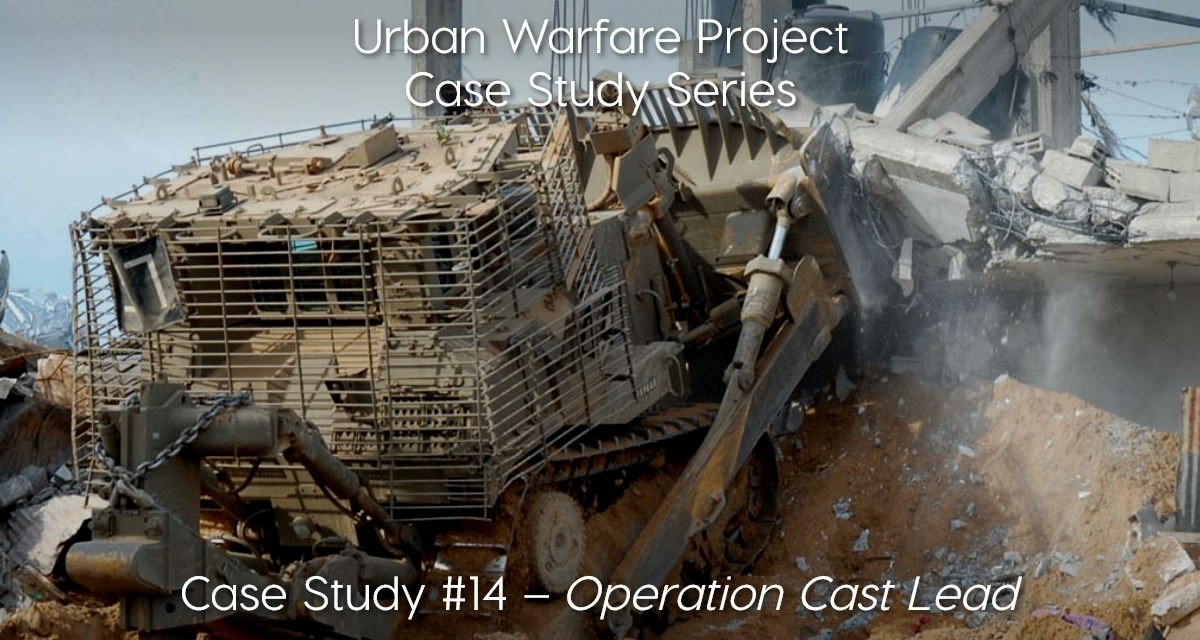
Combat engineers often led the advance using armored D9 bulldozers. These bulldozers weighed seventy-two tons after being upgraded with a seventeen-ton armor kit. They used their heavy blades to clear IEDs and debris, and when necessary, to breach structures obstructing movement. In addition to physical clearance, the engineers employed mine-clearing line charges to open safe lanes through minefields and IED belts. For the first time, the IDF used the Carpet system, a fuel-air explosive line charge capable of clearing a six-meter-wide lane up to one hundred meters long, depending on the number of rockets fired. This system could be mounted on nearly any armored vehicle. It was used alongside the older Tzefa Shiryon system, which relied on a rocket-dragged soft tube filled with explosives to achieve a similar effect.
Despite the intensity of operations, direct contact with Hamas fighters remained infrequent during the early stages. The speed, scale, and surprise of the Israeli advance overwhelmed Hamas defenses. Many encounters involved small, disorganized teams that happened to be in the path of advancing or patrolling Israeli units. Hamas antitank teams were unable to mount an effective response and the group’s antiaircraft assets failed completely. The IDF destroyed most of Hamas’s heavy machine guns within the first few days of the battle.
Hamas’s plan to conduct a coordinated, conventional defense of territory collapsed almost immediately. Commanders and fighters reverted to more familiar guerrilla tactics, and in some cases fled as soon as Israeli forces approached or directed fire on their positions. Hamas focused its remaining efforts on sustaining rocket and mortar fire into Israel and attempting to slow the Israeli advance with mines, IEDs, and sporadic resistance along the approach to Gaza City’s outer neighborhoods.*†
On January 4, as maneuver units reached the outer edge of Gaza City, combat engineers attached to each battalion began constructing a network of fortified positions in the open ground surrounding the urban areas. These consisted of square courtyards enclosed by high earth berms, with integrated fighting positions on the perimeter. These sites were not intended as fixed defensive strongpoints but as temporary operating bases for units to rest and to support logistics activity under cover. Meanwhile, combat units spread across the front occupied captured buildings or established improvised fighting positions. They rotated positions frequently to prevent Hamas from identifying and targeting them.*
While clearing operations continued across their sectors, the Givati, Iron Tracks, and Golani Brigades began limited incursions into the urban areas to their front. These small-scale forays served two purposes: first, to engage and locate Hamas fighters, which was necessary to inform planning for the next phase of the operation, and second, to force Hamas to defend rather than initiate attacks. Each battalion was granted significant freedom of maneuver within its assigned zone. Coordination between units was minimal and aimed to deconflict fire support and prevent fratricide. The IDF’s new digital maps significantly supported this coordination and further reduced the risk of friendly fire. As the days progressed, these patrols and raids began to evolve into deliberate attacks that seized and held terrain, including buildings and key vantage points.*
On January 7, Israel initiated a daily three-hour humanitarian pause. During these windows, the IDF coordinated medical evacuations, enabled access for international aid organizations, and supported the evacuation of foreign nationals in coordination with embassies. To streamline these efforts, Israel established a Humanitarian Affairs Coordination Center to coordinate with international relief agencies operating inside Gaza. Among the center’s priorities were assisting foreign evacuations and facilitating the flow of food, fuel, and essential supplies. By the end of the operation, 1,503 aid trucks had entered Gaza, delivering a total of 37,159 tons of humanitarian assistance. Despite these efforts, Israel was criticized for not doing enough to address the “dire humanitarian concerns.”
By January 9, the Givati Brigade had secured control over the southern perimeter of buildings within the Zeytoon Quarter and began preparing to push deeper into the neighborhood. In contrast, the Iron Tracks Brigade chose not to seize and hold terrain in its southwestern Gaza City sector. It instead relied on aggressive patrolling and frequent raids to maintain pressure on Hamas without committing to static positions. For example, on January 7, the armored brigade executed a company-sized armored thrust south toward Nuseyrat to disrupt Hamas efforts to mount a counterattack from that direction. On other days, the brigade focused long-range tank fire against identified Hamas teams or conducted persistent movement to deny the enemy time to regroup.*†
In the northwest, the Paratroopers Brigade completed its clearance of al-Atatra. With the town under its control, elements of the brigade shifted south to confront the northern edge of Gaza City. From these new positions, they conducted reconnaissance patrols and targeted raids into the city’s outer perimeter, mirroring the activity of the other maneuver brigades. At the same time, the two regional brigades assigned to the Gaza Division continued their mission of securing the Israeli border. In addition to static and mobile defense along the frontier, these units also launched shallow incursions into Gaza to preempt or disrupt potential infiltration attempts by Hamas cells.*†
The initial shock of the Israeli assault disrupted Hamas’s command-and-control network. Not only had the group’s organized defense collapsed, but it was also slow to transition to coordinated irregular warfare. The IDF’s persistent patrolling and raiding further complicated Hamas’s efforts to reconstitute a functional resistance. Throughout the remainder of the war, Hamas was unable to launch any significant counterattacks or cross-border raids. Israeli ground forces aggressively targeted rocket and mortar launch areas and frequently uncovered and destroyed weapons caches, launch sites, and storage facilities. This contributed to a sharp decline in the volume and accuracy of rocket fire into Israel. Mortars, once used effectively against Israeli towns along the border, were now used to engage advancing IDF formations inside Gaza.*
As Israeli troops pushed into more densely populated areas, Hamas shifted its focus to attempting abductions of IDF soldiers. These efforts included attempts to lure individual soldiers or small teams into buildings or tunnel entrances with the intent to capture them. Anticipating this threat, the IDF had trained units in tactics to protect against the risk of abduction and enforced movement protocols that minimized opportunities for isolation or entrapment.
Hamas fighters employed a mix of ambushes, IEDs, mines, and sniper fire to inflict casualties on the advancing Israeli forces. However, these efforts generally failed to halt the IDF’s momentum. At most, they slowed progress briefly and inflicted minimal losses. The most effective weapon system Hamas employed during this phase was the light mortar, which accounted for the majority of the IDF’s casualties in the early urban engagements.*†
Hamas also attempted deception operations. One of these was a psychological campaign centered on “ghost martyrs”—suicide bombers rumored to be hiding throughout the city, waiting for the opportunity to strike. In practice, this deception proved largely ineffective. When Hamas did use suicide bombers, it employed elderly individuals, women, or teenagers, hoping that Israeli soldiers might hold their fire until the bomber could get close enough to detonate the device. In other cases, they sent children toward Israeli positions to report weapons caches or request help for supposed family emergencies, hoping to lure troops into IED ambush zones or established kill zones. These tactics rarely succeeded and sometimes backfired by exposing Hamas’s use of civilians in combat operations.†
As Israeli forces entered the dense neighborhoods on Gaza City’s outskirts and in surrounding areas, the frequency of firefights increased. Most, however, remained brief. Anticipating that the IDF would disrupt their communications, the al-Qassam Brigades relied on a decentralized structure. They typically operated as independent teams of two to three fighters with enough ammunition and supplies to sustain limited engagements. Despite orders to conduct suicide attacks if captured or if death appeared imminent, many fighters avoided confrontation. Some fighters removed their uniforms and attempted to blend in with the civilian population rather than fight. Overall, the al-Qassam Brigades demonstrated a low level of tactical proficiency during this phase of the battle.
To counter the threats posed by concealed fighters and booby-trapped structures, the IDF augmented infantry formations with additional capabilities. Units employed bomb-sniffing and attack dogs ahead of lead elements and often sent the dogs into buildings first to reduce the risk of soldiers triggering IEDs or ambushes on themselves. One Palestinian civilian later described the tactic: “The soldiers don’t dare get out of the [armored vehicles] and come into our homes—only after they send in dogs to clear the area. The dogs have a camera on one leg and a walkie-talkie on the other. That’s how the dogs transmit what is in the house. Then the [armored personnel carriers] advance up to the doorway by rolling over the fence, and the soldiers exit the [vehicles].” This technique, while unsettling to residents, minimized IDF casualties. Despite using dogs frequently, only three were killed during the war. Their effectiveness in detecting traps and threats was widely acknowledged by the infantry units that employed them.
Another tool the Israelis employed to reduce casualties was the Bull Island robotic camera. The tennis-ball sized camera could be thrown into a building or room and then transfer 360-degree imagery to the soldiers positioned outside. These devices provided real-time intelligence on interior spaces without exposing troops to immediate danger.
To further reduce the risk from booby-trapped doors and entry points, Israeli infantry often avoided using conventional building entrances such as doors and windows. Instead, they breached walls using controlled explosives, Matador rockets, sledgehammers, armored vehicle ramming, or tank fire. This allowed troops to enter buildings from unexpected directions and denied Hamas defenders the ability to fix their fire on choke points or doorways.
After securing and clearing the outer blocks of Gaza City, Israeli forces began preparing for deeper raids into the urban core. At the same time, reserve units mobilized earlier in the campaign started arriving in the field to reinforce frontline brigades, which enabled renewed offensive momentum.* Israel began mobilizing reserve forces shortly after the start of the air campaign on December 27 and expanded mobilization at the start of the ground phase to include two reserve infantry brigades and multiple armored battalions. These included reservists integrated into regular units as well as full reserve units.†
On January 10, the IDF deployed a reserve infantry brigade to the al-Atatra area, allowing the Paratroopers Brigade to shift its focus south toward the northwestern quarters of Gaza City, particularly the Shati refugee neighborhood. Another reserve infantry brigade advanced into Beyt Lahiya, a town that had not yet been contested, while the Gaza Northern Regional Brigade, now reinforced with reserve units, launched an attack toward Beyt Hanoon. These reserve formations operated under the same combined arms framework and with the same tactical methods as the regular brigades they supplemented. On January 14, the IDF attached a reserve infantry battalion to the Iron Tracks Brigade to secure the brigade’s logistics route. Deploying reserve units in this manner allowed regular maneuver elements to focus on offensive operations along the Gaza City perimeter.†
During this period, the tempo of Israeli operations increased significantly. The frequency and depth of raids grew as the brigades’ areas of operations expanded. These efforts were designed to apply persistent pressure on Hamas’s leadership, keep the group off balance, and disrupt its attempts to reestablish a coordinated defense. As the IDF controlled or pressured more neighborhoods, Hamas’s operational space and freedom of movement continued to shrink.*
As Israeli forces pressed deeper into Gaza City, international pressure to halt the operation intensified. Hamas’s information operations campaigns focused heavily on the civilian death toll, claiming that more than two-thirds of those killed were noncombatants. Israel strongly disputed this assertion, but it struggled to control the narrative in the international media. Many news outlets and nongovernmental organizations accepted Hamas’s casualty figures, often attributing them to United Nations sources, even though the UN frequently cited Hamas-provided data without independent verification.
On January 17, Prime Minister Ehud Olmert ordered a unilateral cessation of offensive operations and the withdrawal of all Israeli forces from Gaza. The IDF began their withdrawal the following day and executed it in deliberate stages. They withdrew the deepest elements, such as the Iron Tracks Brigade and the Paratroopers Brigade, first, with other elements following over the next three days. By January 21, the last IDF ground troops had exited Gaza Strip.
Despite being tactically overmatched and suffering significant losses, Hamas’s leadership attempted to project the withdrawal as a victory. On January 20, Ismail Haniya, the political leader of Hamas in Gaza, emerged from hiding to deliver a speech declaring success. That same day, tens of thousands of Hamas supporters staged “victory” rallies in Gaza City, celebrating what they portrayed as a triumph of resistance.
As with most urban battles, casualty assessments varied widely. The IDF reported that Israeli forces had killed 709 Hamas operatives and estimated that 295 civilians had also been killed during the operation. An additional 162 adult males remained unclassified, pending determination of their combatant status. The Palestinian Centre for Human Rights claimed the Israelis killed 236 fighters, 255 police officers, and 926 civilians during the operation. Gaza’s Ministry of Health reported that an additional 5,303 Palestinians had been wounded, though it did not distinguish between civilians and fighters. The IDF’s figures appear to be more accurate, supported by a 2010 admission from Hamas Interior Minister Fathi Hamad, who acknowledged that six hundred to seven hundred Hamas and affiliated security personnel had been killed.
IDF casualties included ten soldiers killed and 207 wounded. On the Israeli home front, three civilians were killed and 182 injured from Hamas rocket and mortar fire during the conflict.
In terms of material damage, Israeli strikes caused widespread destruction in Gaza. An estimated 11,154 civilian homes were damaged or destroyed. Of these, 84 percent were struck by tank shells or aerial munitions, with another 12 percent damaged or destroyed by armored bulldozers, 3 percent by Israeli soldiers when they occupied them, and 1 percent by explosives. The Israeli Air Force conducted 5,650 sorties over the course of the operation, totaling 20,650 flight hours. These included 1,700 fixed-wing and 1,150 helicopter attack missions, hitting 3,430 targets. Precision-guided munitions accounted for 81 percent of the 5,500 weapons employed.
Lessons Learned
At the strategic level, Operation Cast Lead demonstrated the limitations of using a time-limited urban campaign to achieve lasting strategic deterrence. Israel inflicted significant damage on Hamas’s military capabilities, degraded its command-and-control network, and temporarily reduced rocket and mortar fire into Israeli territory. Hamas, however, remained in power, quickly reconstituted its forces, and portrayed its survival as a strategic victory. The war’s limited objectives, combined with the decision not to topple Hamas or occupy Gaza, produced only temporary deterrence, and Israel would find itself back in Gaza three years later during Operation Pillar of Defense. As Israel anticipated, deterrence achieved through such campaigns tends to erode over time and requires periodic reinforcement through subsequent operations. In Israeli strategic thinking, Operation Cast Lead became part of a broader pattern of recurring conflicts aimed at periodic attrition rather than decisive victory.
A second strategic lesson is the need to consider humanitarian efforts as part of any urban campaign. From the outset, Israel recognized that public and international scrutiny would be intense and that managing perceptions of proportionality and civilian harm would shape both political and military outcomes. While the IDF took steps to warn civilians and facilitate humanitarian aid during combat, the urban environment limited the effectiveness of these measures. Hamas’s systematic use of civilian infrastructure to shield military activity further complicated efforts to reduce collateral damage. Operation Cast Lead demonstrated the centrality of humanitarian constraints in urban warfare and the reality that legal, political, and moral dimensions are inseparable from the conduct of operations in densely populated environments.
At the operational level, Operation Cast Lead marked the IDF’s first large-scale application of reforms implemented after the 2006 Second Lebanon War. Among the most important was the emphasis on combined arms maneuver at the brigade level, including the integration of infantry, armor, engineers, artillery, and UAVs. These reforms corrected many of the coordination failures experienced in Lebanon by improving battlefield awareness, speed of execution, and adaptability in complex environments.
The IDF demonstrated a significantly higher level of coordination during Operation Cast Lead. Brigades were augmented with organic fire support officers and intelligence capabilities. Air and ground assets operated in close cooperation, allowing precision strikes on enemy positions in dense terrain. Each brigade operated as a task-organized force tailored to its mission. The IDF maintained a high tempo by advancing on multiple axes and using decentralized control to avoid being fixed by Hamas’s defensive lines. At the same time, the operation exposed the enduring challenge of defeating a hybrid adversary with internal lines of communication and access to tunnel infrastructure. Even without air superiority or armor, Hamas’s structure allowed it to resist and regroup within the urban depth of Gaza, underscoring the need for persistent intelligence, surveillance, and reconnaissance and pressure across the entire battlespace.
At the tactical level, one lesson is the need to fight as a combined arms element in the urban environment. Following the Second Lebanon War, the IDF implemented reforms focused on combined arms maneuver in dense urban environments. Infantry, armor, and engineers advanced together, supported by UAVs and real-time intelligence. Armored bulldozers led many advances, clearing debris, breaching obstacles, and detonating IEDs. The IDF expanded the use of mine-clearing line charges beyond open terrain and used them in to clear paths through IED belts inside urban spaces. These engineering assets proved vital in reducing casualties and maintaining momentum.
A second tactical lesson is that soldiers should rarely be the first thing to enter a structure, and when they do, they should avoid doing so through obvious entry points such as doors and windows. The IDF employed various methods to mitigate tactical risk, including the use of dogs and cameras before entering buildings. They also used armored bulldozers to level buildings and negate the need to enter and clear them altogether. Their urban breaching techniques emphasized entering through walls rather than doorways, a response to Hamas’s placement of IEDs or fire at likely entry points.
A final tactical lesson is the need for precision, discipline, and fire control at the lowest levels. In a battlespace saturated with civilians and dominated by complex terrain, success depends not just on firepower but on the ability of small units to distinguish combatants from noncombatants in real time. Tactical decisions can have strategic consequences. In Operation Cast Lead, every engagement was shaped not only by terrain and enemy activity but also by the political and legal expectations imposed on Israeli forces operating under international scrutiny.
Conclusion
Operation Cast Lead marked a significant evolution in the urban conflict between Israel and Hamas. For the first time, Hamas attempted to defend territory through a structured, brigade-based system, combining elements of conventional organization with irregular tactics. Its deliberate embedding of fighters, weapons, and command infrastructure within civilian areas reflected a hybrid doctrine tailored to Gaza’s urban terrain. In response, the IDF executed a coordinated air and ground campaign that showcased the doctrinal reforms and combined arms integration developed after the 2006 Second Lebanon War. The IDF demonstrated improved tempo, maneuver, and tactical adaptation, particularly at the brigade and battalion levels.
The battle reinforced enduring truths about urban warfare: The terrain is complex, the enemy is adaptive, and civilians are present in nearly every zone of combat. The IDF’s use of armored engineers, mine-clearing systems, dog teams, and precision intelligence enabled Israeli forces to degrade Hamas’s capabilities while minimizing their own casualties. Yet these tactical and operational gains did not translate into lasting strategic effect. Much of Hamas’s leadership survived, its forces reconstituted, and its rocket fire resumed. The decision to isolate rather than seize Gaza City reduced the costs of combat but also left key components of Hamas’s infrastructure intact.
Operation Cast Lead provides a defining example of modern urban warfare between a state military and a hybrid adversary. It offers insight into how cities can be weaponized by nonstate actors, and how conventional forces must adapt at every level to confront that reality. Most importantly, it highlights a central paradox of urban war: Even when militaries succeed tactically and operationally, they may still fall short of achieving lasting political or strategic outcomes. As more conflicts are fought in cities, the case of Operation Cast Lead underscores the need for military strategies that do more than destroy enemy forces—they must also align battlefield actions with broader political purpose.
Liam Collins, PhD was the founding director of the Modern War Institute at West Point and a distinguished military fellow with the Middle East institute. He is a retired Special Forces colonel with deployments to Iraq, Afghanistan, Bosnia, the Horn of Africa, and South America, with multiple combat operations in Fallujah in 2004. He is coauthor of Understanding Urban Warfare and author of Leadership & Innovation During Crisis: Lessons from the Iraq War.
John Spencer is chair of urban warfare studies at the Modern War Institute, codirector of MWI’s Urban Warfare Project, and host of the Urban Warfare Project Podcast. He served twenty-five years as an infantry soldier, which included two combat tours in Iraq. He is the author of the book Connected Soldiers: Life, Leadership, and Social Connections in Modern War and coauthor of Understanding Urban Warfare.
The views expressed are those of the authors and do not reflect the official position of the United States Military Academy, Department of the Army, or Department of Defense.