The lens of US-China strategic competition is most typically focused on geographic areas of friction like the South China Sea and potential flashpoints like Taiwan, locations inside the first island chain. Occasionally, it zooms out to the second island chain. Too rarely, however, does the aperture widen even further to the Pacific Islands. But these islands are not a backwater. They are the front line.
Oceania spans more than three hundred thousand square miles and sits astride some of the world’s most important sea lanes and beneath vital air corridors. From the second through the third island chains, the region plays a pivotal role in Indo-Pacific security and would certainly do so in any future military contingency involving China. Though these island nations are often small and remote, their strategic value is undeniable. Geography remains destiny, and in the case of Oceania, whoever controls access to the region holds a powerful advantage. China understands this. The United States must act accordingly and urgently.
China has spent the last two decades executing a comprehensive strategy of influence across Oceania. This campaign reflects a model of unrestricted warfare: economic enticement, diplomatic charm offensives, elite capture, media manipulation, and the deployment of state-owned enterprises that serve both commercial and military functions. Beijing-backed companies now operate critical infrastructure including ports, airports, undersea cables, and telecommunications networks across the region. In many cases, these services are monopolistic by necessity; most Pacific island countries are too small to support multiple competitors. This creates single points of failure and vulnerability.
Chinese infrastructure is not just dual-use in theory. In a future conflict, these assets will support early warning operations or integrate into a kill chain for the People’s Liberation Army targeting US and allied forces. Even in peacetime, their presence enables surveillance, coercion, and disinformation, all of which align with Beijing’s larger effort to reshape the regional order and cast the United States as an unreliable or even malign actor.
Mitigating strategic risk in Oceania requires a nuanced understanding of several interlocking dynamics. First and foremost is the intensifying geopolitical competition between China, the United States, and regional partners like Australia, New Zealand, and Japan. These islands offer critical nodes for access, basing, and overflight. Political recognition of Taiwan remains a flashpoint, and China’s ability to pressure island nations into switching allegiance reveals the transactional nature of Beijing’s diplomacy.
Environmental vulnerability adds a second layer of complexity. Climate change, including rising sea levels and more intense cyclones and droughts, disproportionately affects these nations. Disaster diplomacy is a vector of influence. Beijing has repeatedly capitalized on natural disasters to strengthen its image and deepen dependency. US and allied efforts should prioritize building climate-resilient infrastructure, modular housing, and drought-proof agriculture while offering rapid, pre-positioned disaster relief capabilities.
Economic fragility is another risk China has exploited. Many island economies depend on a few sectors—usually tourism, fisheries, or remittances. Chinese development assistance often undercuts local sovereignty through debt traps or corrupt deals. The United States and its allies can provide fair and transparent alternatives. This includes supporting trade integration, diversifying exports, and creating reliable digital and renewable energy industries. Washington should also compete directly with Beijing’s influence in education by expanding Fulbright, Young Pacific Leaders, and other talent development initiatives.
Governance challenges compound these vulnerabilities. In countries like Papua New Guinea and the Solomon Islands, weak institutions and political instability open the door to Chinese interference. The United States can provide targeted support through electoral assistance, anticorruption programming, and civil society strengthening. Security sector reform, particularly police and military training, offers another long-term advantage. Whoever trains and equips these forces also shapes their norms and allegiances.
Digital infrastructure must not be overlooked. As Pacific island countries digitize rapidly, their cybersecurity postures remain underdeveloped. China has already laid digital foundations through telecom deals and cloud services that raise major national security concerns. The United States and its allies should push for national cybersecurity frameworks, regional incident response cooperation, and independent audits of critical infrastructure. Collaboration with trusted technology providers offers the only viable path forward.
Across all these dimensions, the United States must lead with a strategy of competitive engagement, backed by credible alternatives and sustained presence. A whole-of-government approach is essential, but it must also be integrated with regional mechanisms like the Pacific Islands Forum, Melanesian Spearhead Group, and initiatives that support scenario planning, local resilience, and food and medical strategic reserves. Civil society, youth networks, and indigenous leaders should be included as primary stakeholders, not afterthoughts.
For too long, the United States ceded ground in Oceania. China filled the vacuum with little resistance, achieving influence on the cheap while focusing its resources on military modernization. But that uncontested environment is changing. It’s time to impose costs. By forcing China to defend its holdings across Oceania, the United States can compel leaders in Beijing to expend resources they previously didn’t need to spend. The more they have to hold, the less they can reach.
Now is the time to act—not just to compete, but to offer a better vision. China’s coercive diplomacy, ethnonationalist rhetoric, and unequal deals offer a preview of what long-term alignment with Beijing entails. The United States, with its allies and partners, can and should offer another path—one rooted in respect, transparency, and long-term partnership.
Oceania is not a peripheral concern. It is the southern flank of the Indo-Pacific. And the window to mitigate strategic risk is closing fast.
Lieutenant Colonel George J. Fust is an Army officer in the US Indo-Pacific Command area of responsibility, where he is the G2 director of targeting and collection and advisor to senior leaders within US Army Pacific. He is a graduate of Duke University and an adjunct professor. He previously taught in the Department of Social Sciences at the US Military Academy and served in the 75th Ranger Regiment. He has multiple deployments and experience in Europe, Africa, and Asia.
The views expressed are those of the author and do not reflect the official position of the United States Military Academy, Department of the Army, or Department of Defense.
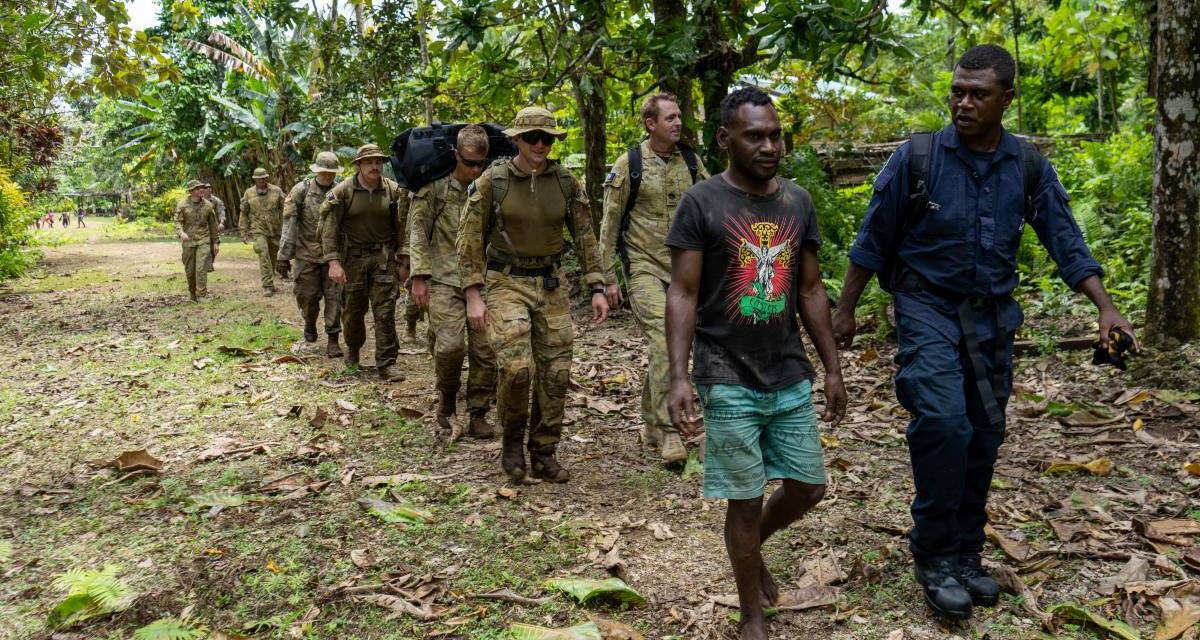
Image: A member of the Royal Solomon Islands Police Force and a Solomon Islands local lead service members from the US Army, Australian Defence Force, and Canadian Armed Forces to an unexploded ordnance location during Operation Render Safe in Ringgi Cove, Kolombangara, Solomon Islands, Sept. 9, 2024. (Credit: Gunnery Sgt. Kassie McDole, US Marine Corps)