In May 2025, the Pentagon announced plans to shutter two of the Army’s six security force assistance brigades (SFABs) and to downsize Security Force Assistance Command into a small shop of about three dozen personnel within US Army Forces Command. This decision ignores clear doctrinal and operational evidence demonstrating SFABs’ strategic value—from Field Manual 3-22 accounting for the utility of Gulf War advising to how the Korean Military Advisory Group was pivotal in halting North Korea’s initial assault in 1950. Yet, SFABs today face shrinking personnel authorizations and institutional ambivalence about their future.
Drawing on operational insights, doctrine, and firsthand observations, we contend that SFABs are indispensable across the competition–crisis–conflict continuum. They shape the battlespace before, during, and after conflict, and must be treated as core elements of US joint campaigning—not peripheral experiments to be cut. For too long, the US military relied on a train-and-pray model of building foreign militaries: ad hoc trainers sent with the hope the forces they train actually perform under fire. This is the epitome of hope as a strategy, and the approach has repeatedly failed. Since 2000, the United States has spent over $400 billion on security force assistance only to see many foreign units “crack” once US personnel depart—in Afghanistan, in Iraq, and elsewhere. This is because the train-and-pray template emphasizes numbers trained over actual combat readiness; it also does not take into account having a cadre of dedicated professionalized advisors that are specialized in working with foreign militaries.
SFABs offer a different path. Established in 2017, these dedicated advisor units provide persistent engagement, forward presence, and scalable missions across the competition continuum. As professionalized advisors, they replaced what were effectively pickup teams (ad hoc MiTTs) with cohesive units of specially trained soldiers. SFABs bridge the gap between peacetime engagement and wartime effectiveness through sustained, embedded advising that builds real trust, capacity, and ability to conduct large-scale combat operations as a coalition.
SFABs are not a boutique capability; these units strategically bridge forward presence with enduring operational goals. And per a Department of Defense Inspector General report, SFABs “have been highly effective in building partner nation capacity and providing partner nations with new capabilities.” As the administration of President Donald Trump demands more burden sharing, allies and partners in Europe and Asia are expected to invest more in their defense and military readiness. SFABs can help make this a reality, as they are an enabling function that makes sure allies and partners are more militarily effective and capable of interoperability with US forces. Policymakers must consider their value to the joint force, given that advisors are often the only Army element in-country building the military-to-military relationships that will be needed in a future crisis.
Redefining the Advisory Edge
Advisory missions can no longer be relegated to the margins of defense planning. Current strategic competition requires consistent engagement, not reactive deployments. SFABs provide that persistent presence, real-time situational awareness, and operational agility. Unlike past ad hoc efforts, SFABs institutionalize a scalable, professional advisor corps with the expertise to maximize partner capabilities.
SFABs also embody a “left of boom” approach, deploying to key regions to cultivate access, influence, and interoperability. In contested theaters like Eastern Europe or the Indo-Pacific, advisors assess partner readiness, will to fight, and logistical resilience. Finally, persistent relationships and ground-level observations give SFABs the ability to provide nuanced information to combatant commands so that they understand partner capabilities and friction points. All of this enhances deterrence.
SFABs elevate deterrence by making any potential adversary face a more networked and prepared coalition. A partner force that trains regularly with American advisors, speaks a common operational language, and can leverage US systems in a crisis is far more resilient—and from an adversary’s perspective, more dangerous—than one left to fend for itself. By shaping local armies into credible, interoperable warfighting partners, SFABs complicate enemy planning, create additional dilemmas for aggressors, and reduce the likelihood of miscalculation. In effect, they build partner capacity and ensure a coalition can rapidly coordinate a response.
SFABs close a critical gap: linking peacetime advising to wartime integration. Too often, advisory programs have been treated as disconnected shaping activities divorced from real combat outcomes. SFABs upend that paradigm. They train to fight with their partners as part of US-led operations, not merely to train and depart. SFAB advisors’ work feeds directly into theater campaign plans and CJADC2 (combined joint all-domain command and control) networks, enabling host-nation brigades to plug seamlessly into American-led missions. Ultimately, SFABs translate partnerships into combat power.
Preconflict Phase: Presence as Prevention
SFABs are most valuable before bullets start flying. Their persistent forward presence gives the United States a unique ability to shape the security environment in ways that episodic training teams or advising by video teleconference simply cannot. In competition, deterrence is about more than hardware—it hinges on relationships, trust, and readiness. SFABs help build all three.
During the shape, deter, and compete phase, SFAB advisor teams enable geographic combatant commanders and Army service component commands to understand conditions on the ground. Advisors provide granular visibility into the readiness of allied and partner units. Unlike scripted, one-off exercises, SFAB engagements span multiple echelons of a partner’s military—not only training individual soldiers, but helping mold entire brigades to conduct large-scale combat operations alongside US forces. These shaping efforts include establishing interoperable communications, reinforcing institutional backbones, and improving combined mission planning and force posture.
Unlike short-term mobile training teams, SFAB deployments provide continuity and local intuition. Advisors live with and observe partner forces continuously, acting as sensors for both battlefield and institutional friction points. They don’t just gauge whether a foreign battalion is trained on paper—they assess whether it is truly ready, with cohesive leadership, logistical endurance, and the ability to regenerate combat power after taking losses. Such ground-truth insight is irreplaceable.
For example, over a recent twenty-five-week period, a 2nd SFAB advisory team operating at only one-third of its brigade strength provided more than ninety on-the-ground observations across Africa that answered fifty-nine priority information requirements for five US agencies. Persistent engagement builds the muscle memory needed for interoperability. Rather than discovering a partner’s capabilities and limitations in the fog of war, advisors that help train alongside partner forces learn to streamline tactics, radios, and rhythms. They develop trust in peacetime so they can move in lockstep during crisis. This is a decisive competitive edge, where vast distances and antiaccess/area-denial threats will slow US responses.
Finally, SFABs serve as powerful signalers. American advisor presence reassures allies and partners of commitments, while shaping adversary perceptions. Unlike regular units that rotate in and out on fixed tours, SFAB teams stay long enough to foster continuity of understanding, language, and rapport that short deployments or video teleconferencing cannot match. In sum, SFABs provide the connective tissue between competition and conflict.
Crisis Response: Winning the First Fight
When deterrence fails, speed and timing become decisive as SFABs already in theater can give US and partner forces a vital edge in coherence, responsiveness, and coalition alignment. During an interview as part of a DoD Minerva-backed research project on security force assistance, an SFAB major explained that combatant command planners assume it takes “five allied brigades to equal the combat power of a single American brigade.” The work of SFAB teams, he added, aims to “close that gap.” Moving partner forces closer to a one-to-one effectiveness ratio can only be achieved by having American advisors, enabling interoperability, readiness, and coalition warfighting.
The concept of winning the first fight is hardwired into SFAB design. As a crisis unfolds, SFAB advisors embedded at various echelons provide real-time battlefield awareness and help integrate combined command and control, ensuring partner formations maneuver in concert with American objectives. Armed with secure communications and digital liaison tools, SFAB teams can bridge interoperability gaps and cue multinational actions at the speed of relevance. They liaise between units, synchronize efforts, and fill critical voids. Advisor handbooks often ignore these unsexy but essential activities.
A recent National Training Center (NTC) rotation further proved these advantages. In early 2025 at Fort Irwin’s “division in the dirt” exercise, one SFAB team embedded with a partner brigade alongside the US 1st Infantry Division, while another SFAB contingent partnered with a foreign division under the Army’s III Corps. The SFAB advisors gave US commanders a clear picture of the partner units and integrated those formations to achieve shared objectives. The two SFAB-led elements synchronized daily to align US and partner operations. This success mirrored 1st SFAB’s contribution to the XVIII Airborne Corps Warfighter 24-5 exercise, where SFAB advisors helped a foreign corps headquarters coordinate with US forces in a multinational scenario.
At both NTC and during the warfighter exercise, SFAB advisors were the vital link—helping partners leverage US assets (for example, calling in American long-range fires to hit the enemy early) and buying time for US reinforcements to arrive. In the NTC after-action review, observers noted the partner brigade’s artillery—enabled by SFAB fire support advisors—achieved near parity with the opposing force’s fires, an unprecedented outcome at NTC. Without SFAB advisors, such coalition lethality and integration would be impossible. By empowering partners to win at first contact, SFABs help set the stage for overall victory. Among other deleterious effects, then, cutting SFAB advisors would greatly diminish the lethality and operational reach of a multinational corps.
Conflict Phase: Grind and Regeneration
Success in the conduct of large-scale combat operations is usually less about the shooting, and more about sustained operations (e.g., endurance, logistics, regeneration, etc.). After the initial clashes, both sides face the challenge of maintaining momentum, replacing losses, and generating fresh combat power. This is where SFABs become even more strategically vital: They can pivot from pure advising and enabling roles to actively regenerating and scaling up a partner’s fighting force.
SFABs accelerate force regeneration in several ways. When allied units suffer casualties or equipment losses, embedded advisors provide rapid assessments, coordinate recovery efforts, and guide the reconstitution of those formations—drawing on preexisting relationships and deep contextual knowledge. SFAB presence also allows the United States to surge additional advisor teams into theater as needed, seamlessly integrating them with local forces rather than starting from scratch. Given sufficient time and resources, SFABs can help raise a partner brigade’s effectiveness close to parity with US formations, which can quickly change the calculus of warfighting. For example, during the Korean War, advisors from the Korean Military Advisory Group helped build the South Korean Army into a force that by 1953 was defending two-thirds of the front line and absorbing two-thirds of casualties. This experience led General James Van Fleet to author his “25 Divisions for the Cost of One” essay in 1954, detailing how it was much cheaper and more efficient to use advisors to build up the Korean military to do the fighting than to just deploy more American soldiers.
As a conflict deepens, SFABs can shift focus from battalion- and brigade-level advising to strengthening the host nation’s institutional base—training centers, logistics hubs, military schools—to create a self-sustaining pipeline for recruiting, equipping, and fielding new units. In a drawn-out war, this ability to scale up a partner’s war effort can prove decisive for maintaining operational tempo. Even if it means teaching a foreign military officer how to use Microsoft Excel to track fuel, food, or ammunition, these are the boring, essential tasks that keep battalions alive in large-scale combat operations.
Recent experience underscores this point. Western advisors helping Ukraine since 2014—and especially after 2022—played a critical role in bridging gaps between Ukraine’s frontline needs and its institutional capacity. They did not just pass on tactics; many have worked with Ukraine’s military to overhaul training and logistics. Unfortunately, US SFAB teams have been kept at a distance in Ukraine—a missed opportunity to further boost Ukraine’s combat effectiveness and to gather lessons for the US Army. This is precisely the kind of wartime advising SFABs are uniquely positioned to conduct with partners: operating forward in the thick of the fight, adapting alongside allied and partner officers, and shaping their development in stride with battlefield realities, all while simultaneously feeding lessons learned back into the US military. Whereas other US units might rotate in for short combat deployments, SFABs provide a continuity of doctrine, relationships, and institutional memory that helps partners stay resilient even as conditions change unpredictably.
From Episodic to Enduring
When the first shots are fired, it is too late to start building trust and interoperability. Beyond cutting two SFABs, these units are already undermanned, dropping from the 816 billets originally envisioned to a constrained 550 soldiers per brigade. SFABs can inform decision-makers and build partner capacity at echelon. And they can provide real-time assessments of partner goals and objectives, to include assisting with reception, staging, onward movement and integration—as shown by US-Chilean Army exercises in 2024. But achieving interoperability goals is only possible with sufficient numbers of SFAB advisors in each region to ensure coalitional large-scale combat operations are effective.
The US military has spent years relearning a hard truth: Presence matters. Field Manual 3-22 reinforces the realities that relationships can’t be surged, trust and interoperability can’t be retrofitted, and posture and placement can’t be airdropped in once a war starts. SFABs offer a proven alternative to the failed episodic model of advising—not with slogans or postconflict lessons learned, but through persistent, forward engagement that shapes outcomes before, during, and after conflict.
SFABs aren’t just trainers on the sidelines. As demonstrated in exercises like the “division in the dirt” rotation at NTC, SFAB teams enabled partner units to integrate seamlessly with US forces, synchronize fires, and align with US campaign objectives. In short, SFABs act as relationship builders in competition, integrators in crisis, and force generators in the grind of war. They enable partners to fight smarter, scale up faster, and endure longer. By operating at multiple echelons in stride with their foreign counterparts, SFABs can elevate a partner brigade or division to a level of effectiveness much closer to that of a US formation—provided they’re given the time, trust, command-and-control authority, and resources to do so.
If the US military is confronted by the need to conduct large-scale combat operations, America’s allies and partners will be needed to tip the military balance. SFABs’ mission is not a secondary or nice-to-have one. It is central to coalitional warfighting success. SFABs must be recognized for what they truly are: not boutique, niche formations, but critical nodes in America’s ability to campaign, compete, and win alongside our partners. Especially given the current focus on countering China in the Indo-Pacific, sending US military advisors to strengthen allies and partners in the region is a cheap and efficient approach that can deter China with minimal provocation.
If the US military continues marginalizing the advising mission or ignoring it altogether, then it means going back to the failed train-and-pray model. Fully staffed SFABs are not a luxury; they’re a necessity. Without them, the United States risks being flat-footed in the next war.
Lieutenant Colonel Jahara “Franky” Matisek, PhD, (@JaharaMatisek) is a military professor in the national security affairs department at the US Naval War College and a fellow at the European Resilience Initiative Center, Payne Institute for Public Policy, and Defense Analyses and Research Corporation. He has published two books and over one hundred articles on strategy, warfare, and national security.
Lieutenant Colonel Anthony Messenger is a Special Forces officer who has served in 5th Special Forces Group, the JFK Special Warfare Center and School, and US Special Operations Command Central. He is currently the commander of 3rd Squadron, 2nd Security Force Assistance Brigade.
Lieutenant Colonel Curt Belohlavek is the commander of 3rd Battalion, 395th Infantry Regiment. Prior to assuming command, he was executive officer of 3rd Squadron, 2nd Security Force Assistance Brigade, where he also previously served as a troop commander.
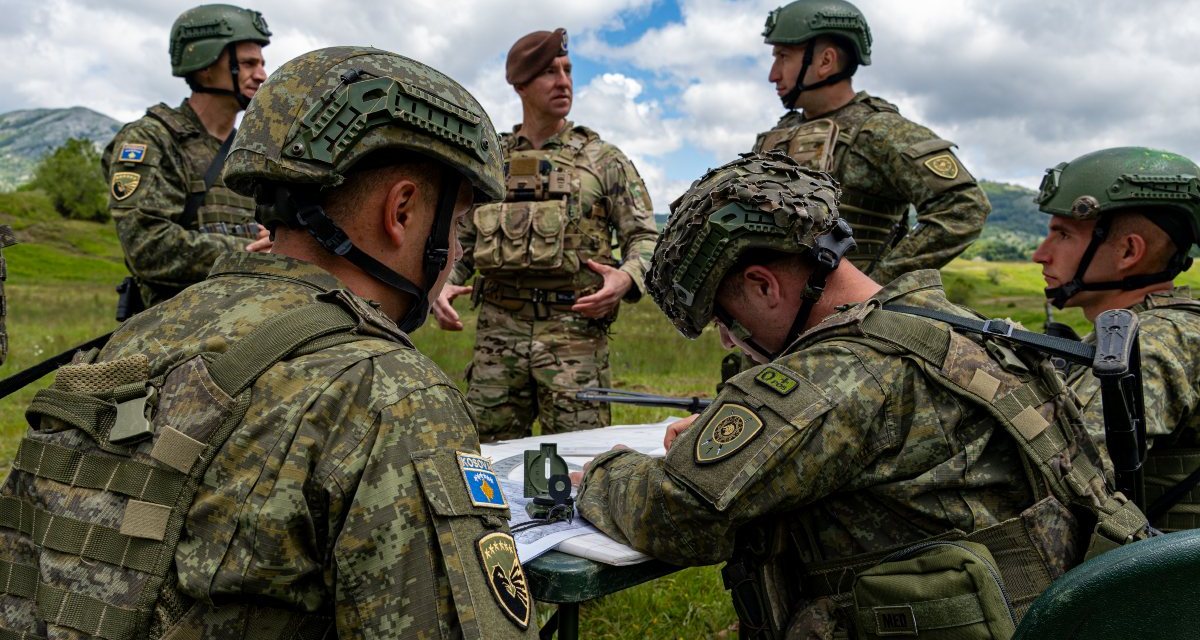
Image credit: Capt. Aaron Blevins, US Army