
For thirty years, Army modernization has pursued increasingly capable weapon systems. But capability is not combat power. Combat power is capability that survives contact with war. Until modernization initiatives measure availability as aggressively as they measure lethality, the Army will continue buying systems that look increasingly dominant on a PowerPoint slide while becoming progressively less resilient on the battlefield. A platform unavailable because it cannot be repaired, sustained, or regenerated contributes no more combat power than one destroyed by enemy fire. A weapon system’s real value on the battlefield can be expressed simply: capability × availability = combat power. A platform with extraordinary capability but near-zero availability under wartime conditions contributes near-zero combat power.
The problem is not theoretical. In 2025, the Government Accountability Office reported that none of the Army’s major ground combat vehicles achieved the service’s own operational availability objective, with mission-capable rates declining across nearly every fleet over the previous decade. Modernization has produced systems of unprecedented lethality, precision, and connectivity. It has also produced a force increasingly dependent on civilian contractors, proprietary software, specialized diagnostics, and just-in-time supply chains. These dependencies functioned adequately during counterinsurgency operations in uncontested environments but may not survive a peer fight. Technology that cannot endure isolation, attrition, and disruption is not advanced; it is strategically fragile.
Every modernization decision creates two products: increased capability and increased sustainment demand. The Army measures one routinely but the other rarely. Far too many increases in capability have been purchased with an increase in a capability debt.
History Already Solved this Problem
This is not a new problem. History has already run the experiment and has shown the criticality of reliability over sophistication. During World Waw II, the German Panther and Tiger tanks were superior, on paper, to the American M4 Sherman. They had thicker armor, more powerful optics, and greater individual lethality. But both were over-engineered and mechanically temperamental. From its earliest deployment, the Tiger I suffered chronic engine overheating, transmission and final-drive failures, and suspension defects; at nearly fifty-seven tons, its weight placed extreme strain on every mechanical system. Replacing its transmission required removing the turret, a labor-intensive procedure impossible near the front line. The Panther fared little better, plagued by chronic engine overheating, fuel leaks that posed fire hazards, and an interleaved road-wheel suspension so prone to clogging with mud and ice on the Eastern Front that basic maintenance became a battlefield ordeal in itself.
The Sherman, by contrast, was engineered around a different philosophy: standardization, interchangeable parts, and field accessibility. Its transmission could be reached and replaced through a bolt-on frontal plate, without removing the turret. Paired with America’s vast industrial base and a robust parts pipeline, this design philosophy produced a consistently high operational readiness rate. The Sherman’s advantage was never that it outfought the Tiger or Panther in a fair one-on-one encounter, it usually did not. Its advantage was that it could be produced, transported, repaired, crewed, and returned to the fight at a scale Germany could never match. Reliability and volume defeated technological superiority. The Germans optimized for maximum lethality, the Americans for maximum availability.
World War II illustrated how maintainability holds a distinct advantage over perfection. The Jeep was engineered for global logistics from the outset. To maximize cargo space and protect vehicles from saltwater damage during transit, Willys-Overland and Ford partially disassembled Jeeps at the factory and packed them into standardized crates, a sort of Jeep in a box. Wheels, axles, and steering components were removed and secured; the chassis was bolted to the crate floor; a small toolkit was included. On arrival in theater, ordinary soldiers with basic tools and simple instructions could uncrate and assemble a fully functional Jeep in as little as four hours. The design assumed the end user would be a tired soldier, not a factory technician, and it worked.
The war also revealed that availability matters more than peak performance. A weapon’s value is defined by whether it is in the fight, not by its best day in a controlled test. A Sherman with a swapped transmission could quickly return to combat, whereas a fleet of dead-lined vehicles awaiting a proprietary software patch in a contested battlespace is a static liability regardless of what its specification sheet says. History rewards systems that remain operational, not systems that post the highest laboratory numbers.
Modern armies often assume these lessons belong to the industrial age. In reality, they have become even more relevant as military systems have grown increasingly dependent on an unrealistic sustainment architecture. Many modern tactical vehicles, including the Joint Light Tactical Vehicle (JLTV), illustrate the broader trend, growing dependence on software diagnostics, specialized tools, and proprietary components create a support pipeline poorly suited to contested, disrupted logistics. The point is not that modern tactical vehicles like the JLTV should not exist. Rather, the point is that every increase in survivability and capability has been purchased with an increased capability debt: a hidden sustainment obligation that comes due precisely when conditions are worst. None of America’s most successful wartime systems were optimized for perfection. They were optimized for availability.
The Sustainment Trap
Imagine an armored brigade on day forty-five of a conflict with a peer adversary. A JLTV experiences a software fault. The mechanic identifies the issue but cannot clear it because the diagnostic software requires network authentication and the network is degraded by cyberattack. The civilian field service representative cannot reach the unit because air superiority has been lost. The replacement module sits in a port awaiting transportation. The vehicle becomes a parts donor. The enemy never destroyed the vehicle. It simply broke one link in the dependency chain.
Recent Army modernization efforts have produced extraordinarily lethal platforms. They have also produced a force quietly dependent on specialized software and diagnostics, networking, autonomy, civilian contractors, and just-in-time supply chains. We have built combat power that performs brilliantly under ideal conditions and may falter under the conditions that define war. Modernization needs a new north star: not performance under ideal conditions, but operational availability under disruption. That single shift in metric—measuring what a system can do when everything around it has gone wrong, rather than what it can do in a controlled test environment—would reorient acquisition, training, and doctrine toward the war we are likely to fight.
The Hidden Dependency Chain
Any assumption that maintenance reach-back will be available is unlikely to survive a peer war. Across two decades of counterinsurgency, the Army grew comfortably reliant on civilian field service representatives (FSRs) to repair, update, and sustain its primary systems. Under the uncontested skies of Iraq and Afghanistan, where FSR movement to the point of need was straightforward, this worked. In a contested theater, it may become impossible. We must plan for long-range fires striking centralized brigade support battalions and maintenance nodes; cyber operations severing the digital reach-back needed to diagnose complex faults; denied airspace preventing rapid airlift of technicians and delicate replacement parts; rear-area attacks against the logistical underbelly of combat formations.
Compounding this, green-suit mechanics are often locked out of their own equipment: without proprietary diagnostic software and authorized networks, which can make even basic troubleshooting impossible. The Government Accountability Office has reported that the data rights the Department of Defense negotiates determine how it can use, maintain, and distribute contractor-owned technical information, and has documented recurring gaps in sustainment-stage data-rights planning across selected programs. A just-in-time industrial base with shallow stockpiles makes the whole structure sensitive to even minor transport disruptions.
With every hidden dependency associated with a weapon or platform—its battery, its software, its network, its diagnostic tool, FSR support, replacement parts, transportation, the industrial base, and critical minerals—another link is added to the chain. A peer adversary does not need to destroy our tanks; it only needs to sever one link that keeps them running. By severing the networks that authorize patches, targeting the contractors required for depot repairs, or interdicting the supply lines, the enemy can neutralize American combat power without firing a single antitank missile.
The Javelin Problem: Exquisite Weapons and Single Points of Failure
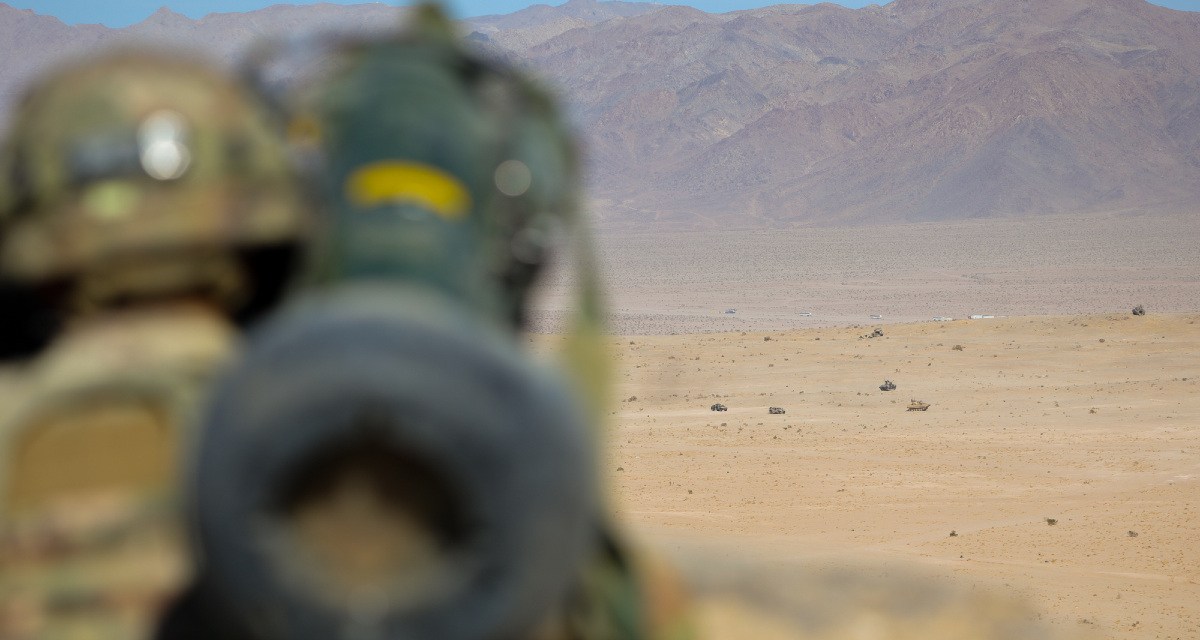
Nowhere is this dependency chain more visible than in a single system Ukraine has made famous. The Javelin has rightly cemented its reputation as a devastating antiarmor weapon. But its lethality resides in a complete system: the missile, the reusable command launch unit (CLU), the battery, a trained operator, a repair pipeline, and a replenishment chain. Disrupt any part of that system and a premier capability becomes a limited-use asset.
The CLU is expensive, demands careful battery management, and requires specialized maintenance. Significant malfunctions typically require reach-back above the brigade support battalion, historically relying on contractor support, a dependency documented since the system’s initial fielding. Any leader who has watched an infantryman drag a CLU through the mud on 550 cord knows these units absorb brutal abuse. In a protracted fight, a unit can run out of working CLUs, and out of the technicians to fix them, while still holding a rack of missiles it can no longer launch.
The answer is not to abandon the Javelin, and nothing here should be read as an argument that disposable systems can replace it. The Javelin’s range and precision remain decisive in open terrain, and Ukraine’s experience has only reinforced its value. The argument is narrower and more structural: No single antiarmor capability should depend entirely on a small number of exquisite, hard-to-sustain systems, such as the CLU. The Army needs a deliberate high-low mix. Disposable systems like the M72 LAW or NLAW cost a fraction as much, carry essentially zero maintenance tail, and can be mastered in minutes rather than through a lengthy gunner pipeline. If one fails, the soldier discards the tube and grabs another.
In a typical platoon with only one or two Javelin teams, that concentration is a single point of failure. Pushing disposable antiarmor down to every fire team converts a fragile bottleneck into distributed, redundant lethality, decisive in exactly the urban and restrictive terrain where the Javelin’s range advantage disappears and combat collapses to close-quarters shots, pairing exquisite precision at the point of greatest need with attritable mass everywhere else.
As we continue to modernize, we will see an increase in the sophistication of our platforms and equipment from the M1A2 SEPv3 and the AN/TPY-2 radar of the THAAD (Terminal High Altitude Area Defense) to future drones and robotic combat vehicles. The problem is fundamentally a systems problem, because every system in this discussion terminates in the same place: a human being under fire, trying to make a weapon work when everything else has gone wrong. Whether it is a CLU that needs battery discipline or a disposable LAW that needs none, the ultimate point of failure or success is never the hardware alone, it is the soldier, often exhausted, undertrained, or often a replacement who may have just arrived at their unit.
The Soldier Is Part of the Weapon System
Almost two centuries ago, French theorist Charles Ardant du Picq argued in Battle Studies that moral and psychological factors ultimately outweigh material ones. Wars are won by cohesion, resilience, and the will to fight. As the Army prepares for large-scale combat operations, his thesis is a warning: Our systems are outrunning the human dimension.
The practical test is brutal and specific. Could a replacement soldier arriving yesterday employ our systems tomorrow. Modern systems must be usable by tired, cold, frightened, undertrained, recently arrived replacement soldiers under fire. In a high-casualty environment where units integrate replacements continuously, a system that demands days or weeks of specialization becomes a liability the moment its trained operator becomes a casualty. When a replacement has hours, not months, intuitive design is the difference between a functioning weapon and dead weight.
There is a cognitive cost as well. When a soldier is buried in augmented-reality overlays, sensor feeds, and decision aids, attention shifts from the enemy to the interface. That sensory overload breeds hesitation and tethers warfighters to screens, dissolving the aggressive initiative du Picq identified as the true arbiter of victory. If a system distracts from the terrain or requires a pristine cognitive environment to function, it fails its ultimate test: whether the weapon serves the soldier, not the reverse.
Why the System Rewards Complexity
If the danger is this clear, why hasn’t it been fixed? Because the system is structurally wired to reward complexity. This is not primarily a story of bad actors. It is a story of misaligned incentives.
- Industry optimizes profit. A “razor and blades” business model earns its real revenue in the decades-long sustainment tail, not the initial sale. Cost-plus contracting, closed architectures, and proprietary software lock down intellectual property so that the government cannot legally or technically repair its own equipment. Complexity is profitable; self-reliance is not.
- Program offices optimize capability. Program executive offices are incentivized to pursue cutting-edge specifications; promotions and funding follow technological marvels, not boringly reliable platforms.
- Congress optimizes jobs. Complex programs spread subcontractors across dozens of districts, building an economic shield that makes exquisite systems politically difficult to cancel or simplify relative to cheaper, mass-producible alternatives.
The result is that the Army inherits sustainment dependencies that become operational liabilities in war. Every increase in capability, in effect, adds to a growing level of capability debt that comes due when the force is in the middle of a war and units are under fire and cut off from resupply. Every stakeholder optimizes for success as defined within their own institutions. Together they have optimized away from wartime resilience.
Designing Systems That Survive War
Adversaries facing a superior conventional force do not fight it symmetrically. Rather than trading tank for tank, they pursue disruption, attrition, and exhaustion, leveraging irregular warfare to target fragile supply chains, centralized maintenance nodes, vulnerable networks, and unarmed contractors. In large-scale combat operations, the rear area is no longer a sanctuary; sustainment assets become primary targets. Under that pressure, assumptions of uninterrupted connectivity, protected reach-back, and freely maneuvering FSRs collapse. Ukraine’s battlefield experience has reinforced this dynamic: Forces facing contested logistics and constant strike threats increasingly favor cheap, throwaway, field-repairable systems precisely because exquisite platforms cannot be replaced at wartime tempo.
The fix is to acquire and field technology soldiers can understand, adapt, and repair themselves, organized around a set of wartime design standards. Notably, the Department of Defense’s existing modular open systems approach already reflects one of these standards, which strengthens the case that these are corrections to a known problem, not radical departures from acquisition norms. Every future program should be evaluated against five wartime tests:
- Availability as a design requirement. Survivability must be measured not only by armor, but by a system’s ability to function when cut off from its supply chain. Logistics and maintainability must be weighted key performance parameters from a program’s inception, on par with lethality and survivability.
- The right to repair. Proprietary lockout must end. Green-suit mechanics must be legally empowered and physically equipped with the software, manuals, and tools to fix their own equipment at the point of need. This is the practical answer to the data-rights gaps Government Accountability Office has documented.
- Contractor-denied certification. Before fielding, a unit must demonstrate the ability to operate, sustain, and repair the platform for extended periods with zero reach-back to FSRs or factory support.
- Open architecture. Aggressively pursue open systems to eliminate single-source fragility, consistent with the modular open systems approach, a strategy to improve competitive, affordable acquisition and sustainment across the life cycle. Standardized hardware and open software enable rapid adaptation, cannibalization, and local manufacture when supply lines fail. The Department of Defense has already acknowledged the importance of open architecture. The remaining challenge is moving beyond modularity toward wartime maintainability and operational resilience.
- High-Low force design. Balance advanced platforms with a larger volume of rugged, mechanically simple, highly producible systems that can absorb mass attrition.
As military systems grow more complex, they become increasingly fragile under persistent disruption. To win the next war, the Army must design systems that embrace mechanical simplicity, eliminate proprietary bottlenecks, and empower the soldier to keep the equipment in the fight.

The question of modernization facing the Army is no longer how advanced a weapon can become. It is whether that weapon remains useful after the supply chain collapses, communications are degraded, contractors cannot deploy, and replacement soldiers arrive with minimal training. Until modernization measures resilience as rigorously as it measures lethality, the Army will continue confusing technological sophistication with combat power. Capability wins demonstrations; availability wins wars.
Major Jonathan Buckland currently serves in the J33 on the Joint Staff. His previous assignments include serving as the executive officer of 5th Squadron, 7th Cavalry Regiment, 1st Armored Brigade Combat Team (ABCT), 3rd Infantry Division; operations officer for 3rd Battalion, 69th Armor Regiment, 1/3 ABCT; and future operations chief for 3rd Infantry Division. He also commanded both a rifle and headquarters company in the 2nd Brigade Combat Team, 82nd Airborne Division. He has a bachelor’s degree in English from the Virginia Military Institute, a master’s degree in international studies from the University of Kansas, and a master’s in operational studies from the Army Command and General Staff College.
The views expressed are those of the author and do not reflect the official position of the United States Military Academy, Department of the Army, or Department of Defense.
Image credit: Sgt. Hunter Xue, US Army