
The United States is actively losing a war it barely acknowledges. Recognizing America’s overwhelming conventional military overmatch, our adversaries have bypassed the physical battlefield to strike our strategic center of gravity: the human mind. They continuously weaponize the information environment—leveraging AI-driven algorithms, state-sponsored influence campaigns, and bot farms—to inject false narratives, fracture societal trust, and paralyze national decision-making. America’s next catastrophic defeat will not begin with a kinetic strike; it will occur because adversaries successfully manipulated millions of Americans into supporting foreign interests.
Reactionary defense fails in the cognitive domain. To survive, fight, and win, the US government and joint force must immediately operationalize narrative intelligence as a decisive warfighting capability. We can no longer afford to merely monitor enemy disinformation, and the key to moving beyond monitoring is narrative intelligence. This is the systematic practice of detecting, understanding, analyzing, and acting on the stories—true, partial, or false—that shape how people interpret events, form beliefs, and make decisions. The United States must aggressively deploy advanced, agentic AI to detect, dissect, and destroy hostile narratives at scale before they achieve strategic impact. By wielding both cognitive warfare and narrative intelligence to proactively shape the information environment, the joint force will shatter adversarial influence campaigns, outmaneuver peer competitors, and secure the cognitive high ground. The battle for the mind is absolute; narrative intelligence is the weapon required to win it.
Cognitive warfare has emerged as a strategic imperative for the United States, representing a new phase in national defense and global influence. By exploiting our advances in agentic AI–driven narrative intelligence, the United States can proactively shape the information environment, protect our values, and secure national interests against adversaries who manipulate public opinion and societal trust. This approach integrates multisource data, advanced natural language processing, and predictive modeling to detect, analyze, and strategically influence narratives at scale. Demonstrated capabilities include adversarial influence detection, counternarrative generation, and campaign simulation, which together provide measurable strategic impact. Maintaining resilience and dominance in the cognitive domain is essential. And the integration of narrative intelligence into cognitive operations ensures continued resilience, adaptability, and dominance in the information environment, where future conflicts will be decided.
Despite these initiatives, both the joint force and the public remain vulnerable to gray-zone influence, which erodes trust and achieves strategic effects without the use of kinetic action. Our adversaries are adept at amplifying, coordinating, and exploiting our domestic divisions to shape US public sentiment. Notably, these adversarial campaigns often rely on authentic American voices being algorithmically amplified rather than entirely fabricated accounts.
The internet is filled with social media posts, continuous news updates, commercial advertisements, and coordinated campaigns, many from adversarial bot farms disseminating false narratives. Cognitive warfare, troll farms, and the proliferation of misinformation and disinformation significantly influence collective perceptions and public opinion. China’s “Spamouflage” network repeatedly impersonates Americans, pushes narratives on race, highlights gun violence, emphasizes political disfunction, and attempts to inflame tensions over Taiwan, COVID, and Gaza. This persistent flow of biased information misshapes public understanding of events, exacerbates societal divisions, and complicates efforts to differentiate between authentic and fabricated content.
Multidisciplinary teams, comprising specialists in psychological operations, information operations, cyber, and civil affairs, offer a means of countering adversary operations in the information environment, but the challenge they face is doing so at the pace necessary to be impactful. Even as advanced visual tools emerge, PowerPoint remains the primary medium for most briefings in the US military. This longtime staple of staff work, however, limits opportunities for real-time collaboration, integrated data analysis, and dynamic visualization—precisely what is needed to succeed in the narrative battle. The adoption of future dashboards, big data platforms, and agentic AI software capabilities is essential for effectively understanding and influencing the contemporary information environment.
The Department of Defense lacks comprehensive, integrated education on cognitive warfare and narrative intelligence despite increasing threats from peer competitors who systematically target human cognition through disinformation, psychological operations, and AI-enhanced narrative campaigns. Russian, Chinese, and Iranian state media increasingly promote narratives that democracy is ineffective, authoritarian governments are more competent, free speech in America is an illusion, and the United States is in irreversible decline. Existing infrastructure, from professional military education to basic training to nonmilitary academic curricula, has not sufficiently equipped military personnel (to say nothing of the broader citizenry) with the skills necessary to recognize and counter attacks on perception, decision-making, and societal cohesion. This deficiency results in low awareness, with cognitive defense often regarded as secondary rather than as a fundamental warfighting domain. New initiatives, for example the NCNI’s one-hour senior executive and twelve-hour narrative intelligence professional certifications, prepare student interns and other teams for future integration of narrative operations and tactics. The 2026 National Defense Authorization Act’s mandate to formally define these concepts represents a further sign of initial progress. However, systemic gaps remain, doctrine is fragmented, training is inconsistent across organizational levels, and critical media literacy is not consistently integrated into resilience or professional development frameworks.
To address this challenge, the company where I now work after thirty years of military service hosted three West Point cadets as part of the academy’s Academic Individual Advanced Development program for three weeks this summer. The objective was to examine how young individuals learn and comprehend cognitive warfare and narrative intelligence concepts and their practical applications. During the first week, the focus was on cognitive analysis, participation in multiple virtual meetings with the NCNI, and research into established information-gathering methods in the regions of Mordovia, Venezuela, and India/Pakistan. The cadets developed problem statements and proposals addressing how these populations exhibit conflicting behavioral patterns.
During the second week, the teams traveled to the NCNI in Oxford, Mississippi. The cadets were immersed in their twelve-hour narrative intelligence professional certification program and earned their certification. Their certificates read:
Narrative Intelligence is the discipline of understanding how narratives form, evolve, and drive decisions. This certification—issued by the NCNI—validates your ability to detect, assess, and respond to narratives that shape markets, policy, and reputation. Built for leaders, analysts, communicators, and strategists who need to operate where information drives decisions.
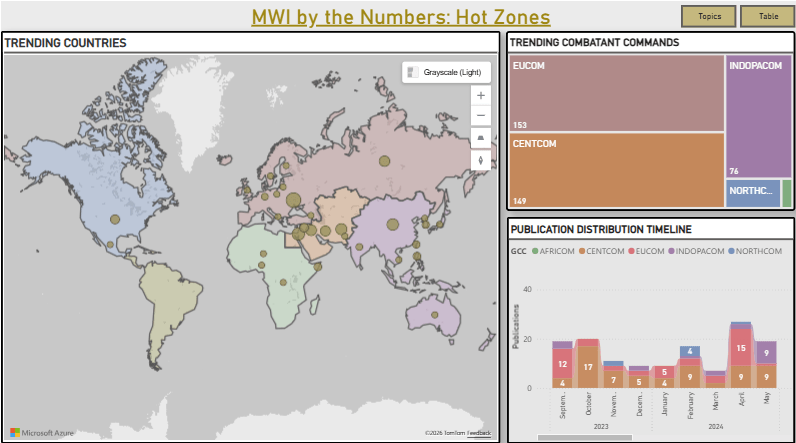
The remainder of the week was dedicated to developing regional minimum viable products for demonstration at Fort Bragg, North Carolina. The cadets presented their findings using data and various sections provided by the situational awareness platform to illustrate how different sources framed aid efforts and responses.
During the final week, cadets participated in Special Warfare Center and School training and engaged with the 8th Psychological Operations Group’s advanced skills company. They observed the Psychological Operations Qualification Course’s student mission analysis out-brief presented to 25th Infantry Division role players at the PSYWAR School. The cadets analyzed the impact of influence operations, using human, media, and other sources, on population behavior in support of United States objectives and on regional leadership perceptions of authentic and deceptive narratives. On the concluding day, cadets met with Colonel Bob Cusick, commander of the 8th Psychological Operations Group. Along with the advanced skills company, they discussed the future of cognitive warfare, influence operations targeting near-peer adversaries (i.e., Russia and China), and the implementation of narrative intelligence AI software.
Cognitive warfare is dynamic at both regional and global levels. It is culturally embedded, multilingual, and frequently disseminated through coordinated or organic networks. Adversaries employ advanced narrative intelligence techniques, including reframing, flooding, and microtargeted storytelling. Detecting subtle or emerging narratives, mapping complex narrative ecosystems, and generating effective counternarratives that resonate without unintended consequences are technically demanding tasks. In this context it is not hard to see how military commanders aren’t just fighting for faster information, but for trusted understanding under manipulation. In cognitive warfare, the core problem is that adversaries attack the commander’s ability to observe, orient, decide, and act before a decision can be made with confidence.
This impact is felt well beyond the battlefield. Foreign adversaries’ malign information operations have amplified anticapitalist, antiestablishment, and antigovernment narratives that align with their strategic interests. When these topics are amplified, it is no wonder the United States is seeing a growing political and social division.
Through decades of conflict, the Department of Defense has continuously demonstrated exceptional speed, shock, and precision lethality, only to be outpaced by our adversaries’ information operations. Cognitive warfare cannot be considered merely an unconventional supporting function of maneuver warfare. Rather, it shapes the strategic outcome of maneuver warfare, before, during, and after any direct action. Understanding and rapidly addressing this paradigm shift is critical to our success. Ultimately, this requires a wholistic adaptation across the spectrum of DOTMLPF-P (doctrine, organization, training, materiel, leadership and education, personal, facilities, and policy). But where to start? With a rapid expansion of narrative intelligence education to enable our force to tackle this challenge.
The NCNI narrative intelligence professional certification and similar education programs provide a scalable option to create the awareness and required operational integration of cognitive warfare and narrative intelligence. In parallel military academies and professional military education programs must incorporate cognitive warfare and narrative intelligence not only as essential elements of maneuver doctrine, but most importantly as an essential strategic element of national power. To that end, we strongly recommend the military academies establish year-long cognitive and narrative research projects to identify requirements, future capabilities, and constraints. On top of this, the right tools are critical, so the Department of Defense should pursue the development and implementation of a unified, global, artificial intelligence–powered cognitive warfare platform with narrative intelligence as its foundational element.
The decisive terrain in modern conflict is no longer defined solely by geography or firepower. It is increasingly defined by perception. Adversaries understand that they need not defeat the United States militarily if they can erode public trust, deepen societal divisions, and shape how Americans interpret events. Every false narrative we leave unanswered, every manipulated story we leave amplified, and every distortion we leave to be accepted as fact becomes a strategic advantage for those seeking to weaken our national resolve. The antidote is not counterpropaganda, but credible, timely, and transparent communication rooted in verifiable truth. When our government, military, academia, industry, and informed citizens can rapidly expose deception, provide context, and reinforce objective facts, adversarial influence loses its power. Success in the cognitive domain is therefore measured not by controlling the narrative, but by ensuring that truth consistently outpaces falsehood. In an era where information can shape strategic outcomes as effectively as kinetic force, the ability to detect, understand, and counter malign influence is no longer a supporting function. It is essential to our national defense.
Paul Sparks is a recently retired military officer with thirty years of experience, including five years as chief information officer/G6 for the United States Special Operations Command. He led organizations within the Pentagon, joint forces, and special operations. He deployed for operations including the Hurricane Katrina response, Operation Tomodachi disaster relief after the 2011 tsunami in Japan, Operation Enduring Freedom, and Operation Iraqi Freedom. As commander of the 160th Signal Brigade from 2018 to 2020, he led three thousand IT professionals supporting thirty thousand users in Southwest Asia. Paul currently serves as technical delivery manager at ITility for narrative intelligence, cognitive warfare, and special operations business development and acts as a solutions architect for government contract proposals.
The views expressed are those of the author and do not reflect the official position of the United States Military Academy, Department of the Army, or Department of Defense.