
Liam Collins, Jayson Geroux, John Spencer, and Amanda Zhao | 10.28.26
The Battle of Shanghai occurred from August 13 to November 11, 1937, and was the first major battle of the Second Sino-Japanese War (1937–1945). Following Japan’s invasion of Manchuria in 1931, the two countries engaged in periodic skirmishes. The deadliest of these was 1932’s “Shanghai incident,” in which thousands of soldiers and ten thousand civilians lost their lives. Despite this, the nations avoided full scale war until July 7, 1937. The war started with the “Marco Polo Bridge incident” in northern China, but its focus quickly shifted to Shanghai. On August 9, 1937, Chinese police officers shot and killed Japanese First Lieutenant Oyama Isao and his driver when they attempted to enter Shanghai’s Hongqiao Airport in violation of the 1932 ceasefire agreement. Soon thereafter, tensions escalated into a major battle for Shanghai that ultimately ended in a Japanese victory.
Due to colonialism, Shanghai had evolved into a city with control divided between three governing bodies. A joint municipal council governed the 8.35-square-mile international settlement. The settlement stretched across the center of the city from west to east and contained a large American, British, and Japanese presence. To its south the French consulate general administered control over the 3.9-square-mile French concession. The Chinese Municipality of Greater Shanghai governed the remaining fifteen square miles of the metropolis and the most populous parts of the city. From west to east the Zhabei, Hongkou, and Yangshupu districts were situated within the Chinese municipality north of the international settlement. The Zhabei district was an industrial area and a major transportation hub where roads, waterways, and railways converged. The Sihang Warehouse was located at its southern tip. The Old City and Nanshi districts were located within the Chinese municipality south of the French concession. The underdeveloped Pudong district sat on a peninsula opposite the international settlement on a bend formed by the Huangpu River. The river flowed from south to north with a sharp bend at Shanghai, before emptying into the Yangtze River fifteen miles north of the city.

The 150-foot-wide Suzhou Creek with its steep seven-foot banks bisected the city. It ran from northwest to southeast along the border of the Zhabei district and the international settlement and then through the international settlement before emptying into the Huangpu River’s bend. There were few subterranean spaces within Shanghai due to the water-saturated soil. The city’s streets were a mix of asphalt and dirt arranged in a mostly grid-like pattern intersected by narrow, maze-like alleyways. Most buildings were multistory and constructed of wood. The combination of narrow streets, dense building clusters, and limited avenues of movement created canalized engagement areas where defending forces could mass fires against advancing troops.
Trade had transformed Shanghai into a metropolis. In 1937, its population of 3.5 million made it the second-largest city in Asia (Tokyo was the largest) and the fifth largest in the world. The city’s residents included seventy thousand foreigners from forty-seven countries. The largest group (twenty thousand Japanese) was concentrated in the eastern half of the international settlement, Little Tokyo (in the Hongkou district’s south), and parts of the Zhabei district.
The Battle
The international settlement was divided into four defense sectors run by Italy, the United States, the United Kingdom, and Japan to defend the international residents. The United States defended its sector—the westernmost part of the international settlement—with its 4th Marine Regiment. The United Kingdom defended its sector—the central portion of the international settlement—with British forces commanded by Major General Alexander Telfer-Smollett. Observing that the fight for the city was impending, a multinational Shanghai Volunteer Corps and additional British and American military personnel began building concrete blockhouses and machine gun posts reinforced with barbed wire to defend their respective sectors.
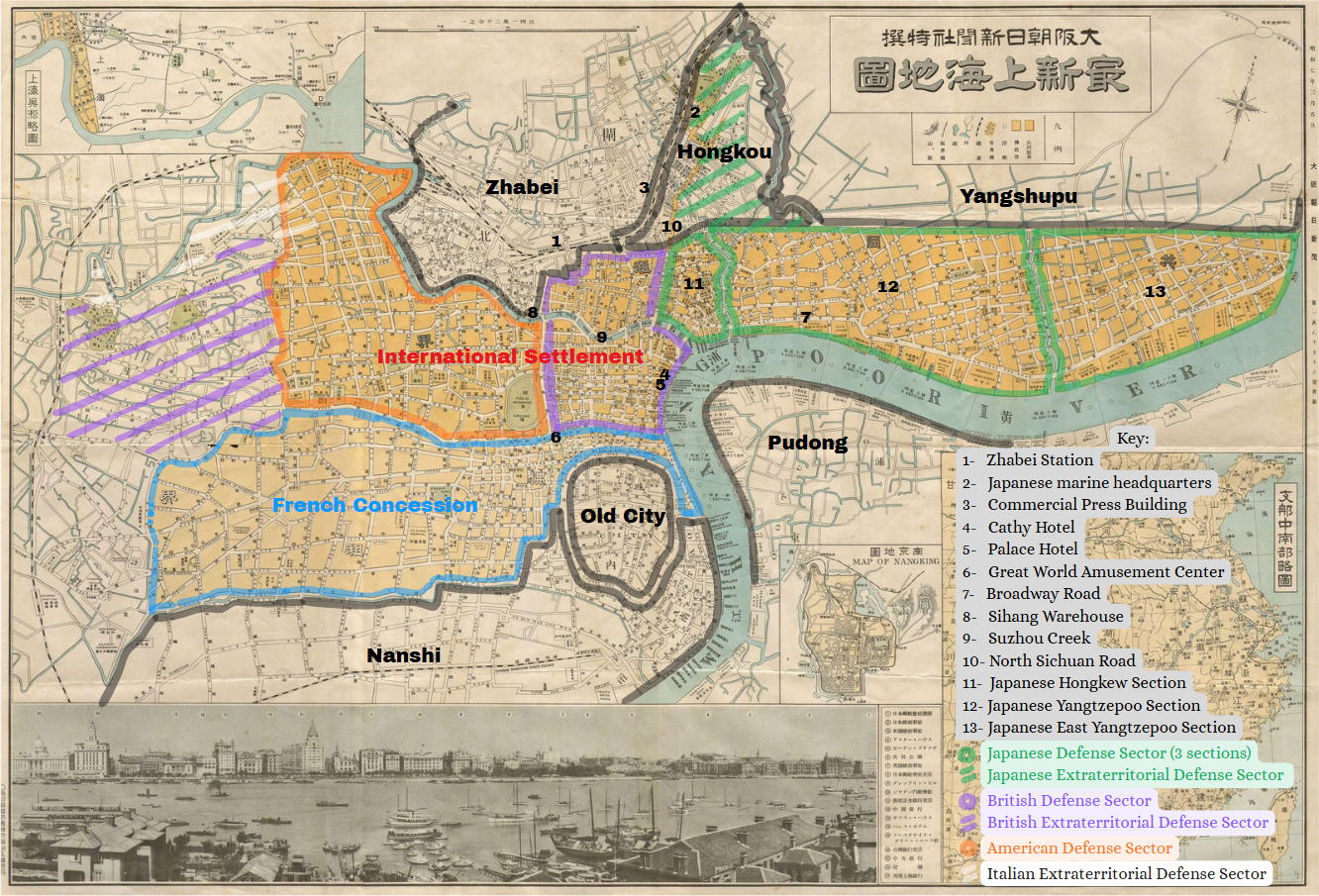
The Japanese defense sector was the largest. It included the eastern portion of the international settlement and the southern part of the Hongkou district. The Japanese forces stationed in Shanghai included 2,500 members of the Special Naval Landing Forces, marine infantry units. They were stationed at their headquarters—a two-block, fortress-like, four-story building with a roof made of two layers of reinforced concrete—as well as other positions throughout the district and within the Japanese defense sector. The headquarters building, located in Little Tokyo, included a dense network of machine gun positions protected by sandbag walls, concrete emplacements, and barbed wire obstacles. The marines had light armored vehicles, tanks, and artillery. On August 11–13, the Japanese Navy’s 3rd Fleet reinforced the garrison with another 2,500 marines who arrived on twenty-one warships that moored near where the Suzhou Creek joined the Huangpu River. Over the course of the battle, Japan would land additional divisions that participated in the battle in and around Shanghai. Japanese naval and army aviation units, including the 1st Combined Air Group, supported the battle. In total, nearly three hundred thousand Japanese forces would participate in the three-month battle.
General Zhang Zhizhong, a veteran of 1932’s Shanghai incident, commanded the Chinese 9th Army Group at the beginning of the conflict, which conducted most of the urban combat. These forces included twenty-two thousand soldiers from the 87th and 88th Divisions, a half-strength brigade (2,500 soldiers) from the 98th Division (at the disposal of the 87th Division), and two regiments (five thousand soldiers) from the 36th Division, all located in the Shanghai North Railway Station. The 55th Division (six thousand soldiers) was positioned in the Pudong district on the eastern bank of the Huangpu River. The 87th and 88th Divisions had undergone modernization plans before the start of the war and were trained by members of the German advisory corps, which consisted of seventy officers. As a result, their soldiers were more competent than typical Chinese soldiers and on par with their Japanese adversaries. Also present was the Peace Preservation Corps, a Chinese paramilitary group and the only Chinese force permitted to operate within Shanghai as stipulated by the 1932 ceasefire agreement. A total of seven hundred thousand Chinese soldiers would ultimately participate in all three phases of the Shanghai campaign as additional forces arrived throughout the battle.
Other elements supported these infantry forces, but they lacked sufficient size, training, combat power, and experience. Artillery units possessed several types of guns, the largest being 150-millimeter, but their crews and forward observers were undertrained. Chinese armor consisted of sixteen light tanks but their crews suffered from the same lack of training. Air defense units were equipped with an insufficient number of German/Swiss Solothurn S-18/100 20-millimeter antitank rifles. The Chinese air force included 250 functional aircraft. Their pilots were being mentored by retired United States Army Air Corps Captain Clair Chennault, but they still lacked sufficient skill.
Both sides entered the battle with weapons and equipment that shaped the character of the urban fight. Japanese forces employed modern infantry weapons, light machine guns, mortars, artillery, and naval gunfire support from ships positioned along the Huangpu River. These systems proved highly effective in suppressing many Chinese assaults before they could get close enough to destroy Japanese defensive positions. Chinese forces possessed some modern German-supplied equipment, but a majority lacked the training and coordination to employ it effectively. In the dense urban terrain, machine guns, artillery, and naval fires dominated streets, intersections, and avenues of approach, making movement in the open extremely costly.
China’s objective for the operation was to eradicate Japanese forces from Shanghai and to prevent Japan from landing additional forces near the city. Chinese forces’ concept of operations was to occupy and fortify key terrain within the city, identify weak points in the Japanese defenses, and then vigorously assault to push the Japanese forces out of the city. The battle unfolded in three phases. During Phase I (August 13–23), both sides prepared for and initiated the battle. Phase II (August 23–October 24) was focused on operations both inside and outside of Shanghai. Phase III (October 24–November 11) included the Chinese withdrawal from the northern parts of Shanghai, a major battle at the Sihang Warehouse, and combat operations in Shanghai’s Nanshi district.
Japanese forces sought to defend their positions within Shanghai while maintaining control of the Huangpu River to support, resupply, and reinforce their marines in the city. As the battle developed, Japanese forces sought to transition to the offensive by landing additional divisions north and south of Shanghai to isolate the Chinese forces and force their withdrawal.
Phase 1
Recognizing the waterway was Japan’s main logistical route, the Chinese sunk two old steamers and dozens of junks at critical spots along the Huangpu River on August 12 to impede river transit. Simultaneously, soldiers from the 87th and 88th Divisions filed into Shanghai from Nanjing, the Kuomintang capital several miles upstream on the Yangtze River, and started digging trenches throughout the Zhabei district.
Seeing that the urban fight was coming and fearing a repeat of 1932’s Shanghai incident, tens of thousands of Chinese residents started fleeing to the countryside and the international settlement, the latter receiving fifty thousand at the onset of the conflict. Likewise, thirty thousand Japanese civilians fled from Shanghai and China’s interior, crowding the city’s wharves as they waited to be ferried back to Japan. Yet hundreds of thousands of civilians remained. The United States ambassador requested that Chinese forces not enter the international settlement, which the Chinese agreed to only if the Japanese agreed not to base in the settlement. This proved effective at keeping the battle—other than errant bombs or stray bullets—out of the American and British sectors. The American commander ordered the 4th Marines to prevent entry into the American defense sector by all means necessary.
The battle started in the morning of August 13 with meeting engagements between small Japanese and Chinese patrols. The patrols had advanced through the narrow alleys to minimize detection and met at the Peace Preservation Corps barricades at the northern edge of the Yangshupu district, near the Commercial Press Building in Little Tokyo, and at the Chih Chih University in the Zhabei district. Japanese forces reacted to Chinese sniper and machine-gun fire by sending out search-and-destroy parties to conduct house-to-house searches and setting any buildings on fire that were thought to contain Chinese positions. That evening a heavy rainstorm moved over the city.
Throughout the night and into the following morning, both sides indiscriminately fired mortars and artillery in the direction of one another. While Japanese forces worked to fortify their positions in western Hongkou, American and German military advisors recommended to their respective Chinese leaders that they conduct an air and ground offensive the following day. Captain Chennault helped the Chinese plan close air strikes—which would start in the morning and continue throughout the day—to destroy the 3rd Fleet’s ships anchored in the Huangpu River to prevent the ships from supporting the battle. The ground offensive was to begin in the late afternoon and would focus on destroying Japanese forces that had taken up positions throughout western Hongkou and then close with and destroy the Japanese marine headquarters at the northern end of that district.
Chinese leader Chiang Kai-shek had selected Shanghai as the location for the first major battle of the war because of the large number of foreigners who lived there. He hoped that a battle in Shanghai would attract global attention and result in foreign support for China. But to maintain that support, he knew he had to prevent Chinese forces from endangering foreign civilians. As such, he forbade Chinese forces from travelling through the American and British defense sectors to advance on Japanese forces. German military advisors, however, recommended to their Chinese counterparts to ignore the agreement to stay out of the international settlement. They argued that Japanese forces were expecting Chinese forces to attack from Zhabei and, thus, had heavily defended positions on the western side of Hongkou. If Chinese forces instead advanced through the American and British sectors, they could hit the Japanese rear where they had no defenses. Chiang, however, refused to rescind the order recognizing that while it might be tactically advantageous, it would be strategically disastrous because it risked the loss of international support.
On the morning of August 14, the Chinese air force began its bombing campaign. It was nothing short of an unmitigated disaster due to the rainstorm turning into a typhoon. Chinese aircraft flew a paltry six missions because most of their pilots could not fly under such difficult conditions. Even their best pilots struggled. The weather forced the pilots to fly at an extremely high altitude, and they failed to adequately adjust their bomb sights to account for the altitude and high winds. Despite dropping many bombs, only one hit a Japanese ship, the cable-laying Okinawa Maru. At 4:27 p.m., two bombs struck the Cathay and Palace Hotels in the international settlement, resulting in the deaths of 150 civilians. The hotels were located on the bank of the Huangpu River southwest of where Japan’s 3rd Fleet was anchored. At 4:45 p.m., two bombs hit the Great World Amusement Center in the French concession and killed an additional 675 civilians. As a result of the errant bombings, the date became known as “Bloody Saturday.” The incident highlighted the difficulty of employing airpower in dense urban environments and demonstrated how quickly civilian casualties could undermine strategic objectives.
The Chinese ground operation fared no better. As Chinese forces worked their way through the multistory buildings and narrow alleyways from Zhabei into Hongkou, they routinely stumbled into well-concealed Japanese defensive strongpoints within buildings that were hard to see through the typhoon’s torrent rain. Chinese forces repeatedly advanced along predictable avenues of approach and conducted frontal assaults against prepared Japanese strongpoints. These attacks exposed advancing units to concentrated machine-gun fire, artillery, and naval gunfire that inflicted heavy casualties before Chinese troops could close with and destroy the defenders.
Since the Chinese air force had failed to destroy the Japanese fleet, the ships’ naval guns could support the Japanese marines within the city. The powerful naval guns helped decimate Chinese assaults, which allowed the Japanese forces to counterattack into the flanks and rear of advancing Chinese forces. In the confusing urban terrain, Chinese commanders at all levels had only a vague understanding of where their personnel were located and what was happening. The Chinese had kept their artillery well to the rear to protect their few guns, so they were too far away to support the attack. Yet even if they were positioned farther forward, their crews were so poorly trained that they likely would have done little more than produce collateral damage and civilian casualties. Chinese casualties quickly grew so high that General Zhang called off the ground attack only hours after having ordered its start.
The battle paused on August 15–16 as both sides waited for the typhoon to pass before recommencing operations. During this time the Japanese brought in reinforcements, rebuilt defensive strongpoints, placed large obstacles on the streets, and positioned tanks and armored cars at critical locations in Hongkou. Understanding the Japanese forces were more than likely strengthening their defenses, the Chinese attackers sought to press the attack before the Japanese defenders could fortify their positions even more. Thus, they brought in their own reinforcements and created an improved plan, Operation Iron Fist. Instead of attacking into the Zhabei district, the plan called for an attack into the eastern and northern portions of Hongkou. General Zhang ordered the 87th Division, reinforced with 2,500 soldiers from the recently arrived 98th Division, to assault into Hongkou from the less fortified Yangshupu district. He ordered the 88th Division to assault into northern Hongkou, move through Hongkou Park, and advance south toward the Japanese marine headquarters.
The Chinese forces also adjusted their tactics given the failure of their frontal attacks during the battle’s first two days. General Zhang directed that once Chinese forces discovered a Japanese position, they would use the minimum combat power necessary to pin down the defenders and set the building on fire. Meanwhile, other forces would attempt to find and exploit gaps between defensive positions by moving inside buildings using mouseholes or on rooftops to advance beyond Japanese positions and then attack them from the rear. The 88th Division’s German advisor recommended that dismounted soldiers advance behind creeping artillery barrages. When performed correctly, Japanese forces would seek cover from the artillery and when it lifted, the Chinese forces would be at extremely close range, thus negating the defenders’ inherent advantage. Chinese commanders believed that if they could squeeze the Japanese defenders into Little Tokyo and cut the defense into three sectors, they could they could then defeat the isolated forces in succession and force the remaining Japanese forces to retreat to the Huangpu River and out of the city on ships. The tactics might have been effective had the Chinese conducted sufficient reconnaissance prior to the attack, but they felt pressured to press the attack as soon as the weather lifted to prevent the Japanese from fortifying their positions any further.
At 5:00 a.m. on August 17, the two Chinese divisions began their assault and immediately ran into challenges. Recently emplaced obstacles, newly arrived Japanese armored vehicles and tanks, and reinforced strongpoints surprised the Chinese attackers. They found the strongpoint positions too challenging to eliminate despite attempting, unsuccessfully, to implement General Zhang’s new tactics. Likewise, communication challenges undermined the 88th Division’s attempts to advance using creeping artillery barrages. The Chinese soldiers trailed too far behind the artillery shells, which allowed the Japanese defenders sufficient time to regroup and effectively engage the advancing Chinese soldiers after the artillery fire had lifted. The 88th Division lost an entire battalion while attacking a single building.
When Chinese units did seize a building, they often lost it a short while later to Japanese counterattack. Buildings often changed hands several times, thus preventing a breakthrough. Chinese commanders found it difficult to track their units advances due to the confusion of the urban terrain, which was compounded by some units exaggerating their successes or being unable to identify their exact locations. One regimental commander from the 87th Division became so frustrated that he issued orders for his subordinate units to remove street signs and send them to their headquarters so that staff officers could monitor units’ progress. When Chinese commanders eventually realized they were not making any forward progress, they paused offensive operations to create another plan of attack.
Civilians tried to avoid the battle, but many could not. Although the fighting had remained outside the international settlement, 2,700 British and American civilians departed Shanghai. In Hongkou, Japanese soldiers and civilian thugs killed an unknown number of Chinese civilians. Likewise, Chinese civilians attacked individuals suspected of being Japanese or accused of collaborating with Japanese forces.
On August 18, 1,400 Japanese marines and 5,000 Chinese soldiers from the 36th Division arrived in Shanghai and entered the battle the following day. With Chinese forces having performed so poorly in Zhabei and Hongkou, General Zhang positioned his newly arrived forces east of the Hongkou salient in Yangshupu and had them conduct an offensive through Yangshupu in the hopes that they could reach the Huangpu River and cut Japanese forces in half. The remainder of the 88th Division was right-forward, the 87th Division left-forward, and the 36th Division’s two regiments of five thousand were in the center when they attacked that morning.
When the Chinese forces restarted their attack, they once again demonstrated limited proficiency in urban combat by advancing along open streets and through open areas. Japanese soldiers in defensive positions on the top floors of buildings easily engaged the Chinese soldiers, who were often forced to use their dead comrades as cover to return fire. Nevertheless, through sheer mass in numbers the Chinese troops slowly advanced to Broadway Road, one block north of the Huangpu River, before they ran into a wall with large iron gates that surrounded Japanese-owned factories on the river’s wharves. The Japanese forces had turned the area between the wall and the river into a series of fortified strongpoints with positions along the top of the wall. After failing to advance beyond the wall, the Chinese brought three howitzer artillery guns forward to breach the wall in direct-fire mode, but all three malfunctioned. Chinese soldiers desperately attempted to scale the walls, but they were cut down by Japanese machine-gun and naval gunfire.
On August 19–21Chinese forces continued to press the attack but failed to make headway due to poor coordination between their infantry, armor, and artillery forces. Chinese forces often conducted narrow advances, which allowed Japanese marines, supported with tanks, to move up adjacent streets and attack their flanks. With their forces lacking antitank weapons, Chinese commanders sent tanks forward to support the dismounted troops. They, however, deployed them in piecemeal fashion and without infantry protection, which resulted in the destruction of two the 87th Division’s tank companies. To protect their artillery, the Chinese forces hid them in the Pudong district’s bamboo groves on the south bank of the Huangpu River.
By this point of the battle the Japanese military had gained air superiority, thereby grounding the Chinese air force. Meanwhile Japanese fighters and bombers destroyed bridges, railways, and airfields and forced the Chinese forces to conduct large movements of personnel and supplies at night. Although the Chinese forces possessed German/Swiss Solothurn S-18/100 20-millimeter antitank rifles, they did not use them against aircraft for fear of revealing their locations and receiving swift retribution from Japanese aircraft. They did, however, employ them against Japanese marines. By the third week of August, the Chinese 88th Division had suffered so many casualties that it became combat ineffective and the 36th Division’s two regiments had suffered two thousand casualties. On August 21 the Japanese received another one thousand marine reinforcements, which boosted their numbers to approximately 6,300 personnel. Realizing their attack had failed, Chinese commanders ordered a withdrawal.
Phase 2
On August 23, Japan landed another 7,500 soldiers from the 11th and 3rd Divisions at Wusong, roughly fourteen miles north of central Shanghai, and at Chuanshakou, about thirty miles northeast of the city, along the southern bank of the Yangtze River. In early September, three more divisions—the 9th, 13th, and 101st—landed. Chinese leaders recognized the threat these forces posed. The new Japanese divisions could easily move south and isolate the Chinese forces within the city. As a result, they left the depleted 88th Division to defend within the Zhabei district and directed the remaining Chinese units north to meet the Japanese divisions. For the next two months the forces clashed north of the city in a slow battle of attrition, but the Japanese forces slowly pushed the Chinese forces back to the city by late October. These amphibious landings fundamentally altered the campaign by extending the battlespace beyond Shanghai itself and placing Chinese forces at growing risk of encirclement.
Phase 3
With his forces now under great threat of being trapped, Chiang directed the 88th Division to defend in Zhabei, while the rest of the Chinese forces were to begin their withdrawal to Nanjing on October 23. Chiang directed the 88th Division to disperse into small, independent units to conduct guerrilla warfare. His goal was not to defeat the Japanese forces but to prolong the fighting until the Nine-Power Conference in Brussels in early November, to demonstrate to Western nations that China had not been defeated. This conference was being convened to discuss Japanese expansion and policies to halt it. Chiang hoped the West would force Japan to cease all offensive actions, which would allow him to hold Shanghai.
While conceptually sound, the plan was not suited to the conditions on the ground. General Sun Yuanliang, commander of the 88th Division, did not believe the conditions were conducive for practical reasons. Sun did not believe that many of the soldiers were capable of operating independently because only 20–30 percent of his reinforcements had combat experience. He also did not believe that small, independent groups could resupply themselves or evacuate casualties. Moreover, many of the buildings in Zhabei had been damaged or destroyed, which he believed rendered the terrain unsuitable for guerrilla warfare. Sun effectively argued his case with Chiang and convinced him to leave only a single battalion behind to defend from one large, fortified strongpoint. This, he believed, would demonstrate the capability and will of the Chinese to fight for the city without losing too many soldiers.
General Sun selected the twenty-thousand-square-meter Sihang Warehouse complex, which had served as his division headquarters, for the battalion’s strongpoint. The complex rested on the northern bank of the Suzhou Creek and was located at the southern tip of Zhabei. It was a sound tactical position. Its two six-story buildings offered clear visibility in all directions, and if all of the debris on the streets and open areas could be cleared, the Chinese battalion would have ample kill zones in which to engage advancing Japanese forces. The buildings’ walls were made of ten-foot-thick steel-reinforced concrete, which included dozens of large firing ports. The British defense sector was located on the opposite bank of the Suzhou Creek meaning the warehouse would only have to be defended to the north and east. The Lese Bridge joined the warehouse complex with the British sector. British soldiers defended the bridge to their sector behind sandbags and barbed wire. General Sun believed the proximity of the British sector to the warehouse would discourage Japanese forces from using airstrikes or artillery.
Lieutenant Colonel Xie Jinyuan, the commander of the 524th Regiment, commanded the defense, which was comprised of Major Yang Ruifu’s 1st Battalion. The battalion included three rifle companies and a machine-gun company, totaling four hundred soldiers. The battalion, however, had become separated during earlier fighting, so two of the companies were presently withdrawing with the rest of the Chinese forces, leaving Xie with a single rifle company in his possession and Yang with another.
On the evening of October 26 Lieutenant Colonel Xie ordered Major Yang to send messengers to his two withdrawing companies directing them to move to the warehouse to join the battalion’s defense. Withdrawing Chinese units had enacted an urban “scorched earth” policy, setting fire to thousands of buildings to impede the Japanese advance. But this also made it difficult to recall Major Yang’s two companies. Nonetheless, the companies reached the warehouse complex by 9:00 a.m. on October 27, apart from one platoon that became entangled in a firefight with a Japanese column near the Shanghai North Railway Station four blocks northeast of the Sihang Warehouse. The platoon finally reached the complex at 10:15 a.m. after a two-hour firefight.
The first Japanese troops arrived at the warehouse complex at 1:00 p.m. They then initiated their assault after seeing Chinese troops defending from the outer wall and from some of the structures around the complex including the Bank of Communications building, which neighbored the warehouse. By this point of the battle, the Chinese troops had learned some of the Japanese tactics. Japanese units rarely attacked Chinese strongpoints directly. Instead, they would often seize an undefended or less defended neighboring building to stage from and then launch their attack from there. Lieutenant Colonel Xie believed the Japanese troops would try this tactic to seize the Bank of Communications building before attacking the Sihang Warehouse. As a result, the Chinese company defending from the bank building rigged a nearby bunker with grenades and mortar rounds. They put up a light defense at the bank building and bunker, withdrew, and then detonated the explosives in the bunker after the Japanese soldiers stormed it. Soon thereafter, a group of Japanese soldiers attempted to crawl through the rubble-filled streets to infiltrate into the complex, but they were easily observed. Once they were close enough, Chinese soldiers threw hand grenades from rooftops which forced the advancing Japanese soldiers to withdraw.
On October 28 the Japanese forces attacked the Sihang Warehouse in greater force, starting with a close air strike at 7:00 a.m. The aircraft, however, failed to drop their ordnance after the Chinese defenders engaged them with Maxim machine-guns from rooftops. Fearing the contested aircraft might errantly drop their bombs on the nearby international settlement, the Japanese commander waved off the airstrike. Japanese ground forces spent most of the day moving into position, emplacing machine-gun teams atop neighboring buildings (including the Bank of Communications), moving five artillery pieces forward to be used in direct-fire mode, and cutting electricity and water to the complex. They initiated the attack at 3:00 p.m. For the next two hours Chinese defenders repulsed repeated Japanese advances using machine-guns and hand grenades and mortar rounds thrown from the upper floors.
Now under siege, Major Yang enacted a ration plan, placed guards around the water reserve, and ordered urine to be stored for firefighting purposes. That evening he directed continued improvements to the buildings’ defenses, organized medical evacuations across the Lese Bridge, and, as part of a deception plan, further directed evacuating troops to inform journalists that there were eight hundred defenders within the complex. International media picked up the story and dubbed the fighting at the warehouse the “Chinese Alamo.” Throughout the battle Chinese civilians provided intelligence and logistic support to the outnumbered defenders. During the day, Chinese civilians observing the battle from the other side of the Suzhou Creek cheered any Chinese success and created large signs of encouragement. They also telephoned the defenders to send heartfelt messages and inform about Japanese troop movements. They gathered food, clothing, medicine, cigarettes, and other supplies. Some fasted to provide funds and obtain supplies for the defenders while others begged British soldiers to pass food to them. With the support of the municipal council and the Shanghai Volunteer Corps, Chinese civilians transported ten truckloads of supplies over the Lese Bridge, sometimes under fire.
On October 29 the Japanese repositioned forces from within the city to support the attack. The Japanese forces attacked at 2:00 p.m. using armor and artillery (in direct- and indirect-fire modes) to support the infantry advance. After an hour-long artillery barrage, infantry troops stormed the warehouse carrying ladders that they placed against the walls in an attempt enter the large firing ports on the building’s second floor. The Chinese defenders, however, pushed the ladders away while raining intense small-arms and machine-gun fire on the advancing troops. The Japanese forces made multiple attempts with similar results. One individual Chinese soldier was rumored to have conducted a suicide attack by strapping grenades to his body and running into a group of Japanese soldiers who were attempting to explosively breach the warehouse wall.
At 2:45 p.m. British soldiers observed two small Japanese pinnaces sailing up the Suzhou Creek with thirty marines to attack the warehouse from behind. A British officer contacted the Japanese consul general and ordered him to turn the vessels around since they were intruding into the British defense sector and warned that if they did not, the British would assume they were being attacked and would open fire to destroy the pinnaces. The British were pro-Chinese due to a Japanese aircraft strafing the British ambassador’s car earlier in the conflict, the accidental killing of the three British soldiers by Japanese shelling and bombing during this battle, and Japan’s illegal occupation and fortification of British property in the Yangshupu district. Due to Britain’s pressure, the Japanese military turned the pinnaces around. Fighting continued into the evening and throughout the night as Japanese aircraft bombed the complex while tanks and artillery inched closer. The Japanese forces used large spotlights at night to help illuminate their targets.
The Japanese forces continued the attack on October 30 as both sides exchanged small-arms fire throughout the day and into the evening. Despite using aircraft, tanks, and artillery, the Japanese forces lacked the combat power to seize the hardened objective without taking high casualties. The Chinese, however, could not defend indefinitely given their tenuous supply lines. That evening, Chiang Kai-shek, who had received hundreds of telegrams from military and civilian supporters begging him to save the defenders, directed that the battalion had met its objectives and that they were to withdraw into the international settlement, something the British had also recommended multiple times during the previous two days.
Japanese forces continued pummeling the complex with munitions while the Chinese planned, with the help of the British, their withdrawal for the early morning hours of October 31. A platoon with a heavy machine-gun formed the rearguard, covering the four companies as they raced across the Lese Bridge under fire in small groups of two to three. After crossing the bridge, they surrendered to the British forces. Major Yang’s battalion wanted to leave the British sector and rejoin the Chinese army, but the British commander forbade it. To do so would have violated international agreements and given the Japanese a pretext to invade the British sector. Fighting at the Sihang Warehouse resulted in the death of roughly two hundred Japanese and fifty Chinese soldiers, with many more wounded.
On November 5, the Japanese 10th Army landed at the weakly defended Hangzhou Bay, approximately twenty-five miles south of Shanghai on the East China Sea, and easily pushed the surprised Chinese 8th Army Group north to the city. In the Nanshi district south of the French concession, China’s 55th Division continued fighting against Japanese forces well into November. With the battle at the Sihang Warehouse complete, the Japanese forces sought to eradicate all Chinese forces from Shanghai and began attacking multiple areas of the district to overwhelm the Chinese defenders. During this time Japanese tanks adopted a new tactic of opening fire down alleyways at Chinese positions and then immediately backing away to prevent retaliatory antitank strikes. The Japanese forces’ advance in Nanshi was slowed by the district’s numerous canals, which required pontoon bridges to move from one block to the next. Nonetheless, the Japanese made steady progress. As they had done at the Sihang Warehouse, many Chinese soldiers in the Nanshi district made a final stand before withdrawing and surrendering to the French military in the French concession.
On November 11, Japanese forces secured control of Shanghai following the withdrawal of the remaining Chinese forces and the collapse of organized resistance within the city. The Battle of Shanghai, including fighting outside the city, involved one million combatants including seven hundred thousand Chinese soldiers and three hundred thousand Japanese marines and soldiers. Casualty estimates vary, but Chinese forces suffered approximately 187,000 casualties before withdrawing toward Nanjing, while Japanese forces suffered over 9,000 killed and more than 31,000 wounded. By the end of the battle the population within the international settlement had swelled from 250,000 to four million as residents moved there to avoid the violence. The battle produced tens of thousands of civilian casualties for those who were not lucky enough to flee. The battle also resulted in the destruction of 2,900 of Shanghai’s 5,255 factories, and damage to the lone railway into the interior resulted in the decrease of trade from $31 million to $8.3 million after Japanese occupation.
Lessons Learned
The first strategic lesson from the Battle of Shanghai is that in a globally connected city, the fight for legitimacy can be as decisive as the fight for terrain. Chiang Kai-shek chose to defend Shanghai not only for its economic value, but also because of its international population and foreign-controlled sectors. He sought to draw global attention to gain external support. That objective shaped battlefield decisions. Chinese forces refused to maneuver through the international settlement even when it offered a clear tactical advantage, because doing so risked foreign casualties and the loss of international backing. As a result, Chinese units repeatedly attacked into prepared Japanese positions from less favorable directions. In this case, the strategic objective of influencing international opinion constrained tactical freedom of action and contributed to battlefield failure.
The second strategic lesson is that protected neutral zones within a city fragment the battlespace and restrict maneuver for both sides. In Shanghai, the American, British, and French sectors created areas that neither side risked transiting. These zones forced both Chinese and Japanese forces to fight around them rather than through them, shaping avenues of approach and limiting options to outflank or reposition. Theses neutral zones also imposed constraints on the use of fires. Both forces had to consider the risk of striking foreign sectors when employing artillery and airpower near those areas. Modern cities often contain similar constraints in the form of diplomatic sites, protected populations, or politically sensitive infrastructure that limit how forces can fight.
The first operational lesson is that a force can fail in the urban fight and still win the campaign by controlling access, reinforcement, and maneuver outside the city. Chinese forces focused on defeating Japanese units within Shanghai through repeated attacks in Zhabei, Hongkou, and Yangshupu, but they failed to close the waterway. As a result, the Japanese military was able to bring in reinforcements throughout the battle. These operations threatened Chinese lines of communication and created the risk of encirclement. China’s decision to withdraw was driven by this pressure outside the city, not by a decisive tactical defeat inside it. Control of approaches and sustainment routes proved more important than local gains inside the city.
A second operational lesson is that the value of an urban strongpoint comes from its location and the constraints it imposes on the enemy, not simply its construction. The Sihang Warehouse was a strong defensive position, but its true advantage came from its location along the Suzhou Creek next to the British sector. This limited Japanese forces’ avenues of approach and restricted their use of artillery and airpower due to the risk of escalation. Japanese forces were forced into repeated frontal assaults and could not fully isolate the position. A well-sited position that limits enemy options can be more effective than one that is simply hardened.
The first tactical lesson is that combined arms integration is essential in urban combat, and the failure to synchronize forces often leads to rapid losses. Chinese forces employed infantry, armor, artillery, and airpower, but these elements were not coordinated. Infantry advanced without effective fire support. Tanks that operated in small numbers without infantry protection were destroyed. Air operations conducted independently resulted in little effect on the ground fight. Communication problems made coordination even more difficult. Japanese forces, by contrast, were able to combine fire and maneuver more effectively, including the use of naval gunfire to disrupt Chinese attacks. Urban terrain magnifies the consequences of poor coordination and quickly exposes gaps between units.
A second tactical lesson is that in dense urban combat seizing terrain is not enough. Units must also be able to hold it. Chinese forces were able to capture buildings but often lost them shortly thereafter to immediate Japanese counterattacks. Positions changed hands repeatedly because units could not secure flanks, maintain awareness of adjacent elements, or reinforce gains. Commanders struggled to track unit locations in the dense terrain and lacked a clear understanding of the fight. Without the ability to consolidate and defend, tactical success remained temporary. In urban warfare, the ability to hold ground is what turns local success into lasting progress.
Conclusion
The Battle of Shanghai was one of the first large-scale modern urban battles in which infantry forces, armor, artillery, naval gunfire, and airpower were brought to bear in a dense city. It was not merely a fight for terrain; it was a contest shaped by political objectives, international presence, and constraints imposed by a globally connected city. Chinese forces entered the battle seeking both military success and international support, while Japanese forces adapted by reinforcing from outside the city and expanding the fight beyond the urban core.
The battle demonstrates that success in urban warfare is rarely determined by tactical actions alone. Chinese forces achieved local gains and demonstrated determination but were unable to translate those actions into operational success due to poor coordination, lack of integration, and the inability to counter Japanese maneuver outside the city. Japanese forces, while facing stiff resistance in the urban fight, ultimately achieved success by controlling reinforcement, sustainment, and encirclement. Shanghai reinforces a recurring reality of urban warfare: Cities magnify the consequences of decisions at every level of war. Tactical actions inside the city cannot be separated from operational maneuver, sustainment, political objectives, and international perception. Success in urban warfare depends not only on controlling terrain, but on aligning tactical actions with operational and strategic objectives under conditions of extreme friction and constraint.
Liam Collins, PhD is the director of Madison Policy Forum and a distinguished military fellow with the Middle East Institute. He is a retired Special Forces colonel with deployments to Iraq, Afghanistan, Bosnia, the Horn of Africa, and South America. He is the coauthor of The War for Karabakh: Strategy, Technology, and Victory, coauthor of Understanding Urban Warfare, and author of Leadership & Innovation During Crisis: Lessons from the Iraq War.
Major Jayson Geroux is an infantry officer with The Royal Canadian Regiment and is currently with the Canadian Army Doctrine and Training Centre. He has been a fervent student of and has been involved in urban operations training for twenty-five years. He is an equally passionate military historian and has participated in, planned, executed, and intensively instructed on urban operations and urban warfare history for the past thirteen years. He has served thirty-one years in the Canadian Armed Forces, which included operational tours to the former Yugoslavia (Bosnia-Herzegovina) and Afghanistan.
John Spencer is chair of urban warfare studies at the Modern War Institute, codirector of MWI’s Urban Warfare Project, and host of the Urban Warfare Project Podcast. He served twenty-five years as an infantry soldier, which included two combat tours in Iraq. He is the coauthor of The War for Karabakh: Strategy, Technology, and Victory, author of Connected Soldiers: Life, Leadership, and Social Connections in Modern War, and coauthor of Understanding Urban Warfare.
Amanda Zhao is an undergraduate student in the Georgetown School of Foreign Service, majoring in international politics (international security concentration) and minoring in government. She served as the lead researcher and author on this case study.
The views expressed are those of the authors and do not reflect the official position of the United States Military Academy, Department of the Army, or Department of Defense.