
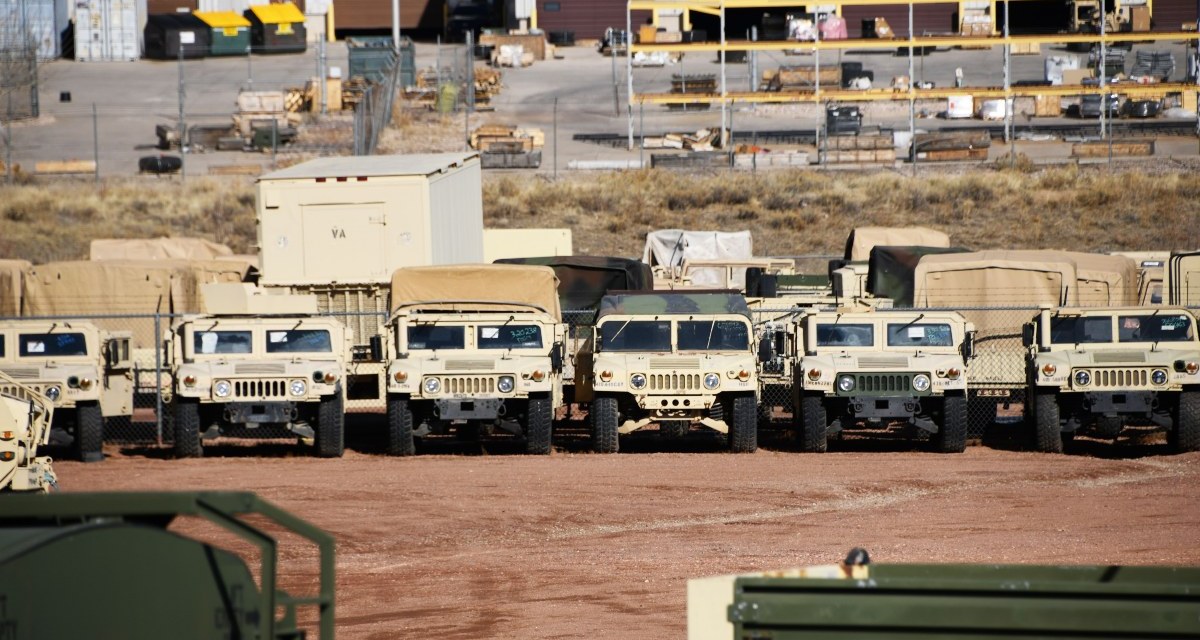
Walk through the back corner of almost any Army motor pool and the same scene emerges. Rows of vehicles sit motionless, many for years, awaiting disposition. Shipping containers filled with forgotten parts line fence rows. Maintenance bays designed to repair combat systems have become storage facilities. Across the force, units maintain hidden inventories of equipment that only reappear during command inventories or property book reviews. These forgotten vehicles and abandoned components represent more than wasted storage space. They represent a warning. Every idle engine, deadlined vehicle, and unrecovered transmission reflects a system that has lost the ability to move resources back into productive use. In peacetime, these are markers of inefficiency. In war, they are the seeds of defeat.
The Army routinely describes this as an excess equipment problem. That is not accurate. It is a regeneration problem. The institutional response has become predictable: conduct another layout, launch another divestiture initiative, or construct additional storage space. These efforts treat the symptoms rather than the disease.
This distinction matters because the issue is far larger than accountability, storage capacity, or property management. The inability to rapidly move, recover, repair, redistribute, and regenerate equipment reveals a deeper vulnerability: The Army lacks the institutional mechanisms necessary to absorb mobilization at scale.
If the Army cannot effectively regenerate the equipment it already owns during peacetime, why should anyone expect it will be able to absorb the massive influx of equipment required during a major war? That question sits at the heart of the Army’s readiness challenge. A transmission sitting on a pallet behind a maintenance facility is not excess inventory. It is trapped combat power. An engine awaiting disposition is not clutter. It is unrealized readiness. Every idle vehicle occupying maintenance space reduces the Army’s ability to generate future combat power.
In industrial warfare, logistics is not inventory. Logistics is movement. Combat power is not created when equipment is purchased. It is created when resources continuously circulate between operational units, depots, manufacturers, and repair facilities. Like blood through a circulatory system, military logistics depends on movement. Once movement stops, capability begins to decay.
Put simply, the Army’s problem is that it struggles to regenerate combat power. This problem’s cause is that the Army cannot effectively circulate material. The implication is that the Army will be unable to absorb wartime losses. The consequent risk is that the Army enters a prolonged war with no mechanism to rebuild combat power.
The United States has spent years discussing defense production while ignoring defense regeneration process. And the defense industrial base cannot compensate for a military incapable of circulation.
The Return of Industrial Warfare
For two decades, Army sustainment systems operated in relatively permissive environments. Equipment losses were limited. Supply chains were largely uncontested. Repair timelines could be measured in months rather than days. The war in Ukraine has shattered that false reality. Both Russia and Ukraine have experienced equipment losses on a scale not witnessed by Western militaries in generations. Tanks, infantry fighting vehicles, artillery systems, and support equipment are consumed at rates that challenge even the largest industrial bases. Success has increasingly depended not merely on producing new equipment, but on recovering damaged systems, repairing battle losses, and rapidly returning equipment to combat.
The lessons from Ukraine are not abstract; they are written on the battlefield in salvaged steel and repurposed parts. Kyiv’s forces have turned adaptive regeneration into a core capability. Dedicated recovery teams work under fire to effectively harvest damaged vehicles—both friendly and captured—from the battlefield. Workshops create “Frankentanks,” hybrid vehicles built from the salvaged parts of multiple destroyed systems, while 3D printing provides critical components on demand to shorten repair timelines. This is the ultimate example of circulating material back into the fight. The side that regenerates combat power fastest gains an advantage. Industrial warfare is not simply a contest of production. It is a contest of circulation. The United States has rightly focused significant attention on strengthening the defense industrial base, increasing munitions production, and strengthening supply chains. Yet production is only one side of the mobilization equation. The other side is absorption.
Factories may produce additional equipment, but military organizations must possess the capacity to receive, store, distribute, repair, and employ it. If warehouses are already saturated, maintenance facilities are already overloaded, and railheads already congested before mobilization begins, increased production simply shifts bottlenecks downstream.
Furthermore, by treating excess as a local clutter issue to be solved with periodic cleanup campaigns, the Army has failed to build the institutional muscle memory required to circulate resources at scale. In a conflict with a peer adversary, the defense industrial base will not be able to immediately replace battlefield losses. The Army will have to rely on its own internal logistics network to harvest parts, rebuild assemblies, and rapidly push systems back to the front lines. Without an established, active circulation framework already running in peacetime, the transition to wartime mobilization will fail because the physical and administrative pipelines will be completely rusted shut.
Wartime mobilization does not begin only when the first shots are fired. The habits and systems of peacetime are the foundation of wartime mobilization. Today’s inability to circulate equipment is a harbinger of the Army’s likely—perhaps inevitable—struggle to regenerate combat power in a conflict.
Solving the Wrong Problem
The Army has recognized the challenge of excess equipment and has taken steps to address it through initiatives such as the Army Materiel Command’s Rapid Removal of Excess (R2E) program. These efforts have achieved measurable success, identifying and removing hundreds of thousands of pieces of equipment from installations across the Army.
However, these initiatives remain largely focused on divestiture; they measure removal rather than readiness. This metric teaches the wrong lesson. R2E trains the Army to get rid of assets, whereas large-scale combat operations will require the Army to recover them.
These legacy programs were fundamentally designed around a peacetime disposal mindset rather than a wartime regeneration framework. They treat excess equipment as an administrative property-book problem to be cleared away rather than a mobilization muscle that needs to be trained. The core failure of these past efforts lies in their linear, one-way design. They function as a conveyor belt to the scrapyard, measuring success by the volume of equipment removed from property books and clean, empty warehouses. In contrast, high-intensity conflict demands a continuous, closed-loop system where equipment is rapidly recovered, repaired, and redistributed back into the fight. By focusing solely on divestiture, previous programs created a false sense of readiness, treating the disposal of vital, repairable, combat-sustaining components as a cosmetic cleanup rather than a resource-preservation effort.
A conflict with a peer adversary will not care how efficiently the Army disposes of equipment. It will care how rapidly the Army can recover, repair, refurbish, and redistribute combat systems back into the fight. A wartime logistics system cannot function as a linear drain to a scrapyard reservoir; it must operate as a closed-loop cycle, linking forward-deployed units to a responsive defense industrial base to constantly purify and return resources to the front. This industrial-to-tactical loop must function as a continuous circulation network capable of transforming damaged equipment into restored combat power. The fundamental challenge is not determining what to remove. The challenge is determining how to keep resources moving.
What World War II Tells Us About Closed-Loop Systems
Following the spectacular Allied breakout from Normandy in August 1944, rapid advance quickly turned into a logistical nightmare: Allied combat forces were racing toward Paris far faster than their supply lines could keep up, and the French railway system had been destroyed by Allied bombing ahead of the invasion. To prevent the entire offensive from grinding to a halt for lack of fuel and ammunition, Allied planners engineered an unprecedented solution called the Red Ball Express—a massive, dedicated truck convoy system operating on a strictly regulated, one-way highway loop. This system effectively kept logistics moving by transforming transport into a continuous, unbroken circle, utilizing nearly six thousand trucks to rush an average of five thousand tons of supplies daily to the front lines.
However, the Red Ball Express also proved that wartime matériel circulation is not a simple, one-way delivery, but a delicate, closed-loop ecosystem that depends heavily on reverse logistics. This vulnerability became glaringly apparent during the jerrycan crisis, when frontline troops routinely discarded empty five-gallon fuel cans rather than sending them back to the rear. Because the outward flow of fuel relied entirely on these containers being returned, refilled, and recirculated, the failure to return empty cans threatened to paralyze the entire supply chain. Ultimately, the Red Ball Express demonstrated that effective wartime logistics requires managing both ends of the loop; a failure in reverse logistics and asset recovery can halt an invading army just as effectively as a destroyed railway. The lesson is not that armies need trucks. The lesson is that combat power depends on maintaining circulation in both directions. Forward movement without recovery eventually collapses under its own success.
Building a Material Circulation Framework
The Army does not need to invent this closed-loop framework from scratch; the blueprint already exists in the commercial heavy machinery sector. Global manufacturers like Caterpillar have long operated highly successful “core exchange” programs. In this model, a broken engine or transmission is never treated as administrative waste. Instead, it is classified as a “core”—in essence, the vital physical currency required to trigger the next repair cycle. Customers return broken cores to regional hubs in exchange for refurbished replacements, ensuring that high-value components are constantly circulating through repair pipelines rather than rusting in a motor pool. The Army must adopt this exact mindset: Broken equipment is not a disposal problem; it is the raw material for future combat power.
The Army should shift from viewing excess equipment as a local accountability problem to recognizing it as an enterprise-wide readiness resource. Instead of allowing equipment to languish in motor pools and storage yards, every item should immediately enter one of four circulation pathways:
- Reuse: redistribute serviceable equipment immediately to active units with identified shortages.
- Repurpose: divert surplus or legacy equipment to support training, experimentation, reserve components, or foreign partner assistance.
- Rebuild: route repairable systems and components into rapid refurbishment pipelines.
- Recycle: expedite the disposal of truly obsolete or unserviceable matériel.
Collectively, these pathways create a continuous circulation model rather than a static storage model. Most importantly, circulation creates space. Motor pools are designed to generate readiness, not warehouse equipment. Every square foot occupied by obsolete matériel is unavailable for maintenance, modernization, and mobilization. Readiness is not always generated through additional funding. Sometimes it is generated through creating room to work.
Mobilization Starts Before Mobilization
Fixing this challenge requires institutional reform rather than periodic cleanup campaigns. First, the Army should establish a service-wide matériel circulation campaign focused on combat power regeneration rather than equipment disposal. Regeneration is a vital wartime activity, but it is built on peacetime habit. Organizations that cannot rapidly recover and redistribute equipment during routine operations will not suddenly develop those capabilities after suffering battlefield losses. Senior leaders, therefore, should measure circulation metrics alongside traditional readiness indicators. These should include:
- Stagnation rate, to identify bottlenecks before equipment becomes permanent motor pool clutter. This measures the number of days matériel remains idle or unassigned at the tactical unit level.
- Redistribution timelines, to prove the system can rapidly shift assets to where they are most needed. This measures the time elapsed from identifying an excess asset at one unit to delivering it to a formation with an active shortage.
- Tactical recovery rate, to ensure units maintain the muscle memory of battlefield salvage. This measures the percentage of unserviceable carcasses successfully retrieved from tactical echelons and routed into the refurbishment pipeline.
- Refurbishment turnaround rate, to demonstrate the speed at which the system can absorb losses and output readiness. This measures the time elapsed from a component’s failure at the tactical level to its return to the supply system as a fully mission capable asset.
- Reclamation yield, to quantify the value of treating broken equipment as a resource rather than trash. This measures the financial and readiness value of serviceable parts harvested from obsolete or destroyed systems, offsetting industrial production shortfalls.
- Installation storage utilization, to prevent peacetime clutter from destroying wartime expansion capabilities. This measures the percentage of warehouse, motor pool, maintenance bay, railhead, and marshaling yard real estate kept deliberately vacant and preserved strictly for mobilization.
Second, the Army should establish regional circulation hubs capable of receiving excess equipment, harvesting serviceable components, conducting refurbishment, and redistributing assets across the force. By accelerating circulation in peacetime, these facilities establish the active, warm-start infrastructure required to immediately scale battle damage repair and combat power regeneration upon mobilization.
Finally, installations should preserve portions of warehouses, railheads, marshaling yards, and maintenance facilities as designated mobilization surge capacity. These spaces cannot be permanently consumed by excess equipment if they are expected to support large-scale force expansion during crisis.
Establishing this circulation foundation during peacetime serves as the ultimate mobilization rehearsal. By treating motor pools and maintenance bays as dynamic staging areas designed to generate readiness rather than permanent warehouses, the system learns to breathe. When senior leaders shift their command metrics away from simple disposal numbers to track redistribution timelines, repair turnaround rates, and reclamation value generated, they force the logistics enterprise to aggressively circulate equipment today. This builds the responsive, agile network necessary to sustain and regenerate combat power when the next major conflict begins.
Across installations today sit thousands of vehicles, engines, and components that could contribute to that future fight. They are not excess equipment. They are the first test of whether the Army understands regeneration before it is forced to practice it in combat.
Major Jonathan Buckland currently serves in the J33 on the Joint Staff. His previous assignments include serving as the executive officer of 5th Squadron, 7th Cavalry Regiment, 1st Armored Brigade Combat Team (ABCT), 3rd Infantry Division; operations officer for 3rd Battalion, 69th Armor Regiment, 1/3 ABCT; and future operations chief for 3rd Infantry Division. He also commanded both a rifle and headquarters company in the 2nd Brigade Combat Team, 82nd Airborne Division. He has a bachelor’s degree in English from the Virginia Military Institute, a master’s degree in international studies from the University of Kansas, and a master’s in operational studies from the Army Command and General Staff College.
The views expressed are those of the author and do not reflect the official position of the United States Military Academy, Department of the Army, or Department of Defense.
Image credit: Brea DuBose, US Army