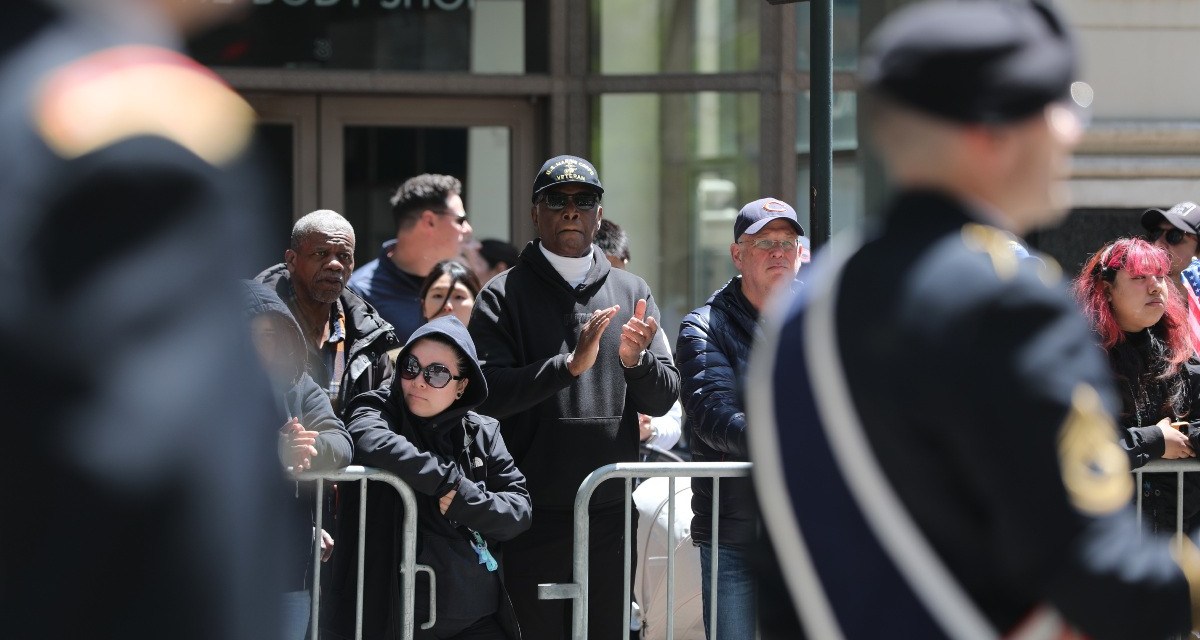
There is a scene most American service members know without thinking about it. You walk through the airport in uniform, and someone—a stranger, often older—stops to thank you for your service. The interaction lasts ten seconds. Both parties know roughly what the script is. Both perform it well. The gratitude is real and the encounter ends in a moment of mutual American ceremony that has been performed enough times to be almost reflexive.
In the same airport, on a screen in the corner of the terminal, a chyron is reporting on the latest controversy at the Pentagon. A senior officer has been relieved. A weapons system is over budget. A retired general is on cable news arguing that civilian leadership has lost the plot. Statistically, if the person who stopped to thank the service member has spoken to a pollster recently, he or she has likely claimed to have lost confidence in the senior leadership of the US military, agreed that the Department of Defense cannot be trusted to spend money wisely, or expressed the view that the country’s foreign policy establishment is broken.
These two facts coexist with no apparent tension. They produce no cognitive dissonance for the person holding both of them at once. They are, instead, the structure of how Americans actually think about their military: deep specific trust in the people in uniform, paired with falling broad trust in the institution those people serve.
The pattern is familiar to anyone who has read the Reagan Institute’s National Defense Survey, the Pew Research Center’s recurring military trust battery, or the YouGov work on civilian confidence in the armed services. It is among the more stable features of American attitudes toward the military, and it has held up through every shock—the wars in Iraq and Afghanistan, the Niger ambush, the Bergdahl episode, Abbey Gate, Operation Epic Fury—that should, in theory, have collapsed it.
It is also a specific instance of a more general pattern that political science research has been pointing at for two decades.
The Two Tracks of Trust
Americans hold institutional trust on two tracks rather than one. There is a broad track—what they tell pollsters when asked, “Do you trust the federal government?” And there is a specific track—what they tell pollsters when asked about a particular agency, a particular program, or a particular function the government actually performs. The two tracks do not move together. Pew’s broad-trust line sits at historic lows—22 percent of Americans say they trust the federal government to do what is right “always or most of the time”—while specific-program trust runs two to three times higher. The Postal Service polls at 72 percent favorable, the National Park Service at 76 percent, NASA at 67 percent, the Social Security Administration in the low 60s. Thirteen of the sixteen federal agencies Pew tested in 2024 were viewed more favorably than unfavorably even as the broad-trust number remained near its modern floor.
This pattern has been documented and redocumented by survey researchers at least since Marc Hetherington’s book was published two decades ago, and the mechanism behind it has been the subject of work by Daniel Carpenter, John Hibbing and Elizabeth Theiss-Morse, and most recently Yuval Levin. The reason it matters for civil-military relations is that the two-track pattern is not a quirk of how Americans think about civilian programs. It is the operative architecture of every question of institutional trust in American public opinion, and the military version is just the case where it is most consequential.
What the Data on the Military Shows
Kori Schake and Jim Mattis named the dynamic in Warriors and Citizens, the 2016 Hoover Institution volume that should be on the desk of anyone serious about civ-mil relations. Their argument was not that public trust in the military had collapsed—by most measures, it had not. Their argument was sharper: that the combination of high public support and very low public engagement and knowledge was the dangerous part. As Schake described, public support for the military is high “yet the public’s knowledge of military issues is extremely low forty years into having an all-volunteer force.” Adoration without comprehension is the thing the institution should be worried about, because adoration without comprehension is what lets a strategic enterprise drift away from the public it serves without the public noticing until something breaks.
The trust data tracks this. The 2024 Reagan National Defense Survey found broad confidence in the US military rebounding to 51 percent—up five points from the prior year, but still nearly twenty points below the 70 percent registered in 2018. This easily outpaced trust in the White House (22 percent), the Supreme Court (21 percent), or Congress (9 percent). Those numbers are striking. The report then disaggregates: Confidence in senior military leadership runs lower; confidence in the institution’s stewardship of resources runs lower still; confidence in the strategic enterprise that decides what the military does runs lower still again. The aggregate number averages a high specific track and a much lower broad track, and the aggregate is what gets reported.
Peter Feaver’s Armed Servants supplies the theoretical scaffolding for why this two-track structure is a problem and not just a curiosity. Feaver’s principal-agent framework treats civil-military relations as an information problem: Civilian principals must monitor military agents whose preferences and capabilities are imperfectly observable. When monitoring is intrusive, agents “work”; when monitoring lapses, agents have room to “shirk.” The legibility argument advanced here is, in essence, a public-side extension of Feaver’s monitoring argument: The broad public is also a principal whose ability to monitor the institution depends on what the institution makes visible. When the strategic enterprise is illegible, the public’s monitoring degrades into reflexive support paired with reflexive distrust—exactly the pattern the Reagan and Pew data describe.
Risa Brooks, writing in International Security, has argued that the prevailing Huntingtonian norms of military professionalism contain three paradoxes that make the institution increasingly mismatched to its civic environment. The norms intended to keep the military out of politics can also enable partisan behavior; the norms that elevate civilian authority over the use of force can erode civilians’ practical control; and the norms that promote tactical effectiveness can corrode strategic effectiveness. Each paradox sits at exactly the place the two-track pattern shows up: The structural feature that produces high specific trust (professionalism) is the feature whose internal contradictions are widening the broad-trust gap.
Mara Karlin’s The Inheritance makes the same point about consequences. Twenty years of war shaped how the military goes to war, who serves, who leads, and how the institution thinks about its own continuity. The narrowing of the recruitment base—to which I return below—is one of her central concerns. So is the way the strategic enterprise has, over twenty years, become less legible to itself, let alone to the civilian public it answers to. Karlin’s diagnostic question is the one this essay’s prescription tries to answer: How does the most capable military in US history end up fighting to a draw in its longest contemporary conflict without producing the public reckoning the outcome should have demanded?
Why the Military Is the Extreme Case
If the two-trust pattern is general, why is it so much more pronounced in the military version?
Three reasons.
First, legibility asymmetry is wider in civ-mil than anywhere else. Most Americans have direct contact with at least some specific service members—a cousin in the reserves, a neighbor at the Air Guard wing, a friend who deployed—and very limited contact with the strategic apparatus that decides what those service members do. The visible piece is intimate; the invisible piece is institutional. Compare that to, say, Social Security, where the visible piece (the check) and the invisible piece (the actuarial models) are both at least nominally explicable to a determined citizen. In civ-mil, the gap between what is visible and what is consequential is larger than anywhere else in American institutional life.
Second, the post-Vietnam reserve component restructuring under Secretary of Defense Melvin Laird and Chief of Staff of the Army General Creighton Abrams deliberately distributed cost into communities to keep the institution legible. The argument, realized most fully in the Army under Abrams, went that no president could sustain a major war without mobilizing the National Guard and reserve components, and no mobilization could occur without reaching into communities across the country. The structure was designed to make the costs of war visible at the neighborhood level—to tighten the connection between the broad institution and the specific service member in a way that civilian programs do not have to engineer because they already deliver to specific people. That design has eroded. Pentagon and Pew Research data consistently show that roughly 80 percent of new recruits across the services have a close relative who has served, and more than a quarter have a parent who did. Veterans cluster near installations. Southern and rural states produce a disproportionate share of enlistees. The post-9/11 wars produced a narrowing of the recruitment base even as the institution’s strategic footprint expanded. The structural mechanism designed to keep broad trust and specific trust connected has been doing less of that work each decade. This is precisely the thread Karlin pulls in The Inheritance and that Peter Feaver takes up in Thanks for Your Service, his study of what drives public confidence in the US military: The recruitment base shapes the political-feedback architecture that the broad-trust track depends on.
Third, the strategic enterprise has had a string of high-visibility credibility failures. These include the Iraq war’s intelligence rationale, the Afghan withdrawal, the post-2020 procurement scandals, and the F-35 saga. More recently, there were the boat strikes in the Caribbean and eastern Pacific, the admiral who quit over them, and the renamed department and bases. The media decides which of these stays in front of the public, and partisanship decides what the public makes of it. The same event reads as scandal or vindication depending on the priors a viewer brings. These were not conspiracy theories. They were real failures, and they gave distrust that was already present, some of it ideological, something concrete to point at. The broad-trust line on the military has not collapsed the way the broad-trust line on Congress has, but the gap between broad and specific trust in the military has widened faster than for any other institution in the time series. Schake and Mattis warned this would happen. Brooks named the institutional mechanism by which it would happen. The data shows it has.
An Example of Why This Matters Now
Right now the citizen-soldier is in the spotlight. Three Ohio Air National Guardsmen died on March 12 when their KC-135 went down over western Iraq during Operation Epic Fury. A Wisconsin Army National Guard artillery battalion is running HIMARS missions out of Kuwait and Iraq. Mississippi sent its 2-20th Special Forces to the same fight. The chairman of the Joint Chiefs recently praised the “integrated reserve and National Guard forces” doing it.
Knowing some of those deployed, I am confident the communities they come from trust their neighbors who are our defenders. However, those same communities—as evidenced by the data described above—are skeptical about the enterprise that deployed them. That tension is a microcosm of our issue. The post-Vietnam design assumed the two would stay connected—that a town watching its Guardsmen ship out would ask harder questions about why, and that those questions would result in political consequences that influenced policy. This is the promise of liberalism’s self-correcting mechanisms. However, the connection has frayed for many reasons, chief among which is that the base of people doing the shipping out keeps getting smaller. Fewer towns have skin in the game, fewer questions get asked, and the decision goes unexamined.
These structures are more influential than the people who run them. New administrations and secretaries have real effects, but they operate inside an architecture they mostly inherit and rarely reshape.
What the Two-Trust Framework Prescribes
The strategists will push back first, and they have a point. Before you worry about how the military reports its costs, you have to settle what it is for—which fights it is built to win, how big it needs to be, and other fundamental questions. Elbridge Colby makes that case as well as anyone in The Strategy of Denial. He is right that the strategy question comes first. But that does not cancel the legibility question. Pick any strategy you like and the public still cannot hold the military to it unless the military lets the public see what it is doing and what it costs. Colby wants everything pointed at China. Schake wants to be capable of engaging in several theaters at once. They are arguing about where to aim, not about whether the country gets to watch.
The fix follows from the diagnosis. If the institution is hard to see, make it easier to see. Several ways of doing so stand out.
First, make the strategic enterprise legible. The Department of Defense already tracks casualties by component in the Defense Casualty Analysis System. It just does not report them to the public by component while operations are ongoing. The data exists; the disclosure is withheld. Releasing it in real time—active and reserve, side by side—would put the citizen-soldier’s share of the cost in front of the public in the only format that makes the strategic conversation honest. So would a cost review of every operation that runs past 180 days. So would a readiness assessment, filed each time a state’s Guard mobilizes, that says plainly what that state gives up at home. None of this is hard to build. It is just not being built. It is also likely a tactical change that wouldn’t create a ripple without many complements.
Second, resource the legibility infrastructure inside the institution. Government Accountability Office reporting found the Army fielding new equipment to units before the facilities, people, and training to absorb it were in place, and mission-capable rates falling for sixteen of eighteen ground combat vehicle types reviewed since 2015. Tennessee’s Army National Guard took delivery of Bradleys in such poor shape the unit had to pay to make them run.
Third, defend specific functions on their merits, not the institution as a whole. The reflex in Washington is to answer every specific scandal by invoking the military as an institution—to reach for the broad-trust halo. Crisis communications research has a name for why that fails. W. Timothy Coombs’s situational crisis communication theory, the standard framework in the field, finds that leaning on an organization’s general reputation does little when the damage is specific; what protects reputation is a response matched to the actual event. The two-trust data says the same thing in different words. Specific trust is what holds the whole thing up. The Ohio crew lost over Iraq, the Wisconsin Guardsmen running guns in Kuwait, the Mississippi Special Forces in the field—those are what you defend, by name, with their costs and their contributions in the open. Broad trust follows specific trust; it rarely leads it.
Fourth, widen the recruitment base. A shrinking recruitment base is not a personnel problem. It is a strategic vulnerability, and in Brooks’s terms a paradox of professionalism playing out in slow motion. When nearly 80 percent of new Army recruits come from a family that has served and the tripwire Abrams designed runs through fewer neighborhoods, the wire stops tripping. The proposals to widen it—civilian-military exchanges, for example, or the national service expansions the bipartisan National Commission on Military, National, and Public Service laid out—are not luxuries. They are the upkeep on the thing that keeps the institution legitimate.
And fifth, give civilians something real to monitor. Feaver’s Armed Servants warned what happens when civilian oversight thins out: Agents do not just cut corners, they quietly take over decisions that were supposed to be civilian. Serious monitoring in 2026 does not look like a Senate hearing. It looks like a standing transparency requirement, enforced agency by agency. The civilian leadership at the Department of Defense could order that reporting tomorrow. The only open question is whether any of them will spend the capital to do it.
I offer these as a direction, not a cure. The trust gap took decades to open and will not close on the strength of any single reform—least of all one proposed from the outside, on paper, by someone who does not have to implement it. What I am confident of is narrower: Every item here makes the institution easier to see, and visibility is the precondition for accountability, not a substitute for it. Start there, and the rest of the argument has somewhere to stand.
The Civilian Connection
The military is not the only institution where the two-track pattern shows up. The same gap between specific trust and broad trust runs through the public’s view of Social Security, the Federal Aviation Administration, the National Park Service, and every other federal program Americans hold in their heads as both the government (distrusted) and the function (trusted). The cure is the same: Make the function visible, make its costs honest, and resist the rhetorical convenience of the broad-distrust frame.
The military just happens to be the case where the gap between the two tracks is widest, the consequences of getting it wrong are most direct, and the architecture for getting it right was deliberately designed in 1973 and has been allowed to atrophy ever since.
The diagnosis has been clear for a decade—from Schake and Mattis through Feaver, Brooks, and Karlin. The harder part is doing something about it before the next budget cycle forces the issue. When distrust drives the budget, the cuts are indiscriminate, and they land on whatever has no constituency—usually readiness. The Army cut depot overhauls from more than a thousand a year to barely a dozen. Per-vehicle maintenance costs went up anyway, because deferring the work does not cancel it. None of those choices started as strategy. They were the path of least resistance, and the public that still trusts the units never connected that trust to the line that keeps them ready.
The military is the case where the answer is most obvious because the costs of getting it wrong are most concrete. It is also, for that reason, the case most worth getting right first.
Ted Delicath is a captain in the US Army Reserve serving with Army Cyber Command, a senior advisor at McChrystal Group, and the author of “The Hidden Subsidy of the Citizen-Soldier” (Small Wars Journal, May 2026).
The views expressed are those of the author and do not reflect the official position of the United States Military Academy, Department of the Army, or Department of Defense.
Image credit: 2nd Lt. Trenton Fouche, US Army