“Multi-Domain Operations is NATO’s strategic priority, a game changer for our strategic advantage. We’re transitioning from joint to multi-domain with a bold vision captured in a ground-breaking concept. NATO Allied Command Transformation is leading the team, ensuring our future fight depends on this vital work.”
So stated General Philippe Lavigne in October 2023, while serving as the supreme allied commander transformation, at the annual NATO Multi-Domain Operations Conference. The speech came a few months after NATO’s first official operational concept on multidomain operations (MDO) had been published. The concept presents itself as an evolution to military operations that responds to a clear need for change. NATO sees the MDO concept as a potential answer to a new and rapidly changing operational environment, especially defined by constant competition between great powers and an increased militarization of new domains. However, MDO did not originate in NATO. Its origins are founded in American concepts and doctrine, and as such it was developed with great power potential in mind. But the transition toward MDO risks affecting smaller NATO countries negatively in terms of capability development, because smaller nations cannot keep up with the multidomain capability requirements from a concept made by—and for—great powers. This presents a real problem for smaller European nations in the future, and threatens their contributions in an alliance structure, because nations build capabilities individually but in conflict scenarios have to deploy them collectively. As such, the future of NATO’s new operational concept needs to be adapted to fit the whole of the alliance, not only the great powers in charge of creating these concepts.
MDO and Its Challenges for Small States
The first actual concept on multidomain operations was published by the United States Army’s Training and Doctrine Command (TRADOC) in 2018. The TRADOC pamphlet—“The U.S. Army in Multi-Domain Operations 2028”—expanded on the ideas of “multi-domain battle” that had taken shape over the previous three years. It aimed to address changes in adversary capabilities, shifting the threat profile from nonstate actors toward “near-peer” adversaries, such as Russia and China. It focused especially on expanded adversary capabilities, militarization of the space and cyber domains, and sophisticated anti-access / area-denial systems capable of limiting maneuver. While most of the military services in the United States and larger European states have adopted some sort of MDO concept, smaller states are aligning with NATO’s own concept published in 2023. This presents a risk, because the concepts created by the US services and large European nation require greater military capabilities than most smaller European nations possess, and the concepts are therefore not necessarily applicable to these nations.
To be sure, a change is necessary, and the transition from joint operations to multidomain operations reflects the realities of the contemporary operational environment, as illustrated by the following figure.
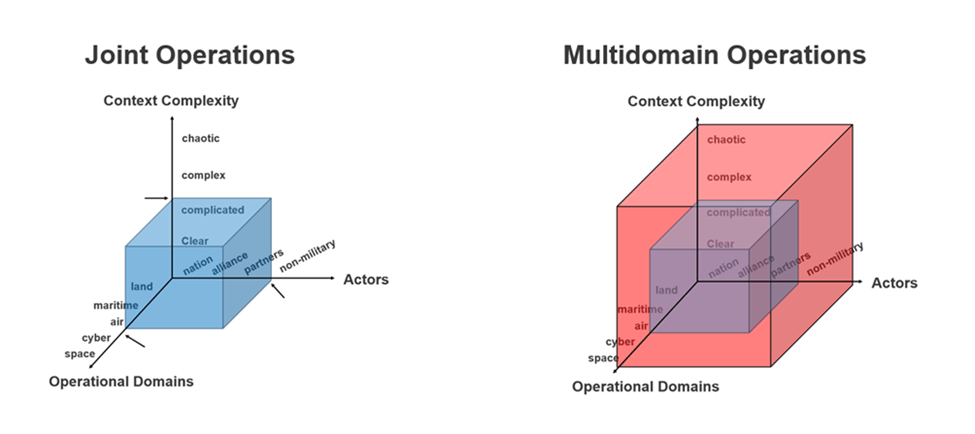
Because MDO concepts and doctrines try to address changes in the character of warfare, they also have a number of shared similarities between them. As seen in the figure above, orchestrating military activities across at least five domains and synchronization with nonmilitary actors to enable military operations are essential. However, other key competencies to ensure transformation from joint to multidomain operations include gaining cognitive superiority (e.g., through understanding of systems theory and boosting critical and creative thinking in military personnel).
Such a transformation requires a shift in capabilities and added resources, and while this change might be possible for larger states, it is a daunting and arguably even impossible task for small member states.
What the transition to MDO does not necessarily take into consideration is NATO`s joint operational ambition levels (two major joint operations and six small joint operations at the same time), which requires certain dedicated military capability contributions from each member states. The standard requirements for these military capabilities are codified in NATO capability codes and capability statements. This prescription of specific operational requirements is supposed to help with assessing and developing military capabilities among member states, facilitating interoperability and effective defense planning, However, in reality, this often amounts to presenting an impossible wish list for small NATO members. Since all these requirements were designed based on the US vision of war (joint and combined maneuver warfare) and the capabilities of a great power’s military ecosystem, all small NATO member countries have been hopelessly struggling for decades trying to meet them. The expensive price tag of high-end military hardware, the cost of training and exercising with it, the need for substantive human capital and sizable training areas to maneuver large formations, and the imperative of high-quality training and education infrastructure are just some examples why small NATO members have never been and will never be able to build meaningful military capabilities in accordance with NATO standards. The introduction of the MDO concept and the significant extension of needed capabilities and capacities along the three axes depicted in the figure above put small NATO countries into an even more hopeless situation. The operational environment is changing, and NATO must adapt to its realities to remain relevant. Those are undeniable facts. But equally undeniable is that small NATO members will never be able to meet the requirements of such change. Encouraging them to become jacks of all trades only risks rendering them masters of none. Since MDO is forced on NATO by its environment, abandoning the concept is not an option. Instead, NATO must execute groundbreaking changes to its overall approach to defense capability and capacity development.
Solving the MDO Paradox: Collective Competencies and Capabilities
The fundamental problem with the current system is that NATO members are developing capabilities and capacities individually (with some small and rare exceptions) but deploy them collectively. This means small member states must try to embrace everything, which is simply not realistic. As such, three potential solutions could ease the transition toward MDO.
First, NATO can switch to collective capability and capacity building across all domains to maximize the alliance’s relevance as the character of warfare continues to change. Of course, critics will immediately argue that such a change would be extremely costly and take a very long time. While this is indeed true, one might argue the cost of irrelevance is even higher. Moreover, the idea of collective capability and capacity building already exists in NATO, albeit on a smaller scale, with the Baltic Air Policing mission, strategic airlift capacity, and some joint fighter programs—so this is not without precedence. Additionally, this change can be adopted in a deliberate and phased manner, starting in those areas of MDO requirements that extend beyond those of joint operations (highlighted in red in the figure above), such as space and cyber. Processes and standards developed in these areas can later be translated to other domains and operational spaces for full transformation of NATO. While not all capabilities can perhaps be shared, trying to streamline as much as possible would aid in ensuring all states contribute toward the MDO transition and remain operationally functional in times of deployment.
Second, another important area for short-term transformation that will support long-term changes is the integration of a shared professional military education system across NATO. As discussed earlier, currently NATO has specific requirements and goals for operational capabilities but not for education. Just like with capabilities, member states develop their leaders individually while deploying them collectively. Since “mindset” and cognitive superiority are already identified as necessary for successful MDO, there should be a shared baseline of knowledge, skills, and competencies across NATO military members, which requires an integrated professional military education ecosystem. If, as NATO suggests, conflict is becoming increasingly complex, there needs to be a shared foundation of education and competencies across the member states, fostered as part of an alliance-wide effort, to ensure that NATO has the required cognitive abilities to ensure MDO is even a viable option.
A third stream of transition for smaller states could also be to strongly lean into the whole-of-society approach, effectively utilizing nonmilitary actors in a total defense approach to collective security. The two newest members of NATO, Sweden and Finland, already have vast experience with total defense, using it to improve resilience, build stockpiling and logistical advantages, leverage conscription services, and emphasize the psychological aspect to prepare their populations. Another example from the Nordic states is Denmark, where the Center for Cybersecurity was created under the Defense Intelligence Service, a leading initiative on national cybersecurity that facilitates and benefits from relationships between other public agencies and actors in private industry.
Advancing civil-military cooperation toward total defense would allow smaller states to expand their overall security capabilities, not least by freeing up potential resources and funding for critical military capacities by outsourcing tasks to other agencies. This would allow smaller states to essentially boost additional military tasks connected to the MDO transition by having nonmilitary actors facilitating supporting areas. Furthermore, this approach would arguably be better suited for smaller rather than larger states, because the smaller size allows for better cooperation across government sectors. This would allow the smaller states to actually be the leading force in part of the MDO transition. Additionally, since many smaller NATO states are already incorporating a total defense approach to varying degrees, best practices could very well be identified to allow for an easier transition toward MDO. Sharing these practices, however, is still contingent on a common approach to professional military education and building competencies.

The operational environment is undeniably changing and becoming more and more complex, requiring military capabilities and capacities to adapt to new realities of contemporary warfare. While MDO might seem to be the silver bullet for such adaptation, in reality, it puts an impossible burden on small NATO member states. Instead of making them stronger and more capable in its current form, NATO’s MDO concept makes small member states weaker and more exposed, threatening both their relevance and ultimately that of the alliance. But it does not have to happen. NATO can transform for MDO in a way that not only protects small states’ contributions but enhances them.
The shift to MDO is the right one for NATO. Now it needs to execute the shift in the right way.
Holger Lindhardtsen is a military analyst at the Institute for Military Operations at the Royal Danish Defence College. He is the main researcher for special operations at the Lessons Learned from the Russo-Ukraine War project at the Institute for Military Operations. Additionally, he contributes to other research projects such as the Educating Future Warfighters project, aimed at comparatively researching how officers can best build competencies for future conflicts, as well as supporting the integration of multidomain operations into military education.
Dr. Sandor Fabian is a former Hungarian Special Forces lieutenant colonel with twenty years of military experience. He was previously an MWI and IWI nonresident fellow and is the author of the book Irregular Warfare: The Future Military Strategy for Small States.
The views expressed are those of the authors and do not reflect the official position of the United States Military Academy, Department of the Army, or Department of Defense.
Image credit: Sgt. Terron Williams, US Army