
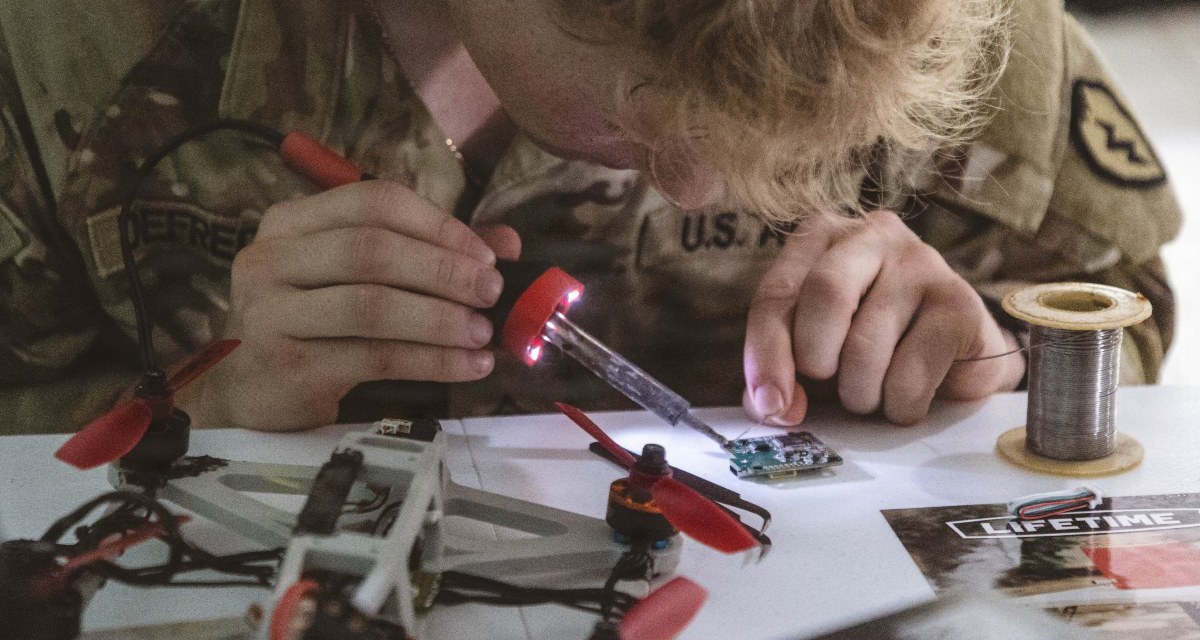
A small drone returns from a mission, its frame cracked and its motor damaged, but its camera, radio, and battery still working. Traditional Army maintenance logic offers a familiar sequence: Diagnose the fault, repair what can be repaired, evacuate what cannot, and return the system to service.
For mass attritable drones, that logic can impose operational costs out of proportion to the value of the airframe. A drone may spend too long out of the fight, usable components may be discarded with it, and units may consume replacement systems faster than the supply system can replenish them. The problem is not simply that the Army’s maintenance system was designed for different equipment. It is that, when applied too rigidly to attritable systems, it can reduce sortie generation, slow combat regeneration, and increase demand for replacement airframes.
Ukraine and Russia have taken very different institutional paths in unmanned warfare, yet both have moved maintenance, engineering, and adaptation closer to combat operators. Ukraine’s frontline workshops combine maintenance, engineering, fabrication, and battlefield adaptation. Russia has reached a similar destination from the opposite direction through a more centralized effort to institutionalize and spread adaptation. Different systems, same conclusion: The pace of unmanned warfare pushes technical decision authority toward the tactical edge.
For the US Army, the answer is not to abandon maintenance doctrine, but to redistribute technical capability and decision authority closer to the fight. Repair Forward, Replace Fast applies mission command to maintenance by pushing bounded repair, adaptation, recovery, and replacement decisions toward trained technicians, while preserving enterprise standardization, safety, and accountability.
A Maintenance System Built for Durable Platforms
The Army’s maintenance system is not irrational or outdated; it was built around durable, standardized, high-value platforms whose replacement cost justifies recovery and repair.
Army maintenance doctrine divides Army maintenance between operator tasks, field-level repair, and sustainment maintenance. This fits well when the objects being maintained are tanks, fighting vehicles, air defense systems, and large aviation platforms. It fits less well when units are operating large numbers of low-cost, modular, commercially derived systems whose components change quickly and whose tactical value often depends more on rapid return to service than on preservation of a specific airframe.
The key question is no longer simply whether a damaged drone can be repaired. It is whether it should be repaired, cannibalized, modified, or replaced—and who should be empowered to decide.
Ukraine’s own reported production numbers show the scale. From almost no domestic drone manufacturing capacity when Russia invaded in 2022, in 2024 it produced two million drones, and has since scaled that up to ten million per year—volume that places fundamentally different demands on a maintenance system built primarily around durable platforms. Ukraine’s drone ecosystem runs on commercial components, rapidly changing hardware and firmware, batteries, radios, antennas, and additive-manufactured parts—technology that changes faster than a technical baseline can be written down. The US Army is already moving in this direction as it revises maintenance policy and experiments with “replace, not repair” approaches with the RACS framework (Rapid Attritable Commercial Off-the-Shelf Strike. The program is building that concept directly into how the Army Reserve fields and sustains attritable equipment.
The question, then, is not whether Army maintenance must adapt, but where technical capability and decision authority for maintenance should reside.
Ukraine: The Baseline Case
Ukraine offers the most mature example. Jorge Rivero’s 2025 Modern War Institute study documented Ukrainian drone battalions running frontline engineering workshops of roughly ten to twelve personnel. These shops do far more than fix broken drones—they diagnose faults, integrate new components, modify airframes, fabricate parts, work on batteries and electronics, and adapt systems to changing battlefield conditions, often returning equipment to operators in hours rather than sending it through a lengthy rearward process. The result is a short cycle: A failure or enemy adaptation reaches a technician, gets fixed or worked around, and comes back to the operator, sometimes the same day.
The approach has costs. Ukraine’s decentralized innovation has produced an equally decentralized assortment of equipment—the Centre for Eastern Studies reported in 2025 that Ukraine’s Unmanned Systems Forces were operating more than 250 drone models, with inconsistent procedures and uneven technical standards paired with the benefits of decentralization.
It would be easy to write this off as the product of an entrepreneurial wartime ecosystem—one country’s improvisation under extreme mobilization. Russia’s experience makes that explanation harder to sustain.
Rubicon: The Same Requirement from the Opposite Direction
Russia’s military approached the drone problem from a very different institutional culture, and its answer is the Rubicon Center for Advanced Unmanned Technologies, established by order of Defense Minister Andrei Belousov on August 2, 2024, to centralize and scale what was a fragmented set of Russian drone initiatives. Rob Lee and Dmytro Putiata’s reconstruction of the organization shows it combining combat employment with research, procurement, training, experimentation, analysis, and technical support under one organization.
Alongside its combat formations, Rubicon runs a technical directorate, logistics and sustainment functions, warehouses, transportation, and a maintenance and repair unit. Its research and development arm includes software, electronic warfare, reverse engineering, field testing, defense industry liaison, and technical sustainment, as well as individual combat detachments with their own maintenance personnel.
The US Army shouldn’t reproduce Rubicon’s org chart. What matters is how Russia shortened the institutional distance between the battlefield and the engineer. Rubicon detachments receive equipment directly from manufacturers and route operational feedback straight back to them, letting new systems and tactics get tested in combat, evaluated, modified, and pushed back out. Lee and Putiata argue Rubicon has partly compensated for the slower adaptation cycle of conventional Russian forces than their Ukrainian counterparts by building a parallel rapid innovation structure.
The result is something close to what Ukraine’s frontline workshops do, even though almost nothing about the two organizations looks alike. Ukraine built a decentralized and heterogeneous system, tied into volunteer networks, private companies, and frontline formations. Russia built something centralized and state-directed, meant to standardize and spread innovation from the top down. Both ended up in the same place: technical adaptation, maintenance expertise, testing, and manufacturer feedback closer to the operators flying the drones.
That convergence matters more than either structure. A military with as strong an institutional preference for centralized control as Russia’s still found it necessary to shorten the distance between operators, maintainers, engineers, and manufacturers. That independent convergence suggests the requirement comes from the technology and the battlefield, not from either military’s institutional culture.
Copy the Requirement, Not the Organization
The United States shouldn’t replicate either system wholesale. Ukraine and Russia fight with domestic industrial bases, civilian engineers, and volunteer networks all situated relatively close to the theater. An American expeditionary force may operate thousands of miles from manufacturers while moving replacement systems and components across contested ports, airfields, sea lanes, and distribution networks that a peer adversary can target. Rivero similarly warns that US forces could consume unmanned systems faster than traditional resupply can replace them. An expeditionary American force may therefore require greater forward technical self-sufficiency than either Ukraine or Russia.
Maintenance Mission Command
The Army already has a philosophy built for distributing decision authority when a situation moves faster than higher headquarters can issue instructions: mission command. Army doctrine describes it as the Army’s approach to command and control that empowers subordinate decision-making and decentralizes execution to match the situation, built on competence, mutual trust, shared understanding, commander’s intent, mission orders, disciplined initiative, and risk acceptance.
Sustainment organizations already exercise mission command over how maintenance formations are led—Army field support brigades, for instance, command their subordinate field support battalions and sustainment maintenance activities this way. But the new requirement here is not mission command for sustainment formations. It is mission command applied to technical decisions traditionally governed through maintenance and engineering authorities—decisions about what gets repaired, modified, or replaced at the point of failure.
Current doctrine leaves more room for this than is often assumed. The Army’s maintenance operations manual already recognizes operator-maintainers and notes that maintenance classifications can vary by system and specialty, and it tells leaders to make maintenance decisions on operational and mission variables rather than a fixed checklist. But the broader technical enterprise still prioritizes standardization, safety, engineering oversight, and configuration control—priorities that developed around systems of record whose technical baselines change slower than those of commercially derived attritable drones. The problem isn’t that oversight exists. It’s that oversight built for older equipment and a slower tempo is now operating in a much faster reality.
Mission command offers a way to reconcile the two without abandoning either. A commander sets the boundaries of acceptable technical adaptation—which components can be substituted, which software or firmware changes are authorized, what spectrum restrictions apply, what safety requirements can’t be waived, and when a system has to come out of service entirely. In practice, commanders might establish replacement-cost and repair-time thresholds and identify components authorized for technician-level exchange, with decisions outside those limits routed to engineering authority. Inside those boundaries, trained technicians exercise disciplined initiative. A workshop noncommissioned officer weighing whether to pull usable parts from three damaged first-person-view drones to return five others to service shouldn’t need permission from an engineering authority a thousand miles away—but a technician also shouldn’t have unrestricted authority to make modifications that compromise cybersecurity, airworthiness, spectrum management, or safety. Delegated technical authority within defined limits is the point. Without it, moving a workshop forward geographically does little to shorten the technical decision cycle.
Repair Forward, Replace Fast
An American model should spread capability across three tiers. These tiers should serve as defaults rather than fixed boundaries—commanders should shift capabilities forward or rearward based on mission variables.
Tier 1: Operator Maintenance. Drone operators should be trained to inspect their systems, troubleshoot common failures, manage batteries, replace modular components, run authorized configuration tasks, and perform simple repairs. Tier 1 expands an existing doctrinal concept rather than creating a new one—again, maintenance doctrine already recognizes operator-maintainers. The goal isn’t to turn every infantryman into an electronics technician—operators should stay operators—but they should be able to fix predictable problems without immediately routing equipment to another organization.
Tier 2: Forward Drone Technical Workshop. At roughly battalion or brigade level—the exact echelon should be refined through experimentation—the Army should field specialized capability for electronics, radio frequency systems, software and configuration, advanced repair, component recovery, additive manufacturing, integration, testing, and authorized battlefield modification. The distinguishing feature of Tier 2 is not forward repair alone. It is the deliberate combination of maintenance, software, radio frequency expertise, fabrication, engineering adaptation, testing, and operator feedback under delegated technical authority. It should borrow Ukraine’s tight operator-engineer loop and Rubicon’s integration of technicians, testers, and manufacturers. It should operate under maintenance mission command, with clear boundaries and enough delegated authority to move at the speed of battlefield adaptation. A firmware or frequency-hopping update allowing a fleet to adapt to a newly encountered jamming threat is exactly the kind of modification this tier should be authorized to make and deliver to operators within hours, not weeks.
Tier 3: Theater and Enterprise Sustainment. Existing Army sustainment organizations remain here, providing bulk replacement systems, batteries, components, transportation, contracting, specialized repair, industrial support, reverse engineering, and theater supply-chain management. Repair Forward, Replace Fast doesn’t dismantle that enterprise. It optimizes the sustainment pipeline at the point of failure—moving a damaged system rearward only when evacuation yields greater operational return than fixing, cannibalizing, or replacing it forward.
Repair, Recover, or Replace?
Army policy already recognizes repair-versus-replace decisions, controlled exchange, and cannibalization. The challenge presented by mass attritable systems is therefore not inventing these practices but determining how far forward the authority to employ them should reside. The RACS framework calls for repair-versus-replace strategies, and Army sustainment leaders have pushed for simpler, more modular system designs specifically to make swapping and replacement practical rather than defaulting to repair.
The next step is turning that authority into a tactical decision framework, weighing at least six variables: replacement cost, expected repair time, parts availability, technical complexity, tactical urgency, and probability of successful repair. These variables provide the boundaries within which technicians exercise disciplined initiative. A heavily damaged low-cost first-person-view drone may warrant harvesting its camera, motors, and radio before retiring and replacing the airframe. A more expensive reconnaissance drone with a modular antenna failure may be back in service after thirty minutes of repair.
Neither decision needs an elaborate staff process. What it needs is a bounded framework like the decision-making processes commanders already use—enough structure to produce disciplined judgment without pulling the decision away from the person who understands the equipment and the tactical requirement. The principle is simple: The cheapest system isn’t always disposable, and the repairable system isn’t always worth repairing.
Army policy distinguishes controlled exchange, which moves serviceable components between repairable items to restore readiness, from cannibalization, which recovers usable components from materiel designated for disposal. The distinction should remain, as should accountability for both. Mass attritable drones change the frequency and echelon at which those decisions must occur. Routine component recovery and exchange should migrate toward technician-level decisions conducted within command-established limits. That is maintenance mission command applied to the repair decision.
A Different Kind of Maintenance System
Ukraine and Russia reached the same conclusion from opposite directions: Unmanned warfare demands a shorter distance between operators, maintainers, engineers, and the organizations building their equipment.
The lesson for the US Army is not to copy Ukrainian workshops or reproduce Rubicon, but to build an American system suited to expeditionary warfare—one that trains operators to handle basic maintenance, fields forward technical workshops with bounded authority to repair and adapt, and sustains enough enterprise depth to replace losses at scale. The issue is not simply maintenance efficiency. It is whether units can regenerate combat power fast enough to stay in the fight.
As the Army fields more inexpensive, software-defined, and commercially derived systems, it will need to apply mission command not only to maneuver, but to technical sustainment. The force that can repair, recover, adapt, and return systems to combat fastest will hold the advantage.
Lieutenant Colonel Philip J. McCormick is an information operations officer at US Army Western Hemisphere Command headquarters. He is a graduate of the School of Advanced Military Studies and the Western Hemisphere Institute for Security Cooperation, with deployments to Afghanistan, Kuwait, and South Korea.
Major Angel F. Davila is a logistics officer currently assigned to US Army Western Hemisphere Command headquarters. A graduate of Texas A&M University and the Command and General Staff College, he has completed operational tours to Eastern Europe and combat deployments to Afghanistan and Iraq.
The views expressed are those of the authors and do not reflect the official position of the United States Military Academy, Department of the Army, or Department of Defense.
Image credit: Sgt. Taylor Gray, US Army